


19 Aug EU CBAM Rules: Commerce Dept Conducts Awareness Session for Exporters
✎ CBAM is a carbon tariff imposed by the EU on carbon-intensive imports, requiring exporters to report and verify embedded emissions to prevent carbon leakage and ensure climate policy alignment.
Subject Relevance — Where This Topic Fits
- GS Paper II — International Relations (Global Governance, Climate Change Diplomacy, Trade Regulations) | GS Paper III — Economy (International Trade, Carbon Pricing, Industrial Policy)
- Prelims: Carbon Border Adjustment Mechanism (CBAM), EU Green Deal, Paris Agreement Article 6, WTO Agreement on Subsidies and Countervailing Measures, Embedded Emissions, Accreditation and Verification, National Accreditation Board for Certification Bodies (NABCB), Engineering Export Promotion Council (EEPC), Sustainable Development Goals (SDG 12, 13), Non-Tariff Barriers (NTBs)
- Essay: Climate Change and Global Trade: Balancing Environmental Sustainability with Economic Competitiveness, The Role of Carbon Border Adjustment Mechanisms in Achieving Net-Zero Targets: A Multilateral Perspective
Quick Revision: CBAM is a carbon tariff imposed by the EU on carbon-intensive imports, requiring exporters to report and verify embedded emissions to prevent carbon leakage and ensure climate policy alignment.
Why is this in the news?
The Department of Commerce, Government of India, in collaboration with the National Accreditation Board for Certification Bodies (NABCB) and the Engineering Export Promotion Council (EEPC), organised an awareness session on the European Union’s Carbon Border Adjustment Mechanism (CBAM) for Indian exporters on 18 August 2026. This initiative underscores the growing importance of carbon-related trade regulations in global commerce and highlights India’s proactive engagement in preparing its export sector for compliance with emerging sustainability norms. The session reflects India’s strategic response to the EU’s CBAM and its potential impact on key Indian export sectors such as iron, steel, and aluminium.
Background
- The European Union’s Carbon Border Adjustment Mechanism (CBAM) is a key component of the EU’s Green Deal and Fit for 55 package, aimed at preventing carbon leakage while ensuring that imported goods are subject to the same carbon pricing as domestically produced goods.
- The mechanism targets carbon-intensive sectors which are significant contributors to global emissions.
- India is the EU’s 10th largest trading partner, with bilateral trade exceeding €100 billion in 2022. The EU is a critical market for Indian exports, particularly in sectors like engineering goods, chemicals, and textiles.
- The CBAM is designed to align with the principles of the Paris Agreement and the World Trade Organization (WTO) rules, though its compatibility with WTO disciplines remains a subject of international debate.
- The Indian government has been actively engaging with stakeholders to assess the implications of CBAM and formulate a response that balances trade competitiveness with environmental sustainability.
What is the EU Carbon Border Adjustment Mechanism (CBAM)?
- CBAM is a tariff on carbon-intensive imports into the EU, designed to equalise the carbon price between domestic and imported goods, thereby preventing carbon leakage and incentivising global decarbonisation.
- Embedded emissions refer to the total greenhouse gas emissions associated with the production, processing, and transportation of a product, including direct emissions from manufacturing and indirect emissions from energy use.
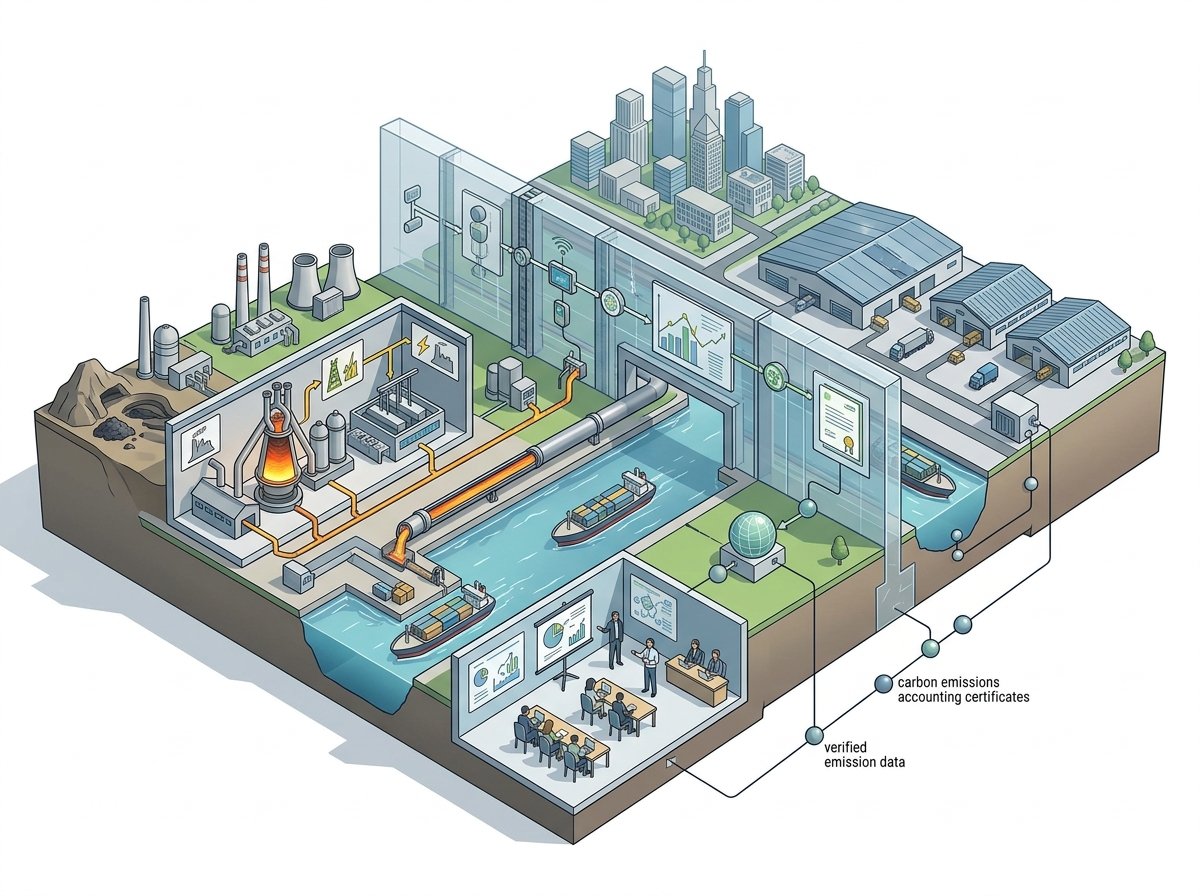
- CBAM requires third-country exporters to provide detailed data on embedded emissions, which must be verified by accredited bodies. The mechanism relies on a robust accreditation and verification ecosystem to ensure data reliability and compliance.
- CBAM is part of the EU’s broader strategy to achieve climate neutrality by 2050 and aligns with the EU’s commitment under the Paris Agreement to limit global warming to 1.5°C.
- The mechanism is intended to be WTO-compliant, though its design has raised concerns among developing countries, including India, regarding potential trade distortions and the burden of compliance on exporters.
Key Features
| Feature | Significance |
|---|---|
| EU CBAM Framework | A carbon border adjustment mechanism to levy charges on imports based on embedded emissions, ensuring carbon-price parity with EU producers and preventing carbon leakage. |
| Embedded Emissions Calculation | Mandatory quantification of greenhouse gas emissions embedded in exported goods, forming the basis for CBAM liability assessment. |
| Data Reporting Requirements | Systematic collection and submission of emission data to EU authorities, ensuring transparency and compliance with CBAM reporting timelines. |
| Accreditation and Verification | Third-party accreditation and verification of emission data by certified bodies, enhancing credibility and reducing regulatory risks for exporters. |
| Sector-Specific Case Studies | Practical illustrations for iron, steel, and aluminium sectors to demonstrate compliance pathways and mitigate implementation challenges. |
Why it Matters
Economic Impact on Indian Exporters
- CBAM may impose additional costs on Indian exporters of carbon-intensive goods, potentially reducing competitiveness in the EU market.
- Early compliance preparation can mitigate financial and operational disruptions, safeguarding export volumes and market access.
- Alignment with global sustainability norms can enhance India’s export competitiveness in the long term.
Regulatory and Compliance Dimensions
- CBAM introduces a new layer of regulatory compliance for Indian exporters targeting the EU market, necessitating institutional capacity building.
- Accreditation and verification systems must align with international standards to ensure mutual recognition and avoid trade barriers.
- Data integrity and transparency in emission reporting are critical to prevent penalties and maintain market access.
Strategic Trade Policy Implications
- CBAM underscores the growing intersection of trade and climate policy, requiring India to integrate sustainability into its trade negotiations.
- Proactive engagement with EU regulatory frameworks can position India as a responsible global trade partner.
- Domestic policy coherence between trade facilitation and climate action becomes essential to navigate emerging trade barriers.
Industry Preparedness and Capacity Building
- Sector-specific awareness sessions, such as the one organised by the Commerce Department, are vital for building exporter readiness.
- Collaboration with industry bodies like EEPCl and accreditation agencies like NABBCB ensures practical and scalable compliance solutions.
- Capacity building in emission measurement and reporting can unlock opportunities in carbon-neutral trade.
Challenges
1. Data Accuracy and Measurement Challenges
- Precise quantification of embedded emissions requires robust data collection systems, which may be lacking in some Indian industries.
- Variability in emission factors and methodologies across supply chains can lead to inconsistencies in reporting.
- Third-party verification may face delays or resource constraints, impacting timely compliance.
UPSC Link: Environmental Governance
2. Regulatory Compliance and Cost Burden
- CBAM compliance may impose significant administrative and financial costs on exporters, particularly SMEs.
- Navigating complex EU regulatory frameworks demands technical expertise, which may be scarce in smaller enterprises.
- Failure to comply could result in penalties, loss of market access, or reputational damage.
UPSC Link: WTO and Trade Agreements
3. Supply Chain Transparency and Traceability
- Ensuring end-to-end traceability of emissions across global supply chains is technically and operationally challenging.
- Lack of standardised emission data across suppliers may hinder accurate reporting and verification.
- Collaboration with upstream suppliers is essential but may face resistance due to commercial sensitivities.
UPSC Link: Global Supply Chains
4. Competitiveness and Market Access Risks
- CBAM could erode the price competitiveness of Indian exports in the EU market, particularly for carbon-intensive sectors.
- Diversification of export markets may be necessary to mitigate dependency on the EU, but this requires strategic planning.
- Domestic industries may face pressure to adopt cleaner technologies, which could entail high capital investments.
UPSC Link: International Trade
5. Institutional Capacity and Coordination
- Building institutional capacity for CBAM compliance requires coordination among multiple agencies, including customs, industry associations, and accreditation bodies.
- Delays in policy implementation or lack of clarity in guidelines can create uncertainty for exporters.
- Continuous engagement with EU authorities is necessary to stay updated on evolving regulatory requirements.
UPSC Link: Government Policies and Interventions
Challenges — UPSC Perspective
| Issue | Concern |
|---|---|
| Data Collection Infrastructure | Lack of standardised systems for measuring and reporting embedded emissions across industries. |
| Verification Bottlenecks | Limited availability of accredited verifiers, leading to delays in compliance certification. |
| Cost of Compliance | Financial burden on exporters, particularly SMEs, to meet CBAM reporting and verification requirements. |
| Supply Chain Complexity | Difficulty in tracing emissions across multi-tiered global supply chains. |
| Regulatory Uncertainty | Evolving CBAM rules may require frequent updates to compliance strategies. |
| Market Diversification | Over-reliance on the EU market may expose exporters to higher compliance risks. |
Way Forward
- Establish a dedicated national task force to coordinate CBAM compliance efforts across industries and government agencies.
- Develop sector-specific emission calculation tools and guidelines tailored to India’s industrial profile.
- Strengthen accreditation and verification infrastructure by expanding the capacity of agencies like NABBCB.
- Promote public-private partnerships to facilitate knowledge sharing and capacity building among exporters.
- Integrate CBAM compliance into existing trade facilitation schemes to reduce administrative burdens.
- Encourage industry associations to develop collective emission databases and verification protocols.
- Advocate for international harmonisation of carbon accounting standards to reduce trade barriers.
- Monitor EU CBAM implementation closely to anticipate changes and adjust compliance strategies proactively.
UPSC Value Addition
Keywords for Mains Answer-Writing
Carbon Border Adjustment Mechanism (CBAM) · European Union Green Deal · Sustainable trade regulations · Embedded emissions · Climate change mitigation · Carbon border taxes · Export competitiveness · Trade compliance · Accreditation and verification systems · Sustainability reporting · Indian export sector · Non-tariff barriers · Circular economy · Paris Agreement obligations · Carbon pricing mechanisms
Concept Flow
EU introduces CBAM to address carbon leakage and ensure carbon-price parity for imports. → Indian exporters of carbon-intensive goods face potential trade barriers in the EU market. → Commerce Department organises awareness sessions to sensitise exporters about CBAM obligations. → Exporters must quantify embedded emissions, report data, and obtain third-party verification. → Non-compliance risks financial penalties, loss of market access, and reputational damage. → Long-term adaptation requires technological upgrades, supply chain transparency, and policy alignment.
Prelims Practice Questions
Q1. Consider the following statements regarding the European Union’s Carbon Border Adjustment Mechanism (CBAM):
1. CBAM is designed to levy a carbon price on imports of certain goods to ensure that imported products are subject to the same carbon costs as domestic EU producers.
2. CBAM currently applies to all goods imported into the EU, including agricultural products and textiles.
3. CBAM requires importers to report embedded emissions in covered goods and may require payment of a carbon border adjustment tax.
How many of the above statements are correct?
- Only one
- Only two
- All three
- None
Answer: Only two — Statement 1 is correct as CBAM aims to equalise carbon costs between domestic and imported goods. Statement 2 is incorrect; CBAM currently covers specific sectors such as iron, steel, aluminium, cement, fertilizers, electricity, and hydrogen. Statement 3 is correct as importers must report embedded emissions and may face carbon border adjustment taxes.
Q2. Assertion (A): The Carbon Border Adjustment Mechanism (CBAM) is part of the European Union’s broader strategy to achieve climate neutrality by 2050.
Reason (R): CBAM seeks to prevent carbon leakage by imposing a tax on imports from countries with less stringent climate policies.
In the context of the above two statements, which one of the following is correct?
- Both A and R are true, and R is the correct explanation of A
- Both A and R are true, but R is not the correct explanation of A
- A is true, but R is false
- A is false, but R is true
Answer: Both A and R are true, and R is the correct explanation of A — Both Assertion (A) and Reason (R) are true. CBAM is indeed part of the EU’s strategy to achieve climate neutrality by 2050 under the European Green Deal. Additionally, CBAM aims to prevent carbon leakage by levying a carbon border tax on imports from countries with lower carbon pricing, making R the correct explanation of A.
Q3. Match the following sectors with their current status under the European Union’s Carbon Border Adjustment Mechanism (CBAM):
Column I (Sector)
A. Iron and Steel
B. Aluminium
C. Cement
D. Textiles
Column II (Status under CBAM)
1. Covered under CBAM
2. Not covered under CBAM
3. Partially covered under CBAM
4. Under consideration for future inclusion
Select the correct match:
- A-1, B-1, C-1, D-2
- A-1, B-1, C-2, D-4
- A-2, B-1, C-1, D-3
- A-1, B-2, C-1, D-4
Answer: A-1, B-1, C-1, D-2 — Iron and steel (A), aluminium (B), and cement (C) are currently covered under CBAM. Textiles (D) are not covered under the current framework of CBAM and are not under consideration for future inclusion at present.
Mains Practice Question
✍ The European Union’s Carbon Border Adjustment Mechanism (CBAM) represents a significant shift in global trade policy towards climate action. Critically analyse the implications of CBAM for India’s export sector, with particular reference to its compliance requirements, embedded emissions reporting, and the role of accreditation and verification systems. Also, discuss the strategic measures India can adopt to mitigate potential trade disruptions while aligning with global sustainability norms. (15 Marks)
Approach: MODEL-ANSWER SKELETON:
1. **Introduction (2 marks)**: Define CBAM as a carbon border tax mechanism under the EU’s Green Deal to prevent carbon leakage and ensure a level playing field for domestic industries. Highlight its objective: to impose a carbon cost on imports equivalent to that borne by EU producers.
2. **Implications for India’s Export Sector (5 marks)**:
– **Sectoral Coverage**: Identify that CBAM currently applies to iron, steel, aluminium, cement, fertilizers, electricity, and hydrogen. Emphasise that India’s engineering and industrial goods exports (e.g., steel, aluminium) are directly impacted.
– **Compliance Burden**: Discuss the need for Indian exporters to report embedded emissions accurately, which requires robust data collection systems and third-party verification.
– **Trade Disruptions**: Explain potential risks such as increased compliance costs, reduced competitiveness, and possible trade barriers if non-compliance is detected.
– **Market Access Challenges**: Highlight the risk of losing market share in the EU if Indian exporters fail to meet CBAM requirements, given the EU’s stringent sustainability norms.
3. **Key Compliance Requirements (3 marks)**:
– **Embedded Emissions Calculation**: Outline the methodology for calculating embedded emissions in covered goods, including direct and indirect emissions.
– **Data Reporting and Verification**: Discuss the role of accredited bodies (e.g., NABCB) in verifying emission data and the need for reliable verification ecosystems.
– **Accreditation and Certification**: Explain the importance of obtaining certification from accredited bodies to demonstrate compliance with CBAM standards.
4. **Strategic Measures for India (4 marks)**:
– **Strengthening Domestic Frameworks**: Highlight the need for India to develop its own carbon pricing mechanisms (e.g., carbon markets) or align with global standards to ease compliance.
– **Capacity Building**: Discuss the role of government initiatives (e.g., awareness sessions by the Commerce Department) and industry associations (e.g., EEPC) in training exporters on CBAM requirements.
– **Technological Upgradation**: Emphasise the adoption of cleaner technologies and energy-efficient processes to reduce embedded emissions in industrial production.
– **Diplomatic and Trade Negotiations**: Suggest leveraging bilateral and multilateral trade agreements to negotiate exemptions or transitional arrangements for Indian exporters.
– **Collaboration with Global Partners**: Propose partnerships with international bodies to harmonise carbon accounting standards and ensure mutual recognition of compliance systems.
5. **Conclusion (1 mark)**: Summarise the dual challenge and opportunity for India: mitigating trade disruptions while positioning itself as a leader in sustainable manufacturing. Stress the need for proactive policy measures and industry collaboration to navigate CBAM’s evolving landscape.
Source: PIB (Press Information Bureau)
Generated by AanyaAi for educational purpose.

- मद्रास उच्च न्यायालय में ‘वेट्ट्री पयणम’ योजना को असंवैधानिक घोषित करने की मांग - October 4, 2026
- Gurugram’s groundwater extraction exceeds limit by 212%; HC seeks ban - October 4, 2026
- स्वतंत्रता सेनानी श्यामजी कृष्ण वर्मा की जन्म जयंती पर पीएम का श्रद्धांजलि - October 4, 2026

No Comments