


06 Aug FCRA Bill 2026: Lok Sabha on August 12; Retrospective Clause Excluded
✎ The Foreign Contribution (Regulation) Amendment Bill, 2026, seeks to ensure continuity in the management of institutions during lapses in FCRA registration, with explicit assurances that it will not operate retrospectively…
Subject Relevance — Where This Topic Fits
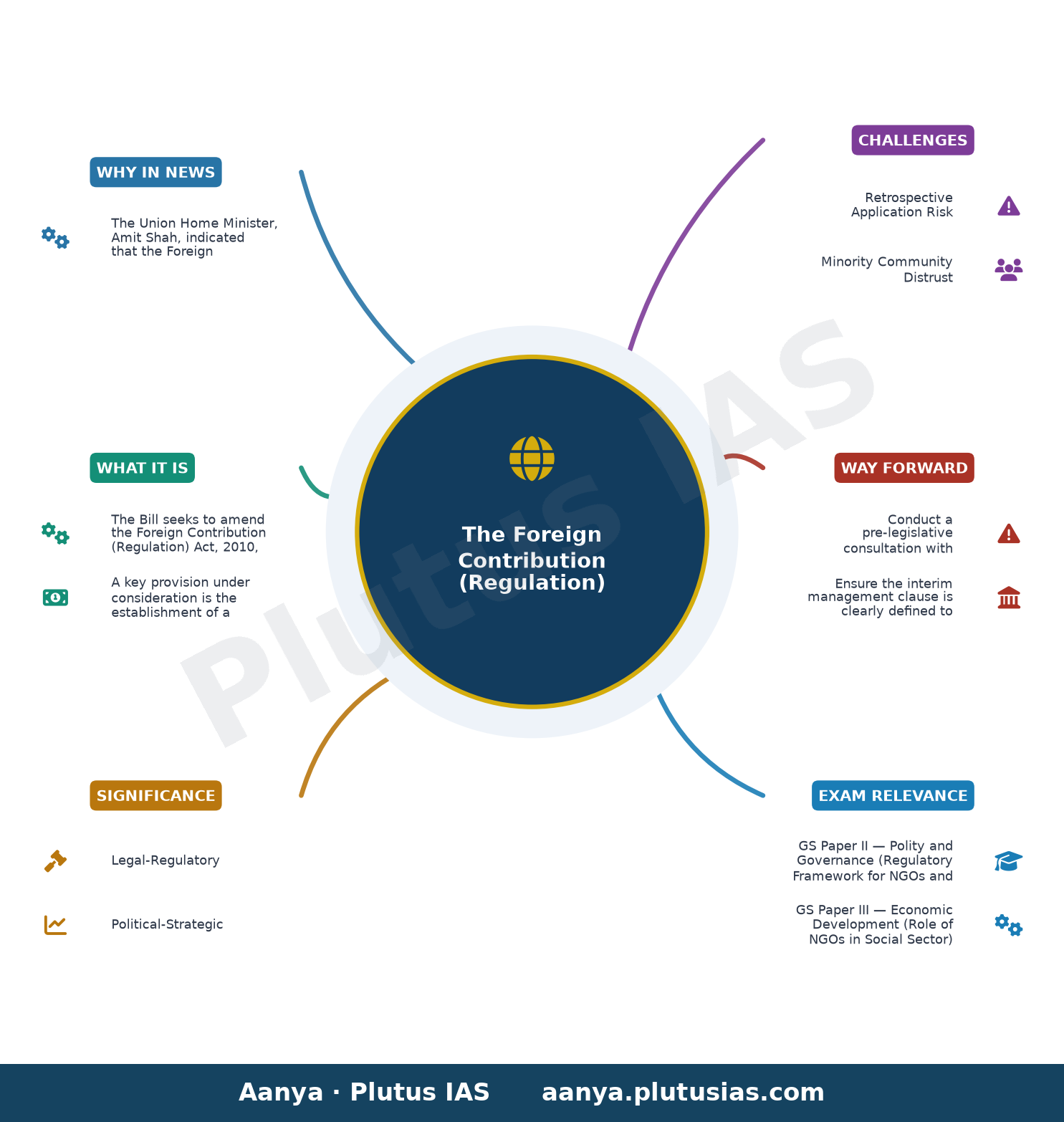
- GS Paper II — Polity and Governance (Regulatory Framework for NGOs and Associations) | GS Paper III — Economic Development (Role of NGOs in Social Sector) and Security (Foreign Influence in Domestic Affairs)
- Prelims: FCRA, 2010; Foreign Contribution (Regulation) Amendment Bill, 2026; Section 12(4) of FCRA; retrospective legislation; Article 19(1)(c) of the Constitution; Public Interest Litigation; Union Home Ministry; Lok Sabha Monsoon Session 2026
- Essay: Balancing National Security and Civil Liberties: The Case of Foreign Contribution Regulation in India, The Role of NGOs in India’s Development Paradigm: Accountability vs. Autonomy
Quick Revision: The Foreign Contribution (Regulation) Amendment Bill, 2026, seeks to ensure continuity in the management of institutions during lapses in FCRA registration, with explicit assurances that it will not operate retrospectively, thereby addressing constitutional concerns while maintaining regulatory oversight.
Why is this in the news?
The Union Home Minister, Amit Shah, indicated that the Foreign Contribution (Regulation) Amendment Bill, 2026 is likely to be introduced in the Lok Sabha on August 12, 2026, following a meeting with the Mizoram Chief Minister Lalduhoma, who raised concerns regarding its potential retrospective application. The Bill has triggered significant apprehensions among Christian organisations and minority communities, particularly in states like Kerala and Mizoram, where foreign contributions have historically played a pivotal role in social and educational development. The political sensitivity of the Bill, coupled with assurances from the government regarding its non-retrospective nature, underscores its relevance for UPSC aspirants navigating the intersection of governance, constitutional rights, and foreign policy.
Background
- The Foreign Contribution (Regulation) Act (FCRA), 2010, was enacted to regulate the acceptance and utilisation of foreign contributions by individuals, associations, and companies in India, with the primary objective of preventing foreign interference in domestic affairs.
- The FCRA was amended in 2020 to introduce stricter provisions, including a cap on administrative expenses, mandatory opening of FCRA accounts in the State Bank of India (SBI), and restrictions on sub-granting of funds.
- The proposed 2026 Amendment Bill aims to further refine the regulatory framework, particularly addressing gaps in the management of institutions during periods of suspended or lapsed FCRA registrations.
- Christian organisations and minority communities have expressed concerns over potential retrospective clauses, which could expose them to penalties for past procedural deviations, despite their compliance with the law.
- The BJP-led government has sought to expand its political base among minority communities, particularly in Kerala, where Christian voters constitute a significant demographic, making the Bill politically sensitive.
- The Union Home Ministry has clarified that the Bill will not have retrospective application, aligning with constitutional principles of legal certainty and fairness.
What is the Foreign Contribution (Regulation) Amendment Bill, 2026?
- The Bill seeks to amend the Foreign Contribution (Regulation) Act, 2010, to introduce provisions for the interim management of institutions in cases where their FCRA registration is suspended, cancelled, or lapses, ensuring continuity in their operations and protection of assets.
- A key provision under consideration is the establishment of a government-designated authority empowered to oversee the management of such institutions, including the utilisation of their assets and funds, during periods of regulatory non-compliance.
- The Bill aims to address ambiguities in the existing framework, where organisations with lapsed registrations face operational disruptions, while ensuring that their assets dedicated to public welfare are not arbitrarily seized or misused.
- The government has categorically stated that the Bill will not apply retrospectively, thereby mitigating concerns among minority communities and religious organisations regarding penalties for past procedural deviations.
- The proposed amendments are part of a broader effort to balance national security imperatives with the autonomy of civil society organisations, ensuring transparency and accountability in the utilisation of foreign contributions.
- The Bill has been framed against the backdrop of heightened scrutiny of foreign funding, particularly in sectors such as education, healthcare, and social welfare, where NGOs play a critical role.
- The Union Home Ministry has emphasised that the Bill does not target any specific community but is designed to strengthen the regulatory framework governing foreign contributions in India.
- The Bill is expected to be introduced in the Lok Sabha during the Monsoon Session of Parliament in August 2026, with potential implications for the functioning of thousands of NGOs across the country.
Key Features
| Feature | Significance |
|---|---|
| Retrospective Clause Exclusion | Assures organisations that past procedural deviations will not invite penalties, reducing legal uncertainty for faith-based and welfare institutions. |
| Interim Management Provision | Ensures continuity of institutional governance if FCRA registration lapses, preventing asset mismanagement or misuse. |
| Minority Outreach Emphasis | Reflects the BJP’s strategic effort to address Christian community concerns ahead of elections in states like Kerala. |
| Parliamentary Timing (August 12) | Signals the government’s intent to prioritise regulatory reforms in the monsoon session, with potential political messaging. |
| State Government Engagement | Highlights the role of state leadership in voicing sectoral apprehensions to the Union government. |
Why it Matters
Legal-Regulatory
- The FCRA Amendment Bill 2026 seeks to refine the regulatory framework governing foreign contributions, balancing transparency with institutional continuity.
Political-Strategic
- The BJP’s cautious approach underscores its electoral calculus in minority-dominated regions, particularly Kerala, where Christian voters hold decisive influence.
Institutional
- Faith-based and welfare organisations, heavily reliant on foreign funds for social projects, face reduced risk of asset seizures or operational disruptions.
Federalism
- State governments, such as Mizoram, play a critical role in articulating local concerns to the Union government, ensuring policy responsiveness.
Challenges
1. Retrospective Application Risk
- Past procedural deviations, even if unintentional, could have been penalised under earlier versions of the Bill, creating legal ambiguity.
UPSC Link: GS-II: Statutory bodies and regulatory mechanisms
2. Minority Community Distrust
- Historical narratives of regulatory overreach have fostered scepticism among Christian institutions, necessitating proactive reassurances.
UPSC Link: GS-II: Government policies for vulnerable sections
3. Operational Continuity Gaps
- Lapses in FCRA registration could disrupt critical social services, necessitating robust interim management mechanisms.
UPSC Link: GS-II: Role of civil society in governance
4. Political Messaging Challenges
- The government must balance regulatory rigour with outreach to minority communities to avoid perceptions of targeting specific groups.
UPSC Link: GS-II: Electoral politics and policy formulation
Challenges — UPSC Perspective
| Issue | Concern |
|---|---|
| Perceived Targeting of Christians | The Bill’s provisions are viewed by some as disproportionately affecting Christian-run institutions, despite broader applicability. |
| Asset Seizure Provisions | Concerns that assets accumulated over decades for public welfare could be frozen or repurposed if registration lapses. |
| Procedural Ambiguity | Lack of clarity on what constitutes a ‘break’ in FCRA registration, leading to potential misuse of discretionary powers. |
| Federal-State Coordination | Inconsistent interpretation of FCRA rules across states may create operational hurdles for multi-state organisations. |
Way Forward
- Conduct a pre-legislative consultation with faith-based and welfare organisations to address residual concerns on asset protection.
- Ensure the interim management clause is clearly defined to prevent arbitrary takeover of institutional assets.
- Publish illustrative case studies to demonstrate how the Bill’s provisions will operate in practice, reducing misinformation.
- Strengthen grievance redressal mechanisms for organisations facing FCRA registration issues, including expedited hearings.
- Monitor implementation post-enactment to assess impact on service delivery in minority-dominated regions.
- Engage state governments proactively to align FCRA enforcement with local socio-religious sensitivities.
- Clarify the distinction between ‘voluntary discontinuation’ of foreign funding and ‘lapse in registration’ to avoid penalisation of compliant entities.
UPSC Value Addition
Keywords for Mains Answer-Writing
Foreign Contribution (Regulation) Amendment Bill, 2026 · FCRA · Lok Sabha proceedings · retrospective legislation · Union Home Minister Amit Shah · Mizoram Chief Minister Lalduhoma · Joint Action Forum for Minorities · DMK MP P Wilson · Catholic Bishops’ Conference of India (CBCI) · continuity in management of institutions · FCRA registration lapses · prospective vs retrospective application · public welfare organisations · minority communities and FCRA
Constitutional & Policy Linkages
- [‘Article 29: Protection of minority interests’, ‘Ensures safeguards for religious and cultural minorities in regulatory frameworks.’]
- [‘Article 30: Right to establish educational institutions’, ‘Protects minority-run institutions from arbitrary regulatory interference.’]
Concept Flow
Foreign Contributions (Regulation) Act (FCRA) governs inflow of foreign funds to Indian entities. → Amendment Bill 2026 introduces provisions for interim management and excludes retrospective penalties. → Christian and minority institutions express concerns over asset seizures and procedural ambiguity. → State governments (e.g., Mizoram) and opposition parties (e.g., DMK) demand withdrawal or JPC review. → Union Home Minister assures no retrospective application, aiming to mitigate political backlash. → Bill scheduled for Lok Sabha discussion on August 12, reflecting government’s legislative prioritisation. → Post-enactment, implementation must balance regulatory oversight with institutional continuity and minority rights.
Prelims Practice Questions
Q1. Consider the following statements regarding the Foreign Contribution (Regulation) Amendment Bill, 2026:
1. The Bill aims to ensure continuity in the management of institutions in case of a break in their FCRA registration.
2. The Bill includes a retrospective clause that empowers a government-designated authority to seize assets of organisations whose FCRA registration has lapsed.
3. The Bill was introduced by the UPA government and has been amended by the current government.
How many of the above statements are correct?
- Only one
- Only two
- All three
- None
Answer: Only two — Statement 1 is correct as per the senior government official’s clarification. Statement 2 is incorrect as the Bill, as per assurances, does not include a retrospective clause. Statement 3 is incorrect as the FCRA was enacted by the UPA government, but the Amendment Bill is a recent initiative.
Q2. Assertion (A): The Foreign Contribution (Regulation) Act (FCRA), 2010, regulates the acceptance and utilisation of foreign contributions by individuals, associations, and companies.
Reason (R): The FCRA was enacted to ensure that foreign contributions do not adversely affect the sovereignty and integrity of India or the public interest.
Options:
A. Both A and R are true, and R is the correct explanation of A.
B. Both A and R are true, but R is not the correct explanation of A.
C. A is true, but R is false.
D. A is false, but R is true.
- A
- B
- C
- D
Answer: A — Both the Assertion (A) and Reason (R) are correct, and R is the correct explanation of A. The FCRA was enacted to regulate foreign contributions and ensure they do not compromise national sovereignty or public interest.
Q3. Which of the following organisations is NOT typically associated with the concerns raised over the Foreign Contribution (Regulation) Amendment Bill, 2026?
A. Catholic Bishops’ Conference of India (CBCI)
B. Joint Action Forum for Minorities
C. Reserve Bank of India
D. DMK MP P Wilson
- A
- B
- C
- D
Answer: C — The Reserve Bank of India is not associated with the concerns raised over the FCRA Amendment Bill. The CBCI, Joint Action Forum for Minorities, and DMK MP P Wilson have been actively involved in discussions and submissions regarding the Bill.
Mains Practice Question
✍ Critically examine the constitutional and legal implications of the prospective versus retrospective application of regulatory provisions in the Foreign Contribution (Regulation) Amendment Bill, 2026. Also, discuss the concerns raised by minority communities and the government’s assurances in this context. (15 Marks)
Approach: MODEL-ANSWER SKELETON:
1. **Introduction (2 marks)**: Define FCRA and its objectives as per the Foreign Contribution (Regulation) Act, 2010. Mention the purpose of the Amendment Bill, 2026, and its emphasis on continuity in management of institutions.
2. **Prospective vs Retrospective Application (5 marks)**:
– Explain the principle of prospective application in law (no punishment for past actions unless explicitly stated).
– Discuss the legal implications of retrospective clauses (violation of Article 20(1) of the Constitution, which prohibits ex-post facto laws in criminal cases; however, civil retrospective laws are permissible with reasonable justification).
– Cite the Supreme Court’s stance on retrospective legislation (e.g., *Shankari Prasad v. Union of India*, *Golak Nath v. State of Punjab*, and recent judgments on regulatory laws).
– Highlight the concerns raised by minority communities (e.g., CBCI, Joint Action Forum for Minorities) regarding uncertainty and penalties for past procedural variations.
3. **Government’s Assurances and Political Context (4 marks)**:
– Discuss the assurances given by the Union Home Minister (no retrospective clause, addressing minority concerns).
– Explain the political sensitivity of the Bill, particularly its impact on Christian institutions and the BJP’s outreach to minority communities.
– Mention the role of the Mizoram Chief Minister and DMK MP P Wilson in raising these concerns.
4. **Conclusion and Way Forward (4 marks)**:
– Summarise the balance between regulatory oversight and protecting bona fide organisations.
– Suggest measures such as a Joint Parliamentary Committee (JPC) or further consultations to address concerns.
– Emphasise the need for clarity in the Bill to avoid legal ambiguities and ensure compliance with constitutional principles.
Source: The Indian Express
Generated by AanyaAi for educational purpose.

- युगांडा का वन्यजीव फॉरेंसिक्स लैब: हाथीदांत तस्करी पर लगाम - October 3, 2026
- Karnataka HC rules against insurance condition on tractor-trailers for hire/reward use - October 3, 2026
- युवा संगम: सिक्किम-राजस्थान सांस्कृतिक आदान-प्रदान से सीखें विरासत - October 3, 2026

No Comments