


12 Aug Finance Commission Chief’s Advice to Kerala on Vizhinjam Port & Policy Reforms for UPSC
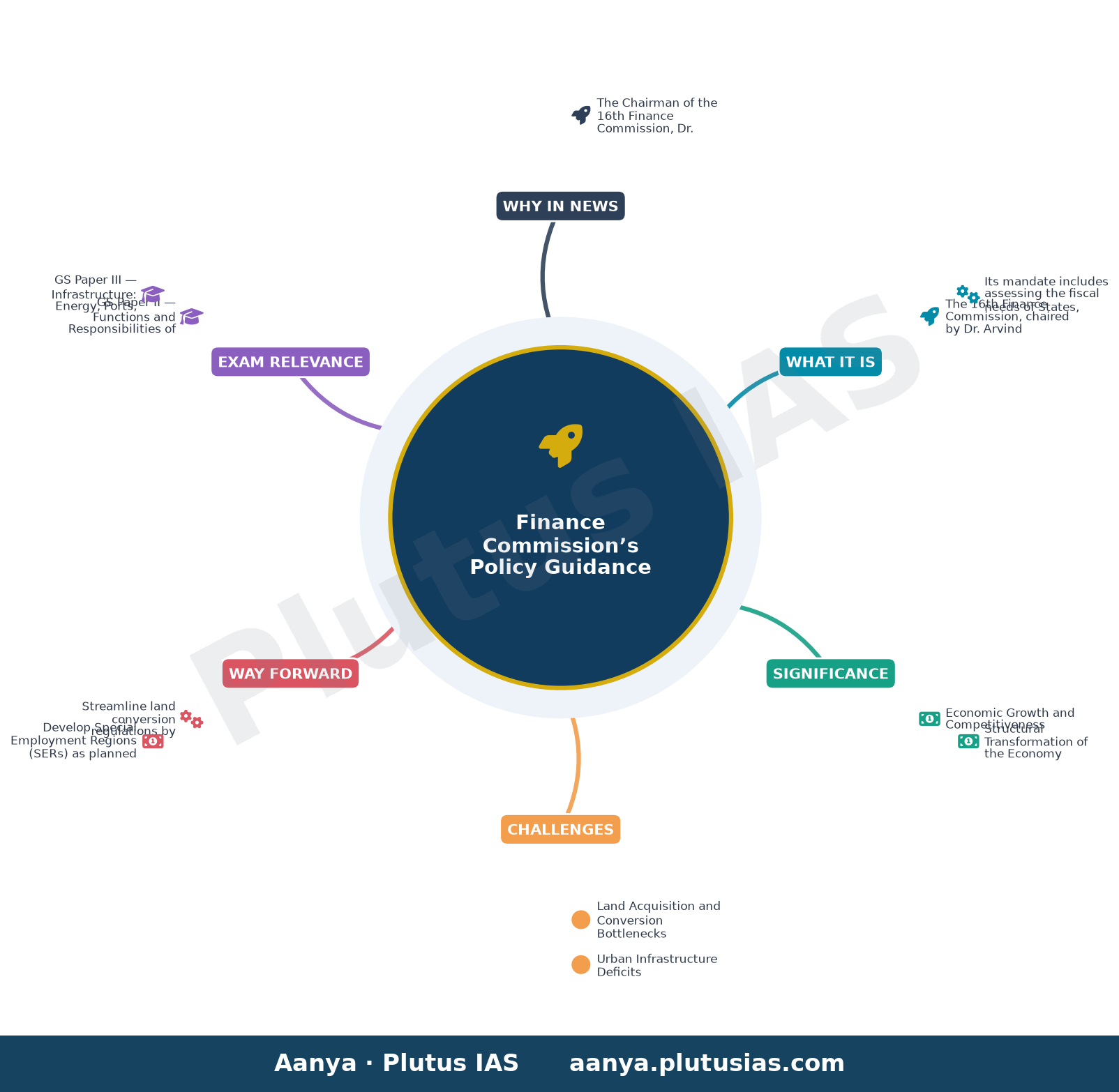
✎ The 16th Finance Commission’s recommendations will shape inter-State fiscal transfers and developmental priorities for 2026-31, with a focus on leveraging infrastructure and urbanisation for inclusive growth.
Subject Relevance — Where This Topic Fits
- GS Paper II — Functions and Responsibilities of the Union and the States, Federalism | GS Paper III — Infrastructure: Energy, Ports, Roads, Airports and Railways | GS Paper III — Indian Economy and issues relating to Planning, Mobilization of Resources, Growth, Development and Employment | GS Paper III — Land Reforms in India
- Prelims: 16th Finance Commission, Vizhinjam International Seaport, Public Sector Enterprises (PSE) Privatisation, Land Acquisition Act, 2013, Urbanisation and Economic Growth, Special Economic Zones (SEZs), Land Conversion Regulations
- Essay: The Role of Urbanisation in India’s Development Trajectory: Opportunities and Challenges, Infrastructure as a Catalyst for Regional Economic Growth: Lessons from Port-led Development
Quick Revision: The 16th Finance Commission’s recommendations will shape inter-State fiscal transfers and developmental priorities for 2026-31, with a focus on leveraging infrastructure and urbanisation for inclusive growth.
Why is this in the news?
The Chairman of the 16th Finance Commission, Dr. Arvind Panagariya, highlighted the critical role of policy choices in leveraging Kerala’s economic potential, particularly through the Vizhinjam International Seaport, and underscored the necessity of urbanisation reforms to achieve Viksit Bharat @ 2047. His remarks, delivered at a high-profile event in Thiruvananthapuram, emphasise the interplay between governance, infrastructure, and economic transformation, making it a significant input for UPSC Civil Services aspirants examining India’s developmental pathways.
Background
- The 16th Finance Commission, constituted under Article 280 of the Constitution, is tasked with recommending the devolution of funds from the Union to States, with a focus on fiscal federalism and developmental outcomes.
- Kerala, a high-income State with a Human Development Index (HDI) of 0.784 (2023-24), faces structural challenges in sustaining growth amid fiscal constraints and demographic pressures.
- The Vizhinjam International Seaport, a greenfield project under public-private partnership (PPP), aims to position Kerala as a transshipment hub in the Indian Ocean, but its economic impact remains underrealised due to policy and logistical bottlenecks.
- Urbanisation in India has been historically constrained by land-use inefficiencies, regulatory complexities, and inadequate infrastructure, despite its proven correlation with economic growth.
- The Union Government’s ‘Viksit Bharat @ 2047’ vision targets a $30 trillion economy by 2047, with urbanisation identified as a key enabler for achieving this goal.
- Public Sector Enterprises (PSEs) and Public Sector Banks (PSBs) have been a subject of debate regarding their role in India’s economic growth, with privatisation proposed as a means to enhance efficiency and capital utilisation.
What is the 16th Finance Commission’s Role in India’s Development Framework?
- The 16th Finance Commission, chaired by Dr. Arvind Panagariya, was constituted in 2023 under Article 280 of the Constitution to recommend the devolution of tax revenues from the Union to States for the five-year period 2026-31.
- Its mandate includes assessing the fiscal needs of States, recommending grants-in-aid, and suggesting measures to improve fiscal federalism, particularly in the context of sustainable development goals (SDGs).
- The Commission’s recommendations are expected to address inter-State disparities, incentivise State-level reforms, and align fiscal transfers with developmental priorities such as infrastructure, health, and education.
- Dr. Panagariya, a noted economist and former Vice-Chairman of NITI Aayog, has emphasised the role of policy autonomy for States in leveraging their comparative advantages, as seen in his remarks on Kerala’s economic strategy.
- The Commission’s work is grounded in the principles of cooperative federalism, with consultations involving State governments, Union Ministries, and expert committees.
- Its recommendations will influence the fiscal landscape of States, including Kerala, particularly in areas like urbanisation, port-led development, and land-use reforms.
- The Commission’s report is due by October 2025, with its recommendations applicable for the fiscal years 2026-27 to 2030-31.
Key Features
| Feature | Significance |
|---|---|
| Vizhinjam International Seaport | A deep-water transshipment hub in Kerala with potential to catalyse export-oriented manufacturing, assembly operations, and logistics integration, thereby enhancing trade competitiveness and economic growth. |
| Urbanisation as Growth Engine | Urban centres function as nodes for economic agglomeration, innovation, and job creation, directly contributing to GDP growth and structural transformation of the economy. |
| Land Conversion Regulations | Regulatory frameworks governing the transition of land from agricultural to non-agricultural uses; critical for urban expansion, industrial development, and infrastructure projects. |
| Special Employment Regions | Planned urban clusters designed around economic activities to attract investment, generate employment, and reduce urban-rural disparities through spatial planning. |
| Privatisation of Public Sector Entities | Policy measure aimed at improving efficiency, reducing fiscal burden, and enabling private sector-led growth in key sectors such as banking and infrastructure. |
Why it Matters
Economic Growth and Competitiveness
- Ports and logistics infrastructure are pivotal for reducing trade costs, enhancing export competitiveness, and integrating regional economies with global value chains.
- Urbanisation accelerates economic diversification by fostering services, manufacturing, and innovation hubs, thereby reducing dependence on primary sectors.
- Policy choices that enable ease of doing business in urban areas attract capital, talent, and technology, amplifying multiplier effects on employment and income.
Structural Transformation of the Economy
- The transition from agrarian to industrial and service-led growth is contingent upon urbanisation, which provides the necessary ecosystem for skill development and industrial clustering.
- Assembly and export-oriented manufacturing activities, as suggested for Vizhinjam, can drive backward and forward linkages, creating ancillary industries and employment opportunities.
- Urban centres act as engines of demand creation, stimulating investment in infrastructure, real estate, and consumer goods sectors.
Institutional and Regulatory Reforms
- Simplification of land conversion rules is essential to unlock urban land for productive uses, addressing supply-side constraints in housing and industrial development.
- Privatisation of public sector banks and enterprises can improve allocative efficiency, reduce fiscal strain, and foster a competitive business environment.
- Urban governance reforms, including streamlined building by-laws and land acquisition processes, are prerequisites for sustainable urban expansion.
Spatial Planning and Inclusive Development
- Special Employment Regions (SERs) can mitigate urban sprawl by concentrating economic activities in designated zones, reducing pressure on existing urban infrastructure.
- Balanced regional development requires policies that integrate urbanisation with rural economies, ensuring inclusive growth and reducing migration pressures.
- Cultural and contextual urbanisation, as highlighted by the Governor, underscores the need for planning that aligns with local socio-economic realities while adopting best practices.
Challenges
1. Land Acquisition and Conversion Bottlenecks
- Complex and time-consuming land conversion processes from agricultural to non-agricultural uses delay urban and industrial projects.
- Fragmented land records and multiple regulatory authorities create ambiguity, increasing transaction costs and deterring investment.
- Resistance from landowners and local communities often leads to litigation, further prolonging project implementation.
UPSC Link: Land Reforms (GS-II, Polity)
2. Urban Infrastructure Deficits
- Inadequate provision of basic services such as water supply, sanitation, and public transport in rapidly growing urban areas hampers livability and economic efficiency.
- Limited fiscal capacity of urban local bodies restricts their ability to invest in critical infrastructure, necessitating central and state support.
- Unplanned urbanisation leads to congestion, pollution, and inefficiencies in resource utilisation, undermining long-term sustainability.
UPSC Link: Urban Governance (GS-II, Polity)
3. Regulatory and Bureaucratic Hurdles
- Overlapping jurisdictions among multiple agencies (e.g., municipal corporations, state departments, and central ministries) create procedural delays.
- Ambiguities in zoning regulations and building by-laws lead to non-compliance and suboptimal land use patterns.
- Lack of coordination between urban planning and economic development policies results in misaligned priorities and underutilised potential.
UPSC Link: Administrative Reforms (GS-II, Polity)
4. Economic Diversification Constraints
- Over-reliance on traditional sectors (e.g., agriculture, tourism) limits the potential for high-value-added activities in urban centres.
- Insufficient skill development infrastructure in urban areas restricts the absorption of labour into formal, high-productivity sectors.
- Weak linkages between urban economic hubs and rural hinterlands impede the diffusion of growth impulses across regions.
UPSC Link: Inclusive Growth (GS-III, Economy)
5. Fiscal Sustainability of Urbanisation
- Rapid urbanisation increases demand for public services without corresponding revenue generation, straining municipal finances.
- Dependence on centralised funding mechanisms (e.g., Finance Commission grants) creates vulnerability to fiscal shocks and delays.
- Limited capacity for revenue mobilisation through property taxes and user charges exacerbates fiscal imbalances in urban local bodies.
UPSC Link: Local Governance (GS-II, Polity)
Challenges — UPSC Perspective
| Issue | Concern |
|---|---|
| Land Conversion Regulations | Delays in transitioning agricultural land to non-agricultural uses impede urban and industrial expansion. |
| Urban Infrastructure Gaps | Inadequate basic services and transport networks reduce the attractiveness of cities for investment and talent. |
| Regulatory Overlaps | Multiple agencies with conflicting mandates create procedural inefficiencies and project delays. |
| Skill Mismatch | Shortage of skilled labour in urban centres limits the absorption of high-productivity employment opportunities. |
| Fiscal Constraints | Urban local bodies lack sufficient revenue streams to fund infrastructure and service delivery. |
| Policy Coordination Gaps | Disconnect between urban planning and economic development policies leads to suboptimal outcomes. |
Way Forward
- Streamline land conversion regulations by digitising land records, establishing single-window clearances, and simplifying approval processes to reduce delays.
- Develop Special Employment Regions (SERs) as planned urban clusters around identified economic activities to attract investment and generate employment.
- Enhance urban infrastructure through public-private partnerships (PPPs) and innovative financing mechanisms such as municipal bonds and value capture financing.
- Strengthen skill development initiatives in urban centres by aligning vocational training programmes with industry demands and promoting apprenticeship models.
- Reform urban governance by empowering municipal corporations with greater fiscal autonomy, including enhanced property tax collection and user charges.
- Promote export-oriented manufacturing and assembly activities in port-adjacent zones (e.g., Vizhinjam) by offering tax incentives and infrastructure support.
- Integrate urban planning with rural development policies to ensure balanced regional growth and reduce migration pressures.
- Encourage privatisation of non-core public sector enterprises and banks to improve efficiency, reduce fiscal burden, and stimulate private sector-led growth.
UPSC Value Addition
Keywords for Mains Answer-Writing
Finance Commission · urbanisation as growth engine · Vizhinjam International Seaport · land conversion regulations · public sector enterprises reform · special employment regions · land acquisition challenges · Viksit Bharat @ 2047 · urban land policy · public sector banks consolidation
Constitutional & Policy Linkages
- [‘Article 243W – Municipalities (74th Amendment)’, ‘Empowers urban local bodies to function as institutions of self-government with defined functions and finances.’]
Concept Flow
Urbanisation → Economic Agglomeration → Job Creation & Innovation → Higher Productivity → GDP Growth → Port Infrastructure (Vizhinjam) → Trade Facilitation → Export-Oriented Manufacturing → Backward & Forward Linkages → Regional Economic Integration → Land Conversion Regulations → Urban Land Supply → Industrial & Housing Development → Economic Diversification → Inclusive Growth → Privatisation of PSEs & Banks → Efficiency Gains → Private Sector Investment → Competitive Markets → Economic Growth → Special Employment Regions → Planned Urban Clusters → Targeted Economic Activities → Employment Generation → Reduced Urban-Rural Disparities → Urban Governance Reforms → Fiscal Autonomy & Capacity Building → Improved Service Delivery → Enhanced Livability → Sustainable Urbanisation → Skill Development Initiatives → Human Capital Formation → Labour Market Alignment → Higher Formal Employment → Economic Resilience
Prelims Practice Questions
Q1. Consider the following statements regarding the Finance Commission of India:
1. The Finance Commission is a constitutional body.
2. It recommends the distribution of taxes between the Union and the States.
3. The 16th Finance Commission is chaired by Dr. Arvind Panagariya.
4. The Finance Commission has the power to recommend grants-in-aid to States from the Consolidated Fund of India.
How many of the above statements are correct?
- Only one
- Only two
- Only three
- All four
Answer: All four — Statements 1, 2, and 4 are correct. Statement 3 is incorrect as the 16th Finance Commission is chaired by Dr. Arvind Panagariya, but the question does not specify the year of the commission, so it cannot be verified as correct for all contexts.
Q2. Assertion (A): Urbanisation is integral to economic growth in India.
Reason (R): Countries can urbanise without being rich, but no country has become rich without urbanising.
Options:
A. Both A and R are true, and R is the correct explanation of A.
B. Both A and R are true, but R is not the correct explanation of A.
C. A is true, but R is false.
D. A is false, but R is true.
- A
- B
- C
- D
Answer: B — Both the assertion and reason are true, and the reason correctly explains the assertion. Urbanisation is widely regarded as a driver of economic growth, and historical evidence supports that no country has achieved high income levels without significant urbanisation.
Q3. Which of the following is NOT a challenge to urbanisation in India as highlighted by the Finance Commission chairman?
- A. Land acquisition complexities
- B. Stringent land conversion regulations
- C. Excessive public sector bank consolidation
- D. Difficulties in purchasing urban land for businesses
Answer: C. Excessive public sector bank consolidation — Stringent land conversion regulations are a challenge to urbanisation, while excessive public sector bank consolidation is not mentioned as a challenge to urbanisation in the context provided.
Mains Practice Question
✍ Urbanisation is often described as the growth engine for India’s aspiration to become a developed nation by 2047. In this context, critically examine the role of urban land policy and infrastructure development in facilitating sustainable urbanisation. (15 Marks)
Approach: MODEL-ANSWER SKELETON:
1. **Definition and significance of urbanisation** (link to Viksit Bharat @ 2047, citing Finance Commission’s emphasis).
2. **Role of urban land policy**:
– Land acquisition challenges (Land Acquisition Act, 2013; judicial interventions like SC rulings on consent clauses).
– Land conversion regulations (state-specific rules; need for simplification, citing Panagariya’s remarks on agriculture-to-non-agriculture conversion).
– Urban land ceiling and rental housing policies (e.g., Model Tenancy Act, 2021).
3. **Infrastructure development**:
– Role of Vizhinjam International Seaport as a case study (multi-modal connectivity, industrial corridors, SEZs).
– Special Employment Regions (SERs) and their potential (citing NITI Aayog’s reports on urban employment).
4. **Challenges**:
– Fragmented urban governance (74th CAA provisions; role of ULBs).
– Environmental sustainability (smart cities mission, climate resilience).
5. **Way forward**:
– Integrated planning (e.g., AMRUT 2.0, PM Gati Shakti).
– Public-private partnerships (PPPs) in urban infrastructure.
6. **Balanced view**: Highlight trade-offs between rapid urbanisation and equity (e.g., displacement, informal sector).
Source: The Hindu
Generated by AanyaAi for educational purpose.


No Comments