


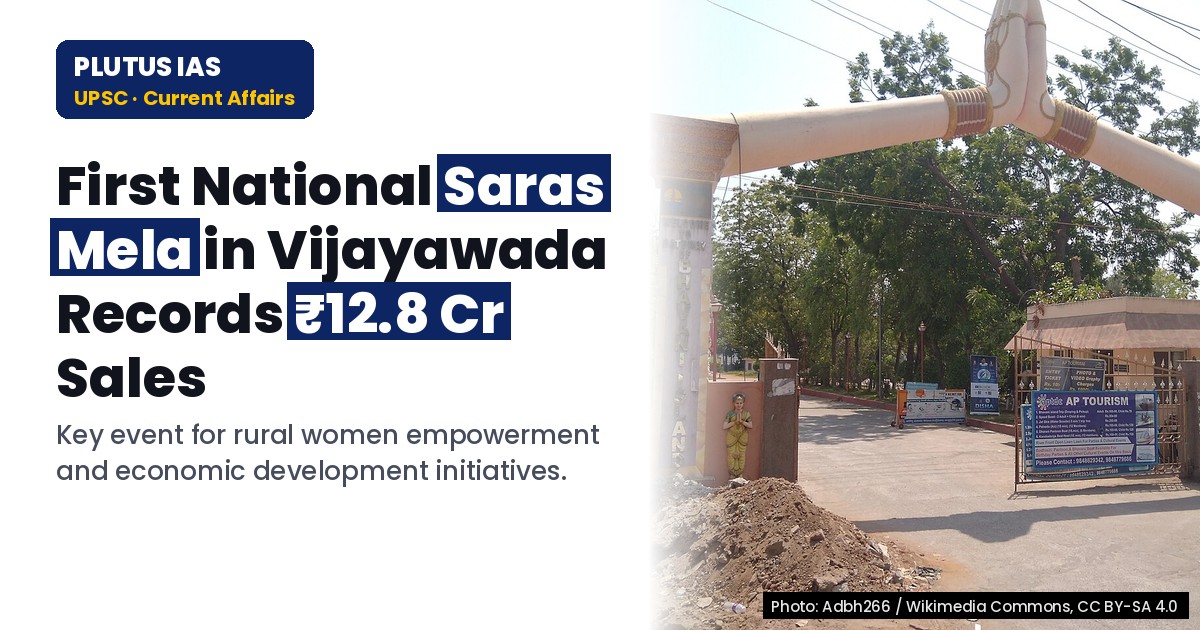
06 Nov First National Saras Mela: Rural Women Empowerment & Economy
✎ The National Saras Mela is a flagship initiative by the Ministry of Rural Development, promoting rural women's entrepreneurship and market access for SHG products, aligned with DAY-NRLM and 'Vocal for Local' objectives.
Subject Relevance — Where This Topic Fits
- GS Paper II — Government Policies and Interventions for Development in various sectors and Issues arising out of their Design and Implementation | GS Paper III — Indian Economy and Issues Relating to Planning, Mobilization of Resources, Growth, Development and Employment; Inclusive Growth and Issues arising from it
- Prelims: National Saras Mela, Deendayal Antyodaya Yojana – National Rural Livelihoods Mission (DAY-NRLM), Self-Help Groups (SHGs), Lakhpati Didis, Vocal for Local, Ministry of Rural Development
- Essay: The Role of Women’s Self-Help Groups in India’s Socio-Economic Transformation, Market Access and Rural Livelihoods: A Pathway to Inclusive Growth
Quick Revision: The National Saras Mela is a flagship initiative by the Ministry of Rural Development, promoting rural women’s entrepreneurship and market access for SHG products, aligned with DAY-NRLM and ‘Vocal for Local’ objectives.
Why is this in the news?
The inaugural National Saras Mela, held outside the Delhi-NCR region in Vijayawada, Andhra Pradesh, recently concluded successfully. This event, an initiative of the Ministry of Rural Development, Government of India, in collaboration with the Government of Andhra Pradesh, provided a significant platform for over 1,500 rural women entrepreneurs from more than 30 states and Union Territories to showcase their products, achieving sales exceeding ₹12.8 crore and attracting over 1.2 million visitors.
Background
- The National Saras Mela is conceptualised as a national-level exhibition to provide market access and exposure to products made by rural Self-Help Groups (SHGs) across India.
- It aligns with the broader objectives of the Deendayal Antyodaya Yojana – National Rural Livelihoods Mission (DAY-NRLM), which aims to reduce poverty by enabling poor households to access gainful self-employment and skilled wage employment opportunities.
- The ‘Lakhpati Didi’ initiative, a component of DAY-NRLM, seeks to empower rural women to earn an annual household income of at least ₹1 lakh, thereby enhancing their financial independence and economic decision-making capacity.
- The ‘Vocal for Local’ campaign, championed by the Prime Minister, encourages the promotion and consumption of indigenous products, thereby supporting local artisans, entrepreneurs, and the rural economy.
- Such melas serve as crucial platforms for rural women entrepreneurs, many of whom gain their first exposure to national consumer markets, facilitating skill development, financial literacy, and entrepreneurial growth.
- The event was organised in collaboration with the National Institute of Rural Development and Panchayati Raj (NIRDPR) and Kudumbashree, highlighting a multi-stakeholder approach to rural development.
What is the National Saras Mela?
- The National Saras Mela is an annual exhibition organised by the Ministry of Rural Development, Government of India, to provide a national-level marketing platform for products manufactured by rural Self-Help Groups (SHGs).
- Its primary objective is to facilitate market access for rural women entrepreneurs, enabling them to showcase and sell their indigenous products, including handicrafts, handlooms, natural food items, and regional cuisines.
- The Mela promotes the ‘Vocal for Local’ initiative by encouraging the patronage of products made by rural artisans and entrepreneurs, thereby strengthening local economies and preserving traditional crafts.
- It directly supports the Deendayal Antyodaya Yojana – National Rural Livelihoods Mission (DAY-NRLM) by providing entrepreneurial opportunities and market linkages to women associated with SHGs, including those aspiring to become ‘Lakhpati Didis’.
- The event serves as a platform for knowledge exchange and capacity building, allowing rural women to interact with consumers, understand market demands, and learn about best practices in product development and marketing.
- By bringing together women entrepreneurs from diverse states and Union Territories, the Mela fosters cultural exchange and highlights the rich tapestry of India’s rural craftsmanship and culinary heritage.
- The Mela also includes a ‘Saras Shakti Food Court’ dedicated to regional food products, further diversifying the offerings and providing additional avenues for income generation for rural women.
Key Features
| Feature | Significance |
|---|---|
| First National Saras Mela outside Delhi-NCR | Marks a strategic decentralisation of national-level market access initiatives, extending benefits to a broader geographical base of rural entrepreneurs. |
| Participation of 1,500+ rural women entrepreneurs from 30+ States/UTs | Demonstrates extensive outreach and inclusivity, providing a diverse national platform for self-help group (SHG) members and ‘Lakhpati Didis’. |
| Total sales exceeding ₹12.8 crore, with 75% from handlooms and handicrafts | Highlights the significant economic potential of traditional rural crafts and products, contributing substantially to local livelihoods and the rural economy. |
| First-time national market access for over 50% of participating entrepreneurs | Crucial for capacity building and integration of nascent rural enterprises into the mainstream national consumer market, fostering entrepreneurial growth. |
| Inauguration by the President of India and presence of multiple dignitaries | Lends significant institutional gravitas and national recognition to the efforts of rural women entrepreneurs and the broader mission of rural development. |
Why it Matters
Economic Empowerment and Livelihood Generation
- Facilitates direct market access for rural women entrepreneurs, enabling them to sell products directly to consumers and bypass intermediaries, thereby increasing their income.
- Promotes the growth of micro-enterprises within rural areas, diversifying income sources and reducing dependence on traditional agricultural livelihoods.
- Showcases the economic viability of traditional crafts, handlooms, and local food products, encouraging their preservation and commercialisation.
Social Inclusion and Women’s Empowerment
- Strengthens the agency of rural women by providing them with entrepreneurial opportunities and financial independence, enhancing their role in household and community decision-making.
- Fosters a sense of community and shared purpose among women’s self-help groups (SHGs) across different regions, promoting peer learning and networking.
- Contributes to the ‘Lakhpati Didi’ vision by providing a platform for SHG members to achieve higher income levels through enhanced market linkages and skill utilisation.
Promotion of ‘Vocal for Local’
- Serves as a tangible manifestation of the ‘Vocal for Local’ initiative by providing a national platform for locally produced goods, encouraging their consumption and appreciation.
- Raises consumer awareness about the quality and uniqueness of products made by rural artisans, fostering a market for indigenous crafts and food items.
- Supports the development of local supply chains and value addition within rural economies, reducing reliance on mass-produced goods.
Rural Development and Policy Implementation
- Acts as a key implementation strategy for the Deendayal Antyodaya Yojana – National Rural Livelihoods Mission (DAY-NRLM) by strengthening market linkages, a critical component of sustainable livelihoods.
- Encourages inter-state collaboration and sharing of best practices in rural enterprise development, such as the Andhra Pradesh model for SHG product promotion.
- Highlights the importance of government support and institutional frameworks in nurturing rural entrepreneurship and achieving inclusive growth objectives.
Challenges
1. Sustained Market Access
- Ensuring year-round market opportunities beyond temporary fairs and exhibitions for rural products.
- Establishing robust and efficient supply chains that can connect rural producers to urban and national markets consistently.
UPSC Link: Rural Development; Marketing of Agricultural Produce
2. Quality Control and Standardisation
- Maintaining consistent quality and standardisation of diverse products from various SHGs to meet consumer expectations and national market requirements.
- Implementing effective quality assurance mechanisms without stifling traditional production methods or increasing costs excessively for small producers.
UPSC Link: Rural Industries; MSME Development
3. Branding and Packaging
- Developing attractive and competitive branding and packaging for rural products to enhance their market appeal against established commercial brands.
- Providing design and marketing expertise to SHGs to effectively position their products in a competitive market.
UPSC Link: Marketing Strategies; Entrepreneurship Development
4. Financial Inclusion and Digital Literacy
- Ensuring access to affordable credit and digital payment systems for rural entrepreneurs, particularly for scaling up production and managing finances.
- Bridging the digital divide to enable SHG members to leverage e-commerce platforms and digital marketing tools effectively.
UPSC Link: Financial Inclusion; Digital India Initiatives
Challenges — UPSC Perspective
| Issue | Concern |
|---|---|
| Limited market exposure | Many rural entrepreneurs lack consistent access to broader national consumer markets, limiting their sales potential and growth. |
| Inadequate infrastructure | Challenges in logistics, storage, and transportation hinder the efficient movement of rural products to distant markets. |
| Skill gaps in marketing | Rural women entrepreneurs often require enhanced training in modern marketing techniques, digital sales, and customer engagement. |
| Competition from organised sector | Products from SHGs face stiff competition from mass-produced, commercially branded goods with extensive marketing budgets. |
| Sustainability of enterprises | Ensuring that rural enterprises are not merely project-based but evolve into self-sustaining business models capable of long-term growth. |
Government Initiatives — Must-Memorise for Prelims
- Deendayal Antyodaya Yojana – National Rural Livelihoods Mission (DAY-NRLM)
Way Forward
- Establish permanent retail outlets and e-commerce platforms, such as ‘She Marts’ and ‘Swayam Andhra’ models, to ensure continuous market access for SHG products.
- Develop a national brand identity for SHG products, focusing on quality, authenticity, and ethical sourcing, to enhance their market competitiveness.
- Provide comprehensive training to rural women entrepreneurs in product design, quality control, packaging, digital marketing, and financial management.
- Strengthen backward and forward linkages by integrating SHGs into larger value chains and facilitating partnerships with private sector retailers and exporters.
- Leverage technology for market intelligence, demand forecasting, and efficient supply chain management to optimise production and distribution.
- Encourage state governments to replicate successful models of SHG product promotion and market linkage, adapting them to local contexts and resources.
- Facilitate access to micro-finance and credit facilities for SHGs to enable scaling up of production and investment in modern equipment and infrastructure.
UPSC Value Addition
Keywords for Mains Answer-Writing
Deendayal Antyodaya Yojana-National Rural Livelihoods Mission (DAY-NRLM) · Self-Help Groups (SHGs) · Rural Women Entrepreneurship · Lakhpati Didis · Vocal for Local · Rural Economic Transformation · Market Access for Rural Products · Skill Development · Financial Inclusion · Poverty Alleviation
Concept Flow
Formation of Self-Help Groups (SHGs) under DAY-NRLM → Skill development and capacity building for rural women → Production of diverse goods (handlooms, handicrafts, food items) → Participation in national platforms like Saras Melas → Enhanced market access and direct sales to consumers → Increased income and economic empowerment for rural women → Contribution to ‘Lakhpati Didi’ vision and rural economic transformation
Prelims Practice Questions
Q1. Consider the following statements regarding the National Saras Mela:
1. The first National Saras Mela was organised outside the Delhi-NCR region in Vijayawada.
2. The event is an initiative of the Ministry of Rural Development, Government of India.
3. The Mela aims to provide a national platform for rural women entrepreneurs, particularly those associated with Self-Help Groups (SHGs).
How many of the above statements are correct?
- Only one
- Only two
- All three
- None
Answer: All three — Statement 1 is correct: The news explicitly states that the first National Saras Mela was held outside Delhi-NCR, in Vijayawada. Statement 2 is correct: The event was organised as an initiative of the Ministry of Rural Development, Government of India. Statement 3 is correct: The Mela’s objective is to offer a national platform for rural women entrepreneurs, including Lakhpati Didis and SHG members, to display their products.
Q2. Which of the following initiatives is directly associated with the objective of creating ‘Lakhpati Didis’ by providing skill development, financial assistance, and market access to women associated with Self-Help Groups (SHGs)?
- Pradhan Mantri Jan Dhan Yojana (PMJDY)
- Deendayal Antyodaya Yojana – National Rural Livelihoods Mission (DAY-NRLM)
- Pradhan Mantri Kaushal Vikas Yojana (PMKVY)
- Mahatma Gandhi National Rural Employment Guarantee Act (MGNREGA)
Answer: Deendayal Antyodaya Yojana – National Rural Livelihoods Mission (DAY-NRLM) — The Deendayal Antyodaya Yojana – National Rural Livelihoods Mission (DAY-NRLM) explicitly aims to empower women associated with SHGs by providing skill development, financial assistance, market access, and entrepreneurial opportunities, with a vision to create ‘Lakhpati Didis’. The other options, while important for financial inclusion or skill development, are not directly linked to the ‘Lakhpati Didi’ objective in the same comprehensive manner.
Mains Practice Question
✍ Discuss the significance of initiatives like the National Saras Mela in fostering rural women’s entrepreneurship and achieving the objectives of the Deendayal Antyodaya Yojana – National Rural Livelihoods Mission (DAY-NRLM). How far have such efforts contributed to the economic empowerment of rural women in India? (15 Marks)
Approach: MODEL-ANSWER SKELETON:
1. **Introduction:** Briefly introduce the National Saras Mela as a platform for rural women entrepreneurs and its connection to DAY-NRLM.
2. **Significance of National Saras Mela:**
* **Market Access:** Providing a national-level platform for SHG products (handlooms, handicrafts, food items) to reach a wider consumer base.
* **Visibility and Branding:** Enhancing the visibility of rural products and promoting the ‘Vocal for Local’ initiative.
* **Skill Development and Capacity Building:** Offering opportunities for learning market trends, packaging, and direct consumer interaction.
* **Financial Inclusion and Income Generation:** Direct sales leading to increased income for rural women and SHGs.
* **Empowerment:** Fostering confidence, decision-making abilities, and entrepreneurial spirit among women.
* **Networking:** Facilitating interaction among SHGs from different regions and with government agencies.
3. **Contribution to DAY-NRLM Objectives:**
* **Poverty Alleviation:** Direct income generation contributes to poverty reduction.
* **Lakhpati Didis:** Directly supports the vision of creating ‘Lakhpati Didis’ by enhancing their entrepreneurial capabilities and income.
* **Rural Economic Transformation:** Diversifying rural livelihoods beyond agriculture and integrating rural products into the mainstream economy.
* **Social Mobilisation:** Strengthening SHG networks and collective action.
4. **Assessment of Economic Empowerment (Challenges and Successes):**
* **Successes:** Increased income, improved living standards, enhanced social status, greater participation in household economic decisions (cite examples like the sales figures from the Mela).
* **Challenges:** Sustained market linkages beyond such events, quality control, scaling up production, access to credit, digital literacy, competition from organised sectors, overcoming traditional gender roles.
5. **Conclusion:** Summarise the positive impact of such initiatives while acknowledging the need for continuous support, policy interventions, and infrastructure development to ensure long-term, sustainable economic empowerment for rural women.
Source: PIB (Press Information Bureau)
Andhra Pradesh PCS (APPSC) — State PCS Practice
Prelims: The first National Saras Mela (outside Delhi-NCR) was successfully concluded in Vijayawada. Which of the following statements about this event is/are correct?
I. It recorded sales exceeding ₹12.8 crore.
II. More than 12 lakh visitors attended the Mela.
III. The event aimed to promote rural self-help groups (SHGs) and their products.
IV. It was the first time such a national-level event was held in Andhra Pradesh.
- A. I and II only
- B. I, II and III only
- C. I, II and IV only
- D. I, II, III and IV
Answer: A. I and II only — Based on the provided topic, statements I and II are explicitly mentioned as facts. Statements III and IV are not mentioned in the given topic.
Mains: Discuss the potential socio-economic impact of hosting a large-scale event like the ‘Pehla Rashtriya Saras Mela’ in Vijayawada, specifically considering its implications for rural development and local entrepreneurship in Andhra Pradesh.
Generated by AanyaAi for educational purpose.
Related guides on our sites
- Best economics optional coaching for upsc
- Best economics optional teacher for upsc
- How to prepare for GS paper 1 for UPSC CSE mains exam
- Best UPSC coaching for IFOS exam

- NAMASTE Scheme: Enhancing Sanitation Workers’ Livelihoods & Safety - November 14, 2026
- एमएसएमई का विशेष अभियान 6.0: स्वच्छता और लंबित मामलों का निपटारा - November 14, 2026
- Sea Vigil-26: Coastal Defence Drills Off Visakhapatnam - November 14, 2026

No Comments