


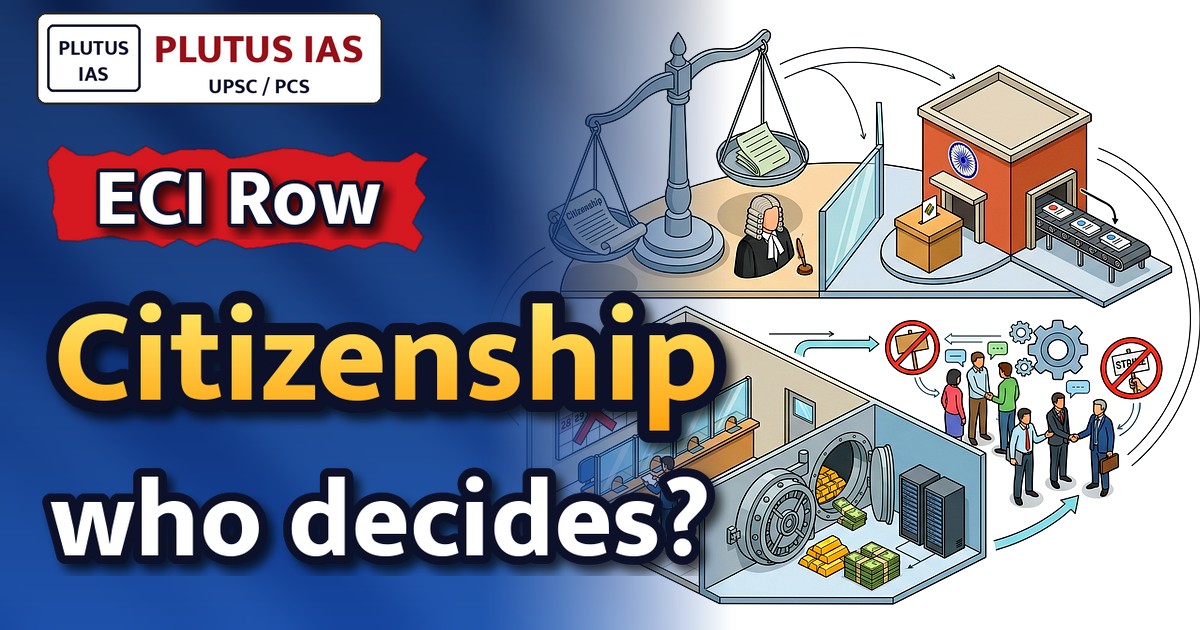
29 Sep Former SC Judge Clarifies: Citizenship Not ECI’s Role
✎ The Election Commission of India’s constitutional mandate is limited to electoral processes; citizenship determination is exclusively within the domain of the Ministry of Home Affairs under the Citizenship Act, 1955.
Subject Relevance — Where This Topic Fits
- GS Paper II — Constitutional and Statutory Bodies | GS Paper III — Indian Economy and Labour Issues
- Prelims: Election Commission of India (ECI), Citizenship Act 1955, Fundamental Rights, Article 11, Article 326, Banking Regulation Act 1949, Industrial Disputes Act 1947, Public Sector Banks, United Forum of Bank Unions (UFBU), Indian Banks’ Association (IBA), LNG-powered trains, Kavach safety system, Automatic Signalling, WAG-12 locomotive
- Essay: Constitutional morality and institutional boundaries in democratic governance, Balancing labour rights with macroeconomic stability: the case of public sector banks
Quick Revision: The Election Commission of India’s constitutional mandate is limited to electoral processes; citizenship determination is exclusively within the domain of the Ministry of Home Affairs under the Citizenship Act, 1955.
Why is this in the news?
The statement by a former Supreme Court judge asserting that the determination of citizenship lies outside the purview of the Election Commission of India (ECI) has reignited constitutional debates on the delineation of institutional roles. Concurrently, the deferment of a three-day nationwide strike by public sector bank unions, following negotiations with the Indian Banks’ Association (IBA), underscores the interplay between labour rights, economic stability, and governance in India’s banking sector. These developments are significant for UPSC aspirants as they intersect with constitutional law, administrative law, and economic governance.
Background
- The Election Commission of India (ECI) is a constitutional body established under Article 324 of the Constitution, primarily responsible for the conduct of elections to the Parliament, State Legislatures, and the offices of the President and Vice-President.
- Citizenship in India is governed by the Citizenship Act, 1955, read with the Constitution (Citizenship) Order, 1950, and is administered by the Ministry of Home Affairs (MHA). The Constitution empowers Parliament to regulate citizenship matters under Article 11.
- Public sector banks in India, regulated by the Reserve Bank of India under the Banking Regulation Act, 1949, are critical to the country’s financial stability. Industrial disputes in this sector can have far-reaching macroeconomic implications.
- The Industrial Disputes Act, 1947, provides the legal framework for resolving disputes between employers and employees in industrial establishments, including banks, through conciliation, arbitration, or adjudication.
- The United Forum of Bank Unions (UFBU) represents the interests of bank employees across public sector banks, while the Indian Banks’ Association (IBA) acts as the representative body of banks in negotiations with unions.
Key Concepts and Institutional Roles in Focus
- The Election Commission of India (ECI): A constitutional authority under Article 324, tasked with superintendence, direction, and control of elections. Its powers are derived from the Representation of the People Act, 1951, and are strictly circumscribed to electoral matters.
- Citizenship Determination: Governed by the Citizenship Act, 1955, and administered by the Ministry of Home Affairs. Citizenship can be acquired by birth, descent, registration, naturalisation, or incorporation of territory. The ECI has no constitutional or statutory mandate to adjudicate citizenship claims.
- Public Sector Banks (PSBs): Account for over 70% of the banking sector’s assets in India. Their operations are critical to credit delivery, monetary policy transmission, and financial inclusion.
- Industrial Relations in Banking: The Industrial Disputes Act, 1947, governs the resolution of disputes in banks, including strikes and lockouts. Strikes in PSBs can disrupt banking services, affect depositor confidence, and pose systemic risks to the economy.
- Role of the Indian Banks’ Association (IBA): Acts as a negotiating body for banks in collective bargaining with unions. It plays a pivotal role in averting industrial actions through dialogue and agreements.
- Macroeconomic Implications of Bank Strikes: Strikes in PSBs can lead to delays in credit disbursement, disruption in payment systems, and erosion of public trust in the banking sector. The deferment of strikes is often achieved through negotiated settlements that balance employee demands with economic stability.
- LNG-Powered Trains and Railway Safety: The introduction of LNG-powered trains are part of India’s efforts to modernise its railway infrastructure, enhance safety, and reduce carbon emissions.
Key Features
| Feature | Significance |
|---|---|
| Deferment of 3-day bank strike | Ensures continuity of banking operations, averts economic disruption, and reflects successful negotiation between IBA and UFBU, maintaining financial stability. |
| Project DRISHTI (AI-based freight monitoring) | Enhances operational efficiency in railway logistics through real-time monitoring of freight wagon integrity, reducing theft and improving supply chain reliability. |
| LNG-powered train launch | Demonstrates India’s commitment to green energy transition in rail transport, reducing carbon footprint and dependence on conventional fuels. |
| Kavach safety system rollout | Strengthens railway safety protocols by providing an indigenous automatic train protection system, addressing collision risks and enhancing passenger security. |
| Sabarmati-Sarkhej railway line doubling | Expands rail connectivity and capacity in Gujarat, supporting regional economic integration and reducing congestion on existing routes. |
Why it Matters
Economic
- Prevention of a 3-day bank strike safeguards financial transactions, liquidity, and investor confidence, mitigating potential GDP contraction risks.
- Railway projects worth ₹1,542 crore in Gujarat stimulate local economies through job creation, infrastructure development, and enhanced trade facilitation.
- AI-driven freight monitoring (Project DRISHTI) optimizes logistics, reducing operational costs and improving India’s competitiveness in global supply chains.
Institutional
- The Election Commission of India’s (ECI) role in citizenship determination is constitutionally delimited, reinforcing the separation of powers between electoral bodies and the Home Ministry.
- The deferment of the bank strike exemplifies the efficacy of tripartite negotiations (IBA, UFBU, and government) in resolving industrial disputes without coercive measures.
- Project DRISHTI underscores the integration of emerging technologies (AI) in public infrastructure, aligning with the Digital India and Atmanirbhar Bharat initiatives.
Strategic
- The launch of India’s first LNG-powered train aligns with energy diversification goals, reducing reliance on imported crude oil and enhancing energy security.
- The Kavach safety system represents a critical step toward achieving zero-accident railways, a key target under the National Rail Safety Mission.
- Russia’s endorsement of India’s UNSC permanent membership bid reflects India’s growing diplomatic influence in multilateral forums, particularly within the Global South.
Challenges
1. Industrial Disputes in Public Sector Banks
- Strikes in public sector banks disrupt financial services, affecting retail customers, businesses, and the broader economy.
- Balancing employee welfare with operational continuity requires robust dispute resolution mechanisms and proactive engagement with unions.
- The deferment of the strike, while positive, highlights the need for long-term structural reforms to prevent recurring industrial unrest.
UPSC Link: Industrial Relations Code, 2020
2. Railway Infrastructure Bottlenecks
- Expansion of railway lines (e.g., Sabarmati-Sarkhej) faces land acquisition delays, environmental clearances, and funding constraints.
- Integrating advanced safety systems (Kavach) across the vast railway network requires substantial capital investment and technical expertise.
- Ensuring seamless adoption of AI-driven monitoring (Project DRISHTI) necessitates workforce upskilling and resistance management.
UPSC Link: National Rail Plan (2030)
3. Energy Transition in Railways
- Transitioning to LNG-powered trains requires significant infrastructure development, including fueling stations and regulatory frameworks.
- Balancing cost efficiency with environmental sustainability remains a challenge, particularly in a price-sensitive market.
- Dependence on imported LNG exposes the sector to global price volatility and geopolitical risks.
UPSC Link: National Energy Policy (2017)
Challenges — UPSC Perspective
| Issue | Concern |
|---|---|
| Land acquisition for railway projects | Delays due to legal disputes, environmental clearances, and compensation negotiations. |
| Workforce resistance to AI adoption | Lack of digital literacy and fear of job displacement hinder technology integration. |
| Funding gaps for safety upgrades | Limited budgetary allocations constrain the nationwide rollout of Kavach and other systems. |
| Industrial unrest in PSBs | Recurring strikes disrupt financial services, eroding public trust and economic stability. |
| Energy security in rail transport | Over-reliance on imported LNG poses risks to cost stability and supply chain resilience. |
Way Forward
- Strengthen tripartite mechanisms (government, IBA, UFBU) to institutionalize dispute resolution in public sector banks, reducing reliance on ad-hoc deferments.
- Accelerate land acquisition and environmental clearances for critical railway projects through streamlined processes and digital land records.
- Expand the Kavach safety system’s coverage to high-density and accident-prone routes within the next 2-3 years, prioritizing safety audits.
- Develop a phased roadmap for LNG-powered trains, including pilot projects in high-traffic corridors and partnerships with domestic gas suppliers.
- Invest in upskilling railway staff in AI and digital tools to ensure smooth adoption of Project DRISHTI and future innovations.
- Enhance transparency in railway project funding by publishing quarterly progress reports and conducting independent audits.
- Promote public-private partnerships (PPPs) for railway infrastructure to leverage private sector expertise and capital.
- Align railway energy policies with the National Hydrogen Mission to explore green alternatives to LNG for long-term sustainability.
UPSC Value Addition
Keywords for Mains Answer-Writing
Constitutional framework of citizenship · Role and powers of the Election Commission of India · Separation of powers in India · Judicial review and constitutional interpretation · Banking sector reforms and labour rights · Public sector bank strikes and industrial relations · Railway infrastructure development and safety systems · AI applications in railway monitoring · UN Security Council reform and representation · Terrorism and international law · Squash and Asian Games achievements · Errors in educational textbooks and quality control
Constitutional & Policy Linkages
- [‘Article 324: ECI’s powers and limitations in electoral governance.’]
- [‘Article 73: Union Government’s executive authority over citizenship and internal security.’]
Concept Flow
Bank unions’ decision to defer strike → Successful tripartite negotiations (IBA, UFBU, government) → Ensures financial stability and continuity of services. → Home Ministry’s authority over citizenship determination → Supreme Court rulings on separation of powers → ECI’s role remains confined to electoral processes. → Union Home Minister’s railway project launches → Expansion of LNG-powered trains, Kavach system, and AI monitoring → Enhances rail safety, efficiency, and energy security. → AI-based freight monitoring (Project DRISHTI) → Real-time wagon integrity checks → Reduces theft and improves supply chain reliability. → Russia’s endorsement of India’s UNSC bid → Diplomatic alignment with Global South → Strengthens India’s multilateral bargaining power. → Anahat Singh’s Asian Games silver medal → India’s emerging talent in sports → Reflects youth potential and national pride in global competitions.
Prelims Practice Questions
Q1. Consider the following statements regarding the Election Commission of India (ECI) and its constitutional role:
1. The ECI is constitutionally mandated to determine citizenship disputes.
2. The ECI’s primary function is to conduct free and fair elections.
3. The ECI can adjudicate on matters related to the preparation of electoral rolls.
4. The ECI derives its powers solely from the Representation of the People Act, 1951.
How many of the above statements are correct?
- Only one
- Only two
- Only three
- All four
Answer: Only three — Statements 2 and 3 are correct. The ECI’s constitutional role is limited to conducting elections and preparing electoral rolls (Articles 324-329). It does not determine citizenship disputes (Statement 1 is incorrect). Its powers are derived from the Constitution (Article 324) and not solely from the Representation of the People Act, 1951 (Statement 4 is incorrect).
Q2. Assertion (A): The Indian Banks’ Association (IBA) and the United Forum of Bank Unions (UFBU) reached an agreement to defer the nationwide three-day bank strike scheduled for September 28, 2026.
Reason (R): The deferment was a result of the intervention of the Reserve Bank of India (RBI) under the Banking Regulation Act, 1949, which mandates the settlement of industrial disputes in the banking sector.
In the context of the above two statements, which one of the following is correct?
- Both A and R are true, and R is the correct explanation of A.
- Both A and R are true, but R is not the correct explanation of A.
- A is true, but R is false.
- A is false, but R is true.
Answer: A is true, but R is false. — Statement A is true as the strike was deferred following negotiations between IBA and UFBU. Statement R is false because the deferment was not mandated by the RBI under the Banking Regulation Act, 1949; it was a voluntary agreement between the parties.
Q3. Match the following pairs related to railway infrastructure and safety systems in India:
Column I (System/Project) Column II (Description)
A. Project DRISHTI 1. AI-based monitoring of freight wagon doors and seals
B. Kavach safety system 2. Indigenous automatic train protection system
C. WAG-12 locomotive maintenance shed 3. Maintenance facility for electric locomotives
D. Sabarmati-Sarkhej railway line doubling 4. Expansion of railway track capacity between two stations
Select the correct match:
- A-1, B-2, C-3, D-4
- A-2, B-1, C-4, D-3
- A-3, B-4, C-1, D-2
- A-4, B-3, C-2, D-1
Answer: A-1, B-2, C-3, D-4 — Project DRISHTI (A) is an AI-based system for monitoring freight wagon doors and seals. Kavach (B) is an indigenous automatic train protection system. WAG-12 locomotive maintenance shed (C) is a maintenance facility for electric locomotives. Sabarmati-Sarkhej railway line doubling (D) involves expanding railway track capacity between two stations.
Mains Practice Question
✍ The Constitution of India assigns specific roles to different organs of the state, reflecting the principle of separation of powers. Critically examine the constitutional limits on the Election Commission of India (ECI) in determining or adjudicating matters related to citizenship, with reference to recent judicial pronouncements and statutory provisions. Also, discuss the implications of such limits for electoral democracy in India. (15 Marks)
Approach: MODEL-ANSWER SKELETON:
1. Constitutional Provisions:
– Article 324: ECI’s constitutional mandate (conduct of elections, superintendence, direction, and control).
– Article 5: Citizenship defined by Parliament (Citizenship Act, 1955).
– Article 11: Parliament’s power to regulate citizenship.
2. Judicial Pronouncements:
– Supreme Court in *State of U.P. v. Raj Narain* (1975): ECI’s powers are limited to electoral rolls and elections.
– *Union of India v. Association for Democratic Reforms* (2002): ECI’s role is not to adjudicate on citizenship.
– *Citizenship Act, 1955*: Citizenship disputes are adjudicated by civil courts or designated authorities under the Act.
3. Separation of Powers:
– Executive (Home Ministry) and Judiciary (civil courts) are the primary authorities for citizenship matters.
– ECI’s role is to ensure that only eligible citizens are enrolled in electoral rolls (Article 326).
4. Implications for Electoral Democracy:
– Prevents overreach by ECI, ensuring checks and balances.
– Maintains the integrity of electoral rolls without encroaching on constitutional domains of other organs.
– Recent controversies (e.g., Assam NRC) highlight the need for clear demarcation of roles.
5. Conclusion:
– ECI’s role is strictly electoral; citizenship determination lies outside its purview.
– Judicial and legislative clarity is essential to avoid conflicts and uphold constitutional principles.
Source: The Indian Express
Generated by AanyaAi for educational purpose.
Related guides on our sites
- Best PSIR optional coaching for upsc
- Best PSIR optional teacher for upsc
- Best teacher of PSIR optional for upsc
- Best PSIR optional coaching in delhi for UPSC

- Supreme Court to Hear Plea Against CEC’s Suspension & SIR Validity - September 30, 2026
- पश्चिम बंगाल में परिवहन सुधार: AI सिग्नलिंग, ट्राम पुनरुद्धार और जल टैक्सी की योजना - September 30, 2026
- Supreme Court to get 3rd Woman Judge: Sunita Agarwal’s SC Appointment Soon - September 30, 2026

No Comments