


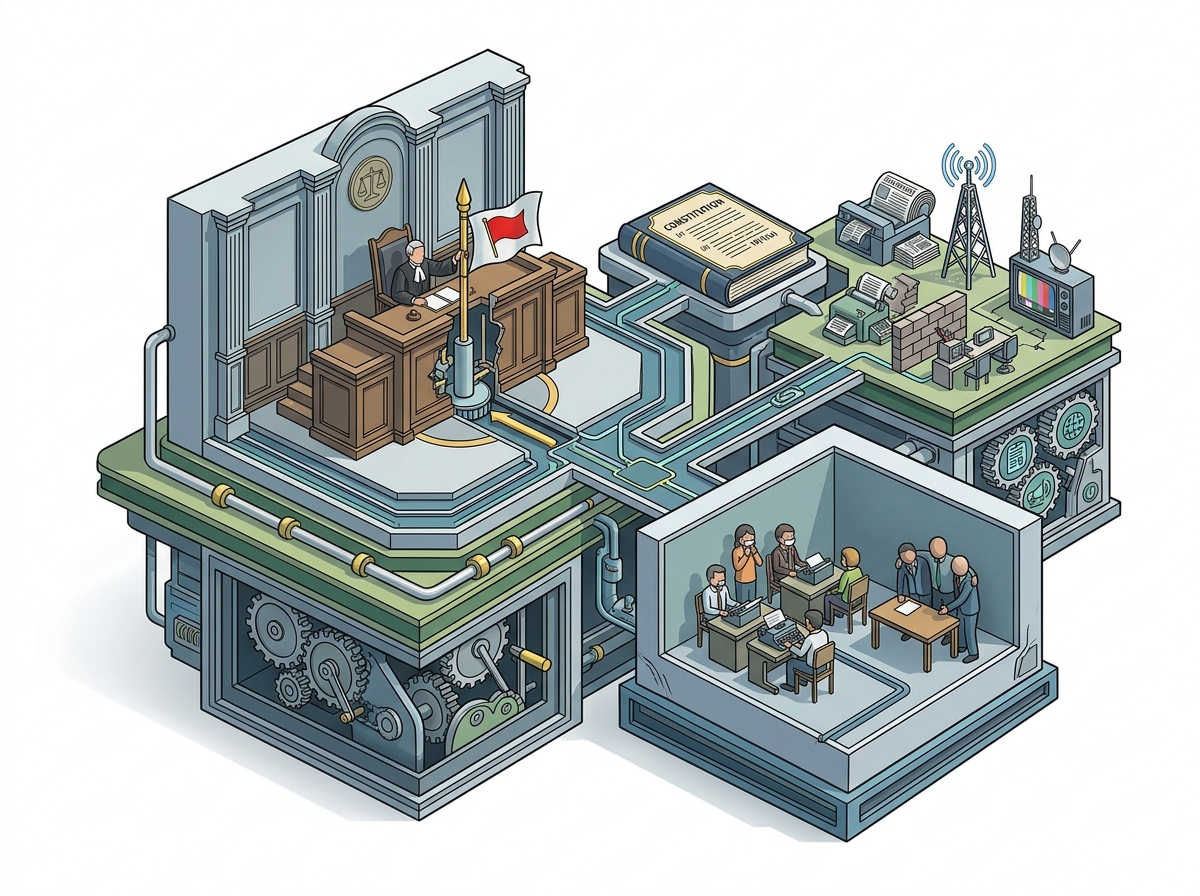
24 Aug Former SC Judge Warns: Journalists’ Silence on Media Laws Threatens Democracy
✎ The constitutional guarantee of press freedom under Article 19(1)(a) is not absolute and is subject to reasonable restrictions; however, the erosion of institutional safeguards, economic pressures, and contractual employment…
Subject Relevance — Where This Topic Fits
- GS Paper II — Polity and Governance (Constitutional Provisions, Fundamental Rights, Role of Judiciary) | GS Paper III — Economy (Impact of Neoliberal Policies on Labour and Media) | GS Paper IV — Ethics (Role of Media in Democracy, Press Freedom and Accountability)
- Prelims: Article 19(1)(a), Press Council of India, Media Transparency and Accountability Bill, Contractual Employment in Media, Federation of Press Clubs, Freedom of Speech and Expression, Trade Union Rights, Neoliberal Economic Policies
- Essay: The Role of Media in a Democracy: Balancing Freedom and Accountability, Economic Policies and Their Impact on Democratic Institutions
Quick Revision: The constitutional guarantee of press freedom under Article 19(1)(a) is not absolute and is subject to reasonable restrictions; however, the erosion of institutional safeguards, economic pressures, and contractual employment practices pose significant challenges to the effective protection of journalists’ rights in India.
Why is this in the news?
The remarks of former Supreme Court judge Justice B. Sudarshan Reddy at the Federation of Press Clubs’ national conclave in Hyderabad on August 23, 2026, have brought renewed attention to the vulnerabilities faced by journalists in India amid evolving media laws and economic pressures. His call for collective action by the journalistic community to safeguard their rights underscores the intersection of constitutional guarantees, institutional safeguards, and socio-economic realities. This discourse is particularly pertinent in the context of ongoing debates on media regulation, employment conditions in the media sector, and the erosion of trade union rights.
Background
- Article 19(1)(a) of the Constitution of India guarantees the right to freedom of speech and expression, which includes the freedom of the press. This fundamental right is the bedrock of democratic governance and public accountability.
- The Press Council of India (PCI), established under the Press Council Act, 1965, serves as a statutory body to oversee the standards of news reporting and address grievances against the press. However, its effectiveness has been debated due to limited enforcement powers.
- The Media Transparency and Accountability Bill, drafted by a seven-member committee, aims to enhance transparency in media ownership, regulate digital platforms, and strengthen the accountability of media organisations. The bill is yet to be introduced in Parliament.
- Neoliberal economic policies, including deregulation and privatisation, have led to significant changes in the media landscape, including the rise of contractual employment, which has weakened job security and collective bargaining power for journalists.
- The Federation of Press Clubs is a collective body representing press clubs across India, advocating for the rights and welfare of journalists and the freedom of the press.
- Trade unions in the media sector have historically played a crucial role in protecting the rights of journalists, but their influence has diminished due to contractual employment practices and anti-union policies adopted by some media houses.
What are the key legal, institutional, and economic challenges to media freedom in India?
- Constitutional Framework: Article 19(1)(a) of the Constitution guarantees freedom of speech and expression, which encompasses press freedom. However, this right is not absolute and is subject to reasonable restrictions under Article 19(2), such as public order, morality, and sovereignty of India.
- Judicial Safeguards: The judiciary has played a pivotal role in interpreting and upholding press freedom. Landmark judgments, such as Romesh Thappar v. State of Madras (1950) and Bijoe Emmanuel v. State of Kerala (1986), have reinforced the constitutional protection of press freedom.
- Institutional Mechanisms: The Press Council of India (PCI) and the News Broadcasters & Digital Association (NBDA) are key institutions tasked with regulating and self-regulating the media. However, their effectiveness is often constrained by limited regulatory powers and industry resistance.
- Economic Pressures: The media industry has undergone significant transformation due to neoliberal economic policies, leading to the proliferation of private news channels and digital platforms. This has resulted in increased competition, cost-cutting measures, and the rise of contractual employment, which undermines job security and professional autonomy.
- Contractual Employment: The growing prevalence of contractual employment in the media sector has weakened trade unions and reduced the collective bargaining power of journalists. This has made journalists more vulnerable to coercion, censorship, and arbitrary dismissals.
- Media Ownership and Transparency: Concentration of media ownership in the hands of a few corporate entities raises concerns about editorial independence and accountability. The proposed Media Transparency and Accountability Bill seeks to address these issues by mandating disclosure of media ownership and regulating digital platforms.
- State Coercion and Legal Ambiguities: Journalists in India face challenges such as legal harassment, arbitrary arrests, and censorship under laws like the Unlawful Activities (Prevention) Act (UAPA) and the Information Technology Act, 2000. Ambiguities in these laws often lead to their misuse, further eroding press freedom.
- Collective Action and Unionisation: The weakening of trade unions and the lack of collective action among journalists have left them vulnerable to external pressures. Strengthening trade unions and fostering a culture of collective resistance are essential to protect the rights and interests of journalists.
Key Features
| Feature | Significance |
|---|---|
| Constitutional guarantee of freedom of speech and expression (Article 19(1)(a)) | Forms the legal foundation for press freedom in India, enabling journalists to critique governance and hold power accountable without state interference. |
| Media regulatory frameworks | Govern the conduct of media institutions, ensuring ethical standards, accountability, and protection of journalistic rights against coercion. |
| Collective action by journalists | Strengthens resistance against state or institutional attempts to dilute rights, fostering solidarity and shared advocacy for press freedom. |
| Contractual employment in journalism | Undermines job security and unionisation, increasing vulnerability of journalists to economic pressures and editorial interference. |
| Media Transparency and Accountability Bill (proposed) | Aims to enhance transparency in media ownership and operations, addressing concerns over corporate control and editorial independence. |
Why it Matters
Constitutional and Legal
- The invocation of Article 19(1)(a) underscores the constitutional imperative of press freedom as a cornerstone of democratic governance, linking journalistic rights to broader civil liberties.
- The debate highlights the tension between statutory protections for journalists and the practical challenges posed by evolving media laws and economic policies.
- The discussion reflects a growing recognition that legal guarantees alone are insufficient without socio-economic safeguards and collective mobilisation.
Institutional and Governance
- The role of press clubs and professional bodies in advocating for journalists’ rights demonstrates the importance of self-regulation and peer support in maintaining press freedom.
- The erosion of unionisation in journalism raises governance concerns about labour rights, editorial independence, and the structural vulnerabilities of media workers.
- The proposed Media Transparency and Accountability Bill signals a potential shift toward greater regulatory oversight, with implications for media ownership and public trust.
Economic and Labour
- Neoliberal economic policies have contributed to the precariousness of journalistic employment, exacerbating divisions within the profession and weakening collective bargaining power.
- Contractual employment models in media institutions prioritise cost-efficiency over job security, undermining the ability of journalists to resist coercion or editorial pressures.
Societal and Democratic
- A free and fearless press is essential for informed public discourse, holding institutions accountable, and preventing the concentration of power in unaccountable entities.
- The silence of journalists on regulatory threats risks normalising censorship and self-censorship, eroding the public’s right to know and the media’s watchdog role.
- Collective action by journalists aligns with democratic principles, reinforcing the idea that press freedom is a public good rather than a privilege.
Challenges
1. Erosion of Press Freedom
- State attempts to introduce or dilute media laws may lead to increased censorship, self-censorship, or legal harassment of journalists.
- Economic pressures, including contractual employment, weaken the ability of journalists to resist institutional or state coercion.
- Divisions within the journalistic community reduce collective bargaining power and hinder unified resistance to threats to press freedom.
UPSC Link: GS-II: Role of media in democracy
2. Weakening of Labour Rights in Media
- The prevalence of contractual employment undermines job security, benefits, and unionisation, leaving journalists vulnerable to exploitation.
- Media managements may exploit labour vulnerabilities to suppress dissent, dilute editorial independence, or resist regulatory compliance.
- The decline of journalists’ unions reduces their capacity to advocate for rights and resist coercive practices.
UPSC Link: GS-II: Labour rights and media industry
3. Regulatory and Ethical Concerns
- Existing media laws may be insufficient to address modern challenges such as digital disinformation, corporate control, or state interference.
- The absence of robust transparency mechanisms in media ownership and operations obscures conflicts of interest and reduces public trust.
- Declining standards of news reporting, as noted in the discussion, risk undermining the credibility and utility of the press.
UPSC Link: GS-II: Media regulation and ethics
4. Socio-Economic Vulnerabilities
- Neoliberal economic policies have prioritised market efficiency over social protections, exacerbating precarity in media employment.
- Journalists face financial instability due to low wages, lack of benefits, and job insecurity, reducing their resilience against coercion.
- The fragmentation of the journalistic community along economic or ideological lines weakens collective action and advocacy.
UPSC Link: GS-III: Impact of economic policies on professions
5. Lack of Public and Institutional Support
- The silence of journalists on regulatory threats may reflect broader societal apathy or misinformation about the importance of press freedom.
- Institutional support from media bodies, civil society, and academia is critical but often fragmented, limiting coordinated resistance.
- Public awareness campaigns are needed to highlight the role of journalists in democracy and the risks posed by unchecked regulatory changes.
UPSC Link: GS-II: Role of civil society in governance
Challenges — UPSC Perspective
| Issue | Concern |
|---|---|
| State interference in media laws | Risk of censorship, legal harassment, or erosion of journalistic autonomy through regulatory changes. |
| Contractual employment in media | Undermines job security, unionisation, and collective bargaining power of journalists. |
| Fragmentation of journalistic community | Reduces unified resistance to threats and weakens advocacy for press freedom. |
| Decline in media ethics and standards | Erodes public trust and reduces the effectiveness of journalism as a watchdog institution. |
| Lack of transparency in media ownership | Obscures conflicts of interest and reduces accountability in editorial decisions. |
| Economic precarity of journalists | Increases vulnerability to coercion, self-censorship, and exploitation by media managements. |
Way Forward
- Strengthen collective action through press clubs, unions, and professional bodies to advocate for journalists’ rights and resist coercion.
- Advocate for the enactment and implementation of the proposed Media Transparency and Accountability Bill to enhance transparency and accountability in media operations.
- Promote ethical journalism by supporting self-regulatory mechanisms, ombudsmen, and independent fact-checking initiatives.
- Address labour rights in media by advocating for fair wages, job security, and the right to unionise for journalists.
- Enhance public awareness campaigns to highlight the critical role of a free press in democracy and the risks of regulatory erosion.
- Encourage interdisciplinary research on media freedom, labour rights, and regulatory frameworks to inform policy and advocacy.
- Foster collaboration between media institutions, civil society, and academia to develop robust safeguards for press freedom.
- Support legal literacy programmes for journalists to enable them to navigate regulatory challenges and assert their rights.
UPSC Value Addition
Keywords for Mains Answer-Writing
Freedom of the Press · Article 19(1)(a) · Media regulation · Constitutional protection of journalists · Media Transparency and Accountability Bill · Collective bargaining rights of journalists · Contractualisation of media workforce · Judicial pronouncements on press freedom · Role of Press Clubs and media associations · Socio-economic vulnerabilities of journalists
Constitutional & Policy Linkages
- [‘Article 19(1)(a): Freedom of speech and expression’, ‘Core constitutional guarantee underpinning press freedom.’]
- [‘Article 19(2): Reasonable restrictions’, ‘Framework for balancing press freedom with state interests in regulation.’]
- [‘Article 21: Right to life and personal liberty’, ‘Implied protection for journalists against coercion or harassment.’]
Concept Flow
Neoliberal economic policies → Precarity in media employment → Weakening of journalists’ unions → Reduced collective bargaining power → State attempts to regulate media → Risk of censorship or legal coercion → Erosion of press freedom → Fragmentation within journalistic community → Reduced unified resistance → Increased vulnerability to institutional pressures → Contractual employment in media → Job insecurity and financial instability → Higher susceptibility to coercion → Decline in media ethics and standards → Loss of public trust → Reduced effectiveness of journalism as a watchdog → Lack of transparency in media ownership → Conflicts of interest → Undermined accountability in editorial decisions → Collective action by journalists → Strengthened advocacy for rights → Enhanced resilience against coercion
Prelims Practice Questions
Q1. Consider the following statements regarding constitutional provisions for press freedom in India:
1. Article 19(1)(a) guarantees the freedom of speech and expression to all citizens.
2. The right to freedom of the press is explicitly mentioned in Article 19(1)(a).
3. The Supreme Court has held that press freedom is not absolute and can be regulated by reasonable restrictions under Article 19(2).
4. The Constitution does not provide any specific safeguards for journalists against coercion by the State.
How many of the above statements are correct?
- Only one
- Only two
- Only three
- All
Answer: Only three — Statements 1 and 3 are correct. Statement 2 is incorrect as the Constitution does not explicitly mention ‘press freedom’ separately; it is subsumed under freedom of speech and expression. Statement 4 is incorrect as judicial pronouncements and institutional mechanisms provide safeguards.
Q2. Assertion (A): The Media Transparency and Accountability Bill, 2023, seeks to regulate the ownership and funding of media organisations.
Reason (R): The Bill aims to address concerns related to the contractualisation of journalists and the weakening of trade unions in the media industry.
Options:
A. Both A and R are true, and R is the correct explanation of A.
B. Both A and R are true, but R is not the correct explanation of A.
C. A is true, but R is false.
D. A is false, but R is true.
- A
- B
- C
- D
Answer: B — Both A and R are true, and R correctly explains the rationale behind the provisions of the Bill. The Bill addresses both transparency in media ownership and labour rights concerns.
Mains Practice Question
✍ The constitutional guarantee of freedom of speech and expression under Article 19(1)(a) is often cited as the bedrock of press freedom in India. However, former Supreme Court judge B. Sudarshan Reddy has argued that this guarantee alone is insufficient to protect journalists from coercion and vulnerabilities. Critically analyse the adequacy of constitutional protections for journalists in India, with reference to recent judicial pronouncements and legislative initiatives. Also, discuss the role of media associations and civil society in safeguarding journalistic rights. (15 Marks)
Approach: MODEL-ANSWER SKELETON:
1. **Constitutional Framework**: Art. 19(1)(a) and its judicial interpretation (e.g., Romesh Thapar v. State of Madras, Sakal Papers v. Union of India, Indian Express v. Union of India).
2. **Limitations and Restrictions**: Art. 19(2) and reasonable restrictions (defamation, contempt of court, public order, sovereignty, integrity, etc.).
3. **Judicial Pronouncements**: Recent Supreme Court rulings on press freedom (e.g., Anuradha Bhasin v. Union of India, 2020; Pegasus Spyware Case, 2021).
4. **Legislative Initiatives**: Media Transparency and Accountability Bill (2023) — key provisions, objectives, and gaps.
5. **Socio-economic Vulnerabilities**: Contractualisation, declining unionisation, neoliberal policies, and economic pressures on media houses.
6. **Role of Media Associations**: Press Clubs, Press Council of India, and their limitations in collective action.
7. **Civil Society and Public Support**: Need for societal mobilisation, public awareness, and institutional safeguards.
8. **Balanced View**: While constitutional protections exist, their effectiveness is contingent on judicial activism, legislative reforms, and societal support. Conclude with a reasoned position on strengthening protections.
Source: The Hindu
Generated by AanyaAi for educational purpose.
Related guides on our sites
- Anthropology VS PSIR
- Best PSIR optional coaching
- Best PSIR optional coaching online
- Best PSIR optional teacher

- Madras HC Rules: Life Convicts Can Avail 40 Days Leave in Two Instalments - October 25, 2026
- तेलंगाना का नया एयरोस्पेस और रक्षा नीति 2.0: UPSC के लिए महत्वपूर्ण जानकारी - October 24, 2026
- Agricultural Biological Resources ABS Benefits ₹1.04 Crore for Biodiversity - October 24, 2026

No Comments