


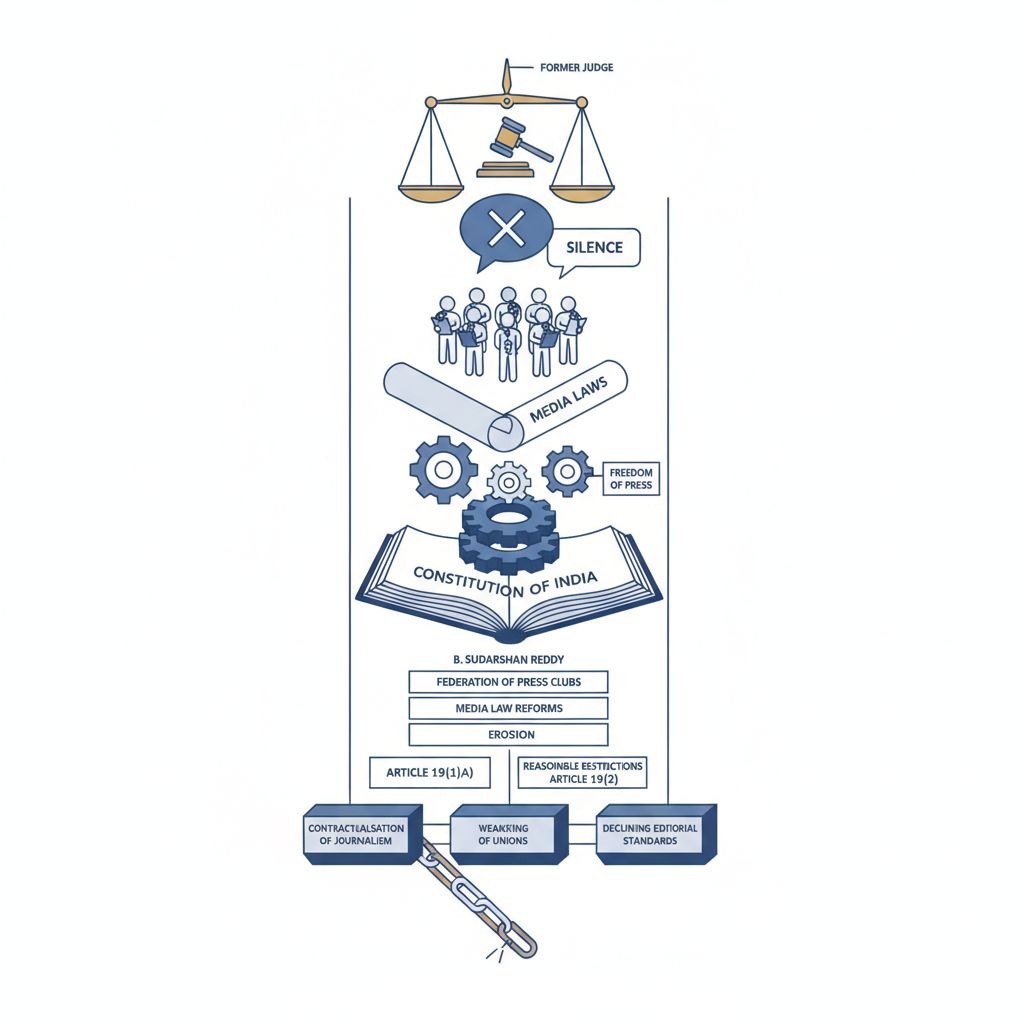
24 Aug Former SC Judge Warns on Media Laws: Why Journalists Must Act Now
✎ The constitutional guarantee of press freedom under Article 19(1)(a) is complemented by statutory bodies like the Press Council of India and self-regulatory mechanisms, but their effectiveness depends on robust enforcement and…
Subject Relevance — Where This Topic Fits
- GS Paper II — Polity and Governance: Fundamental Rights and DPSP | GS Paper III — Economy: Labour Reforms and Informalisation | GS Paper IV — Ethics: Role of Media in Democracy
- Prelims: Article 19(1)(a), Press Freedom, Media Council of India Bill, Contractualisation of Journalism, Unionisation of Media Workers
- Essay: The Role of Media in a Democracy: Challenges and Safeguards, Collective Action as a Tool for Safeguarding Constitutional Rights
Quick Revision: The constitutional guarantee of press freedom under Article 19(1)(a) is complemented by statutory bodies like the Press Council of India and self-regulatory mechanisms, but their effectiveness depends on robust enforcement and collective action by journalists.
Why is this in the news?
The remarks by former Supreme Court judge Justice B. Sudarshan Reddy at the Federation of Press Clubs’ national conclave in Hyderabad on 23 August 2026 underscore the growing concerns over the erosion of journalistic rights amid proposed media law reforms. The discussion highlighted the vulnerabilities of journalists, the need for constitutional safeguards beyond Article 19(1)(a), and the role of collective action in protecting media freedom. The event also reflected broader anxieties about the contractualisation of journalism, weakening of unions, and declining editorial standards.
Background
- The Constitution of India guarantees freedom of speech and expression under Article 19(1)(a), which includes the freedom of the press. However, this right is not absolute and is subject to reasonable restrictions under Article 19(2).
- The Indian media landscape has witnessed significant structural changes, including the rise of contractual employment, which has weakened job security and collective bargaining power among journalists.
- Recent debates on media regulation have centred around proposed legislative frameworks aimed at enhancing transparency and accountability in the media sector, though concerns persist regarding potential overreach or dilution of journalistic freedoms.
- The Union government has, at various times, introduced or proposed amendments to media-related laws, including the Press and Registration of Books Act, 1867, and the Cable Television Networks (Regulation) Act, 1995, which have sparked discussions on their impact on press freedom.
- The Federation of Press Clubs, as a representative body of journalists and media professionals, has been vocal about the need for self-regulation and collective action to safeguard the rights of media workers.
- The neoliberal economic policies of recent decades have contributed to the informalisation of labour, including in the media sector, leading to reduced job security and weakened institutional protections for journalists.
What are the constitutional and legal safeguards for journalists in India?
- Article 19(1)(a) of the Constitution guarantees the right to freedom of speech and expression, which encompasses the freedom of the press. This right is a cornerstone of democratic governance and enables the media to act as a watchdog.
- The Supreme Court of India, in landmark judgments such as Romesh Thappar v. State of Madras (1950) and Bennett Coleman & Co. v. Union of India (1973), has consistently upheld the freedom of the press, recognising its pivotal role in a democracy.
- The Press Council of India (PCI), established under the Press Council Act, 1978, is a statutory body tasked with preserving the freedom of the press and maintaining high standards of journalistic ethics. However, its effectiveness has been debated due to limited powers and funding constraints.
- The Right to Information (RTI) Act, 2005, empowers journalists to access information from public authorities, facilitating investigative journalism and holding the government accountable.
- The Protection of Journalists and Media Personnel Act, 2019 (draft), proposed by the Press Council of India, aims to provide legal protection to journalists facing threats or violence. However, its implementation remains pending.
- The Code of Ethics and Broadcasting Standards, issued by the News Broadcasters & Digital Association (NBDA) and the Indian Broadcasting Foundation (IBF), provides self-regulatory guidelines for television news channels, though compliance is voluntary.
- The Working Journalists and Other Newspaper Employees (Conditions of Service) and Miscellaneous Provisions Act, 1955, provides for the regulation of working conditions, wages, and social security for journalists, though its enforcement is often weak.
Key Features
| Feature | Significance |
|---|---|
| Constitutional guarantee of freedom of speech and expression (Article 19(1)(a)) | Forms the foundational legal basis for journalistic freedom in India, though its protection is not absolute and is subject to reasonable restrictions under Article 19(2). |
| Collective action by journalists | Emphasises the need for unified resistance against coercive state actions or economic policies that undermine journalistic autonomy and rights. |
| Media Transparency and Accountability Bill (proposed) | Aims to regulate media ownership, employment practices, and ethical standards, addressing concerns over contractualisation and weakening of trade unions in journalism. |
| Decline in journalistic standards | Highlights systemic issues such as sensationalism, lack of editorial independence, and erosion of professional ethics in news reporting. |
| Socio-economic and political conditions | Examines how neoliberal economic policies and structural inequalities impact the working conditions and security of journalists. |
UPSC Value Addition
Keywords for Mains Answer-Writing
Freedom of the Press · Article 19(1)(a) · Media regulation in India · Constitutional protection of journalists · Media Transparency and Accountability Bill · Collective bargaining rights of journalists · Judicial perspective on media freedom · Economic liberalisation and media vulnerability · Press freedom vs. state coercion · Role of unions in media industry
Prelims Practice Questions
Q1. Consider the following statements regarding the constitutional protection of freedom of speech and expression in India:
1. Article 19(1)(a) guarantees the freedom of speech and expression to all citizens.
2. The freedom under Article 19(1)(a) is absolute and cannot be restricted by any law.
3. The Supreme Court has held that the freedom of the press is not included within the ambit of Article 19(1)(a).
How many of the above statements are correct?
- Only one
- Only two
- All three
- None
Answer: Only one — Statement 1 is correct as Article 19(1)(a) guarantees freedom of speech and expression. Statement 2 is incorrect because the freedom is subject to reasonable restrictions under Article 19(2). Statement 3 is incorrect as the Supreme Court has consistently held that the freedom of the press is a subset of Article 19(1)(a).
Q2. Assertion (A): The Media Transparency and Accountability Bill, 2023, aims to regulate the ownership and funding of media organisations.
Reason (R): The Bill seeks to address concerns over the concentration of media ownership and its impact on journalistic independence.
Options:
A. Both A and R are true, and R is the correct explanation of A.
B. Both A and R are true, but R is not the correct explanation of A.
C. A is true, but R is false.
D. A is false, but R is true.
Answer: ? — The Media Transparency and Accountability Bill, 2023, does aim to regulate media ownership and funding to ensure transparency and accountability. The Bill addresses concerns over media concentration and its impact on journalistic independence, making both A and R true, with R correctly explaining A.
Q3. Match the following provisions with their respective constitutional articles:
Column I (Provision)
1. Freedom of speech and expression
2. Protection of life and personal liberty
3. Freedom of the press
4. Right to constitutional remedies
Column II (Article)
A. Article 21
B. Article 19(1)(a)
C. Article 32
D. Article 19(1)(a) (inclusive interpretation)
- 1-B, 2-A, 3-D, 4-C
- 1-A, 2-B, 3-C, 4-D
- 1-D, 2-A, 3-B, 4-C
- 1-C, 2-D, 3-A, 4-B
Answer: 1-B, 2-A, 3-D, 4-C — Freedom of speech and expression is guaranteed under Article 19(1)(a). Protection of life and personal liberty is under Article 21. Freedom of the press is an inclusive interpretation of Article 19(1)(a). Right to constitutional remedies is under Article 32.
Mains Practice Question
✍ Critically examine the constitutional and institutional safeguards for the freedom of the press in India. How far do these safeguards address the contemporary challenges faced by journalists, including economic vulnerabilities and state coercion? (15 Marks)
Approach: MODEL-ANSWER SKELETON:
1. Constitutional Basis:
– Article 19(1)(a) and its judicial interpretation (Romesh Thappar v. State of Madras, 1950; Sakal Papers v. Union of India, 1962).
– Inclusive interpretation of press freedom under Article 19(1)(a) (Bijoe Emmanuel v. State of Kerala, 1986).
2. Institutional Safeguards:
– Press Council of India (PCI) and its role under the Press Council Act, 1978.
– Protection of Journalists and Media Persons Act, 2017 (if applicable).
– Role of the Supreme Court in protecting press freedom (e.g., cases on gag orders, defamation laws).
3. Contemporary Challenges:
– Economic vulnerabilities: Contractualisation of journalism, weakening of unions (as highlighted by Hartosh Singh Bal).
– State coercion: Use of sedition laws, defamation suits, and regulatory overreach (e.g., IT Rules, 2021).
– Social and political divisions within the journalistic community.
4. Gaps and Recommendations:
– Need for a robust Media Transparency and Accountability framework.
– Strengthening collective bargaining rights and unionisation.
– Judicial activism in protecting journalists from coercion (e.g., Pegasus spyware case).
Balance of views: Acknowledge the state’s legitimate interest in regulating media (e.g., combating fake news) while critiquing overreach. Conclude with a reasoned position on balancing press freedom and regulatory necessity.
Source: The Hindu
Generated by AanyaAi for educational purpose.
Related guides on our sites
- Anthropology VS PSIR
- Best PSIR optional coaching
- Best PSIR optional coaching online
- Best PSIR optional teacher

- Madras HC Rules: Life Convicts Can Avail 40 Days Leave in Two Instalments - October 25, 2026
- तेलंगाना का नया एयरोस्पेस और रक्षा नीति 2.0: UPSC के लिए महत्वपूर्ण जानकारी - October 24, 2026
- Agricultural Biological Resources ABS Benefits ₹1.04 Crore for Biodiversity - October 24, 2026

No Comments