



12 Nov Fossil Fuel Emissions: Sustained Decline Needed for Climate
✎ A sustained decline in global fossil fuel emissions, coupled with the protection of carbon sinks and a just transition to renewable energy, is imperative to mitigate the escalating impacts of climate change.
Subject Relevance — Where This Topic Fits
- GS Paper I — Geography (Climatology) | GS Paper III — Environment and Ecology, Economy (Energy Sector) | GS Paper III — Science and Technology (Renewable Energy)
- Prelims: Global Carbon Budget, COP31, Greenhouse Gas Emissions, Fossil Fuels, Renewable Energy, Carbon Sinks, Just Transition, Discoms, El Niño, Climate Change
- Essay: The intricate balance between economic development and environmental sustainability., International cooperation and national responsibilities in addressing global climate change.
Quick Revision: A sustained decline in global fossil fuel emissions, coupled with the protection of carbon sinks and a just transition to renewable energy, is imperative to mitigate the escalating impacts of climate change.
Why is this in the news?
The latest Global Carbon Budget study, presented at COP31 in Antalya, Turkey, forecasts a marginal decline in global greenhouse gas emissions from fossil fuel burning for the current year compared to the previous year. This projected decrease is primarily attributed to geopolitical events, economic disruptions, and an expansion in renewable energy adoption. However, overall carbon emissions are projected to rise due to increasing emissions from deforestation and land-use changes, particularly in Southeast Asia, underscoring the necessity for sustained efforts towards decarbonisation.
Background
- The Earth’s climate system is experiencing unprecedented warming, primarily driven by anthropogenic greenhouse gas (GHG) emissions, leading to a range of extreme weather events and long-term environmental consequences.
- International efforts to address climate change are primarily coordinated through the United Nations Framework Convention on Climate Change (UNFCCC), with annual Conferences of the Parties (COPs) serving as key decision-making forums.
- The Paris Agreement, adopted at COP21 in 2015, established a global framework to limit global warming to well below 2 degrees Celsius, preferably to 1.5 degrees Celsius, compared to pre-industrial levels.
- Fossil fuels (coal, oil, and natural gas) remain the dominant source of global energy, contributing significantly to GHG emissions, despite the growing penetration of renewable energy sources.
- Carbon sinks, such as forests and oceans, play a crucial role in absorbing atmospheric carbon dioxide, but their capacity is being depleted by deforestation and land degradation.
- Developing nations, including India, face the dual challenge of meeting growing energy demands for economic development while simultaneously transitioning to a low-carbon economy.
Understanding Key Concepts in Climate Change Mitigation
- Global Carbon Budget: An annual assessment of the sources and sinks of carbon dioxide, providing critical insights into global carbon cycle dynamics and the trajectory of climate change.
- COP (Conference of the Parties): The supreme decision-making body of the UNFCCC, where nations convene to assess progress, negotiate agreements, and implement actions to combat climate change.
- Greenhouse Gas (GHG) Emissions: Gases in the Earth’s atmosphere that trap heat, leading to the greenhouse effect and global warming. Major GHGs include carbon dioxide (CO2), methane (CH4), and nitrous oxide (N2O).
- Fossil Fuels: Non-renewable energy sources formed from the remains of ancient organisms over millions of years, including coal, oil, and natural gas, which release significant CO2 upon combustion.
- Renewable Energy: Energy derived from natural processes that are continuously replenished, such as solar, wind, hydro, geothermal, and biomass energy, offering a sustainable alternative to fossil fuels.
- Carbon Sinks: Natural or artificial reservoirs that absorb and store carbon-containing chemical compounds, thereby removing carbon dioxide from the atmosphere. Examples include forests, oceans, and certain geological formations.
- Just Transition: A framework for ensuring that the shift to a low-carbon economy is conducted in a manner that is as fair and inclusive as possible to everyone concerned, creating decent work opportunities and leaving no one behind.
- Energy Transition: The global shift from fossil fuel-based energy systems to renewable energy sources, encompassing technological advancements, policy changes, and infrastructural development.
Key Features
| Feature | Significance |
|---|---|
| Projected Global Carbon Emissions 2026 | Expected to rise to 43.3 billion tonnes from 42.8 billion tonnes in 2025, indicating an overall increase despite some regional declines in fossil fuel emissions. |
| Fossil Fuel Emissions Decline (2026) | A slight decline is forecasted, primarily attributed to geopolitical factors (Iran war energy shock) and the expansion of renewable energy sources. |
| Historical Emission Declines | Previous drops in 1992, 1998, 2009, and 2020 (due to COVID-19) were temporary aberrations, not indicative of sustained decarbonisation. |
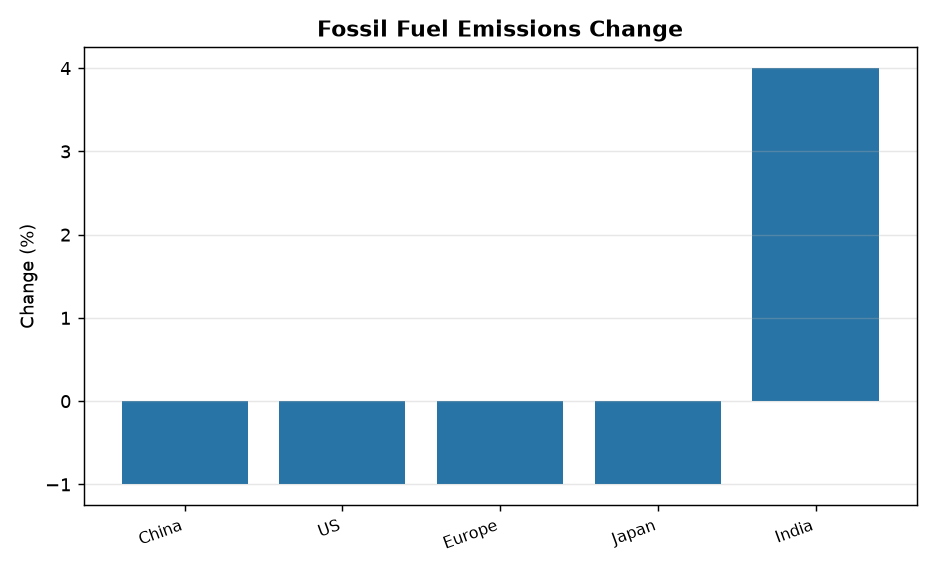
| Regional Emission Trends | China, the US, Europe, and Japan are projected to experience declines in fossil fuel emissions, while India is expected to see a rise of over 4%. |
| Offsetting Emissions | The projected decline in fossil fuel emissions is counteracted by increasing emissions from deforestation and land-use changes, particularly in Southeast Asia. |
| Role of COP31 | The conference in Antalya is tasked with charting a pathway for a just transition away from fossil fuels and addressing the depletion of carbon sinks. |
Why it Matters
Environmental Implications
- The overall increase in total carbon emissions despite a slight fossil fuel reduction underscores the persistent challenge of global warming and extreme weather events.
- Rising emissions from deforestation and land-use changes highlight the critical importance of protecting natural carbon sinks to achieve climate targets.
- The ‘Super El Niño’ exacerbating peat fires signifies a feedback loop where climate change impacts further contribute to emissions.
Economic and Energy Transition
- The temporary nature of past emission drops, linked to economic disruptions, emphasises the need for structural shifts towards sustainable energy systems.
- The growing economic favourability of renewables, compared to previous periods, presents an opportunity for accelerated green energy adoption.
- Addressing the financial health of discoms is crucial for upgrading grid infrastructure and facilitating optimal integration of renewable energy sources, impacting energy security and economic stability.
International Relations and Governance
- COP31’s mandate to chart a ‘just transition’ pathway reflects the complex socio-economic considerations involved in decarbonisation for developing nations.
- The divergent emission trends among major economies (e.g., India’s increase vs. China’s decline) highlight the differentiated responsibilities and challenges in global climate action.
- The need to halt carbon sink depletion underscores the importance of international cooperation on land management and forest conservation policies.
Challenges
1. Ensuring Sustained Emission Decline
- Past emission reductions have been temporary, often linked to economic shocks, indicating a lack of fundamental systemic change.
- Achieving sustained decline requires comprehensive policy interventions beyond short-term economic fluctuations.
UPSC Link: Environmental Pollution & Degradation
2. India’s Rising Emissions
- Despite impressive growth in renewable energy capacity, India’s fossil fuel emissions are projected to increase by over 4%.
- This trend poses a significant challenge to national and global climate goals, requiring intensified decarbonisation efforts.
UPSC Link: Conservation, Environmental Pollution
3. Renewable Energy Infrastructure Gaps
- Storage shortfalls and inadequate grid infrastructure hinder the optimal utilisation of abundant renewable energy generation.
- This limits the effective integration of green energy into the national power system, leading to energy waste and continued reliance on fossil fuels.
UPSC Link: Infrastructure: Energy
4. Financial Health of Discoms
- Poor financial health of electricity distribution companies (discoms) impedes their ability to invest in infrastructure upgrades necessary for renewable energy integration.
- Funding deficits constrain the modernisation of the power sector, slowing down the green transition.
UPSC Link: Infrastructure: Energy
5. Depletion of Carbon Sinks
- Rising emissions from deforestation and land-use changes, particularly in Southeast Asia, offset gains from reduced fossil fuel emissions.
- This highlights the dual challenge of reducing emissions from sources and protecting natural sinks to achieve net-zero targets.
UPSC Link: Conservation, Environmental Impact Assessment
Challenges — UPSC Perspective
| Issue | Concern |
|---|---|
| Temporary Emission Drops | Historical declines in emissions have been aberrations, not sustained trends, indicating a lack of fundamental structural change in energy systems. |
| India’s Emission Trajectory | India’s projected increase in fossil fuel emissions contrasts with declines in other major economies, posing a significant challenge to its climate commitments. |
| Renewable Energy Integration | Inadequate energy storage and grid infrastructure limit the effective utilisation of generated renewable energy, leading to inefficiencies. |
| Discom Financial Viability | The poor financial health of electricity distribution companies hinders investment in critical infrastructure for renewable energy integration. |
| Carbon Sink Degradation | Emissions from deforestation and land-use changes undermine efforts to reduce fossil fuel emissions, necessitating comprehensive land management strategies. |
| Just Transition Pathway | Developing a globally equitable and socially acceptable transition away from fossil fuels, particularly for developing nations, presents complex policy challenges. |
Way Forward
- Implement robust policy frameworks to ensure a sustained, rather than episodic, decline in fossil fuel emissions, decoupling economic growth from carbon intensity.
- Accelerate investment in grid modernisation and advanced energy storage solutions to enhance the integration and optimal utilisation of renewable energy.
- Address the structural financial issues of electricity distribution companies (discoms) through reforms and targeted funding to enable infrastructure upgrades for green energy.
- Strengthen national and international efforts to halt deforestation and reverse land degradation, thereby protecting and enhancing natural carbon sinks.
- Promote research and development in carbon capture, utilisation, and storage (CCUS) technologies to mitigate emissions from hard-to-abate sectors.
- Develop and implement a ‘just transition’ framework that supports workers and communities reliant on fossil fuel industries in shifting to green economies.
- Enhance international cooperation and technology transfer to facilitate the adoption of clean energy technologies and sustainable land-use practices globally.
UPSC Value Addition
Keywords for Mains Answer-Writing
Climate Change Mitigation · Global Carbon Budget · Fossil Fuel Emissions · Renewable Energy Transition · Carbon Sinks Depletion · Just Transition · Energy Infrastructure · Discom Financial Health · COP31 Outcomes · Sustainable Development Goals · Climate Finance · National Determined Contributions
Concept Flow
Geopolitical events/economic disruptions lead to temporary reduction in fossil fuel use. → Expansion of wind and solar power contributes to some emission declines. → Inadequate grid infrastructure and storage limit optimal renewable energy utilisation. → Financial constraints of discoms hinder investment in green energy integration. → Deforestation and land-use changes increase overall carbon emissions, offsetting fossil fuel reductions. → Total global carbon emissions continue to rise, exacerbating climate change impacts. → COP31 aims to chart a just transition and halt carbon sink depletion.
Prelims Practice Questions
Q1. Consider the following statements regarding global carbon emissions and climate change mitigation efforts:
1. The Global Carbon Budget study presented at COP31 forecasts a slight decline in greenhouse gas emissions from fossil-fuel burning for the current year compared to the previous year.
2. Geopolitical upheavals and economic disruptions have historically led to sustained, long-term declines in fossil-fuel use.
3. India is projected to see a significant decline in its fossil fuel emissions this year, similar to China and the US.
4. Deforestation and land-use changes are contributing to an overall increase in total carbon emissions, despite some reductions in fossil fuel emissions.
How many of the above statements are correct?
- Only one
- Only two
- Only three
- All four
Answer: Only two — Statement 1 is correct: The Global Carbon Budget study forecasts a slight decline in GHG emissions from fossil-fuel burning this year compared to 2025. Statement 2 is incorrect: Historical instances of reduced fossil-fuel use due to geopolitical events or economic disruptions (e.g., 1992, 1998, 2009, 2020) remained single-year aberrations, not sustained declines. Statement 3 is incorrect: India is projected to see an increase of more than 4% in its fossil fuel emissions, unlike China and the US which are projected to see declines. Statement 4 is correct: The projected decline in fossil-fuel emissions will be offset by rising emissions from deforestation and land-use changes, leading to an overall increase in total carbon emissions.
Q2. Which of the following factors primarily hinders the optimal utilisation of India’s installed renewable energy capacity?
- Lack of sufficient renewable energy generation potential.
- Absence of government subsidies for renewable energy projects.
- Storage shortfalls and inadequate grid infrastructure.
- Over-reliance on nuclear power generation.
Answer: Storage shortfalls and inadequate grid infrastructure. — The optimal utilisation of India’s impressive growth in installed renewable energy capacity is primarily hindered by storage shortfalls and inadequate grid infrastructure. This leads to situations where abundant energy generated from solar and wind cannot be effectively used or stored when nature is not enabling continuous generation. The poor financial health of discoms further exacerbates the issue by limiting their ability to upgrade infrastructure for renewable energy integration.
Mains Practice Question
✍ Despite significant strides in renewable energy capacity, India faces challenges in achieving a sustained decline in fossil fuel emissions. Critically examine the underlying structural issues impeding India’s green energy transition and suggest policy measures for a ‘just transition’. (15 Marks)
Approach: MODEL-ANSWER SKELETON:
1. Introduction: Briefly acknowledge India’s renewable energy growth and the paradox of rising fossil fuel emissions, referencing the Global Carbon Budget study.
2. Structural Issues Impeding Green Transition:
a. Storage Shortfalls: Inability to store surplus renewable energy for consistent supply.
b. Inadequate Grid Infrastructure: Limitations in transmitting and distributing renewable energy efficiently.
c. Discom Financial Health: Poor financial state of distribution companies hindering infrastructure upgrades and renewable energy integration.
d. Energy Demand Growth: Rapid economic growth leading to increased overall energy demand, often met by fossil fuels.
e. Dependence on Coal: Continued reliance on coal for base-load power generation.
f. Land-use Changes and Deforestation: Contribution to overall emissions, offsetting gains from renewable energy.
3. Policy Measures for a ‘Just Transition’:
a. Grid Modernisation and Smart Grids: Investment in advanced transmission and distribution networks capable of handling intermittent renewable energy.
b. Energy Storage Solutions: Promotion of battery storage, pumped hydro, and other storage technologies.
c. Discom Reforms: Financial restructuring, tariff rationalisation, and performance-linked incentives for discoms to invest in green infrastructure.
d. Green Hydrogen Mission: Development of green hydrogen as a clean fuel for hard-to-abate sectors.
e. Carbon Pricing and Trading: Implementation of mechanisms to internalise the cost of carbon emissions.
f. Skill Development and Livelihood Support: Programmes for workers in fossil fuel industries to transition to green jobs.
g. Climate Finance: Mobilisation of domestic and international finance for renewable energy projects and transition costs.
h. Afforestation and Reforestation: Initiatives to enhance carbon sinks, such as the National Afforestation Programme.
i. International Cooperation: Engagement in forums like COP31 to secure technology transfer and financial support.
4. Conclusion: Reiterate the imperative for a holistic approach combining technological advancements, financial reforms, and social equity to ensure a sustainable and just energy transition for India.
Source: The Indian Express
Generated by AanyaAi for educational purpose.
Related guides on our sites
- How to prepare for GS paper 1 for UPSC CSE mains exam
- Best UPSC coaching for IFOS exam
- Best geography optional coaching
- Best geography optional coaching

- Uttarakhand’s Nanda Gaura Yojana: Application Deadline & New Scheme - November 12, 2026
- वायु गुणवत्ता आयोग का पराली जलाने वाले खेतों के ऑडिट का निर्देश - November 12, 2026
- Odisha’s Cyclone Arnab & Flood Restoration: UPSC Geography - November 12, 2026

No Comments