


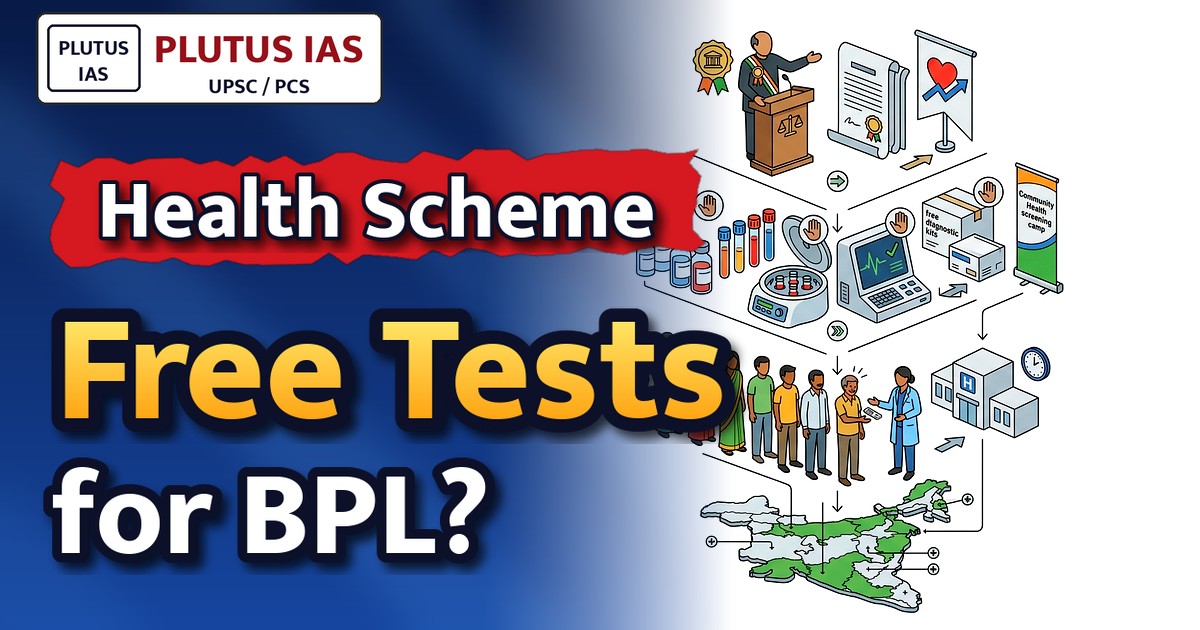
30 Sep Free Heart Attack Detection Tests for BPL Families: Health Minister Announces Initiative
✎ The Troponin T test is a highly sensitive biomarker for the early detection of acute myocardial infarction, and its inclusion in public health screening programmes can significantly reduce cardiovascular mortality.
Subject Relevance — Where This Topic Fits
- GS Paper II — Governance, Welfare Schemes for Vulnerable Sections | GS Paper III — Issues Relating to Development and Management of Social Sector/Services relating to Health
- Prelims: Troponin T test, Ayushman Bharat, National Health Mission, Non-Communicable Diseases, Universal Health Coverage, Basic Life Support (BLS), Sree Chitra Tirunal Institute for Medical Sciences and Technology (SCTIMST), World Heart Day
- Essay: The Imperative of Preventive Healthcare in India: Bridging Access and Affordability, Public Health Infrastructure and the Right to Health: Challenges and Opportunities
Quick Revision: The Troponin T test is a highly sensitive biomarker for the early detection of acute myocardial infarction, and its inclusion in public health screening programmes can significantly reduce cardiovascular mortality.
Why is this in the news?
The announcement of free Troponin T tests for Below Poverty Line (BPL) individuals by Health Minister K. Muraleedharan, during the inauguration of World Heart Day celebrations at the Sree Chitra Tirunal Institute for Medical Sciences and Technology (SCTIMST), underscores the government’s focus on early detection of cardiovascular diseases. This initiative aligns with broader public health strategies to reduce the burden of non-communicable diseases (NCDs) through accessible diagnostic tools and community-based screening programmes.
Background
- Cardiovascular diseases (CVDs) account for approximately 28.1% of all deaths in India, making them the leading cause of mortality (Global Burden of Disease Study, 2019).
- The Government of India has prioritised NCDs under the National Health Mission (NHM) and the Ayushman Bharat scheme, with a focus on preventive and promotive healthcare.
- The Troponin T test is a biochemical marker used for the early diagnosis of acute myocardial infarction (heart attack), offering higher sensitivity than conventional ECG in certain cases.
- The Sree Chitra Tirunal Institute for Medical Sciences and Technology (SCTIMST), Thiruvananthapuram, is an autonomous institution under the Department of Science and Technology, Government of India, specialising in advanced medical research and technology.
- World Heart Day, observed annually on September 29, is a global campaign aimed at raising awareness about cardiovascular health and the prevention of heart diseases.
- Public health infrastructure in India faces challenges in equitable access to diagnostic services, particularly for economically disadvantaged populations.
What is the Troponin T Test and its Role in Cardiovascular Health?
- The Troponin T test is a blood test that measures the levels of cardiac troponin T, a protein released into the bloodstream when heart muscle cells are damaged, typically during a heart attack.
- Unlike an Electrocardiogram (ECG), which may not always detect acute myocardial infarction immediately, the Troponin T test provides a more sensitive and specific indication of myocardial injury within hours of symptom onset.
- Early detection of heart attacks is critical to reducing mortality and morbidity, as timely medical intervention can prevent irreversible damage to the heart muscle.
- The test is particularly useful in asymptomatic individuals or those with atypical symptoms, where conventional diagnostic methods may be inconclusive.
- The Government of India’s initiative to provide free Troponin T tests for BPL individuals aims to enhance early diagnosis and reduce the financial burden on vulnerable populations.
- This initiative complements existing public health programmes such as the Ayushman Bharat Health and Wellness Centres (AB-HWCs), which provide comprehensive primary healthcare services.
- The role of institutions like SCTIMST in developing and disseminating advanced diagnostic tools is pivotal in strengthening India’s healthcare infrastructure.
- Community-based screening programmes, including medical camps, are essential for reaching underserved populations and ensuring equitable access to diagnostic services.
Key Features
| Feature | Significance |
|---|---|
| Free Troponin T tests for BPL category | Ensures early detection of myocardial infarction by measuring cardiac troponin levels, a biomarker released during heart muscle damage, thereby reducing mortality through timely intervention. |
| Government-led medical camps for marginalised sections | Enhances accessibility and affordability of cardiac screening for economically disadvantaged groups, addressing disparities in healthcare access. |
| Prohibition on commissions for medicine procurement | Prevents exploitation of public funds in the supply chain, ensuring cost-effective distribution of essential cardiac medications. |
| Basic Life Support (BLS) training for school students | Empowers younger populations with life-saving skills to respond to cardiac emergencies, fostering a culture of preparedness and community resilience. |
| Public awareness campaigns on cardiovascular health | Promotes preventive healthcare practices, early symptom recognition, and lifestyle modifications to reduce the burden of heart diseases. |
Why it Matters
Public Health Impact
- Reduces the incidence of undetected myocardial infarctions by enabling early diagnosis through Troponin T testing, a critical determinant of survival in acute coronary syndromes.
- Bridges the healthcare access gap for Below Poverty Line (BPL) populations, aligning with Sustainable Development Goal 3 (Good Health and Well-being) targets.
- Demonstrates a proactive approach to non-communicable disease (NCD) management, particularly relevant given India’s high cardiovascular disease burden (30% of total deaths, per WHO estimates).
Policy and Governance
- Illustrates the integration of preventive healthcare into public health policy, complementing existing initiatives like the National Programme for Prevention and Control of Cancer, Diabetes, Cardiovascular Diseases and Stroke (NPCDCS).
- Highlights the role of tertiary institutions (e.g., Sree Chitra Tirunal Institute for Medical Sciences and Technology) in public health outreach, reinforcing the need for academic-government collaboration.
- Emphasises the importance of regulatory oversight in healthcare procurement to prevent malpractices, aligning with the principles of the Clinical Establishments Act, 2010.
Societal and Educational
- Promotes health literacy among school students through structured programmes, fostering long-term behavioural changes in diet, exercise, and emergency response.
- Encourages community participation in health screening, leveraging localised medical camps to decentralise healthcare delivery.
- Demonstrates the use of public platforms (e.g., World Heart Day) to amplify health messaging, aligning with the WHO’s global campaign for cardiovascular disease awareness.
Challenges
1. Equitable Distribution of Diagnostic Services
- Ensuring uniform availability of Troponin T tests across rural and remote regions, where healthcare infrastructure remains underdeveloped.
- Preventing over-reliance on tertiary care centres, which may exacerbate urban-rural disparities in healthcare access.
UPSC Link: GS2: Health Infrastructure
2. Sustainability of Free Screening Programmes
- Managing the fiscal burden of subsidised diagnostics and medications, particularly in resource-constrained states.
- Balancing immediate screening needs with long-term investments in primary healthcare to reduce dependency on secondary/tertiary care.
UPSC Link: GS2: Public Health
3. Public Awareness and Behavioural Adoption
- Overcoming scepticism or lack of trust in government-led health programmes among marginalised communities.
- Ensuring sustained engagement with health camps and preventive measures beyond initial awareness drives.
UPSC Link: GS2: Social Sector
4. Regulatory and Ethical Oversight
- Monitoring compliance with anti-commission norms in medicine procurement to prevent leakage of public funds.
- Addressing potential conflicts of interest in partnerships with private healthcare providers conducting medical camps.
UPSC Link: GS2: Governance
5. Integration with Existing Health Systems
- Aligning free cardiac screening with existing NCD programmes (e.g., NPCDCS) to avoid duplication or fragmentation of services.
- Ensuring seamless referral pathways for patients requiring further intervention post-screening.
UPSC Link: GS2: Health Policy
Challenges — UPSC Perspective
| Issue | Concern |
|---|---|
| Geographical disparities | Limited access to diagnostic facilities in rural and tribal areas despite free testing provisions. |
| Supply chain vulnerabilities | Risk of stockouts or delays in procuring Troponin T test kits and essential medications. |
| Human resource constraints | Shortage of trained personnel to conduct tests and interpret results in medical camps. |
| Data privacy concerns | Need for secure digital records of health data, particularly for BPL beneficiaries. |
| Cultural barriers | Reluctance among certain communities to participate in medical camps due to stigma or misconceptions about heart disease. |
Government Initiatives — Must-Memorise for Prelims
- National Programme for Prevention and Control of Cancer, Diabetes, Cardiovascular Diseases and Stroke (NPCDCS)
Way Forward
- Strengthen primary healthcare centres (PHCs) with point-of-care Troponin T testing facilities to decentralise diagnostic services.
- Establish a real-time monitoring system for tracking the utilisation and impact of free cardiac screening programmes.
- Expand Basic Life Support (BLS) training to include teachers, ASHA workers, and local leaders for broader community reach.
- Collaborate with non-governmental organisations (NGOs) to conduct awareness campaigns in regional languages and dialects.
- Develop a grievance redressal mechanism for beneficiaries to report issues in service delivery or procurement malpractices.
- Integrate cardiac screening with existing maternal and child health programmes to maximise outreach in vulnerable populations.
- Conduct periodic audits of medical camp operations to ensure compliance with anti-commission norms and service quality standards.
- Promote research on cost-effective diagnostic tools and indigenous manufacturing of Troponin T test kits to reduce dependency on imports.
UPSC Value Addition
Keywords for Mains Answer-Writing
Cardiovascular Diseases (CVDs) · Universal Health Coverage (UHC) · Ayushman Bharat Health Infrastructure Mission (AB-HIM) · National Health Mission (NHM) · Public Health System · Poverty and Health Inequities · Preventive Healthcare · Troponin T Test · Non-Communicable Diseases (NCDs) · Health System Strengthening · Primary Healthcare · Early Diagnosis and Screening · Medical Camps · Government Health Schemes · Health Financing · Cardiac Care Infrastructure · World Heart Day · Sree Chitra Tirunal Institute for Medical Sciences and Technology (SCTIMST)
Constitutional & Policy Linkages
- Article 21: Right to Health (interpreted as part of the Right to Life)
- Article 47: Duty of the State to improve public health
Concept Flow
Rising cardiovascular disease burden → Government announces free Troponin T tests for BPL category → Implementation via medical camps → Early detection of myocardial infarction → Timely medical intervention → Reduced mortality and morbidity → Public health outreach (World Heart Day) → Awareness campaigns → Behavioural change in diet/exercise → Prevention of heart disease → Basic Life Support training for students → Community resilience in emergencies → Improved survival rates in cardiac arrests → Prohibition on commissions in medicine procurement → Efficient fund utilisation → Enhanced availability of free medications → Collaboration between SCTIMST and government → Leveraging tertiary expertise for public health → Scalable model for other NCDs
Prelims Practice Questions
Q1. Consider the following statements regarding the Troponin T test:
1. It is a biomarker test used to detect heart muscle damage.
2. It is primarily used to diagnose bacterial infections.
3. Elevated troponin levels indicate a higher risk of heart attack.
4. It is a cost-effective screening tool for early detection of cardiovascular diseases.
How many of the above statements are correct?
- Only one
- Only two
- Only three
- All
Answer: All — Statements 1, 3, and 4 are correct. Statement 2 is incorrect as the Troponin T test is not used to diagnose bacterial infections.
Q2. Assertion (A): The Ayushman Bharat Health Infrastructure Mission (AB-HIM) aims to strengthen primary, secondary, and tertiary healthcare systems across India.
Reason (R): AB-HIM includes provisions for setting up medical colleges and nursing colleges in underserved regions to address healthcare workforce shortages.
Options:
A. Both A and R are true, and R is the correct explanation of A.
B. Both A and R are true, but R is not the correct explanation of A.
C. A is true, but R is false.
D. A is false, but R is true.
Answer: ? — Both the assertion and reason are true, and the reason correctly explains the assertion as AB-HIM is designed to enhance healthcare infrastructure, including medical education institutions.
Q3. Match the following health initiatives with their primary objectives:
Column I (Initiative)
A. Ayushman Bharat Pradhan Mantri Jan Arogya Yojana (AB-PMJAY)
B. National Health Mission (NHM)
C. Ayushman Bharat Health Infrastructure Mission (AB-HIM)
D. Pradhan Mantri Swasthya Suraksha Yojana (PMSSY)
Column II (Objective)
1. Providing financial protection for secondary and tertiary care hospitalization to the poor and vulnerable.
2. Strengthening primary healthcare through sub-centres, primary health centres, and community health centres.
3. Establishing new AIIMS and upgrading existing government medical colleges.
4. Enhancing health infrastructure for primary, secondary, and tertiary care, including medical education institutions.
Options:
A. A-1, B-2, C-4, D-3
B. A-2, B-1, C-3, D-4
C. A-3, B-4, C-1, D-2
D. A-4, B-3, C-2, D-1
Answer: ? — The correct match is: A-1 (AB-PMJAY provides financial protection), B-2 (NHM strengthens primary healthcare), C-4 (AB-HIM enhances health infrastructure), D-3 (PMSSY establishes new AIIMS and upgrades medical colleges).
Mains Practice Question
✍ The provision of free Troponin T tests for early detection of heart attacks among Below Poverty Line (BPL) populations represents a critical intervention in India’s public health strategy. Critically examine the significance of such preventive healthcare measures in addressing the burden of Non-Communicable Diseases (NCDs) like cardiovascular diseases. Also, analyse the challenges in scaling up such initiatives across India’s diverse healthcare landscape. (15 Marks)
Approach: MODEL-ANSWER SKELETON:
1. **Introduction (2 Marks)**: Define NCDs and their burden in India (e.g., WHO data: ~5.8 million deaths annually, 28% of total mortality). State the role of preventive healthcare in reducing NCD burden.
2. **Significance of Free Troponin T Tests (5 Marks)**:
– Early detection reduces mortality and morbidity by enabling timely intervention.
– Addresses inequities by providing affordable access to advanced diagnostics for BPL populations.
– Aligns with Universal Health Coverage (UHC) and Sustainable Development Goal 3.4.
– Reduces long-term healthcare costs by preventing complications.
– Complements existing schemes like Ayushman Bharat (AB-PMJAY) and National Health Mission (NHM).
3. **Challenges in Scaling Up (5 Marks)**:
– **Infrastructure gaps**: Limited number of diagnostic centres in rural and remote areas.
– **Workforce shortages**: Inadequate number of cardiologists and trained technicians.
– **Financial constraints**: High cost of Troponin T tests and maintenance of diagnostic equipment.
– **Geographical disparities**: Urban-rural divide in healthcare access.
– **Awareness and participation**: Low health literacy and hesitancy in availing medical camps.
– **Supply chain issues**: Procurement and distribution of diagnostic kits.
4. **Way Forward (3 Marks)**:
– Strengthen primary healthcare through Ayushman Bharat Health Infrastructure Mission (AB-HIM).
– Leverage telemedicine and mobile health units for remote diagnostics.
– Public-private partnerships to expand diagnostic infrastructure.
– Community engagement and awareness campaigns.
– Integration with existing health schemes like Ayushman Bharat Digital Mission (ABDM).
Source: The Hindu
Generated by AanyaAi for educational purpose.
Related guides on our sites
- Best sociology optional coaching for upsc
- Which is best sociology optional coaching for upsc
- UPSC EPFO Test series
- Best teacher of sociology optional for upsc

- Supreme Court to Hear Plea Against CEC’s Suspension & SIR Validity - September 30, 2026
- पश्चिम बंगाल में परिवहन सुधार: AI सिग्नलिंग, ट्राम पुनरुद्धार और जल टैक्सी की योजना - September 30, 2026
- Supreme Court to get 3rd Woman Judge: Sunita Agarwal’s SC Appointment Soon - September 30, 2026

No Comments