


08 Aug FYUGP Review Panel Recommends Uniform Academic Framework for Universities
✎ The FYUGP review panel’s interim report underscores the critical need for an Inter-University Board of Studies Committee to standardise curricula, internships, and evaluation mechanisms, ensuring uniformity in higher education…
Subject Relevance — Where This Topic Fits
- GS Paper II — Governance, Administration and Challenges (Higher Education Reforms) | GS Paper IV — Ethics, Integrity and Aptitude (Quality Assurance in Education)
- Prelims: Four-Year Undergraduate Programme (FYUGP), Outcome-Based Education (OBE), Inter-University Board of Studies Committee, Kerala State Higher Education Council, National Education Policy (NEP) 2020
- Essay: The Role of Uniformity in Higher Education: Balancing Autonomy and Standardisation, Transforming Indian Education: From Fragmentation to Coherence
Quick Revision: The FYUGP review panel’s interim report underscores the critical need for an Inter-University Board of Studies Committee to standardise curricula, internships, and evaluation mechanisms, ensuring uniformity in higher education reforms aligned with NEP 2020.
Why is this in the news?
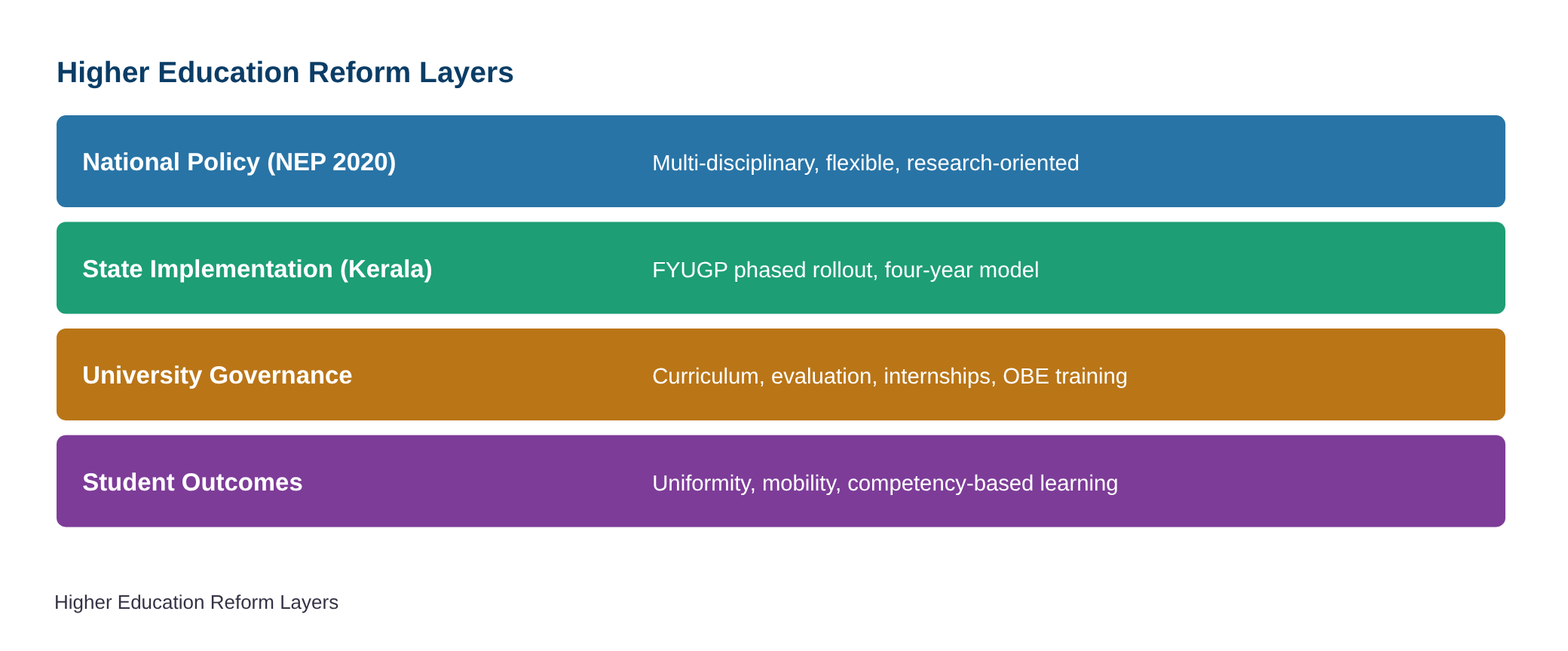
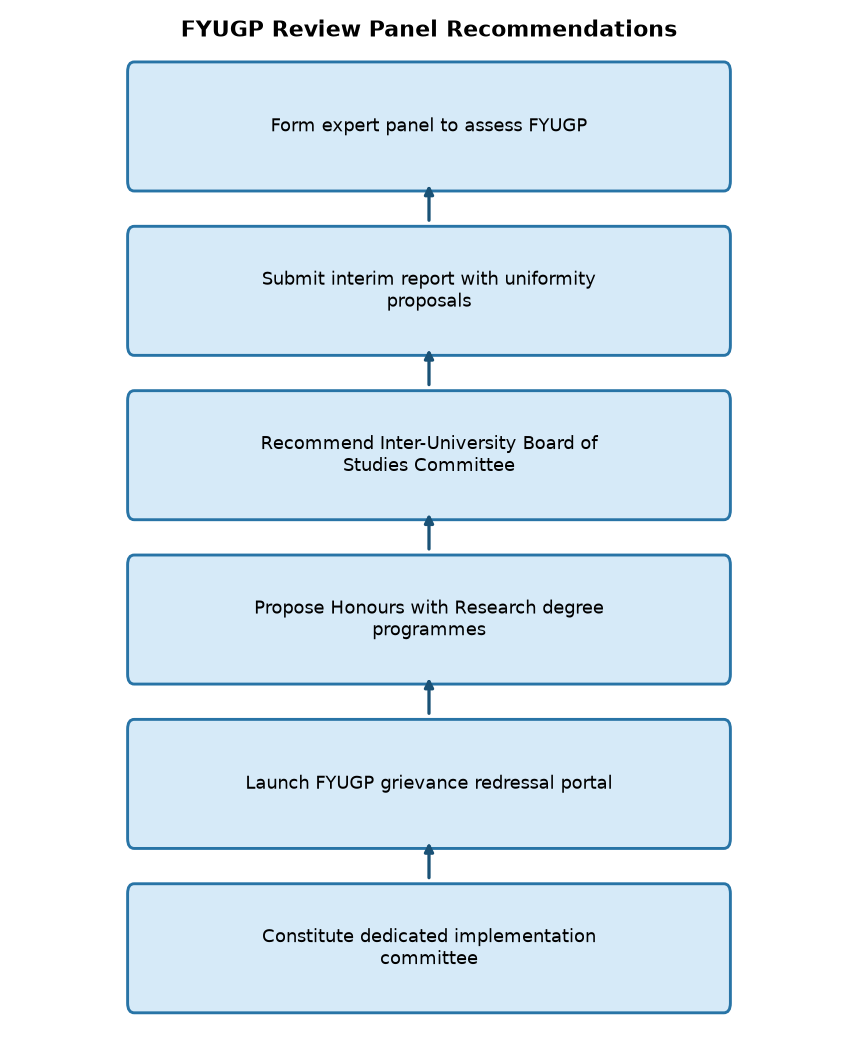
The interim report of the FYUGP review panel underscores the necessity for a uniform academic framework across universities to address inconsistencies in the implementation of the Four-Year Undergraduate Programme (FYUGP). The panel’s recommendations—ranging from the establishment of an Inter-University Board of Studies Committee to teacher training in Outcome-Based Education (OBE)—highlight systemic challenges in higher education governance, including curricular uniformity, internship mechanisms, and evaluation standards. This development is significant as it aligns with broader national efforts to reform higher education under the National Education Policy (NEP) 2020, while also reflecting regional initiatives in Kerala to enhance educational quality and student mobility.
Background
- The Four-Year Undergraduate Programme (FYUGP) was introduced in Kerala as part of a phased implementation of the National Education Policy (NEP) 2020, which advocates for a multi-disciplinary, flexible, and research-oriented undergraduate education system.
- The FYUGP framework aims to replace the traditional three-year degree structure with a four-year model, incorporating foundational, major, minor, and vocational courses, along with research components in the honours stream.
- Kerala’s adoption of FYUGP was accompanied by challenges such as uneven implementation across universities, disparities in curriculum design, and inconsistencies in evaluation and internship mechanisms.
- The expert committee was constituted by the Kerala State Higher Education Council to assess the progress and effectiveness of FYUGP, with a mandate to recommend measures for uniformity and quality enhancement.
- The NEP 2020 emphasises the need for standardisation in higher education to ensure comparability of degrees, promote student mobility, and align with global academic practices.
- The panel’s interim report reflects a growing recognition of the need for regulatory oversight to address fragmentation in higher education governance, particularly in states implementing NEP-aligned reforms.
What is the Four-Year Undergraduate Programme (FYUGP)?
- The FYUGP is a structured four-year undergraduate programme designed to provide a holistic, multi-disciplinary education, integrating foundational, disciplinary, and vocational learning with research components.
- The programme is divided into multiple exit options: a certificate after one year, a diploma after two years, a bachelor’s degree after three years, and an honours degree (with or without research) after four years.
- The honours with research component is intended for students demonstrating academic excellence and research aptitude, requiring a dissertation or project under faculty supervision.
- The FYUGP framework aligns with the NEP 2020’s emphasis on flexibility, mobility, and skill development, enabling students to choose interdisciplinary combinations and vocational courses.
- The programme mandates internships, community engagement, and project-based learning to enhance employability and practical exposure, though implementation has varied across institutions.
- Evaluation in FYUGP is outcome-based, focusing on continuous assessment, project work, and competency-based criteria rather than rote memorisation.
- The FYUGP’s implementation requires significant faculty training, particularly in Outcome-Based Education (OBE), to ensure consistent assessment and learning outcomes.
- The programme’s success depends on robust institutional support, including research facilities, qualified faculty, and administrative coordination to address implementation challenges.
Key Features
| Feature | Significance |
|---|---|
| Uniform academic framework | Ensures consistency in curricula, evaluation, and internship standards across universities, reducing disparities in higher education quality. |
| Inter-University Board of Studies Committee | Acts as a regulatory body to harmonise academic policies, examination formats, and credit systems among institutions. |
| Teacher training on Outcome-Based Education (OBE) | Enhances pedagogical skills to align teaching with measurable learning outcomes, improving student performance and employability. |
| FYUGP grievance redressal portal | Provides a structured mechanism for students to report issues, ensuring accountability and timely resolution in programme implementation. |
| Honours with Research degree programmes | Encourages research culture in undergraduate studies by allowing departments with requisite facilities to offer advanced research-oriented degrees. |
Why it Matters
Educational Reforms
- Standardises academic structures, addressing fragmentation in higher education and promoting uniformity in learning outcomes.
- Facilitates student mobility across universities by harmonising credit systems and evaluation criteria.
- Strengthens research integration in undergraduate programmes, aligning with global higher education trends.
Pedagogical Advancement
- Mandates Outcome-Based Education (OBE) training for faculty, shifting focus from rote learning to competency development.
- Encourages experiential learning through structured internships and research opportunities, enhancing skill acquisition.
Administrative Efficiency
- Introduces a centralised grievance redressal mechanism, improving transparency and responsiveness in programme administration.
- Establishes a dedicated committee to address implementation challenges, ensuring smoother rollout of FYUGP.
Challenges
1. Implementation Uniformity
- Achieving consistency in curricula and evaluation across diverse universities with varying resource capacities.
- Ensuring equitable access to internship opportunities and research facilities for all students.
UPSC Link: GS2: Higher Education
2. Faculty Preparedness
- Training a large cadre of faculty in Outcome-Based Education (OBE) methodologies within constrained timelines.
- Addressing resistance to pedagogical changes among educators accustomed to traditional teaching methods.
UPSC Link: GS2: Teacher Training
3. Resource Allocation
- Providing adequate infrastructure and funding for universities to meet the uniform framework’s requirements.
- Balancing the introduction of Honours with Research programmes without overburdening existing departments.
UPSC Link: GS2: Public Expenditure
4. Student Mobility and Equity
- Ensuring scholarship benefits for fourth-year students are accessible and sufficient to support their academic progress.
- Preventing disparities in internship quality and research opportunities across different socio-economic backgrounds.
UPSC Link: GS2: Social Justice
Challenges — UPSC Perspective
| Issue | Concern |
|---|---|
| Curriculum Standardisation | Diverse academic cultures and resource constraints may hinder uniform adoption of frameworks. |
| Faculty Training Gaps | Large-scale OBE training requires time, funding, and institutional buy-in, posing logistical challenges. |
| Infrastructure Deficits | Universities lacking research facilities or qualified faculty may struggle to offer Honours with Research programmes. |
| Internship Accessibility | Ensuring equitable internship opportunities across regions and disciplines remains a persistent challenge. |
| Grievance Redressal Efficiency | A centralised portal’s effectiveness depends on robust monitoring and responsive administrative mechanisms. |
Way Forward
- Establish the Inter-University Board of Studies Committee with representation from central and state universities to oversee implementation.
- Develop a phased teacher-training programme in Outcome-Based Education (OBE), leveraging digital platforms for scalability.
- Allocate dedicated funds for infrastructure development in universities to support Honours with Research programmes.
- Create a national internship portal with industry partnerships to ensure equitable access and quality assurance.
- Launch a scholarship scheme specifically for fourth-year students under FYUGP, with transparent eligibility criteria.
- Conduct periodic audits of universities to assess compliance with the uniform academic framework and address deviations.
- Promote student exchange programmes to enhance mobility and exposure to diverse academic environments.
UPSC Value Addition
Keywords for Mains Answer-Writing
Four-Year Undergraduate Programme (FYUGP) · Inter-University Board of Studies Committee · Outcome-Based Education (OBE) · University Grants Commission (UGC) · Kerala State Higher Education Council · Academic uniformity in higher education · Internship mechanisms and evaluation standards · Teacher training for OBE · Honours with Research degree programmes · Student grievance redressal portals
Concept Flow
FYUGP Implementation → Recognition of disparities in academic standards → Formation of review panel → Interim report with recommendations → Proposal for uniform academic framework → Formation of Inter-University Board → Standardisation of curricula and evaluation → Enhanced student mobility and research culture.
Prelims Practice Questions
Q1. Consider the following statements regarding the Four-Year Undergraduate Programme (FYUGP) in India:
1. The FYUGP is currently implemented uniformly across all Indian universities.
2. The FYUGP review panel has recommended the formation of an Inter-University Board of Studies Committee to ensure uniformity in curricula.
3. The panel has proposed permitting teaching departments with adequate research facilities to introduce Honours with Research degree programmes.
How many of the above statements are correct?
- Only one
- Only two
- Only three
- None
Answer: Only two — Statement 1 is incorrect as FYUGP is not uniformly implemented across all universities. Statements 2 and 3 are correct as per the interim report submitted by the FYUGP review panel.
Q2. Assertion (A): The FYUGP review panel has recommended extensive training for teachers on Outcome-Based Education (OBE).
Reason (R): OBE is designed to ensure that students achieve specific learning outcomes rather than merely completing a course.
In the context of the above two statements, which one of the following is correct?
- Both A and R are true, and R is the correct explanation of A.
- Both A and R are true, but R is not the correct explanation of A.
- A is true, but R is false.
- A is false, but R is true.
Answer: Both A and R are true, and R is the correct explanation of A. — Both A and R are true, and R correctly explains A. The panel’s recommendation for teacher training on OBE aligns with the goal of achieving specific learning outcomes.
Q3. Which of the following is NOT a recommendation of the FYUGP review panel as per the interim report?
A. Formation of an Inter-University Board of Studies Committee
B. Uniform academic framework across universities
C. Abolition of the FYUGP in all universities
D. Launching an FYUGP grievance redressal portal for students
- A
- B
- C
- D
Answer: C — The FYUGP review panel has not recommended the abolition of FYUGP. Instead, it has proposed improvements and uniformity in its implementation.
Mains Practice Question
✍ Critically examine the need for a uniform academic framework in higher education, with reference to the recommendations of the FYUGP review panel. Also, analyse the challenges in implementing such a framework across diverse universities in India. (15 Marks)
Approach: MODEL-ANSWER SKELETON:
1. Introduction: Define FYUGP and its objectives; highlight the interim report’s key recommendations (Inter-University Board of Studies Committee, OBE training, Honours with Research programmes, grievance redressal portal).
2. Need for Uniformity: Discuss the rationale behind uniformity—standardisation of curricula, internship mechanisms, examination methods, and evaluation standards. Cite the UGC’s role in promoting uniformity and the challenges posed by diverse state-level higher education policies.
3. Challenges in Implementation:
– Institutional diversity: Varied infrastructure, faculty capacity, and research facilities across universities.
– Resistance to change: Faculty and student adaptation to OBE and new evaluation methods.
– Resource constraints: Training teachers, improving internship portals, and setting up grievance redressal mechanisms.
– Federalism: Balancing centralised uniformity with state-level autonomy in higher education.
4. Comparative Perspective: Reference Kerala’s FYUGP implementation as a case study; contrast with other states’ approaches.
5. Conclusion: Weigh the benefits of uniformity against the challenges; suggest a phased implementation strategy with adequate support for universities.
Source: The Hindu
Generated by AanyaAi for educational purpose.

- KWML’s Feasibility Reports for Water Metro in 18 Cities: UPSC & PCS Insights - October 3, 2026
- ओडिशा में वन्यजीव अनुसंधान अनुदान कार्यक्रम शुरू, सिमिलिपाल में 300 कैमरे और बढ़ेंगे - October 3, 2026
- India Summons Pakistan High Commission Official Over Violation - October 3, 2026

No Comments