


01 Aug G20 Health Ministers Back WHO Investment Round for Global Health Funding
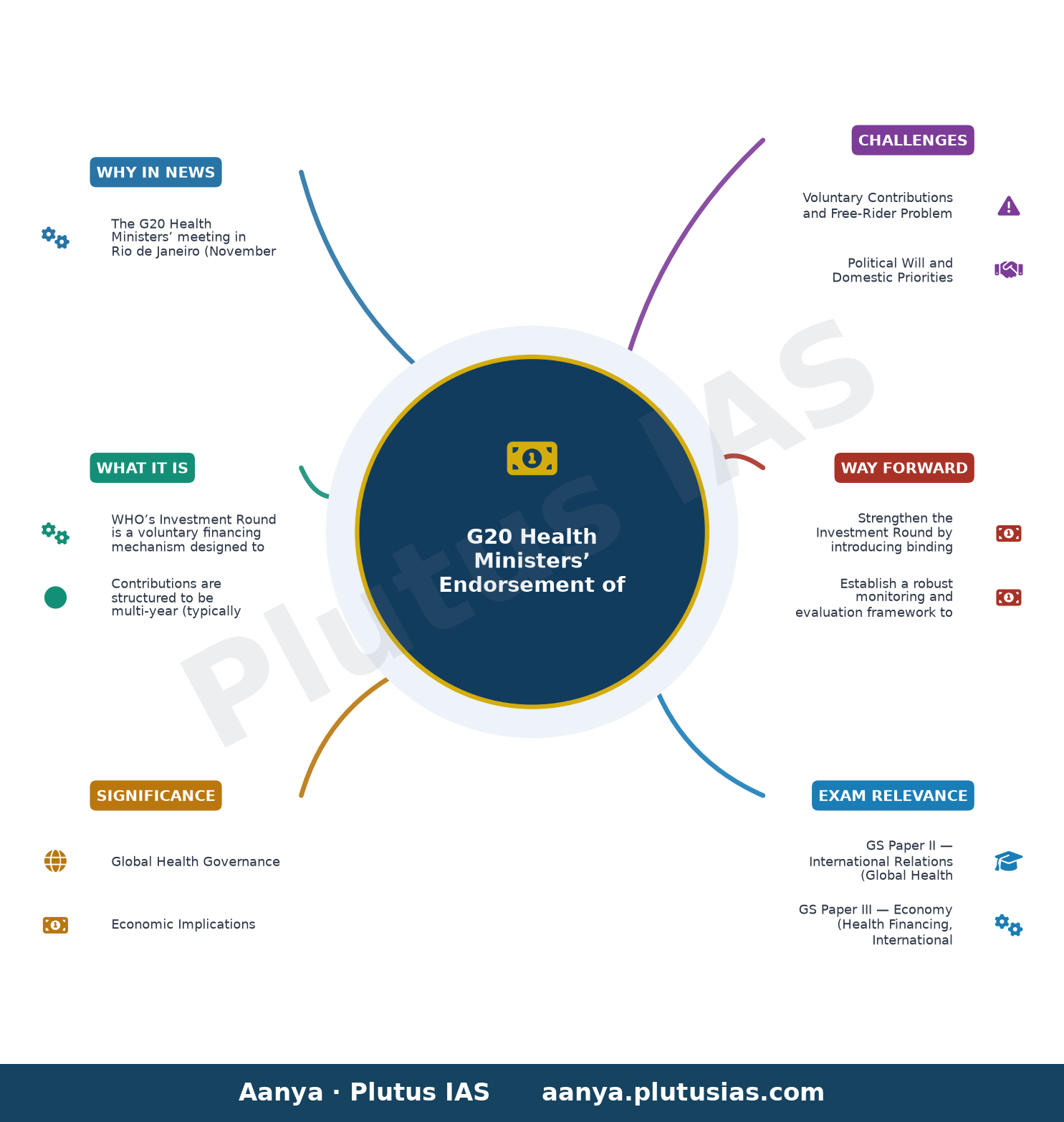
✎ WHO’s Investment Round is a voluntary, multi-year financing mechanism designed to secure predictable and flexible contributions to fund the organisation’s core priorities under GPW 14.
Subject Relevance — Where This Topic Fits
- GS Paper II — International Relations (Global Health Governance, WHO Reform) | GS Paper III — Economy (Health Financing, International Development Cooperation)
- Prelims: WHO Investment Round, G20 Health Ministers’ Meeting, Global Health Security, Sustainable Development Goal 3 (SDG 3), WHO’s 14th General Programme of Work (GPW 14), Voluntary Contributions to WHO, Predictable and Flexible Financing, Global Health Architecture
- Essay: The role of multilateral institutions in addressing global health crises, Sustainable financing mechanisms for public goods: WHO’s Investment Round as a case study
Quick Revision: WHO’s Investment Round is a voluntary, multi-year financing mechanism designed to secure predictable and flexible contributions to fund the organisation’s core priorities under GPW 14.
Why is this in the news?
The G20 Health Ministers’ meeting in Rio de Janeiro (November 2024) has catalysed political momentum for WHO’s Investment Round, a voluntary financing mechanism aimed at securing predictable and flexible resources for the organisation’s 14th General Programme of Work (GPW 14). The endorsement by G20 members, including commitments from South Africa for its 2025 presidency, underscores the criticality of sustainable financing in addressing global health disparities and pandemic preparedness.
Background
- The World Health Organization (WHO), established in 1948, operates primarily through assessed contributions (member dues) and voluntary contributions (donor funding), with the latter accounting for over 80% of its budget, making financial sustainability a persistent challenge.
- The COVID-19 pandemic exposed structural vulnerabilities in global health governance, highlighting the need for robust, predictable financing mechanisms to support WHO’s core functions, including disease surveillance, emergency response, and health system strengthening.
- WHO’s 14th General Programme of Work (GPW 14, 2025–2030) sets ambitious targets, including saving 40 million lives and improving the health of billions, necessitating a significant scaling up of financial resources.
- The Investment Round, launched in 2024, is WHO’s first-ever voluntary financing initiative designed to secure multi-year, flexible contributions from member states and partners, complementing traditional funding models.
- The G20, representing 80% of global GDP and 60% of the world’s population, plays a pivotal role in shaping global health financing, given its influence over major economies and multilateral institutions.
- South Africa’s commitment to advance WHO’s sustainable financing agenda during its 2025 G20 presidency signals continuity in global health diplomacy, following Brazil’s leadership in 2024.
What is WHO’s Investment Round?
- WHO’s Investment Round is a voluntary financing mechanism designed to secure predictable, flexible, and multi-year contributions from member states, philanthropic organisations, and private sector partners to fund the organisation’s core priorities under GPW 14.
- Contributions are structured to be multi-year (typically 3–5 years), providing WHO with financial stability to plan long-term programmes, such as pandemic preparedness, antimicrobial resistance (AMR) control, and universal health coverage (UHC) support.
- The Investment Round complements existing WHO funding streams, including assessed contributions (member dues) and earmarked voluntary contributions, by introducing a new category of unearmarked, flexible funding.
- Key thematic priorities for funding under the Investment Round include: strengthening health systems, accelerating progress on SDG 3 (Good Health and Well-being), enhancing global health security, and addressing health inequities.
- The mechanism aligns with WHO’s broader reform agenda, which seeks to enhance transparency, accountability, and efficiency in resource mobilisation and utilisation.
- Pledges to the Investment Round are voluntary and non-binding, but the G20’s endorsement signals political commitment, increasing the likelihood of broader participation from high-income and emerging economies.
- The Investment Round is distinct from WHO’s traditional funding appeals (e.g., the Contingency Fund for Emergencies) by focusing on sustainable, core financing rather than emergency response.
Key Features
| Feature | Significance |
|---|---|
| WHO’s Investment Round | A voluntary funding mechanism to mobilise predictable and flexible financial contributions from Member States and partners for WHO’s strategic priorities. |
| G20 Health Ministers’ Meeting (Rio de Janeiro, 1 Nov 2024) | A high-level platform where G20 health ministers endorsed WHO’s Investment Round and called for broader participation ahead of the G20 Leaders’ Summit. |
| Pledge Mechanism | Encourages first-time voluntary contributors, including low- and middle-income countries, to participate in WHO’s sustainable financing. |
| Predictable and Flexible Funding | Emphasises the need for long-term, adaptable financial commitments to enhance WHO’s operational resilience and strategic agility. |
| G20 Leaders’ Summit (18-19 Nov 2024) | A critical forum for securing additional pledges from G20 members and global partners to bolster WHO’s financial sustainability. |
Why it Matters
Global Health Governance
- WHO’s Investment Round represents a paradigm shift from episodic funding to a structured, long-term financing model for global health security.
- Strengthens multilateral health governance by aligning national contributions with WHO’s strategic priorities, including pandemic preparedness and universal health coverage.
- Enhances the agency’s ability to respond to emerging health threats, such as antimicrobial resistance and climate-sensitive diseases, through sustained funding.
- Promotes equitable health financing by encouraging contributions from diverse regions, including Africa and South-East Asia, which have historically been underrepresented.
Economic Implications
- Predictable funding reduces WHO’s reliance on unpredictable voluntary contributions, improving financial planning and programme implementation.
- Investments in global health yield high economic returns by preventing disease outbreaks, reducing healthcare costs, and enhancing workforce productivity.
- Supports low- and middle-income countries in building resilient health systems, thereby reducing the economic burden of health crises on their populations.
- Encourages private-sector and philanthropic engagement, diversifying WHO’s funding base beyond traditional donor countries.
Geopolitical Dynamics
- Demonstrates G20’s commitment to multilateralism in health governance, reinforcing the bloc’s role as a leader in global health diplomacy.
- Highlights South Africa’s proactive role in advancing WHO’s sustainable financing agenda during its upcoming G20 presidency, aligning with its domestic health priorities.
- Reflects a growing consensus among major economies on the need for collective action to address transnational health challenges, such as pandemics and antimicrobial resistance.
- Underscores the importance of South-South cooperation in global health financing, with contributions from Türkiye, Singapore, and African nations.
Operational Resilience of WHO
- Enables WHO to scale up emergency response capabilities, including stockpiling of medical countermeasures and rapid deployment of health workers.
- Facilitates long-term investments in health infrastructure, such as laboratories, surveillance systems, and primary healthcare facilities.
- Supports WHO’s strategic initiatives, including the 10-year plan for ending tuberculosis, malaria elimination, and the Global Strategy on Digital Health.
- Improves WHO’s ability to monitor and evaluate health outcomes, ensuring accountability and transparency in fund utilisation.
Challenges
1. Voluntary Contributions and Free-Rider Problem
- WHO’s reliance on voluntary contributions creates unpredictability in funding, complicating long-term planning and programme continuity.
- Risk of free-riding, where some Member States benefit from WHO’s initiatives without contributing proportionally to its financing.
- Ensuring equitable burden-sharing among high-income, middle-income, and low-income countries remains a persistent challenge.
- The absence of binding commitments may lead to underfunding of critical health programmes, particularly in vulnerable regions.
UPSC Link: GS II: International Organisations
2. Political Will and Domestic Priorities
- Domestic political priorities in G20 countries may divert attention and resources away from global health commitments.
- Economic downturns or competing fiscal demands could reduce the willingness of Member States to pledge additional funds to WHO.
- Lack of alignment between national health policies and WHO’s strategic priorities may hinder effective utilisation of pledged funds.
- Geopolitical tensions or shifting alliances could undermine collective action on global health financing.
UPSC Link: GS II: International Relations
3. Sustainability and Predictability of Funding
- Ensuring that pledged funds are disbursed in a timely and predictable manner remains a significant operational challenge for WHO.
- The need for flexible funding to address emerging health threats may conflict with the requirement for long-term financial commitments.
- Balancing the allocation of funds between emergency response and long-term health system strengthening is a complex task.
- The risk of fund fragmentation, where contributions are earmarked for specific programmes rather than pooled for strategic use, could dilute impact.
UPSC Link: GS II: Health
4. Equitable Access and Regional Disparities
- Ensuring that funds reach the most vulnerable populations, particularly in low-income countries and conflict-affected regions, is a persistent challenge.
- Regional disparities in health infrastructure and capacity may lead to uneven utilisation of WHO’s resources across different geographies.
- The need to address health inequities requires targeted funding mechanisms, which may not be prioritised by all contributing Member States.
- Cultural and linguistic barriers in low-resource settings can impede the effective deployment of WHO’s programmes and funds.
UPSC Link: GS II: Health
5. Accountability and Transparency
- Ensuring transparency in the utilisation of WHO’s funds is critical to maintaining donor confidence and public trust.
- The lack of a robust monitoring and evaluation framework for the Investment Round may hinder accountability and impact assessment.
- Potential for misallocation or corruption in fund utilisation, particularly in countries with weak governance structures.
- The need for independent audits and third-party evaluations to ensure that funds are used for their intended purposes.
UPSC Link: GS II: Governance
Challenges — UPSC Perspective
| Issue | Concern |
|---|---|
| Voluntary Contributions | Lack of binding commitments may lead to underfunding and unpredictability in WHO’s financial resources. |
| Free-Rider Problem | Non-contributing or under-contributing Member States may benefit from WHO’s initiatives without sharing the financial burden. |
| Political Will | Domestic priorities and geopolitical tensions may reduce the willingness of Member States to pledge additional funds. |
| Fund Utilisation | Ensuring timely and equitable disbursement of funds, particularly in low-resource settings, remains a challenge. |
| Accountability | The absence of a robust monitoring and evaluation framework may hinder transparency and impact assessment of WHO’s programmes. |
| Regional Disparities | Uneven health infrastructure and capacity across regions may lead to disparities in the utilisation of WHO’s resources. |
Way Forward
- Strengthen the Investment Round by introducing binding financial commitments for Member States, particularly G20 countries, to ensure predictable and long-term funding.
- Establish a robust monitoring and evaluation framework to track the utilisation of pledged funds and assess their impact on global health outcomes.
- Enhance transparency in WHO’s financial operations by publishing detailed reports on fund allocation, disbursement, and utilisation for public scrutiny.
- Promote South-South cooperation by encouraging contributions from middle-income countries and facilitating knowledge-sharing on health financing models.
- Develop targeted funding mechanisms to address health inequities, ensuring that vulnerable populations in low-income and conflict-affected regions receive adequate support.
- Align national health policies with WHO’s strategic priorities to ensure that pledged funds are utilised effectively and in line with global health goals.
- Encourage private-sector and philanthropic engagement by creating incentives for corporate social responsibility initiatives in global health financing.
- Foster multilateral dialogue on global health financing to address geopolitical tensions and align national priorities with collective health security objectives.
UPSC Value Addition
Keywords for Mains Answer-Writing
WHO Investment Round · G20 Health Ministers’ Meeting · Global health financing · sustainable financing of WHO · predictable and flexible funding mechanisms · G20 Leaders’ Summit 2024 · Brazil’s G20 presidency · South Africa’s G20 agenda · WHO’s 13th General Programme of Work (GPW 13) · multilateral health governance · voluntary contributions to WHO · health equity and universal health coverage (UHC) · global health security architecture · WHO financing reforms
Concept Flow
G20 Health Ministers’ Meeting endorses WHO’s Investment Round → → G20 Leaders’ Summit secures additional pledges from Member States and partners → → Predictable and flexible funding enhances WHO’s operational resilience and strategic agility → → WHO scales up emergency response capabilities and long-term health system strengthening → → Improved global health security and equitable access to healthcare for vulnerable populations → → Sustainable financing model reinforces multilateral health governance and collective action on transnational health challenges → → Strengthened WHO as a central actor in global health governance, enabling it to address emerging health threats and achieve universal health coverage.
Prelims Practice Questions
Q1. Consider the following statements regarding the WHO Investment Round:
1. The WHO Investment Round aims to fund the WHO’s 13th General Programme of Work (GPW 13).
2. The Investment Round seeks to mobilise predictable and flexible funding for the WHO.
3. South Africa has pledged to continue advancing WHO’s sustainable financing journey during its upcoming G20 presidency.
How many of the above statements are correct?
- Only one
- Only two
- All three
- None
Answer: All three — Statements 1 and 2 are correct as the WHO Investment Round is designed to fund the WHO’s GPW 13 and seeks predictable, flexible funding. Statement 3 is also correct as South Africa has committed to advancing WHO’s sustainable financing during its G20 presidency.
Q2. Assertion (A): The WHO Investment Round is a mechanism to secure voluntary contributions from Member States and partners to fund the WHO’s strategic priorities.
Reason (R): The WHO relies solely on assessed contributions from Member States for its operational budget and does not accept voluntary contributions.
In the context of the above two statements, which one of the following is correct?
- Both A and R are true, and R is the correct explanation of A
- Both A and R are true, but R is not the correct explanation of A
- A is true, but R is false
- A is false, but R is true
Answer: A is true, but R is false — Assertion (A) is true as the WHO Investment Round seeks voluntary contributions. Reason (R) is false because the WHO’s budget comprises both assessed contributions and voluntary contributions.
Q3. Match the following G20 initiatives with their respective objectives:
Column I (Initiative) | Column II (Objective)
— | —
1. WHO Investment Round | A. Strengthening global health security
2. G20 Health and Finance Ministers’ Track | B. Mobilising predictable and flexible funding for WHO
3. Global Fund to Fight AIDS, Tuberculosis and Malaria | C. Coordinating health and economic policies during crises
4. COVAX Facility | D. Ensuring equitable access to COVID-19 vaccines
Select the correct match:
- 1-B, 2-C, 3-A, 4-D
- 1-A, 2-B, 3-C, 4-D
- 1-D, 2-C, 3-B, 4-A
- 1-B, 2-A, 3-D, 4-C
Answer: 1-B, 2-C, 3-A, 4-D — 1-B: The WHO Investment Round aims to mobilise predictable and flexible funding for WHO. 2-C: The G20 Health and Finance Ministers’ Track coordinates health and economic policies during crises. 3-A: The Global Fund to Fight AIDS, Tuberculosis and Malaria strengthens global health security. 4-D: The COVAX Facility ensures equitable access to COVID-19 vaccines.
Mains Practice Question
✍ The World Health Organization’s (WHO) Investment Round represents a paradigm shift in global health financing by prioritising predictable and flexible funding. Critically examine the significance of this initiative for advancing universal health coverage (UHC) and global health security. Also, analyse the challenges in ensuring sustained political and financial commitment from Member States. (15 Marks)
Approach: MODEL-ANSWER SKELETON:
1. **Introduction (2 marks)**
– Define the WHO Investment Round: voluntary, predictable, and flexible funding mechanism to support WHO’s 13th General Programme of Work (GPW 13).
– Context: WHO’s budget relies on assessed contributions (20%) and voluntary contributions (80%), leading to funding volatility.
– Objective: Mobilise USD 1 billion+ in pledges to fund GPW 13, aiming to save 40 million lives and improve health outcomes globally.
2. **Significance for UHC and Global Health Security (5 marks)**
– **Universal Health Coverage (UHC):**
– WHO’s GPW 13 aligns with SDG 3.8 (UHC) by strengthening health systems, primary healthcare, and pandemic preparedness.
– Predictable funding enables long-term planning for health workforce, infrastructure, and essential medicines (reference: WHO’s Health Financing Strategy 2023-2030).
– **Global Health Security:**
– Flexible funding supports rapid response to health emergencies (e.g., pandemics, antimicrobial resistance) by reducing bureaucratic delays.
– Strengthens the WHO’s role as the coordinating authority under the International Health Regulations (IHR, 2005).
– Enhances equity by prioritising low- and middle-income countries (LMICs) with limited domestic resources.
3. **Challenges in Sustained Commitment (5 marks)**
– **Political Will:**
– G20’s voluntary nature risks uneven pledges; historical precedents show inconsistent follow-through (e.g., 2022 COVID-19 response funding gaps).
– Geopolitical tensions may divert focus from global health priorities (e.g., trade-offs between health and security spending).
– **Financial Sustainability:**
– Over-reliance on voluntary contributions creates unpredictability; assessed contributions remain capped at 22% of total budget.
– Burden-sharing: High-income countries (HICs) may prioritise domestic health crises over global commitments.
– **Institutional Reforms:**
– Need for transparent accountability mechanisms to track pledges and disbursements (reference: WHO’s Independent Panel for Pandemic Preparedness and Response recommendations).
– Alignment with existing mechanisms (e.g., Global Fund, COVAX) to avoid duplication and inefficiencies.
4. **Way Forward (3 marks)**
– **Strengthening Commitments:**
– Institutionalise predictable funding through multi-year pledges (e.g., G20’s 2024 Leaders’ Summit outcome).
– Leverage South-South cooperation and regional blocs (e.g., African Union, ASEAN) to mobilise contributions.
– **Reforms in WHO Financing:**
– Expand the base of assessed contributions or introduce innovative financing (e.g., financial transaction taxes, health levies on carbon emissions).
– Enhance transparency in fund utilisation to build donor confidence.
– **Role of Civil Society and Media:**
– Advocacy to highlight the ROI of global health investments (e.g., economic returns of USD 1 invested in health = USD 3-6 in productivity gains).
**Balanced View:**
– Acknowledge the initiative’s potential while critiquing its limitations (e.g., lack of binding commitments, donor fatigue).
– Highlight successful precedents (e.g., GAVI’s Advance Market Commitments) as models for scaling up.
Source: who.int
Generated by AanyaAi for educational purpose.

- महाराष्ट्र में त्योहार जुलूसों पर बॉम्बे हाईकोर्ट का बड़ा फैसला: पटाखे, लेजर और संगीत पर रोक - September 24, 2026
- Bombay HC Bans Firecrackers, Music in Maharashtra Processions: Key UPSC Analysis - September 24, 2026
- तमिलनाडु में महिला कर्मचारियों के लिए सवैतनिक माहवारी अवकाश नीति पर HC का आदेश - September 24, 2026

No Comments