


06 Aug Gaganyaan Mission 2026: Key Milestones & Human Spaceflight Roadmap Unveiled
✎ The Gaganyaan mission’s success will mark India’s entry into the elite club of nations capable of human spaceflight, with the first crewed flight targeted for 2027, preceded by uncrewed missions and the deployment of Vyommitra in…
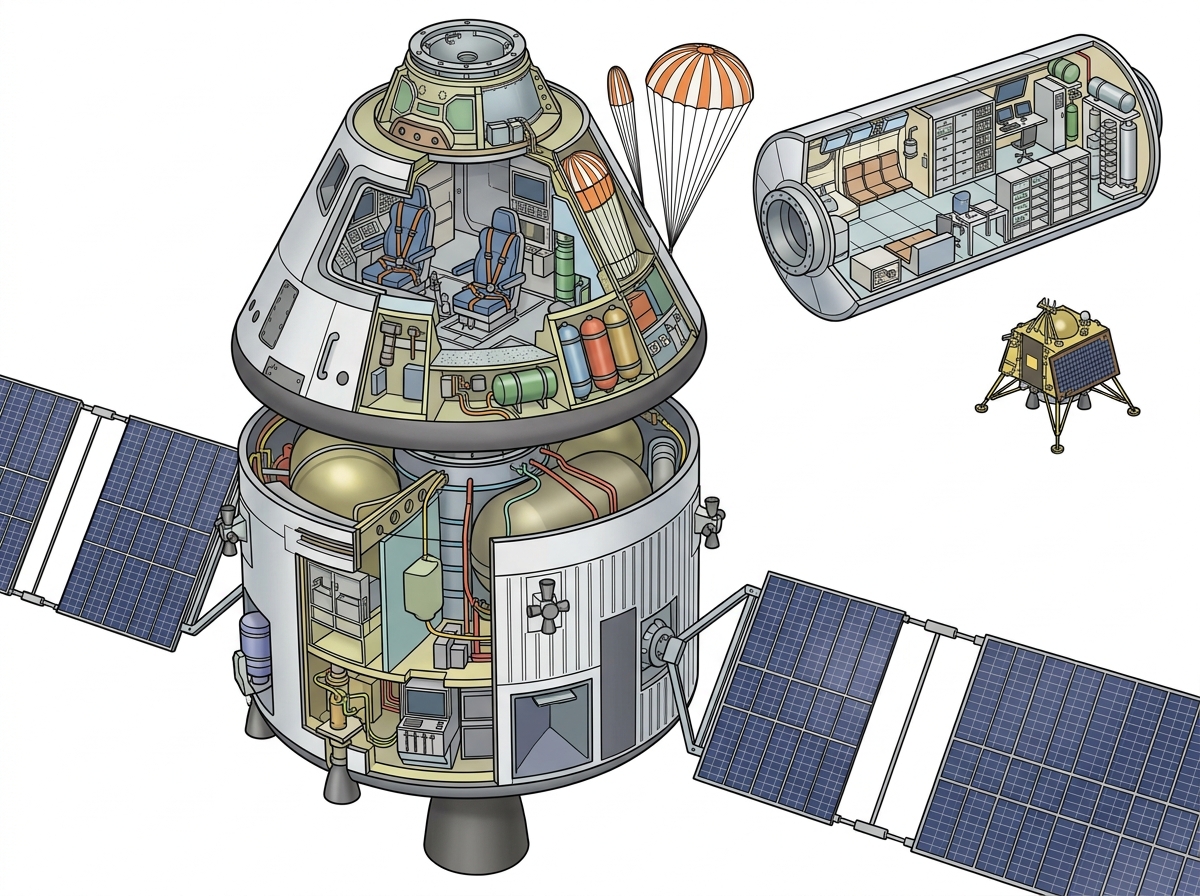 Crew moduleCrew escape systemPropulsion system
Subject Relevance — Where This Topic Fits
- GS Paper III — Science and Technology (Space Technology, Indigenous Innovation)
- Prelims: Gaganyaan Mission, Human-rated Launch Vehicle (HLVM3), Vyommitra, Indian Space Station (BAS), Crew Escape System (CES), Environmental Control and Life Support System (ECLSS), Integrated Air Drop Tests (IADT), ISRO’s Gaganyaan Programme Budget (₹20,193 crore)
- Essay: India’s Ascent as a Spacefaring Nation: Technological Sovereignty and Global Leadership, Balancing Human Exploration with Societal Development: The Case of India’s Space Programme
Quick Revision: The Gaganyaan mission’s success will mark India’s entry into the elite club of nations capable of human spaceflight, with the first crewed flight targeted for 2027, preceded by uncrewed missions and the deployment of Vyommitra in late 2026.
Why is this in the news?
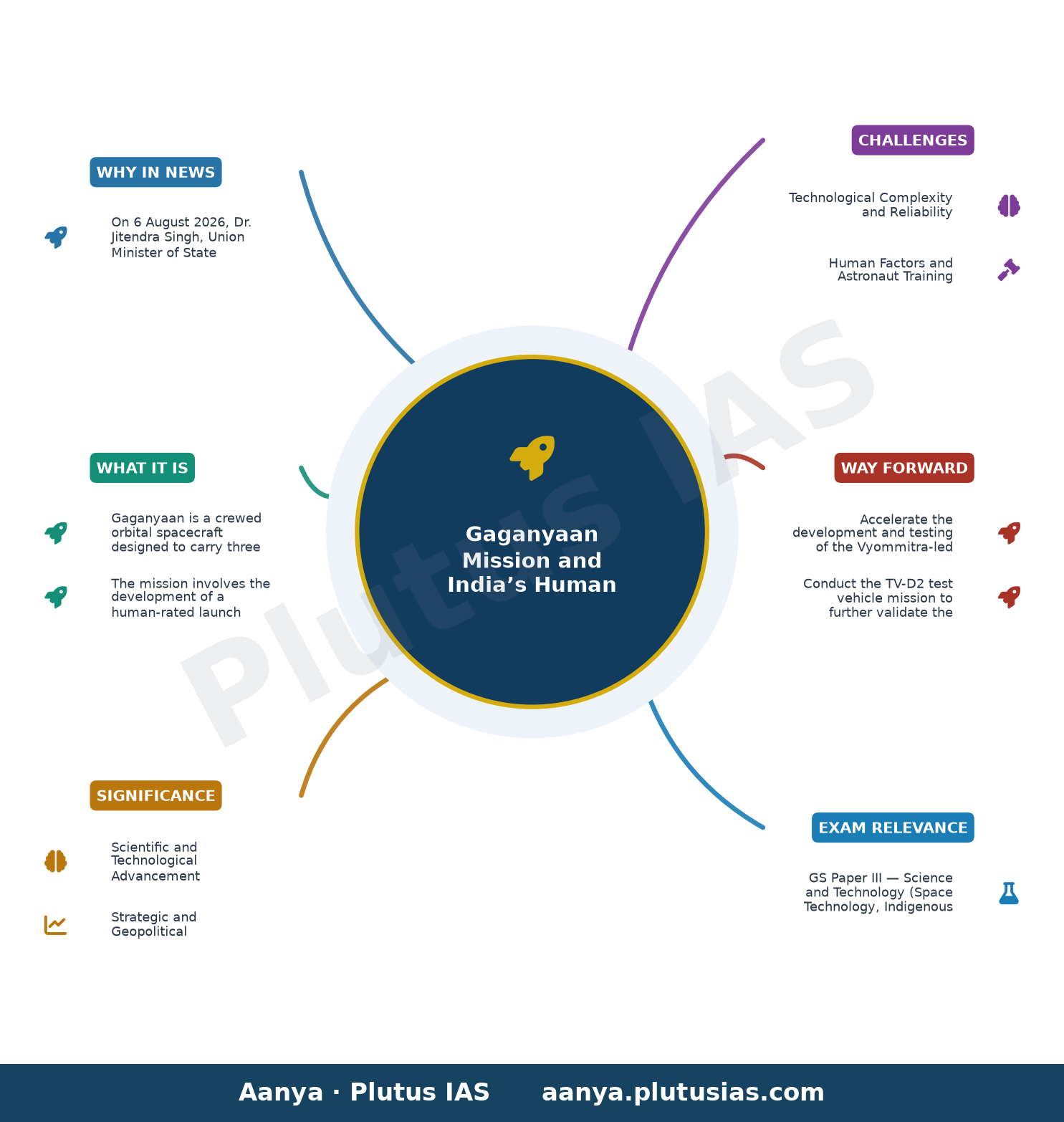
On 6 August 2026, Dr. Jitendra Singh, Union Minister of State (Independent Charge) for Science and Technology, Earth Sciences, and Space, informed the Rajya Sabha about the significant progress of India’s Gaganyaan mission and the broader roadmap for human space exploration. The update highlighted critical human-rating achievements, including the successful testing of propulsion systems, crew module technologies, and crew escape mechanisms, alongside the planned timeline for uncrewed and crewed missions leading to the establishment of an Indian Space Station by 2035.
Background
- The Gaganyaan mission, announced in 2018, is India’s first indigenous human spaceflight programme, aimed at demonstrating the capability to send humans to Low Earth Orbit (LEO) and return them safely to Earth.
- The mission is a collaborative effort under the Department of Space, with ISRO as the nodal agency, and involves multiple national laboratories, academic institutions, and industry partners.
- India’s human spaceflight ambitions align with its broader space policy, which emphasizes self-reliance, international collaboration, and the development of indigenous technologies.
- The mission builds on ISRO’s legacy of successful robotic missions, such as Chandrayaan and Mangalyaan, and marks a paradigm shift toward crewed space exploration.
- The roadmap includes phased testing, starting with uncrewed missions, followed by crewed flights, and culminating in the establishment of a permanent Indian Space Station by 2035.
What is the Gaganyaan Mission?
- Gaganyaan is a crewed orbital spacecraft designed to carry three astronauts to Low Earth Orbit (LEO) for a mission duration of up to seven days, with a primary objective of demonstrating India’s human spaceflight capability.
- The mission involves the development of a human-rated launch vehicle (HLVM3), a crew module (CM), a service module (SM), and critical life support systems such as the Environmental Control and Life Support System (ECLSS) and thermal protection systems.
- The crew module is designed to ensure the safety and comfort of astronauts, incorporating systems for re-entry, descent, and landing, including parachutes and retro-rockets.
- The mission’s success hinges on the Crew Escape System (CES), which provides an abort mechanism during the ascent phase to ensure astronaut safety in case of emergencies.
- Gaganyaan’s technological backbone includes indigenous developments in propulsion, avionics, communication, and recovery systems, reflecting India’s growing self-reliance in space technology.
- The mission is part of a broader strategy to position India as a key player in global human spaceflight, with long-term goals including lunar exploration and interplanetary missions.
- The programme also serves as a catalyst for scientific research, technological innovation, and human resource development in aerospace engineering and related fields.
Key Features
| Feature | Significance |
|---|---|
| Human-rated Launch Vehicle (HLVM3) | Ensures reliability and safety for crewed missions by certifying all propulsion stages and structural integrity through ground testing. |
| Crew Module and Service Module Propulsion Systems | Validates indigenous propulsion technologies critical for orbital manoeuvres and de-orbiting during re-entry. |
| Environmental Control and Life Support System (ECLSS) | Maintains habitable conditions for astronauts, including oxygen supply, carbon dioxide removal, and thermal regulation. |
| Crew Escape System (CES) | Provides abort capability during ascent to ensure astronaut safety by rapidly separating the crew module from the launch vehicle. |
| Integrated Air Drop Tests (IADT-01 & IADT-02) | Validates deceleration systems (parachutes) for safe landing of the crew module post-mission. |
Why it Matters
Scientific and Technological Advancement
- Demonstrates India’s capability to design, develop, and deploy indigenous human-rated space systems, reducing dependence on foreign technologies.
- Advances indigenous expertise in critical domains such as life support, thermal protection, and re-entry technologies.
- Positions ISRO as a key player in global human spaceflight, enhancing India’s prestige in space exploration.
Strategic and Geopolitical
- Strengthens India’s strategic autonomy in space by reducing reliance on foreign launch services for crewed missions.
- Enhances India’s soft power through leadership in cost-effective human spaceflight, fostering international collaborations (e.g., with ESA, ASA).
- Supports India’s long-term vision of establishing a permanent presence in low Earth orbit via the Bharatiya Antariksh Station (BAS).
Economic and Industrial
- Stimulates growth in India’s aerospace and allied industries, creating high-skilled employment and R&D opportunities.
- Encourages private sector participation in space missions, aligning with the ‘Atmanirbhar Bharat’ initiative.
- Potential for spin-off technologies in sectors such as healthcare, materials science, and robotics.
Human Resource Development
- Fosters a new generation of aerospace engineers, scientists, and astronauts through hands-on mission experience.
- Enhances India’s capacity to conduct advanced research in microgravity environments, benefiting fields like biology and materials science.
Challenges
1. Technological Complexity and Reliability
- Achieving human-rated certification for all systems, including propulsion, life support, and thermal protection, under stringent safety margins.
- Ensuring fail-safe mechanisms for critical systems such as the Crew Escape System and parachutes during abort scenarios.
UPSC Link: Science & Tech: Space Technology
2. Human Factors and Astronaut Training
- Developing comprehensive training programs for astronauts to handle microgravity, emergency scenarios, and re-entry stresses.
- Ensuring psychological resilience of crew during prolonged isolation in space.
UPSC Link: Science & Tech: Human Spaceflight
3. Infrastructure and Logistics
- Establishing robust ground infrastructure, including mission control centres, recovery assets, and communication networks.
- Coordinating international collaborations for tracking, data relay, and recovery operations.
UPSC Link: Science & Tech: Space Infrastructure
4. Budgetary and Timeline Constraints
- Managing the allocated budget of ₹20,193 crore efficiently while meeting the tight timeline for mission milestones (e.g., 2026 uncrewed mission).
- Balancing resource allocation between the Gaganyaan programme and other ISRO priorities, such as lunar and planetary missions.
UPSC Link: Economy: Public Expenditure
5. Regulatory and Safety Compliance
- Adhering to international space treaties and safety standards while developing indigenous systems.
- Ensuring compliance with environmental and ethical guidelines for space debris mitigation and planetary protection.
UPSC Link: Science & Tech: Space Law
Challenges — UPSC Perspective
| Issue | Concern |
|---|---|
| Human-rated certification | Rigorous testing required for all systems to ensure astronaut safety under extreme conditions. |
| Microgravity research | Limited understanding of long-term effects of microgravity on human physiology and materials. |
| International collaborations | Coordinating with foreign agencies for tracking, recovery, and training adds complexity. |
| Cost overruns | Risk of exceeding the ₹20,193 crore budget due to unforeseen technical challenges. |
| Public perception and trust | Maintaining confidence in the programme amid high stakes and potential failures. |
Way Forward
- Accelerate the development and testing of the Vyommitra-led uncrewed mission for Q4 2026 to validate critical systems.
- Conduct the TV-D2 test vehicle mission to further validate the Crew Escape System and deceleration mechanisms.
- Finalize the design and commence construction of the Bharatiya Antariksh Station (BAS-01) module for launch by 2035.
- Enhance astronaut training programmes in collaboration with international agencies to ensure readiness for crewed missions.
- Strengthen India’s ground infrastructure, including mission control centres and recovery assets, to support seamless mission operations.
- Establish a dedicated R&D pipeline for life support, thermal protection, and re-entry technologies to address future mission needs.
- Promote private sector participation through policies that incentivize investment in aerospace technologies and manufacturing.
- Develop a long-term roadmap for India’s human spaceflight programme, including lunar missions and deep-space exploration.
UPSC Value Addition
Keywords for Mains Answer-Writing
Gaganyaan Mission · Human Spaceflight Programme · Human-rated Launch Vehicle (HLVM3) · Crew Escape System (CES) · Indian Space Station (BAS) 2035 · Vyommitra · Environmental Control and Life Support System (ECLSS) · ISRO · Space Exploration Policy · Crew Module and Service Module · Orbital Module Preparation Facility · Test Vehicle Missions (TV-D1, TV-D2) · Cabinet approval for Human Spaceflight Programme (₹20,193 crore)
Concept Flow
India’s human spaceflight ambition → Development of indigenous human-rated systems (HLVM3, ECLSS, CES) → Validation through uncrewed missions (Vyommitra, TV-D1/D2) → Crewed orbital mission (2027) → Establishment of Bharatiya Antariksh Station (2035) → Long-term space exploration and scientific research.
Prelims Practice Questions
Q1. Consider the following statements regarding the Gaganyaan Mission:
1. The Crew Escape System (CES) has been developed with five types of motors.
2. The first uncrewed mission with Vyommitra is scheduled for the fourth quarter of 2026.
3. The Indian Space Station (BAS) is planned to be operational by 2030.
How many of the above statements are correct?
- Only one
- Only two
- All
- None
Answer: Only two — Statement 1 is correct as the CES includes five types of motors. Statement 2 is correct as the first uncrewed mission with Vyommitra is targeted for Q4 2026. Statement 3 is incorrect as the BAS is planned for 2035, not 2030.
Q2. Assertion (A): The Environmental Control and Life Support System (ECLSS) is a critical component of the Gaganyaan Mission.
Reason (R): ECLSS ensures the survival and well-being of astronauts by regulating oxygen, temperature, and humidity in the crew module.
Options:
A. Both A and R are true, and R is the correct explanation of A.
B. Both A and R are true, but R is not the correct explanation of A.
C. A is true, but R is false.
D. A is false, but R is true.
- A
- B
- C
- D
Answer: A — Assertion (A) is true as ECLSS is indeed critical for astronaut survival. Reason (R) is also true and correctly explains why ECLSS is essential.
Q3. Match the following missions with their respective timelines as per the Gaganyaan Mission roadmap:
Column I (Mission) | Column II (Timeline)
———————————-|————————
1. First Uncrewed Mission (Vyommitra) | a. 2026 Q4
2. First Crewed Orbital Mission | b. 2027
3. Test Vehicle Mission (TV-D2) | c. 2028
4. Indian Space Station (BAS) | d. 2035
Answer: ? — 1-a: First uncrewed mission with Vyommitra is targeted for 2026 Q4. 2-b: First crewed orbital mission is planned for 2027. 3-c: Test Vehicle Mission (TV-D2) is a preparatory step before crewed missions. 4-d: Indian Space Station (BAS) is planned for 2035.
Mains Practice Question
✍ The successful development of the Crew Escape System (CES) and the Environmental Control and Life Support System (ECLSS) marks a critical milestone in India’s Gaganyaan Mission. Critically examine the technological and strategic significance of these systems for the success of human spaceflight in India. Also, analyse how the Gaganyaan Mission aligns with India’s long-term vision of establishing an Indian Space Station by 2035. (15 Marks)
Approach: MODEL-ANSWER SKELETON:
1. **Technological Significance of CES**:
– Definition and role of CES in ensuring crew safety during launch abort scenarios.
– Development of five types of motors and static testing as highlighted in the PIB release.
– Comparison with international systems (e.g., NASA’s Launch Abort System).
2. **Strategic Significance of ECLSS**:
– Definition and components of ECLSS (oxygen generation, CO₂ scrubbing, thermal regulation, humidity control).
– Importance in sustaining life during orbital and re-entry phases.
– Reference to ISRO’s indigenous development and testing as per the release.
3. **Alignment with Long-Term Vision (BAS 2035)**:
– Overview of the Indian Space Station (BAS) plan: modular structure, timeline, and objectives.
– How Gaganyaan serves as a precursor to BAS by validating critical technologies (e.g., re-entry, life support, docking).
– Synergy with other ISRO missions (e.g., Chandrayaan, Aditya-L1) in building a robust space ecosystem.
4. **Challenges and Way Forward**:
– Technical hurdles in human-rated systems (e.g., reliability, redundancy, fail-safe mechanisms).
– Policy and budgetary commitments (e.g., ₹20,193 crore allocation as per the Cabinet approval).
– International collaborations (e.g., ESA, ASA) and their role in mission success.
5. **Conclusion**:
– Summarise the transformative potential of Gaganyaan for India’s space programme.
– Emphasise the strategic autonomy and global standing it confers.
Source: PIB (Press Information Bureau)
Generated by AanyaAi for educational purpose.

- यूपीएससी/पीसीएस के लिए दूरसंचार विनिर्माण में निवेश: ग्वालियर टीएमजेड के अवसर - September 23, 2026
- Bengaluru Investor Meet: ₹5,500 Cr Investment Proposed for Gwalior Telecom Manufacturing Zone - September 23, 2026
- एल नीनो: दुनिया के सामने जलवायु अनुकूलन की चुनौती - September 23, 2026

No Comments