


06 Aug Gaganyaan Mission: Key Achievements & Roadmap Explained for UPSC
✎ Gaganyaan mission marks India’s first human spaceflight endeavour, with key milestones including HLVM3 qualification, Vyommitra (2026), crewed orbital mission (2027), and the Indian Space Station (BAS) by 2035.
Subject Relevance — Where This Topic Fits
- GS Paper III — Science and Technology — Developments and their Applications and Effects in Everyday Life | GS Paper III — Awareness in the fields of Space
- Prelims: Gaganyaan Mission, Human-rated Launch Vehicle (HLVM3), Vyommitra, Crew Escape System (CES), Indian Space Station (BAS) 2035, ISRO, TV-D1 Mission, ECLSS, IDRSS-1, Netravalkar Committee
- Essay: India’s ascent as a spacefaring nation: From satellites to human spaceflight, The intersection of technology, ambition, and national prestige in India’s space programme
Quick Revision: Gaganyaan mission marks India’s first human spaceflight endeavour, with key milestones including HLVM3 qualification, Vyommitra (2026), crewed orbital mission (2027), and the Indian Space Station (BAS) by 2035.
Why is this in the news?
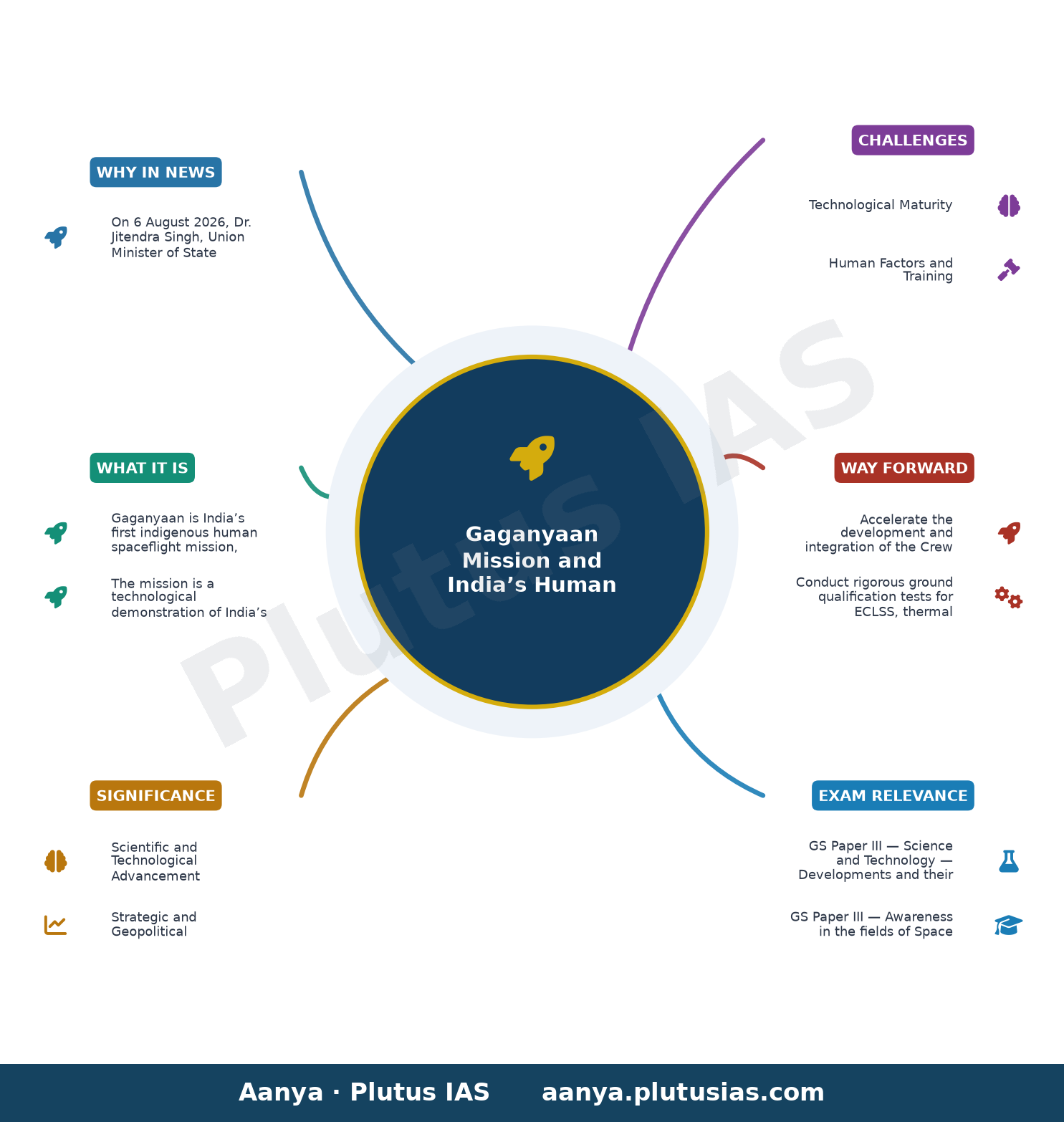
On 6 August 2026, Dr. Jitendra Singh, Union Minister of State (Independent Charge) for Science & Technology, Earth Sciences, and Space, informed the Rajya Sabha about the significant progress of India’s maiden human spaceflight mission, Gaganyaan. He highlighted key achievements in human-rating systems, infrastructure development, and the roadmap for India’s long-term human space exploration, including the planned launch of the Vyommitra mission in late 2026 and the establishment of the Indian Space Station by 2035. This briefing underscores India’s strategic shift from robotic to crewed space missions and its ambition to join the elite group of spacefaring nations.
Background
- The Gaganyaan mission, announced in 2018 by Prime Minister Narendra Modi, is India’s first indigenous human spaceflight programme, aimed at demonstrating the capability to send humans to Low Earth Orbit (LEO) and safely return them to Earth.
- The mission is a critical milestone in India’s space ambitions, following the success of Chandrayaan and Mangalyaan missions, and aligns with the vision of an Atmanirbhar Bharat in space technology.
- India’s space programme has evolved from launching satellites to achieving complex missions like the Mars Orbiter Mission (2014) and the Chandrayaan-2 lunar mission (2019), which included an orbiter, lander, and rover.
- The Gaganyaan mission is part of a broader strategy to establish India as a self-reliant space power, with long-term goals including the development of an Indian Space Station (BAS) by 2035 and potential lunar and interplanetary missions.
- International collaborations, such as those with the European Space Agency (ESA) for network operations and the Australian Space Agency (ASA) for crew recovery, highlight India’s integration into the global space community.
What is the Gaganyaan Mission and India’s Human Spaceflight Roadmap?
- Gaganyaan is India’s first indigenous human spaceflight mission, designed to send a crew of three astronauts to a Low Earth Orbit (LEO) of 400 km for a duration of up to seven days and return them safely to Earth.
- The mission is a technological demonstration of India’s capability to conduct crewed space missions, including human-rated launch vehicles, life support systems, and crew escape mechanisms.
- The Human-rated Launch Vehicle Mark-3 (HLVM3) is the designated launch vehicle for the Gaganyaan mission, with all propulsion stages and structural components undergoing rigorous ground testing and qualification.
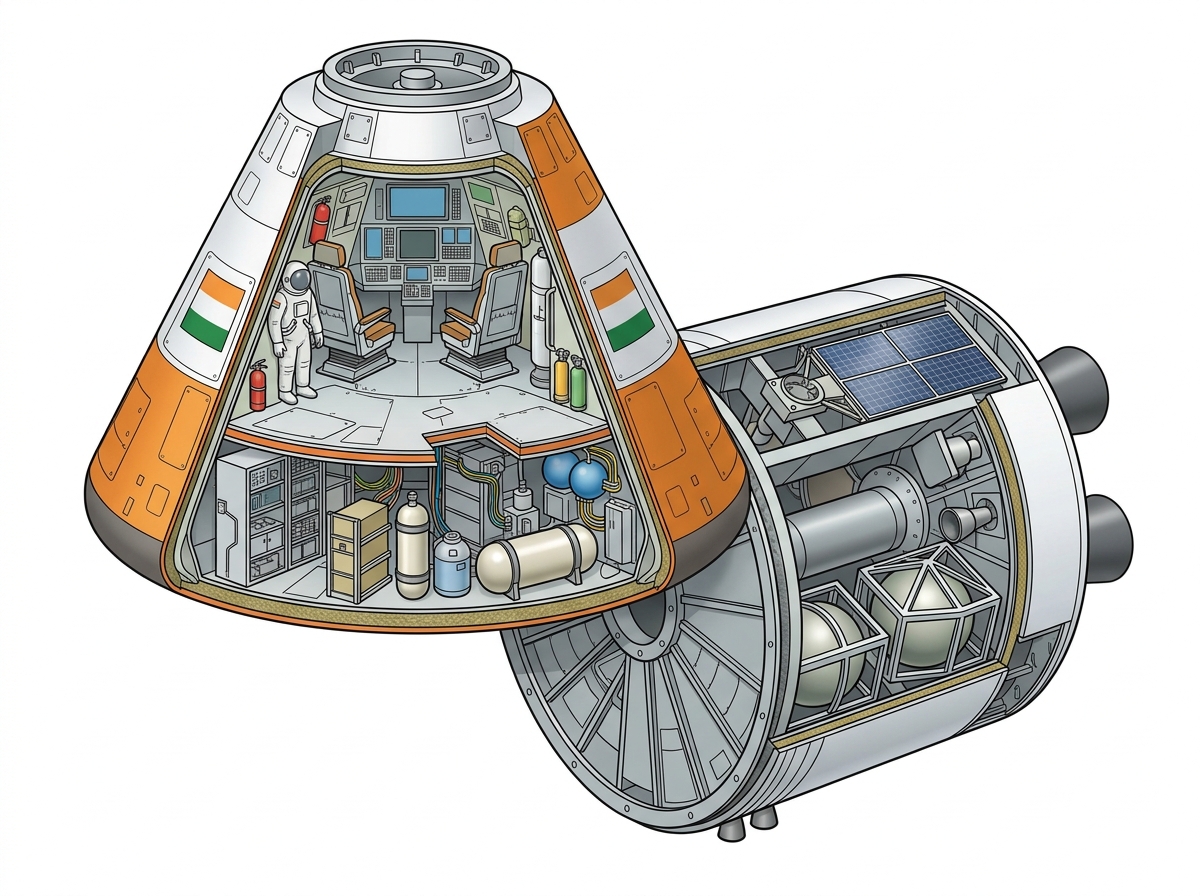
- The Crew Module (CM) and Service Module (SM) form the orbital module, housing the crew during the mission. The CM is designed to re-enter Earth’s atmosphere and land safely, while the SM provides propulsion and support systems.
- The Environmental Control and Life Support System (ECLSS) is critical for maintaining a habitable environment inside the crew module, regulating oxygen, carbon dioxide, temperature, and humidity levels.
- The Crew Escape System (CES) is a fail-safe mechanism designed to separate the crew module from the launch vehicle in case of an anomaly, ensuring the safety of the astronauts by deploying parachutes for a controlled descent and landing.
- Vyommitra, a half-humanoid robot, will be launched in the first uncrewed mission (scheduled for Q4 2026) to test the Gaganyaan systems, including ECLSS, thermal protection, and deceleration systems, prior to human missions.
- The Indian Space Station (BAS) is envisaged as a modular space station with five modules, serving as a platform for scientific research, technology demonstration, and international collaboration in space exploration.
Key Features
| Feature | Significance |
|---|---|
| Human-rated LVM3 (HLVM3) | ISRO’s heavy-lift launch vehicle certified for crewed missions, ensuring payload capacity and reliability for Gaganyaan’s orbital insertion. |
| Crew Module & Service Module | Integrated propulsion, life support, and avionics systems validated; thermal protection and deceleration systems tested for re-entry safety. |
| Crew Escape System (CES) | Five motor variants developed and static-tested; structural qualification completed to ensure astronaut abort capability during ascent. |
| Environmental Control & Life Support System (ECLSS) | Critical for sustaining crew in microgravity; includes oxygen generation, CO₂ scrubbing, and thermal regulation. |
| Orbital Module Preparation Facility | Enables integration, testing, and pre-launch checks for crewed and uncrewed Gaganyaan missions. |
Why it Matters
Scientific and Technological Advancement
- Demonstrates indigenous capability in human spaceflight, reducing reliance on foreign platforms for astronaut missions.
- Validates indigenous propulsion, life support, and recovery systems, positioning India among elite spacefaring nations.
- Advances ISRO’s expertise in orbital rendezvous, docking, and long-duration mission planning.
Strategic and Geopolitical
- Enhances India’s soft power through self-reliance in high-technology domains, fostering international collaborations (e.g., ESA, ASA).
- Strengthens national security by reducing dependence on foreign launch services for critical payloads.
- Supports India’s bid for leadership in the emerging space economy and lunar/Mars exploration partnerships.
Economic
- Stimulates high-tech industries (aerospace, electronics, materials) and generates skilled employment in R&D and manufacturing.
- Potential for spin-offs in medical devices, robotics, and remote sensing, contributing to GDP growth.
- Attracts foreign direct investment in India’s space sector, aligning with the ‘Atmanirbhar Bharat’ vision.
Institutional and Governance
- Showcases ISRO’s institutional resilience and project management capabilities in executing multi-year, high-risk missions.
- Demonstrates inter-ministerial coordination (DoS, PMO, MoD) in funding, regulation, and international engagements.
Challenges
1. Technological Maturity
- Ensuring reliability of life support systems (ECLSS) for 3–7 day missions with zero tolerance for failure.
- Validation of re-entry thermal protection for crew safety during atmospheric descent.
- Achieving precision in crew module landing within designated recovery zones.
UPSC Link: GS3: Science-Tech, Space
2. Human Factors and Training
- Developing astronaut training programs for microgravity, emergency scenarios, and psychological resilience.
- Standardising medical protocols for pre-flight, in-flight, and post-flight health monitoring.
- Ensuring compatibility of international ground support systems (e.g., ESA’s tracking networks).
UPSC Link: GS2: Governance, Personnel
3. Budgetary and Timeline Constraints
- Managing a ₹20,193 crore budget across eight missions without cost overruns or delays.
- Balancing Gaganyaan’s timelines with parallel projects (e.g., Chandrayaan-4, Aditya-L1) under ISRO’s resource constraints.
- Ensuring sustained political and financial commitment over a decade-long program.
UPSC Link: GS3: Economy, Budget
4. International Collaboration and Compliance
- Navigating export controls and technology transfer agreements with partner agencies (ESA, ASA).
- Adhering to international space treaties (Outer Space Treaty, Rescue Agreement) for crewed missions.
- Managing public perception and transparency in high-stakes failures (e.g., test vehicle anomalies).
UPSC Link: GS2: IR, Treaties
5. Sustainability of Long-Term Vision
- Ensuring continuity of funding and political support for the Indian Space Station (BAS) beyond 2035.
- Developing indigenous alternatives for critical components (e.g., life support spares) to avoid supply chain vulnerabilities.
- Integrating Gaganyaan outcomes with India’s lunar and interplanetary ambitions (e.g., LUPEX, Venus mission).
UPSC Link: GS3: S&T, Space Policy
Challenges — UPSC Perspective
| Issue | Concern |
|---|---|
| Life Support System Reliability | Failure risk in oxygen generation, CO₂ scrubbing, or thermal regulation could endanger crew. |
| Re-entry Thermal Protection | Inadequate heat shielding may lead to structural failure during atmospheric re-entry. |
| Crew Training Adequacy | Insufficient simulation of microgravity effects or emergency scenarios may compromise mission safety. |
| Budgetary Overruns | Delays in funding disbursement or cost escalations could derail the mission timeline. |
| International Technology Dependence | Reliance on foreign tracking or recovery assets may limit operational autonomy. |
| Public and Political Pressure | High expectations and scrutiny may lead to hasty decisions or funding cuts after failures. |
Way Forward
- Accelerate the development and integration of the Crew Module and Service Module for the first uncrewed mission (2026 Q4).
- Conduct rigorous ground qualification tests for ECLSS, thermal protection, and deceleration systems to ensure zero-failure tolerance.
- Finalise astronaut training protocols in collaboration with international agencies (e.g., NASA, ESA) for standardised best practices.
- Enhance domestic manufacturing of critical components (e.g., life support spares) to reduce import dependence.
- Strengthen inter-ministerial coordination for seamless budgetary disbursement and regulatory clearances.
- Expand international partnerships (e.g., JAXA, Roscosmos) for technology sharing and joint missions post-Gaganyaan.
- Develop a phased roadmap for the Indian Space Station (BAS), including modular expansion and international collaborations.
- Establish a dedicated public outreach program to build national confidence and attract private sector investments in space tech.
UPSC Value Addition
Keywords for Mains Answer-Writing
Gaganyaan Mission · Human-rated Launch Vehicle Mark-3 (HLVM3) · Crew Escape System (CES) · Indian Space Station (BAS) 2035 · Vyommitra · Environmental Control and Life Support System (ECLSS) · Orbital Module Preparation Facility · ISRO’s long-term space exploration vision · ISRO-ESA collaboration · Net budgetary allocation for Gaganyaan programme
Concept Flow
India’s aspiration for human spaceflight → ISRO’s indigenous development of HLVM3 and crew systems → Technological validation through Gaganyaan missions → Establishment of Indian Space Station (BAS) by 2035 → Long-term participation in global space exploration.
Prelims Practice Questions
Q1. Consider the following statements regarding the Gaganyaan Mission:
1. The Crew Escape System (CES) for the Gaganyaan Mission includes five types of motors.
2. The first unmanned mission with Vyommitra is targeted for the fourth quarter of 2026.
3. The Indian Space Station (BAS) is planned to be operational by 2040.
How many of the above statements are correct?
- Only one
- Only two
- All three
- None
Answer: Only two — Statement 1 is correct as the CES includes five types of motors. Statement 2 is correct as the first unmanned mission with Vyommitra is targeted for Q4 2026. Statement 3 is incorrect as the BAS is planned to be operational by 2035, not 2040.
Q2. Assertion (A): The Gaganyaan Mission aims to develop and validate indigenous human spaceflight technologies.
Reason (R): The mission includes the development of the Crew Module, Service Module, and Environmental Control and Life Support System (ECLSS).
- Both A and R are true, and R is the correct explanation of A
- Both A and R are true, but R is not the correct explanation of A
- A is true but R is false
- A is false but R is true
Answer: Both A and R are true, and R is the correct explanation of A — The assertion is true as the Gaganyaan Mission aims to validate indigenous human spaceflight technologies. The reason is also true and directly explains the assertion, as the mission involves the development of critical systems like the Crew Module, Service Module, and ECLSS.
Q3. Match the following missions with their respective timelines as per the Gaganyaan Mission roadmap:
Column I (Mission) | Column II (Timeline)
——————————————-|————————
A. First unmanned mission with Vyommitra | 1. 2027
B. First crewed orbital mission | 2. Q4 2026
C. Additional unmanned missions | 3. 2025
D. Indian Space Station (BAS) operational | 4. 2035
- A-2, B-1, C-3, D-4
- A-3, B-2, C-1, D-4
- A-2, B-3, C-1, D-4
- A-4, B-1, C-2, D-3
Answer: A-2, B-1, C-3, D-4 — The first unmanned mission with Vyommitra is targeted for Q4 2026 (A-2). The first crewed orbital mission is planned for 2027 (B-1). Additional unmanned missions are targeted for 2027 (C-1). The Indian Space Station (BAS) is planned to be operational by 2035 (D-4).
Mains Practice Question
✍ Critically examine the technological and strategic significance of the Gaganyaan Mission for India’s space exploration programme. Also, discuss the challenges that ISRO may face in achieving its long-term vision of an Indian Space Station (BAS) by 2035. (15 Marks)
Approach: MODEL-ANSWER SKELETON:
1. **Technological Significance (6 points)**
– Indigenous development of human-rated launch vehicle (HLVM3) and propulsion systems.
– Validation of Crew Module, Service Module, and Environmental Control and Life Support System (ECLSS).
– Demonstration of Crew Escape System (CES) and integrated avionics.
– Development of thermal protection, deceleration, and recovery systems.
– Establishment of mission infrastructure (Orbital Module Preparation Facility, Gaganyaan Control Centre).
– International collaborations (ESA, ASA) for communication, recovery, and training.
2. **Strategic Significance (4 points)**
– Assertion of India’s technological sovereignty in human spaceflight.
– Enhancement of India’s global standing in space exploration (comparison with China’s Tiangong, NASA’s Artemis).
– Catalyst for STEM education, innovation, and industrial growth.
– Long-term vision of an Indian Space Station (BAS) by 2035 as a stepping stone for deep-space missions.
3. **Challenges (5 points)**
– **Technological:** Ensuring reliability of human-rated systems (e.g., ECLSS, thermal protection) and redundancy in critical components.
– **Operational:** Managing complex mission phases (launch, orbit, re-entry, recovery) with high precision.
– **Budgetary:** Sustaining funding for long-term programmes amid competing priorities (e.g., Chandrayaan, Aditya-L1).
– **Human Capital:** Training astronauts and ground support teams for high-stakes missions.
– **International Cooperation:** Balancing collaborations (e.g., ESA, ASA) with national security and strategic autonomy concerns.
4. **Conclusion (1 point)**
– The Gaganyaan Mission marks a paradigm shift in India’s space ambitions, but its success hinges on overcoming technological, operational, and strategic challenges while maintaining fiscal prudence and international partnerships.
Source: PIB (Press Information Bureau)
Generated by AanyaAi for educational purpose.

- तमिलनाडु के लिए क्या है ‘एल नीनो’ और उत्तर-पूर्वी मानसून का खतरा? - September 23, 2026
- El Nino & Northeast Monsoon: Impact on Tamil Nadu for UPSC 2026 - September 23, 2026
- हिमाचल में डिजिटल भुगतान क्रांति: बिलासपुर अव्वल, महिलाओं की भागीदारी 93% तक पहुंची - September 23, 2026

No Comments