


06 Aug Gaganyaan Mission: Key Milestones and Roadmap Explained for UPSC 2026
✎ Gaganyaan’s phased roadmap includes two uncrewed missions (2026–2027), a crewed orbital mission, and the launch of India’s first space station module (BAS-01) by 2035, marking India’s emergence as a self-reliant spacefaring…
Subject Relevance — Where This Topic Fits
- GS Paper III — Science and Technology, Space Technology
- Prelims: Gaganyaan Mission, Vyommitra, Human-Rated Launch Vehicle (HLVM3), Crew Escape System (CES), Indian Space Station (BAS-01), ISRO, ECLSS, Thermal Protection System, Integrated Air Drop Tests, TV-D1, TV-D2, Orbital Module Preparation Facility, Gaganyaan Control Centre, IDRSS-1, ISRO-NASA collaborations
- Essay: India’s rise as a space power: From satellite launches to human spaceflight, The role of technology in national development: Lessons from ISRO’s Gaganyaan programme
Quick Revision: Gaganyaan’s phased roadmap includes two uncrewed missions (2026–2027), a crewed orbital mission, and the launch of India’s first space station module (BAS-01) by 2035, marking India’s emergence as a self-reliant spacefaring nation.
Why is this in the news?
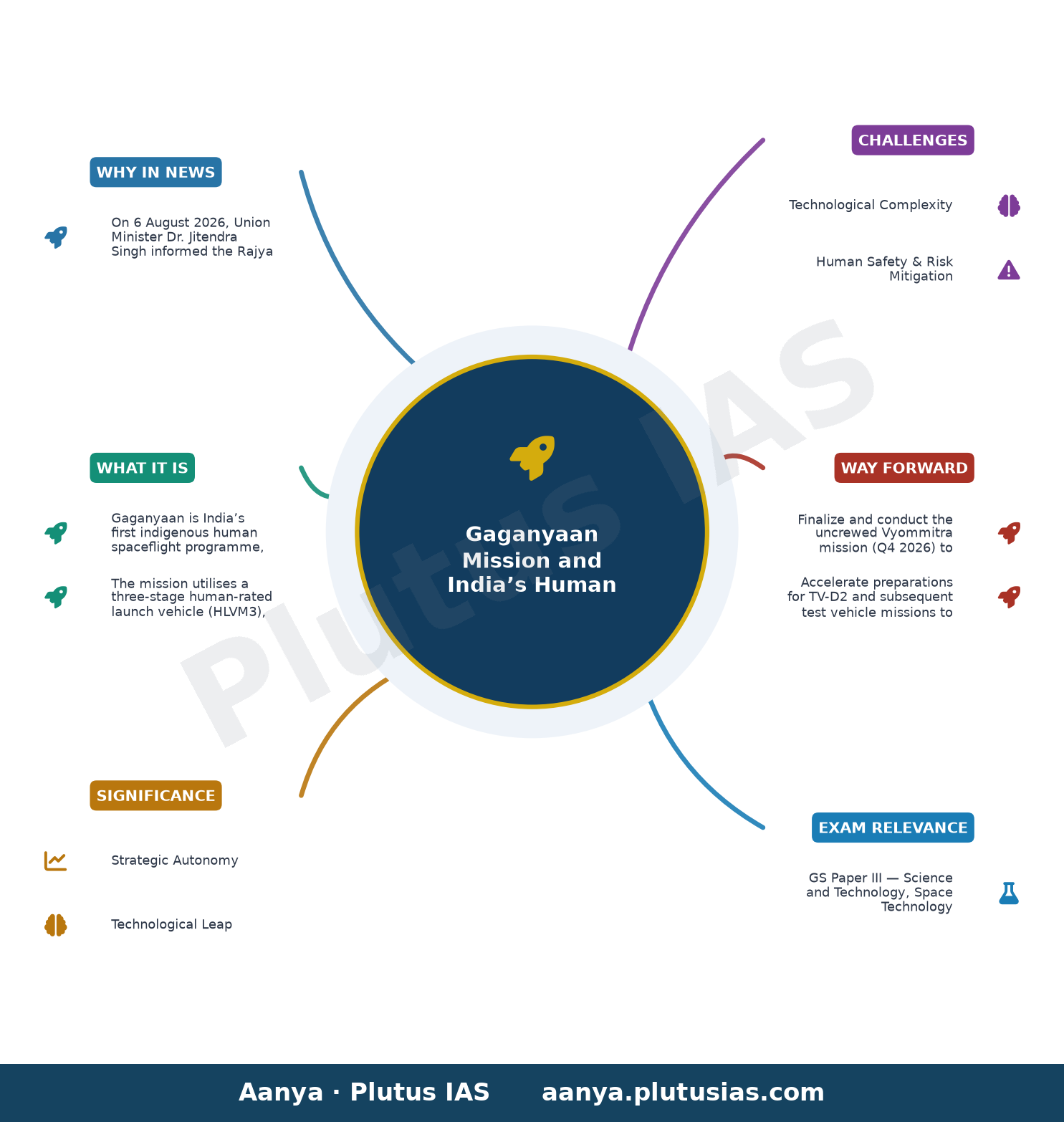
On 6 August 2026, Union Minister Dr. Jitendra Singh informed the Rajya Sabha that India’s maiden human spaceflight mission, Gaganyaan, has achieved critical human-rating milestones, bringing the programme closer to its first crewed orbital flight. The announcement underscored the successful development and testing of propulsion systems, life support systems, crew escape mechanisms, and ground infrastructure, while also outlining the phased roadmap culminating in the establishment of an Indian Space Station (BAS) by 2035.
Background
- India’s space programme, spearheaded by ISRO, has evolved from satellite launches to interplanetary missions, with human spaceflight as the next frontier.
- Human-rated spaceflight requires stringent safety standards, including redundant systems for life support, escape mechanisms, and thermal protection.
- India’s long-term vision includes the establishment of an indigenous space station (BAS) by 2035, aligning with global spacefaring nations.
- Collaborations with international agencies such as ESA, ASA, and NASA are being leveraged for mission support, crew training, and technology validation.
What is the Gaganyaan Mission and India’s Human Spaceflight Roadmap?
- Gaganyaan is India’s first indigenous human spaceflight programme, designed to demonstrate the capability to send a crew of three to a Low Earth Orbit (LEO) of 400 km for a mission duration of up to seven days.
- The mission utilises a three-stage human-rated launch vehicle (HLVM3), with enhanced safety and reliability features.
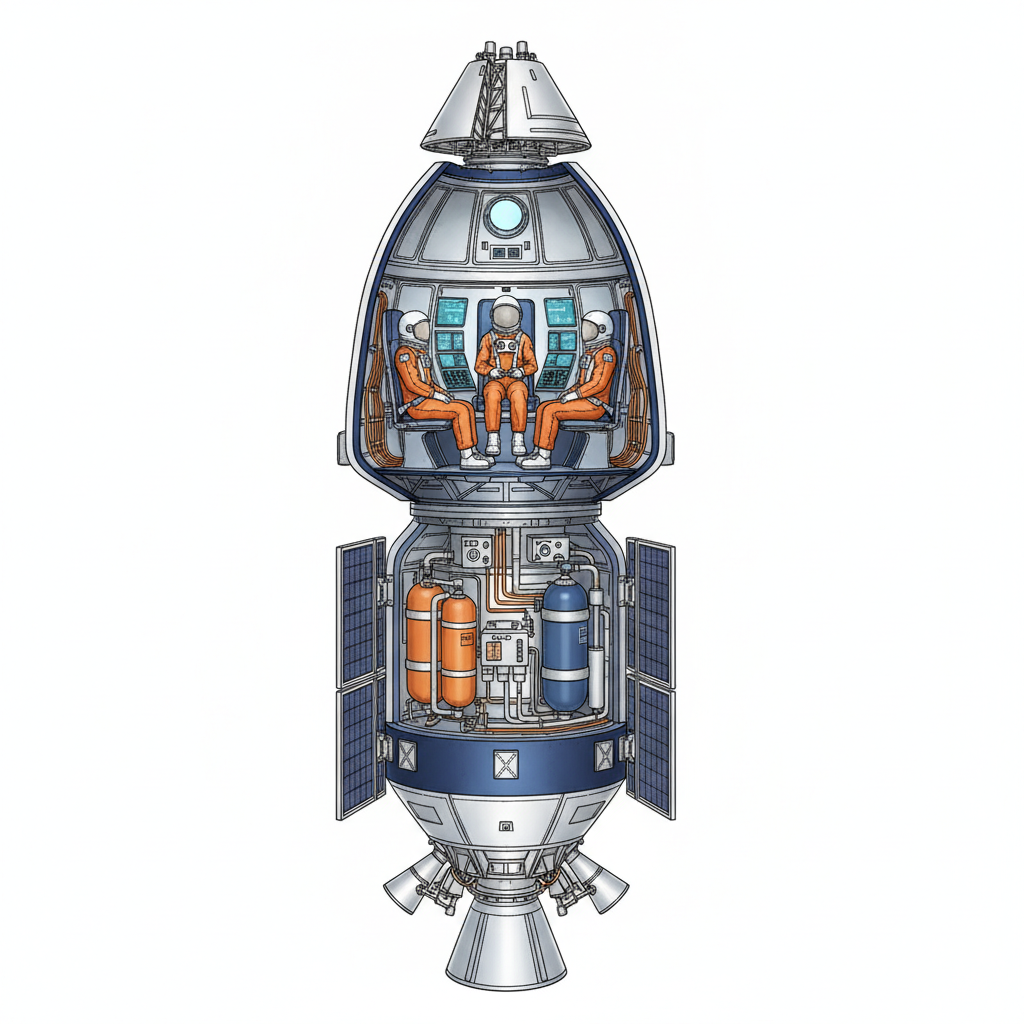
- Critical systems developed and tested include the Crew Module (CM), Service Module (SM), Environmental Control and Life Support System (ECLSS), Thermal Protection System (TPS), and Crew Escape System (CES).
- The programme follows a phased approach: two uncrewed missions (including one with Vyommitra, a half-humanoid), followed by a crewed orbital mission, and culminating in the establishment of an Indian Space Station (BAS) by 2035.
- Vyommitra, a humanoid robot, will be deployed in the first uncrewed mission (scheduled for Q4 2026) to validate systems and gather data on microgravity effects.
- The Indian Space Station (BAS) is envisaged as a modular, 5-module orbital platform, with the first module (BAS-01) serving as a platform for scientific research and international collaborations.
- Safety and reliability are ensured through rigorous ground testing, including Integrated Air Drop Tests (IADT-01 and IADT-02), and the successful completion of the TV-D1 mission, which validated the Crew Escape System.
- The programme integrates indigenous technological advancements with strategic partnerships with international agencies for mission support, crew training, and technology transfer.
Key Features
| Feature | Significance |
|---|---|
| Human-Rated Launch Vehicle (HLVM3) | Fully indigenous three-stage propulsion system designed for crewed missions, ensuring reliability and safety for human spaceflight. |
| Crew Module (CM) & Service Module (SM) | Integrated propulsion, life support, and avionics systems for crew survival, orbital manoeuvring, and re-entry. |
| Environmental Control & Life Support System (ECLSS) | Regulates cabin atmosphere, temperature, humidity, and waste management for astronaut health during mission phases. |
| Crew Escape System (CES) | In-flight abort capability with five validated motors to ensure crew safety during launch or ascent emergencies. |
| Orbital Module Preparation Facility | Critical infrastructure for assembly, integration, and testing of crewed and uncrewed modules prior to launch. |
Why it Matters
Strategic Autonomy
- Demonstrates India’s indigenous capability in human spaceflight, reducing dependence on foreign launch services for crewed missions.
- Positions ISRO as a credible alternative to established space agencies (NASA, Roscosmos) for collaborative and commercial space ventures.
Technological Leap
- Advancement in life-support systems, thermal protection, and avionics aligns with global standards for human-rated missions.
- Development of indigenous systems (e.g., ECLSS, CES) fosters self-reliance in critical aerospace technologies.
Economic Implications
- Potential to stimulate private sector participation in space technology, satellite manufacturing, and launch services.
- Opportunities for international partnerships in lunar/Mars missions, space station modules, and astronaut training.
Scientific & Educational Impact
- Inspires STEM education and research, fostering a new generation of scientists and engineers in aerospace disciplines.
- Enhances India’s global standing in space science, attracting talent and investment in R&D.
Challenges
1. Technological Complexity
- Ensuring fail-safe operation of life-support systems under extreme conditions (vacuum, radiation, thermal gradients).
- Achieving precise re-entry and landing accuracy to avoid damage to crew and module.
UPSC Link: GS3: Science & Tech
2. Human Safety & Risk Mitigation
- Validating Crew Escape System (CES) under all flight regimes to guarantee crew survival in emergencies.
- Managing psychological and physiological stress on astronauts during prolonged missions.
UPSC Link: GS3: Disaster Management
3. Infrastructure & Logistics
- Establishing robust ground support networks (e.g., IDRSS-1 feeder stations) for real-time communication.
- Ensuring rapid recovery of crew and module post-landing, including maritime and terrestrial contingencies.
UPSC Link: GS3: Infrastructure
4. International Collaboration
- Coordinating with foreign agencies (ESA, ASA) for navigation, recovery, and training support without compromising strategic autonomy.
- Navigating geopolitical sensitivities in technology-sharing agreements.
UPSC Link: GS2: International Relations
Challenges — UPSC Perspective
| Issue | Concern |
|---|---|
| Life Support Reliability | Failure in ECLSS could lead to catastrophic cabin environment degradation. |
| Re-Entry Thermal Protection | Inadequate heat shielding may result in module burn-up during atmospheric entry. |
| Abort System Validation | CES must demonstrate 100% reliability across all flight phases to ensure crew safety. |
| Ground Network Latency | Real-time communication delays could compromise mission control during critical phases. |
| Post-Landing Recovery | Adverse weather or terrain may delay retrieval, increasing risk to crew. |
Way Forward
- Finalize and conduct the uncrewed Vyommitra mission (Q4 2026) to validate all human-rated systems.
- Accelerate preparations for TV-D2 and subsequent test vehicle missions to demonstrate integrated abort and recovery capabilities.
- Complete the development of the first Indian Space Station module (BAS-01) by 2030 for initial operational capability.
- Strengthen international collaborations (e.g., ESA, ASA) for navigation, training, and recovery support while safeguarding indigenous technologies.
- Establish a dedicated astronaut training facility with advanced simulators for mission-specific scenarios.
- Enhance public-private partnerships to develop cost-effective launch vehicles and satellite components.
- Integrate AI and robotics (e.g., Vyommitra) for autonomous mission operations and payload management.
UPSC Value Addition
Keywords for Mains Answer-Writing
Gaganyaan Mission · Human Spaceflight Programme · Indian Space Station (BAS) 2035 · Vyommitra · Crew Escape System (CES) · Human-rated Launch Vehicle (HLVM3) · Environmental Control and Life Support System (ECLSS) · ISRO’s Roadmap for Human Space Exploration · Netzwerk operations with ESA · Cabinet approval for Gaganyaan missions (₹20,193 crore) · Test Vehicle missions (TV-D1, TV-D2) · Integrated Air Drop Tests (IADT-01, IADT-02) · Crew Module and Service Module · Thermal Protection System · Orbital Module Preparation Facility · Recovery Assets for Crew Module · Crew Training and Ground Support · ISRO’s collaboration with international agencies (ESA, ASA)
Concept Flow
ISRO’s indigenous development of HLVM3 and human-rated systems → Validation through uncrewed missions (Vyommitra, TV-D1/TV-D2) → Crewed orbital mission (2027) → Establishment of Indian Space Station (BAS-01 by 2035). → Technological advancements in ECLSS, CES, and avionics → Enhanced human spaceflight safety and reliability → Global recognition as a spacefaring nation. → Government approval of ₹20,193 crore budget (2024) → Allocation of resources to ISRO centers → Accelerated mission timelines and infrastructure development. → International collaborations with ESA, ASA → Access to advanced navigation and recovery technologies → Mitigation of technical risks in human spaceflight.
Prelims Practice Questions
Q1. Consider the following statements regarding the Gaganyaan Mission:
1. The first unmanned mission carrying Vyommitra is targeted for the fourth quarter of 2026.
2. The Crew Escape System (CES) has been developed with five types of motors and successfully tested.
3. The Indian Space Station (BAS) is planned to be operational by 2030.
4. The first human-rated launch vehicle for Gaganyaan is HLVM3.
How many of the above statements are correct?
- Only one
- Only two
- Only three
- All
Answer: All — Statements 1, 2, and 4 are correct. Statement 3 is incorrect as the Indian Space Station (BAS) is planned for 2035, not 2030.
Q2. Assertion (A): The Gaganyaan mission includes the development of the Environmental Control and Life Support System (ECLSS) to ensure astronaut safety.
Reason (R): ECLSS is critical for maintaining a habitable environment in the crew module during the mission.
Options:
A. Both A and R are true, and R is the correct explanation of A.
B. Both A and R are true, but R is not the correct explanation of A.
C. A is true, but R is false.
D. A is false, but R is true.
Answer: ? — Both the Assertion (A) and Reason (R) are true, and R correctly explains A. ECLSS is essential for sustaining life in the crew module.
Q3. Match the following missions/targets with their respective timelines as per the Gaganyaan Mission roadmap:
Column I (Mission/Target) Column II (Timeline)
A. First unmanned mission with Vyommitra 1. 2027
B. First human orbital mission 2. 2026 (Q4)
C. Indian Space Station (BAS) operational 3. 2035
D. Test Vehicle mission (TV-D2) 4. 2024 (completed)
Options:
A. A-2, B-1, C-3, D-4
B. A-2, B-1, C-3, D-1
C. A-3, B-2, C-1, D-4
D. A-4, B-1, C-2, D-3
- A
- B
- C
- D
Answer: A — Correct matching: A-2 (First unmanned mission with Vyommitra in Q4 2026), B-1 (First human orbital mission by 2027), C-3 (Indian Space Station operational by 2035), D-4 (TV-D2 is a test mission planned post-TV-D1, which was completed in 2024).
Mains Practice Question
✍ The Gaganyaan Mission represents India’s ambitious leap into human spaceflight, with a meticulously planned roadmap culminating in the establishment of an indigenous Indian Space Station by 2035. Critically examine the technological, strategic, and institutional dimensions of this programme, including its significance for India’s space diplomacy and self-reliance in space exploration. (15 Marks)
Approach: MODEL-ANSWER SKELETON:
1. **Technological Dimensions (5 Marks)**
– Human-rated Launch Vehicle (HLVM3): Development of all propulsion stages, ground testing, and certification.
– Crew Module and Service Module: Propulsion systems, Environmental Control and Life Support System (ECLSS), thermal protection, and avionics.
– Crew Escape System (CES): Five motor types, static tests, and structural qualifications.
– Test Vehicle Missions (TV-D1, TV-D2): Purpose, outcomes, and validation of deceleration systems via Integrated Air Drop Tests (IADT-01, IADT-02).
– Ground Infrastructure: Orbital Module Preparation Facility, Gaganyaan Control Centre, Crew Training Facility, and modifications to the second launch pad.
2. **Strategic Dimensions (5 Marks)**
– Self-reliance in human spaceflight: Reducing dependence on foreign agencies for crewed missions.
– National security implications: Dual-use technologies and strategic autonomy in space.
– Long-term vision: Indian Space Station (BAS) as a platform for scientific research, microgravity experiments, and international collaborations.
– Budgetary allocation (₹20,193 crore): Justification and fiscal prudence in a developing economy.
3. **Institutional and Diplomatic Dimensions (5 Marks)**
– ISRO’s institutional capacity: Collaboration across centres (VSSC, URSC, SAC, etc.) and inter-agency coordination.
– International collaborations: Partnerships with ESA (ground communication network), ASA (crew recovery), and training of flight surgeons.
– Space diplomacy: Enhancing India’s global standing in space exploration and fostering South-South cooperation.
– Challenges: Risk management, astronaut safety, and public-private partnerships in space technology.
Balance of views:
– Critics may argue about the high cost of human spaceflight compared to unmanned missions.
– Proponents highlight the technological spin-offs, national pride, and scientific advancements.
– Conclude with a balanced assessment of the programme’s transformative potential for India’s space sector.
Source: PIB (Press Information Bureau)
Generated by AanyaAi for educational purpose.

- मद्रास उच्च न्यायालय ने एआईएडीएमके के व्हिप के मामले को खारिज किया, मेकेदातू संशोधन पर तमिलनाडु विधानसभा का फैसला बरकरार - September 23, 2026
- Madras HC Rejects AIADMK Plea Against Mekedatu Resolution Amendment - September 23, 2026
- कर्नाटक में उद्योग-आधारित पाठ्यक्रम तैयार करेगा विशेष समिति: मुख्यमंत्री - September 23, 2026

No Comments