


06 Aug Gaganyaan Mission: Key Milestones & Roadmap Explained for UPSC
✎ Gaganyaan’s success hinges on the human-rating of HLVM3, ECLSS, and CES, with the first uncrewed mission featuring Vyommitra slated for Q4 2026, followed by two additional uncrewed missions targeted by 2027 before India's first…
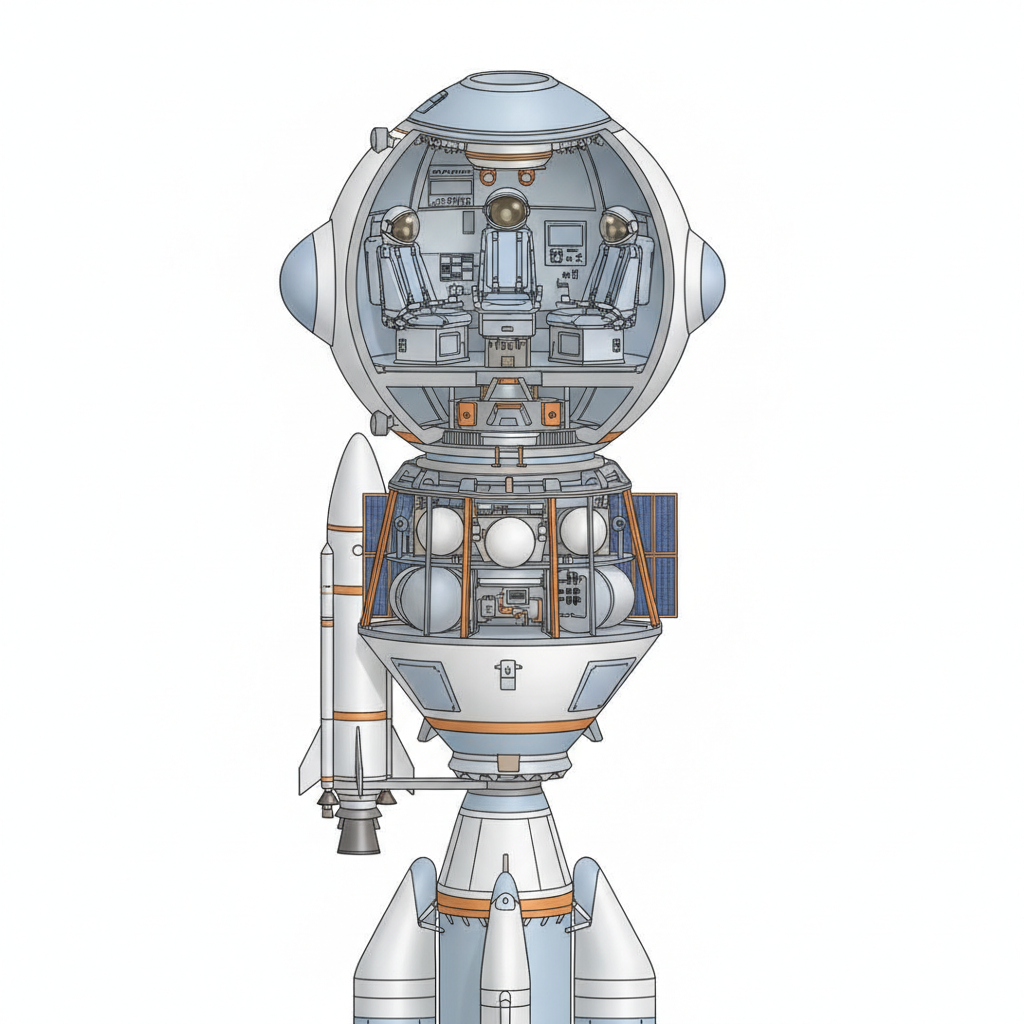 Gaganyaan spacecraftHuman-rating systemsCrew moduleService moduleLaunch vehicle
Subject Relevance — Where This Topic Fits
- GS Paper III — Science and Technology (Space Technology) | GS Paper III — Science and Technology (Indigenisation of Technology)
- Prelims: Human-rated Launch Vehicle (HLVM3), Crew Escape System (CES), Environmental Control and Life Support System (ECLSS), Indian Space Station (BAS), ISRO-NASA collaborations, Gaganyaan mission phases, Vyommitra, ISRO’s budgetary allocations
- Essay: India’s ascent as a space power: From satellites to human spaceflight, The intersection of technology, national pride, and strategic autonomy in space exploration
Quick Revision: Gaganyaan’s success hinges on the human-rating of HLVM3, ECLSS, and CES, with the first uncrewed mission featuring Vyommitra slated for Q4 2026, followed by two additional uncrewed missions targeted by 2027 before India’s first human orbital mission, and the Indian Space Station (BAS) by 2035.
Why is this in the news?
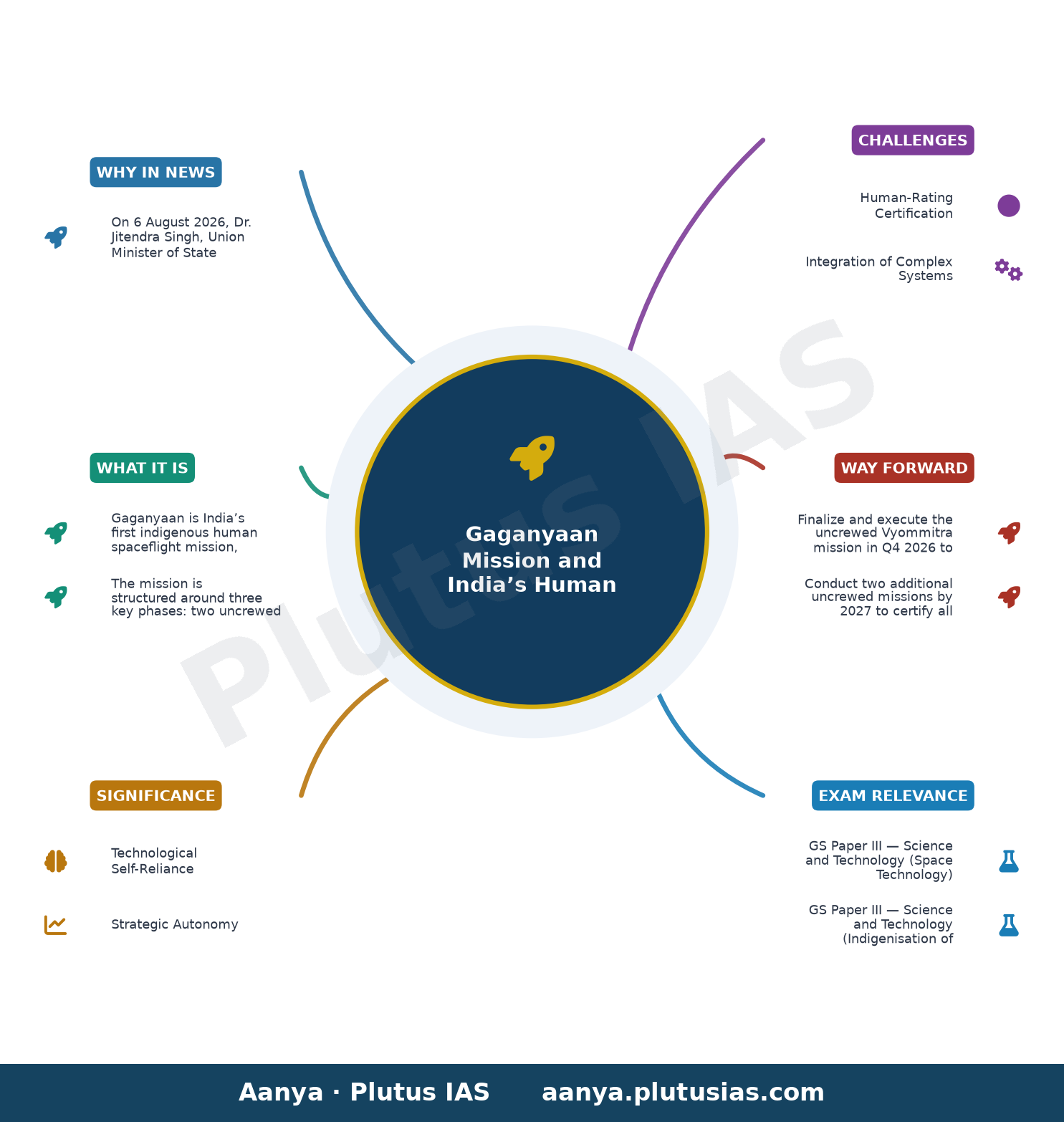
On 6 August 2026, Dr. Jitendra Singh, Union Minister of State (Independent Charge) for Science and Technology, Earth Sciences, and Space, informed the Rajya Sabha about the significant progress achieved by India’s maiden human spaceflight mission, Gaganyaan, particularly in the realm of human-rating critical systems. This announcement underscores the mission’s transition from developmental phases to operational readiness, marking a pivotal moment in India’s space exploration trajectory and aligning with the government’s long-term vision of establishing an indigenous space station by 2035.
Background
- India’s space programme, spearheaded by ISRO, has evolved from satellite launches to complex interplanetary missions, with human spaceflight representing a natural progression in technological capability.
- The Gaganyaan mission, announced in 2018, aims to demonstrate India’s indigenous capability to send humans into Low Earth Orbit (LEO) and safely return them, thereby joining an elite group of nations with human spaceflight programmes.
- The mission is part of a broader strategic vision that includes the development of an Indian Space Station (BAS) by 2035, reflecting India’s commitment to sustained human presence in space.
- Human-rating refers to the certification of space systems to ensure the safety and survival of astronauts during launch, orbital operations, and re-entry, encompassing propulsion, life support, thermal protection, and abort systems.
- Collaborations with international agencies such as ESA, ASA, and NASA for ground support, crew training, and recovery operations highlight India’s integration into the global space exploration ecosystem.
What is the Gaganyaan Mission?
- Gaganyaan is India’s first indigenous human spaceflight mission, designed to send a crew of three astronauts into Low Earth Orbit (LEO) for a duration of up to seven days, followed by a safe return to Earth.
- The mission is structured around three key phases: two uncrewed missions to validate critical technologies, followed by a crewed orbital mission, with a subsequent focus on establishing a permanent Indian Space Station.
- The core technological components include the Human-rated Launch Vehicle (HLVM3), Crew Module (CM), Service Module (SM), Environmental Control and Life Support System (ECLSS), Thermal Protection System (TPS), Crew Escape System (CES), and avionics suite.
- HLVM3, an upgraded version of ISRO’s GSLV Mk III, has undergone rigorous ground testing for all propulsion stages and structural integrity, ensuring reliability for human-rated missions.
- The Crew Module, equipped with ECLSS, provides life support, thermal management, and crew safety during orbital operations and re-entry, while the Service Module houses propulsion and power systems.
- The Crew Escape System (CES) is a critical safety feature designed to abort the mission and safely recover the crew in case of launch vehicle anomalies, with all five motor types successfully tested.
- The mission’s ground infrastructure includes the Orbital Module Preparation Facility, Gaganyaan Control Centre, Crew Training Facility, and modifications to the second launch pad, ensuring end-to-end mission support.
- Vyommitra, a half-humanoid robot, will be deployed in the first uncrewed mission (scheduled for Q4 2026) to validate life support systems and perform microgravity experiments, marking a significant step toward human spaceflight.
Key Features
| Feature | Significance |
|---|---|
| Human-Rated Launch Vehicle (HLVM3) | Development and ground testing of all propulsion stages and structures completed, ensuring reliability for crewed missions. |
| Crew Module and Service Module Propulsion Systems | Development, testing, and certification completed, forming the core of the orbital module for human spaceflight. |
| Environmental Control and Life Support System (ECLSS) | Critical for sustaining human life in space; successfully developed and tested. |
| Crew Escape System (CES) | All five motor types developed and static tested; ensures astronaut safety during abort scenarios. |
| Integrated Air Drop Tests (IADT-01 & IADT-02) | Validated deceleration systems using simulated crew modules, enhancing mission reliability. |
Why it Matters
Technological Self-Reliance
- Demonstrates India’s capability to develop indigenous human-rated space systems, reducing dependence on foreign technologies.
- Advances domestic expertise in propulsion, life support, and thermal protection systems.
- Positions ISRO as a leader in cost-effective and reliable space exploration.
Strategic Autonomy
- Reduces reliance on foreign launch services for human spaceflight missions.
- Enhances India’s geopolitical standing in global space governance and cooperation.
- Strengthens national security by ensuring independent access to space for critical missions.
Economic Impact
- Stimulates growth in aerospace manufacturing, R&D, and allied industries, creating high-skilled employment.
- Attracts foreign investment and partnerships in space technology and commercial ventures.
- Boosts India’s space economy, projected to reach $13 billion by 2025 (ISRO estimates).
Scientific and Educational
- Inspires STEM education and research, fostering a new generation of scientists and engineers.
- Expands India’s scientific knowledge in microgravity, materials science, and human physiology.
- Enhances international collaborations in space science and technology.
Challenges
1. Human-Rating Certification
- Ensuring all systems meet stringent safety and reliability standards for human spaceflight.
- Rigorous testing and validation of life support, thermal, and abort systems.
- UPSLink: GS2/P3: Science & Technology
UPSC Link: GS2/P3
2. Integration of Complex Systems
- Coordinating development and testing of propulsion, avionics, and life support systems.
- Ensuring interoperability between crew module, service module, and launch vehicle.
- UPSLink: GS3/P3: Science & Technology
UPSC Link: GS3/P3
3. Astronaut Safety and Training
- Developing robust crew escape and recovery systems to mitigate launch/abort risks.
- Training astronauts for microgravity, re-entry, and emergency scenarios.
- UPSLink: GS2/P3: Science & Technology
UPSC Link: GS2/P3
4. Infrastructure Development
- Establishing mission control centers, orbital module preparation facilities, and launch pads.
- Ensuring seamless integration of ground communication and recovery assets.
- UPSLink: GS3/P3: Science & Technology
UPSC Link: GS3/P3
5. International Collaboration
- Coordinating with foreign agencies (ESA, ASA) for network support and recovery operations.
- Balancing national priorities with global space governance norms.
- UPSLink: GS2/P3: Science & Technology
UPSC Link: GS2/P3
Challenges — UPSC Perspective
| Issue | Concern |
|---|---|
| Human-Rating Certification | Meeting safety standards for crewed missions. |
| System Integration | Ensuring seamless operation of propulsion, avionics, and life support systems. |
| Astronaut Training | Preparing crew for microgravity, re-entry, and emergency scenarios. |
| Infrastructure Readiness | Developing mission control, launch pads, and recovery assets. |
| International Coordination | Collaborating with foreign agencies for support and compliance. |
| Cost Management | Ensuring budgetary adherence while maintaining high standards. |
Way Forward
- Finalize and execute the uncrewed Vyommitra mission in Q4 2026 to validate human-rated systems.
- Conduct two additional uncrewed missions by 2027 to certify all critical systems for crewed flight.
- Accelerate development of the Indian Space Station (BAS-01 module) for a 2035 operational target.
- Enhance astronaut training programs with advanced simulation and medical support systems.
- Strengthen international partnerships (ESA, ASA) for ground network and recovery operations.
- Expand domestic aerospace manufacturing and R&D to reduce import dependence.
- Establish a dedicated human spaceflight training center for future missions.
- Develop commercial applications of human spaceflight technologies for economic benefits.
UPSC Value Addition
Keywords for Mains Answer-Writing
Gaganyaan Mission · Human Spaceflight Programme · Indian Space Station (BAS) 2035 · Vyommitra · Human-Rated Launch Vehicle (HLVM3) · Crew Escape System (CES) · Environmental Control and Life Support System (ECLSS) · ISRO · Space Station 2035 · Crew Module and Service Module · Test Vehicle Missions (TV-D1, TV-D2) · Orbital Module Preparation Facility · ISRO-ESA collaboration · Budgetary Allocation for Human Spaceflight Programme
Concept Flow
India’s indigenous human spaceflight program (Gaganyaan) → Development of human-rated launch vehicle (HLVM3) → Certification of crew module, service module, and life support systems → Execution of uncrewed missions (Vyommitra, 2026) → Validation of crew escape and recovery systems → First crewed orbital mission (2027) → Establishment of Indian Space Station (2035) → Long-term human space exploration and commercialization.
Prelims Practice Questions
Q1. Consider the following statements regarding India’s Gaganyaan Mission:
1. The first unmanned mission carrying Vyommitra is scheduled for the fourth quarter of 2026.
2. The Crew Escape System (CES) has been developed with five types of motors.
3. The Indian Space Station (BAS) is planned to be operational by 2030.
How many of the above statements are correct?
- Only one
- Only two
- All three
- None
Answer: Only two — Statement 1 is correct as the first unmanned mission with Vyommitra is targeted for Q4 2026. Statement 2 is correct as the CES includes five types of motors. Statement 3 is incorrect as the Indian Space Station is planned for 2035, not 2030.
Q2. Assertion (A): The Environmental Control and Life Support System (ECLSS) is a critical component for human spaceflight missions.
Reason (R): ECLSS ensures the survival of astronauts by regulating oxygen, temperature, and humidity in the crew module.
Options:
A. Both A and R are true, and R is the correct explanation of A.
B. Both A and R are true, but R is not the correct explanation of A.
C. A is true, but R is false.
D. A is false, but R is true.
Answer: ? — Assertion (A) is true as ECLSS is indeed critical for human survival in space. Reason (R) correctly explains why ECLSS is essential, detailing its functions. Thus, both A and R are true, and R is the correct explanation of A.
Q3. Match the following missions with their respective objectives under the Gaganyaan Programme:
Column I
1. TV-D1 Mission
2. Integrated Air Drop Test-01
3. Integrated Air Drop Test-02
4. Vyommitra Mission
Column II
A. Validation of Crew Escape System during flight
B. Verification of the deceleration system
C. Testing of the deceleration system with a simulated crew module
D. First unmanned mission carrying Vyommitra
Options:
A. 1-A, 2-B, 3-C, 4-D
B. 1-A, 2-C, 3-B, 4-D
C. 1-B, 2-A, 3-C, 4-D
D. 1-D, 2-A, 3-B, 4-C
Answer: ? — TV-D1 Mission (1) aimed to validate the Crew Escape System during flight (A). Integrated Air Drop Test-01 (2) and Integrated Air Drop Test-02 (3) were conducted to verify the deceleration system using a simulated crew module (C and B, respectively). The Vyommitra Mission (4) is the first unmanned mission carrying Vyommitra (D).
Mains Practice Question
✍ The Gaganyaan Mission represents India’s maiden foray into human spaceflight, with a stated objective of establishing an Indian Space Station (BAS) by 2035. Critically analyse the technological, logistical, and strategic dimensions of this mission. Also, examine how the Gaganyaan Programme aligns with India’s broader ambitions in space exploration and its implications for India’s global standing in the aerospace sector. (15 Marks)
Approach: MODEL-ANSWER SKELETON:
1. **Technological Dimensions** (5 Marks):
– Human-rated launch vehicle (HLVM3) and propulsion systems: Explain the development and testing of all propulsion stages, crew module, and service module.
– Critical systems: ECLSS, thermal protection, deceleration, and crew module uprighting systems.
– Crew Escape System (CES): Describe the five types of motors and their static tests.
– Test Vehicle Missions (TV-D1, TV-D2): Purpose and outcomes, including Integrated Air Drop Tests.
– Infrastructure: Orbital Module Preparation Facility, Gaganyaan Control Centre, and modifications to the second launch pad.
2. **Logistical and Operational Dimensions** (5 Marks):
– Unmanned missions: Role of Vyommitra in the first unmanned mission (Q4 2026) and subsequent unmanned missions (2027).
– Ground support: Ground communication network, IDRSS-1 feeder station, recovery assets, and astronaut training.
– Budgetary allocation: ₹20,193 crore for eight missions (approved by the Union Cabinet in September 2024).
– International collaborations: ISRO-ESA, ASR for crew recovery, and training of flight surgeons.
3. **Strategic and Global Standing** (5 Marks):
– Alignment with India’s space vision: Indian Space Station (BAS) by 2035, including the five-module structure and approval for BAS-01.
– Comparison with global peers: Contrast India’s timeline and objectives with those of NASA’s Artemis, China’s Tiangong, and private players like SpaceX.
– Implications for India’s aerospace sector: Boost to indigenous technology, self-reliance (Atmanirbhar Bharat), and potential for commercial spaceflight.
– Geopolitical significance: Enhancing India’s soft power and strategic autonomy in space exploration.
Balance of views: Acknowledge challenges such as cost, technological risks, and the need for sustained funding and international cooperation. Conclude with a forward-looking perspective on India’s role in the global space economy.
Source: PIB (Press Information Bureau)
Generated by AanyaAi for educational purpose.

- तमिलनाडु के लिए क्या है ‘एल नीनो’ और उत्तर-पूर्वी मानसून का खतरा? - September 23, 2026
- El Nino & Northeast Monsoon: Impact on Tamil Nadu for UPSC 2026 - September 23, 2026
- हिमाचल में डिजिटल भुगतान क्रांति: बिलासपुर अव्वल, महिलाओं की भागीदारी 93% तक पहुंची - September 23, 2026

No Comments