


06 Aug Gaganyaan Mission: Key Milestones & Roadmap Revealed in Rajya Sabha
✎ Gaganyaan’s human-rated HLVM3, Crew Escape System, and ECLSS are critical milestones, while the 2035 Indian Space Station underscore India’s strategic commitment to sustained human spaceflight.
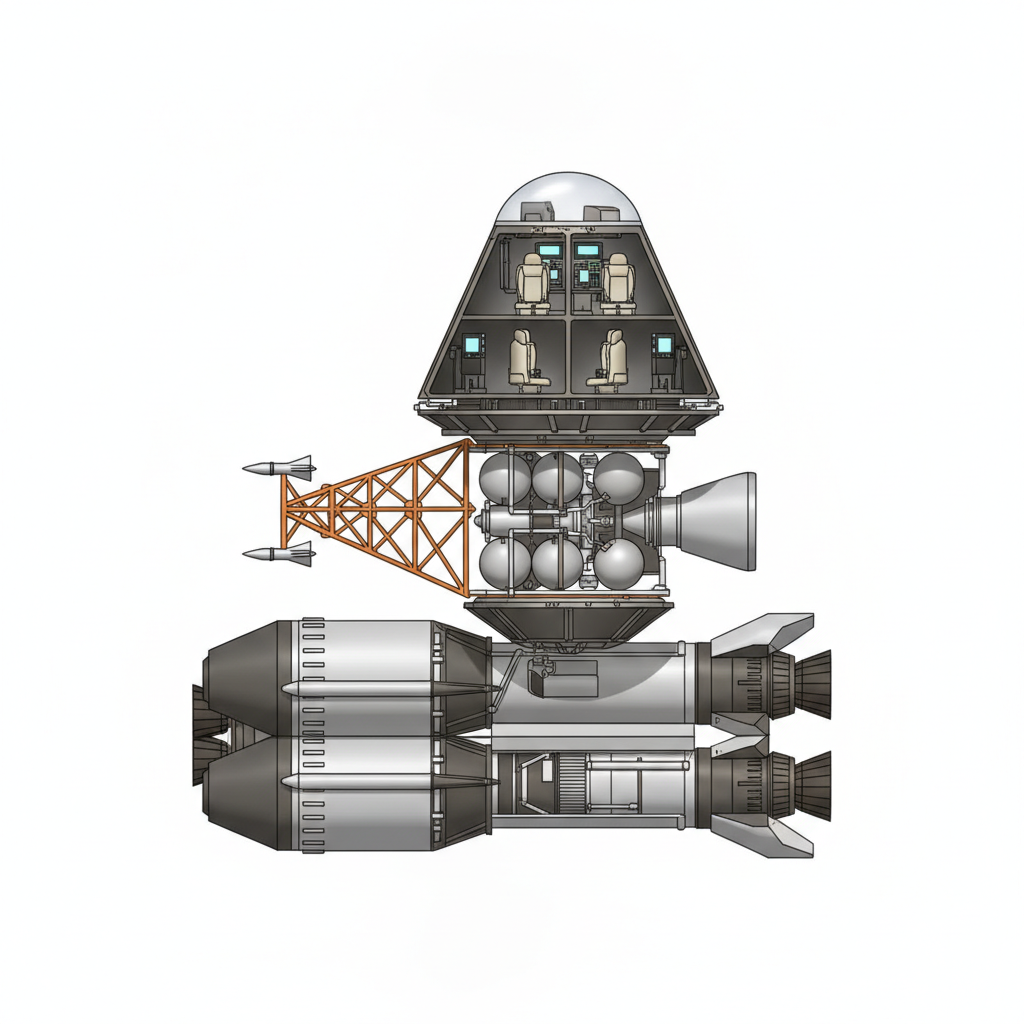 Crew modulePropulsion stagesSafety mechanisms
Subject Relevance — Where This Topic Fits
- GS Paper III — Science and Technology (Space Technology) | GS Paper III — Science and Technology (Indigenization of Technology)
- Prelims: Gaganyaan Mission, Human-rated Launch Vehicle (HLVM3), Vyommitra, Crew Escape System (CES), Indian Space Station (BAS) by 2035, ISRO, Atomic Energy and Space Ministry, Test Vehicle Missions (TV-D1, TV-D2), Integrated Air Drop Tests (IADT-01, IADT-02), Environmental Control and Life Support System (ECLSS), Thermal Protection System, Deceleration System, Orbital Module Preparation Facility, Gaganyaan Control Centre, Recovery Assets, IDRSS-1 Feeder Station, Cabinet approval for ₹20,193 crore in 2024
- Essay: India’s Journey to Self-Reliance in Space Technology: From Gaganyaan to a Global Space Power, The Role of Human Spaceflight in National Development and Strategic Autonomy
Quick Revision: Gaganyaan’s human-rated HLVM3, Crew Escape System, and ECLSS are critical milestones, while the 2035 Indian Space Station underscore India’s strategic commitment to sustained human spaceflight.
Why is this in the news?
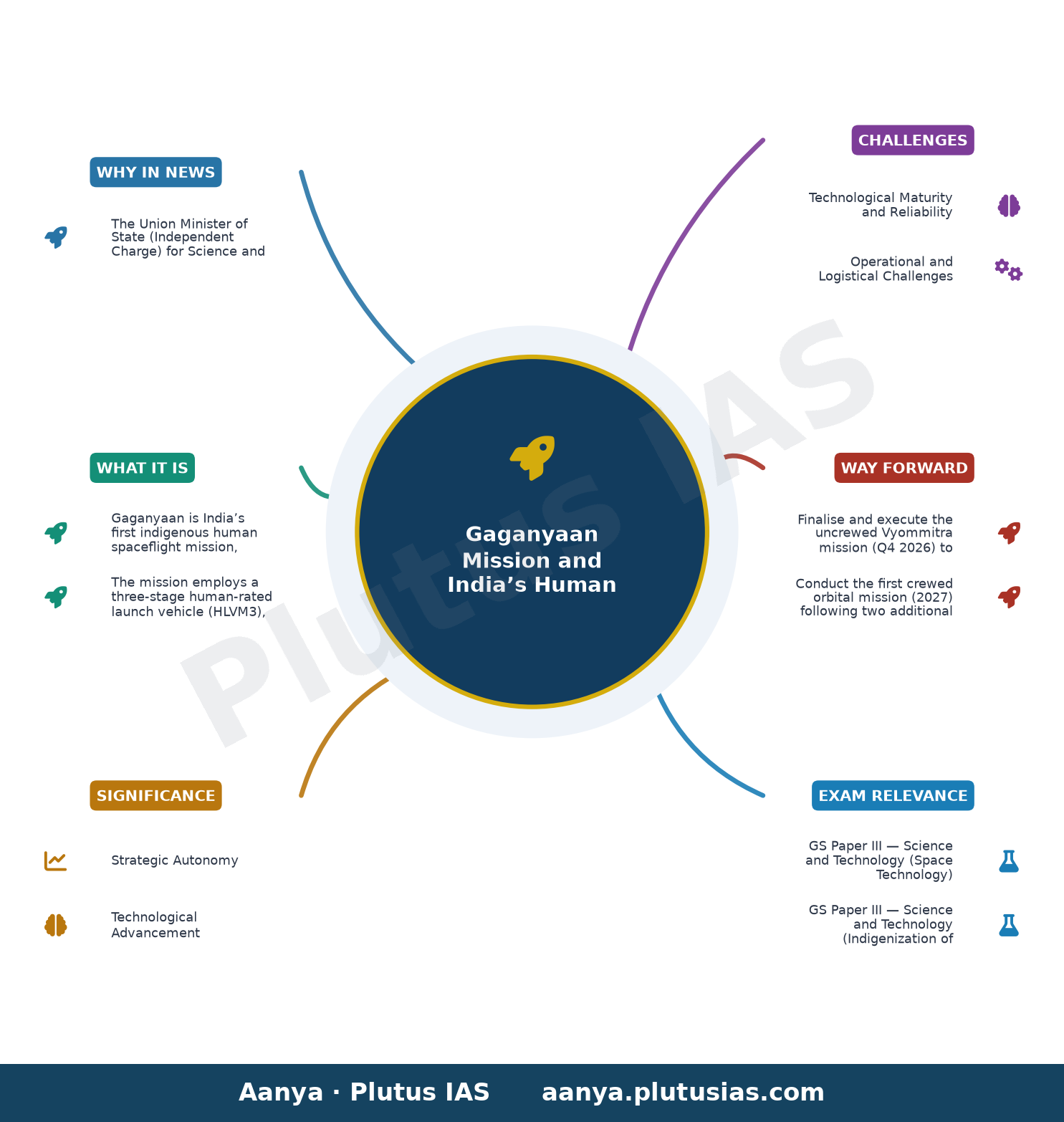
The Union Minister of State (Independent Charge) for Science and Technology, Earth Sciences, and Space, Dr. Jitendra Singh, informed the Rajya Sabha on August 6, 2026, about the significant progress achieved by India’s Gaganyaan mission toward its first indigenous human spaceflight. Key advancements in human-rated systems, including propulsion stages, crew module technologies, and critical safety mechanisms, were highlighted, alongside the roadmap for India’s first human orbital mission and the establishment of an Indian Space Station by 2035. This update underscores India’s strategic push in space exploration and its alignment with global benchmarks in human spaceflight capabilities.
Background
- India’s Gaganyaan mission, announced in 2018, is the country’s maiden human spaceflight programme, aimed at demonstrating indigenous capability to send humans to Low Earth Orbit (LEO) and return them safely to Earth.
- The mission is part of India’s broader vision to establish a sustained human presence in space, including the development of an Indian Space Station (BAS) by 2035, as articulated in the Prime Minister’s Independence Day address in 2018.
- Gaganyaan’s development is being undertaken by ISRO in collaboration with multiple national agencies, international partners (e.g., ESA for network support, ASA for recovery operations), and private sector entities to ensure technological robustness and cost-efficiency.
- The mission follows a phased approach, beginning with uncrewed test flights (including Vyommitra), followed by crewed missions, and culminating in the establishment of a modular space station.
- India’s human spaceflight programme is a critical component of its broader space policy, which also includes missions like Chandrayaan and Aditya-L1, aimed at enhancing scientific research and strategic autonomy.
What is the Gaganyaan Mission and India’s Human Spaceflight Roadmap?
- Gaganyaan is India’s first indigenous human spaceflight mission, designed to send a crew of three astronauts to a Low Earth Orbit (LEO) of 400 km for a duration of 3–7 days before returning them safely to Earth.
- The mission employs a three-stage human-rated launch vehicle (HLVM3), derived from ISRO’s GSLV Mk III, with modifications for human safety, including a Crew Escape System (CES) to ensure astronaut survival in case of launch aborts.
- Key technological components include the Crew Module (CM) and Service Module (SM), which house life support systems, thermal protection, and avionics for navigation and communication. The Environmental Control and Life Support System (ECLSS) regulates oxygen, humidity, and temperature within the CM.
- The mission’s roadmap includes multiple test flights: (1) Uncrewed missions with Vyommitra (a half-humanoid) to validate systems, (2) Integrated Air Drop Tests (IADT) to assess deceleration systems, and (3) Crewed orbital missions to demonstrate end-to-end human spaceflight capability.
- The Indian Space Station (BAS), planned for 2035, will be a modular orbital platform with five modules, serving as a hub for microgravity research, technology demonstration, and international collaborations. The first module, BAS-01, has received government approval for development and launch.
- Safety and reliability are paramount, with the Crew Escape System (CES) undergoing rigorous testing, including static tests of all five motor types and qualification of structural components. Recovery assets and ground infrastructure (e.g., Gaganyaan Control Centre, Orbital Module Preparation Facility) have been established to ensure astronaut retrieval post-mission.
- The mission aligns with India’s long-term space policy, emphasizing self-reliance, indigenous innovation, and strategic autonomy in space exploration, while also fostering international partnerships for technology transfer and mission support.
- The Gaganyaan programme is not merely a technological endeavour but a catalyst for inspiring STEM education, fostering entrepreneurship in the space sector, and positioning India as a credible player in the global space economy.
Key Features
| Feature | Significance |
|---|---|
| Human-Rated Launch Vehicle (HLVM3) | Fully indigenous propulsion systems and structural integrity validated; critical for crew safety and mission success in India’s maiden human spaceflight. |
| Crew Module and Service Module Propulsion | Development, testing, and certification completed; ensures orbital manoeuvring and life support during the mission. |
| Environmental Control and Life Support System (ECLSS) | Regulates oxygen, temperature, and humidity; essential for astronaut survival in the vacuum of space. |
| Crew Escape System (CES) | Five types of motors developed and tested; provides emergency abort capability to safeguard crew during launch or ascent. |
| Orbital Module Preparation Facility | Established to integrate crew module, service module, and payloads; supports pre-launch and post-landing operations. |
| Integrated Air Drop Tests (IADT-01 & IADT-02) | Validated deceleration systems using simulated crew modules; crucial for safe re-entry and landing. |
| Indian Data Relay Satellite System (IDRSS) | Ground communication network finalised; enables real-time telemetry and command during all mission phases. |
Why it Matters
Strategic Autonomy
- Reduces dependence on foreign space agencies for human spaceflight capabilities, aligning with India’s self-reliance (Atmanirbhar Bharat) goals.
- Positions India as a credible competitor in the global space economy, particularly in commercial human spaceflight and satellite services.
- Enhances national prestige and soft power, reinforcing India’s status as a leading spacefaring nation.
Technological Advancement
- Accelerates indigenous development of critical aerospace technologies, including life support, thermal protection, and re-entry systems.
- Demonstrates India’s capability to execute complex, multi-stage missions with precision, akin to established spacefaring nations.
- Facilitates spin-offs in adjacent sectors such as robotics, materials science, and artificial intelligence.
Economic Impact
- Stimulates growth in India’s space industry, creating high-skilled jobs and fostering innovation in private sector participation.
- Opens avenues for commercial partnerships in satellite launches, space tourism, and microgravity research.
- Potential to attract foreign direct investment (FDI) in India’s space sector, diversifying revenue streams.
Scientific Research
- Enables microgravity experiments, biomedical research, and material science studies in orbit, contributing to global scientific knowledge.
- Supports India’s long-term goals in planetary science, astronomy, and astrobiology through sustained human presence in space.
- Provides a platform for international collaboration, particularly with agencies like ESA, NASA, and JAXA.
Challenges
1. Technological Maturity and Reliability
- Achieving human-rated certification for all systems, including propulsion, life support, and thermal protection, under extreme operational conditions.
- Ensuring fail-safe mechanisms for critical systems such as ECLSS and CES to mitigate risks during mission phases.
- Validating long-duration mission capabilities, including radiation shielding and psychological support for astronauts.
UPSC Link: GS3: Science & Tech
2. Operational and Logistical Challenges
- Coordinating multi-agency efforts across ISRO, DRDO, and private sector partners for seamless mission execution.
- Managing ground infrastructure, including launch pads, tracking networks, and recovery assets, for high-frequency missions.
- Ensuring real-time communication and data relay, particularly in polar and equatorial orbits.
UPSC Link: GS3: Infrastructure
3. Human Factors and Safety
- Addressing physiological and psychological challenges for astronauts, including microgravity effects, radiation exposure, and isolation.
- Developing robust training programs for astronauts, flight surgeons, and ground support teams.
- Implementing stringent medical protocols for crew selection, health monitoring, and emergency response.
UPSC Link: GS3: Science & Tech
4. International Collaboration and Competition
- Balancing strategic partnerships with foreign agencies (e.g., ESA, ASA) while safeguarding sensitive technologies and data.
- Navigating geopolitical sensitivities in space cooperation, particularly with nations having divergent space policies.
- Competing with established players like the USA, Russia, and China in the human spaceflight domain.
UPSC Link: GS2: International Relations
5. Budgetary and Resource Allocation
- Ensuring sustained funding for the Gaganyaan programme and subsequent missions, including the Indian Space Station.
- Optimising resource utilisation to avoid cost overruns and delays in critical technology development.
- Leveraging public-private partnerships to reduce financial burden on the exchequer.
UPSC Link: GS3: Economy
Challenges — UPSC Perspective
| Issue | Concern |
|---|---|
| Human-Rated Certification | Ensuring all systems meet stringent safety standards for crewed missions. |
| Real-Time Communication | Maintaining uninterrupted telemetry and command links during all mission phases. |
| Astronaut Training | Developing comprehensive programmes for physical, medical, and psychological preparation. |
| Recovery Operations | Coordinating assets for safe crew and module retrieval post-mission. |
| Regulatory Framework | Establishing clear guidelines for human spaceflight, including liability and insurance norms. |
| Sustainability of Space Station | Ensuring long-term viability of the Indian Space Station with modular upgrades and resupply missions. |
Way Forward
- Finalise and execute the uncrewed Vyommitra mission (Q4 2026) to validate critical systems and crew interfaces.
- Conduct the first crewed orbital mission (2027) following two additional uncrewed test flights for system refinement.
- Accelerate the development and launch of the Indian Space Station’s first module (BAS-01) by 2035, with modular expansion thereafter.
- Enhance international collaborations with agencies like ESA and ASA to leverage expertise in communication and recovery operations.
- Strengthen indigenous R&D in life support, thermal protection, and re-entry technologies to reduce reliance on foreign systems.
- Establish a dedicated astronaut training facility and simulation centres to prepare crews for extended missions.
- Develop a robust space debris mitigation strategy to ensure the safety and sustainability of the Indian Space Station.
- Increase public-private partnerships to foster innovation and commercialise space technologies for economic growth.
UPSC Value Addition
Keywords for Mains Answer-Writing
Gaganyaan Mission · Human Spaceflight Programme · Indian Space Station (BAS) 2035 · Vyommitra (half-humanoid) · Human-rated Launch Vehicle (HLVM3) · Crew Escape System (CES) · Environmental Control and Life Support System (ECLSS) · ISRO’s Orbital Module Preparation Facility · Indian Data Relay Satellite System (IDRSS) · Cabinet approval for Gaganyaan missions (₹20,193 crore) · Crew Module and Service Module propulsion systems · Integrated Air Drop Tests (IADT-01, IADT-02) · Test Vehicle missions (TV-D1, TV-D2) · International collaborations for Gaganyaan (ESA, ASA)
Concept Flow
India’s space programme evolves from satellite launches to indigenous human spaceflight (Gaganyaan) → Development of human-rated systems (HLVM3, ECLSS, CES) → Validation through uncrewed and crewed test missions → Establishment of Indian Space Station (2035) → Long-term scientific and commercial utilisation → Global leadership in space exploration
Prelims Practice Questions
Q1. Consider the following statements regarding India’s Gaganyaan Mission:
1. The first uncrewed mission with Vyommitra is targeted for the fourth quarter of 2026.
2. The Crew Escape System (CES) has been successfully tested with all five types of motors developed indigenously.
3. The Indian Data Relay Satellite System (IDRSS) is designed to support real-time communication with the Gaganyaan crew module.
How many of the above statements are correct?
- Only one
- Only two
- All three
- None
Answer: All three — Statements 1 and 2 are correct as per the official announcement. Statement 3 is incorrect because IDRSS is not yet operational for Gaganyaan; ground communication networks and feeder stations have been established, but IDRSS-1 is still under development.
Q2. Assertion (A): The Indian Space Station (BAS) is planned to be operational by 2035 with a five-module configuration.
Reason (R): The Union Cabinet approved ₹20,193 crore for eight missions under the Gaganyaan programme in September 2024.
Options:
A. Both A and R are true, and R is the correct explanation of A.
B. Both A and R are true, but R is not the correct explanation of A.
C. A is true, but R is false.
D. A is false, but R is true.
- A
- B
- C
- D
Answer: B — Both Assertion (A) and Reason (R) are true. The BAS is planned for 2035 with a five-module structure, and the Cabinet approved ₹20,193 crore for the Gaganyaan programme. However, R does not directly explain A, as the budget pertains to Gaganyaan missions, not the BAS.
Q3. Match the following missions/technologies with their respective timelines or objectives:
Column I
1. Vyommitra mission
2. Crewed orbital mission
3. Test Vehicle-D1 (TV-D1)
4. Indian Space Station (BAS-01 module)
Column II
a. 2026 Q4
b. 2027
c. 2035
d. Post-TV-D1, pre-crewed flight
- 1-a, 2-b, 3-d, 4-c
- 1-b, 2-a, 3-d, 4-c
- 1-a, 2-d, 3-b, 4-c
- 1-d, 2-b, 3-a, 4-c
Answer: 1-a, 2-b, 3-d, 4-c — 1-a: Vyommitra mission is targeted for 2026 Q4. 2-b: Crewed orbital mission is planned for 2027. 3-d: TV-D1 was completed, and TV-D2 is in preparation, with the crewed mission following thereafter. 4-c: BAS-01 module is planned for 2035.
Mains Practice Question
✍ The Gaganyaan Mission represents India’s ambitious leap into human spaceflight, with the Indian Space Station (BAS) slated for operationalisation by 2035. In this context, critically examine the technological, institutional, and strategic dimensions of India’s human space exploration programme. Also, assess the role of international collaborations in mitigating risks and enhancing mission success. (15 Marks)
Approach: MODEL-ANSWER SKELETON:
1. **Technological Dimensions (6 points)**
– Human-rated Launch Vehicle (HLVM3): Development and certification of all propulsion stages, structural integrity, and ground testing.
– Crew Module and Service Module: Indigenous propulsion systems, Environmental Control and Life Support System (ECLSS), thermal protection, and avionics.
– Crew Escape System (CES): Five types of motors tested; critical for astronaut safety during abort scenarios.
– Integrated Air Drop Tests (IADT-01, IADT-02): Validation of deceleration systems using simulated crew modules.
– Ground Infrastructure: Orbital Module Preparation Facility, Gaganyaan Control Centre, Crew Testing Facility, and modifications to the second launch pad.
– Future Technologies: Development of Indian Data Relay Satellite System (IDRSS) for real-time communication.
2. **Institutional Dimensions (5 points)**
– ISRO’s Role: Central agency for design, development, and execution; inter-centre collaboration for system engineering and technology development.
– Budgetary Allocation: ₹20,193 crore approved by the Union Cabinet in September 2024 for eight missions, ensuring financial sustainability.
– Regulatory and Safety Protocols: Adherence to international standards for human spaceflight, including astronaut training, medical protocols, and recovery operations.
– Public-Private Partnership: Engagement with industry for subsystem development and testing.
– Long-term Vision: Alignment with India’s space policy and the goal of establishing a permanent human presence in Low Earth Orbit (LEO).
3. **Strategic Dimensions (2 points)**
– Geopolitical Significance: Assertion of India’s technological prowess and strategic autonomy in space exploration.
– Economic and Scientific Benefits: Spin-offs in materials science, robotics, and life sciences; potential for commercial space ventures.
4. **International Collaborations (2 points)**
– European Space Agency (ESA): Support for ground communication networks and mission operations.
– Australian Space Agency (ASA): Collaboration on crew and crew module recovery operations.
– Training and Expertise: Partnerships with international agencies for flight surgeons, ground support teams, and astronaut training.
– Risk Mitigation: Leveraging global expertise to address technical challenges and ensure mission success.
Balance of Views:
– Optimistic Perspective: India’s programme is a testament to indigenous innovation and strategic foresight, positioning the country as a leader in global space exploration.
– Critical Perspective: Challenges such as cost overruns, technological delays, and the need for sustained funding could pose risks to the programme’s timeline and objectives.
Source: PIB (Press Information Bureau)
Generated by AanyaAi for educational purpose.

- तमिलनाडु के लिए क्या है ‘एल नीनो’ और उत्तर-पूर्वी मानसून का खतरा? - September 23, 2026
- El Nino & Northeast Monsoon: Impact on Tamil Nadu for UPSC 2026 - September 23, 2026
- हिमाचल में डिजिटल भुगतान क्रांति: बिलासपुर अव्वल, महिलाओं की भागीदारी 93% तक पहुंची - September 23, 2026

No Comments