


18 Aug Ganga Expressway Shoulder Damage: UPIDA’s 4-Hour Repair & Traffic Impact Analysis
✎ The Ganga Expressway’s rapid repair mechanism exemplifies the integration of PPP models, real-time monitoring, and MoRTH-compliant maintenance protocols to ensure resilience in critical infrastructure.
Subject Relevance — Where This Topic Fits
- GS Paper III — Infrastructure: Energy, Ports, Roads, Airports, Railways, etc.
- Prelims: Expressways, National Highways Authority of India (NHAI), Uttar Pradesh Expressways Industrial Development Authority (UPEIDA), Concessionaire model, Geosynthetic Stabilized Bases (GSB), Cavitation in road subgrades, Cross-drainage structures
- Essay: Resilience in Public Infrastructure: Balancing Speed, Safety, and Sustainability
Quick Revision: The Ganga Expressway’s rapid repair mechanism exemplifies the integration of PPP models, real-time monitoring, and MoRTH-compliant maintenance protocols to ensure resilience in critical infrastructure.
Why is this in the news?
The Ganga Expressway, a critical infrastructure asset in Uttar Pradesh, experienced localized shoulder damage due to heavy rainfall on 16–17 August 2026. The incident underscores the operational challenges of maintaining high-speed corridors in monsoon conditions and highlights the efficacy of rapid-response maintenance protocols implemented by the Uttar Pradesh Expressways Industrial Development Authority (UPEIDA) and the concessionaire. The swift restoration of the affected segment—completed within four hours without disrupting traffic—demonstrates institutional preparedness in mitigating disruptions to critical transport networks.
Background
- The Ganga Expressway is a 594-kilometre access-controlled expressway under development in Uttar Pradesh, connecting Meerut to Prayagraj, with an estimated cost of ₹36,200 crore.
- The project is being executed on a public-private partnership (PPP) basis under the Hybrid Annuity Model (HAM), with the concessionaire responsible for design, construction, operation, and maintenance for a 30-year period.
- Uttar Pradesh Expressways Industrial Development Authority (UPEIDA), the nodal agency for expressway development in the state, oversees implementation, monitoring, and maintenance protocols.
- Expressways in India are designed to accommodate high-speed traffic (100–120 km/h) and incorporate advanced drainage systems, geosynthetic reinforcement, and robust subgrade layers to withstand environmental stresses.
- Monsoon-induced challenges such as soil erosion, waterlogging, and structural degradation are recurring concerns for expressway maintenance, necessitating real-time monitoring and rapid repair mechanisms.
What is the Ganga Expressway, and how does its maintenance framework function?
- The Ganga Expressway is a 6-lane (expandable to 8-lane) access-controlled expressway, part of Uttar Pradesh’s broader expressway network aimed at improving regional connectivity and economic integration.
- The expressway is divided into multiple construction packages, with the Meerut–Prayagraj stretch divided into 12 packages, each managed by a designated concessionaire under UPEIDA’s oversight.
- Maintenance responsibilities are contractually assigned to the concessionaire for the operational phase, which includes routine inspections, preventive maintenance, and emergency repairs to ensure structural integrity and user safety.
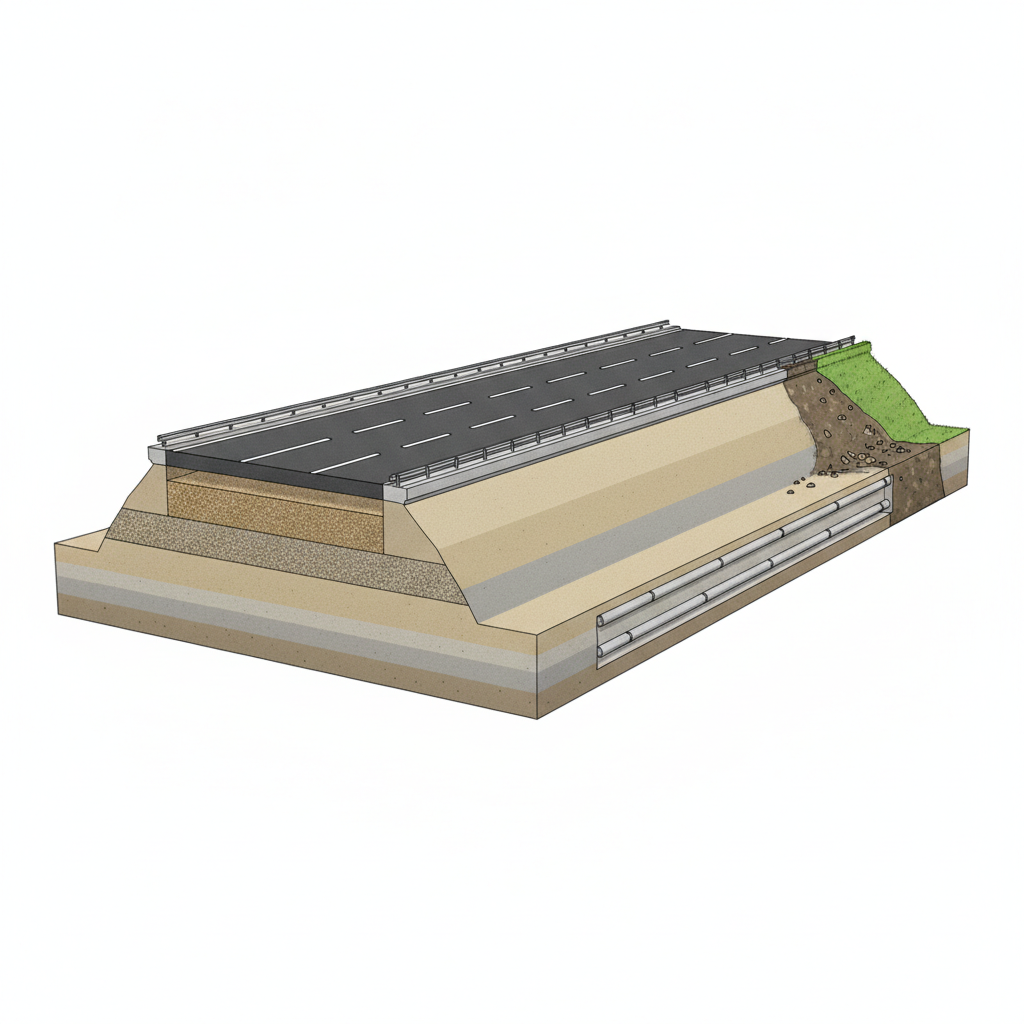
- Rapid-response protocols were activated immediately upon detection, including barricading of the affected area, debris removal, and restoration using Geosynthetic Stabilized Bases (GSB) and concrete fill to re-establish the subgrade and shoulder integrity.
- The repair process adhered to the Ministry of Road Transport and Highways (MoRTH) guidelines for expressway maintenance, emphasizing minimal traffic disruption and adherence to safety standards.
- UPEIDA’s technical report confirmed that the main carriageway (three lanes) remained unaffected, and traffic flow was uninterrupted throughout the repair operation.
- The incident highlights the importance of real-time monitoring systems, including automated sensors and drone-based inspections, in identifying vulnerabilities in expressway infrastructure during extreme weather events.
Key Features
| Feature | Significance |
|---|---|
| Rapid damage detection and isolation | Minimised disruption to expressway traffic through immediate barricading of the affected 5-6 metre stretch. |
| Standardised repair protocol | Adherence to engineering norms using GSB material and concrete backfill for structural restoration. |
| Concurrent traffic management | Maintenance of all three lanes in operational condition despite repair work. |
| Technical documentation | Joint inspection reports and pre/post-repair photographs submitted to headquarters for audit. |
Why it Matters
Infrastructure Resilience
- Demonstrates the operational robustness of expressway maintenance systems under monsoon stress.
- Highlights the role of drainage infrastructure in preventing shoulder erosion and subsidence.
Institutional Efficiency
- Shows the efficacy of UPIDA’s rapid-response protocols for incident management.
- Illustrates inter-agency coordination between concessionaire, engineering teams, and regulatory authorities.
Public Utility
- Ensures continuity of freight and passenger mobility along the Ganga corridor.
- Prevents secondary hazards such as waterlogging or accidents due to road surface failure.
Challenges
1. Monsoon-induced shoulder erosion
- Intense rainfall leading to water infiltration and soil washout beneath the shoulder.
- Risk of progressive damage if unaddressed, potentially compromising the entire carriageway.
UPSC Link: GS3: Disaster Management
2. Traffic disruption mitigation
- Need to maintain uninterrupted flow on a high-traffic expressway during repairs.
- Coordination challenges in managing diversions and safety barriers without congestion.
UPSC Link: GS3: Infrastructure Development
3. Quality control in emergency repairs
- Ensuring repairs meet design specifications to prevent recurrence.
- Verification of material quality (GSB, concrete) under time constraints.
UPSC Link: GS3: Construction Standards
Challenges — UPSC Perspective
| Issue | Concern |
|---|---|
| Localized subsidence | Potential for sudden collapse if drainage failure persists. |
| Material degradation | Risk of substandard fill material leading to future failures. |
| Operational delays | Extended lane closures could impact logistics and economic activity. |
| Climate vulnerability | Increased frequency of extreme weather events exacerbating maintenance demands. |
Way Forward
- Enhance real-time monitoring of expressway shoulders using IoT-based sensors for early detection of erosion.
- Conduct pre-monsoon structural audits of drainage systems and sub-surface layers.
- Integrate predictive maintenance models using historical rainfall and soil data.
- Establish a dedicated rapid-response team for expressway incidents with pre-positioned repair materials.
- Strengthen inter-departmental coordination between UPIDA, NHAI, and state disaster management agencies.
- Develop standard operating procedures for emergency repairs with clear timelines and accountability.
- Promote public awareness campaigns on reporting road defects to expedite corrective action.
UPSC Value Addition
Keywords for Mains Answer-Writing
Ganga Expressway · National Highways Authority of India (NHAI) · Uttar Pradesh Expressways Industrial Development Authority (UPEIDA) · Expressway infrastructure maintenance · road safety standards · concessionaire model · operational resilience · climate-resilient infrastructure · road shoulder failure · drainage systems in highways · emergency repair protocols · public-private partnership (PPP) in infrastructure · traffic management during emergencies
Concept Flow
Heavy monsoon rainfall → Infiltration into shoulder sub-base → Soil erosion and cavity formation → Structural subsidence → Immediate barricading → Joint inspection → Identification of drainage failure → Repair using GSB and concrete → Traffic resumption → Post-repair documentation
Prelims Practice Questions
Q1. Consider the following statements regarding the Ganga Expressway:
1. It is a 594 km long access-controlled expressway connecting Meerut to Prayagraj.
2. The expressway is implemented under the public-private partnership (PPP) model.
3. The Uttar Pradesh Expressways Industrial Development Authority (UPEIDA) is the nodal agency for its implementation.
4. The expressway is designed to have six lanes initially, with provisions for future expansion.
How many of the above statements are correct?
- Only one
- Only two
- Only three
- All four
Answer: All four — Statements 1, 3, and 4 are correct. Statement 2 is incorrect as the Ganga Expressway is implemented under the EPC (Engineering, Procurement, and Construction) model, not the PPP model.
Q2. Assertion (A): The shoulder of a highway is primarily designed to provide structural support to the main carriageway.
Reason (R): The shoulder absorbs lateral stresses and prevents edge failure of the pavement, thereby enhancing road safety.
Options:
A. Both A and R are true, and R is the correct explanation of A.
B. Both A and R are true, but R is not the correct explanation of A.
C. A is true, but R is false.
D. A is false, but R is true.
Answer: ? — Both Assertion (A) and Reason (R) are true, and Reason (R) correctly explains Assertion (A). The shoulder of a highway provides structural support to the main carriageway by absorbing lateral stresses and preventing edge failure, which enhances road safety.
Q3. Match the following pairs related to expressway infrastructure in India:
Column I (Agency/Authority)
A. National Highways Authority of India (NHAI)
B. Uttar Pradesh Expressways Industrial Development Authority (UPEIDA)
C. Ministry of Road Transport and Highways (MoRTH)
D. Concessionaire
Column II (Role/Function)
1. Implements expressway projects under PPP model
2. Regulatory and policy framework for national highways
3. Nodal agency for expressway development in Uttar Pradesh
4. Responsible for operation and maintenance of expressway sections
Options:
A-1, B-3, C-2, D-4
A-2, B-4, C-1, D-3
A-3, B-1, C-4, D-2
A-4, B-2, C-3, D-1
Answer: ? — The correct match is: A-2 (NHAI is the regulatory and policy framework authority for national highways), B-3 (UPEIDA is the nodal agency for expressway development in Uttar Pradesh), C-1 (MoRTH formulates the regulatory and policy framework), D-4 (Concessionaire is responsible for operation and maintenance of expressway sections under PPP model).
Mains Practice Question
✍ The rapid repair of a damaged shoulder on the Ganga Expressway within four hours of detection underscores the operational resilience of India’s expressway infrastructure. Critically examine the institutional, technical, and policy frameworks that enable such swift corrective actions in expressway projects. Also, analyse the challenges in maintaining climate-resilient infrastructure in India’s expressway network. (15 Marks)
Approach: MODEL-ANSWER SKELETON:
1. **Institutional Frameworks (4 Marks)**
– Role of Uttar Pradesh Expressways Industrial Development Authority (UPEIDA) as the nodal agency for expressway development in Uttar Pradesh.
– Coordination between UPEIDA, concessionaires, and state agencies (e.g., irrigation departments for drainage systems).
– Emergency repair protocols and real-time monitoring systems (e.g., use of drones, IoT sensors, and GIS mapping for damage detection).
– Reference to the National Highways Authority of India (NHAI) guidelines for expressway maintenance and the Model Concessionaire Agreement (MCA) for PPP projects.
2. **Technical Frameworks (5 Marks)**
– Design standards for expressway shoulders (e.g., IRC:SP:73-2018 guidelines for shoulder width, material specifications, and drainage provisions).
– Mechanisms for rapid assessment of damage (e.g., geotechnical investigations, non-destructive testing).
– Use of pre-fabricated materials (e.g., geosynthetics, concrete panels) for expedited repairs.
– Case study: The Ganga Expressway incident—damage to the shoulder due to water seepage and soil erosion, followed by immediate repair using concrete fill and GSB (Granular Sub-Base) materials.
3. **Policy Frameworks (3 Marks)**
– Climate-resilient infrastructure policies (e.g., National Mission on Sustainable Habitat, National Disaster Management Authority guidelines).
– Integration of climate risk assessments in expressway planning (e.g., flood-prone area mapping, drainage system design).
– Challenges: Inadequate funding for maintenance, lack of standardized climate risk data, and regulatory gaps in enforcing climate-resilient standards.
4. **Challenges in Maintaining Climate-Resilient Infrastructure (3 Marks)**
– Hydrological risks: Heavy rainfall, waterlogging, and soil erosion (as seen in the Ganga Expressway incident).
– Material degradation: Use of substandard materials or poor construction practices.
– Institutional inertia: Delays in approvals, bureaucratic hurdles, and lack of accountability in maintenance contracts.
– Technological gaps: Limited adoption of advanced monitoring systems (e.g., AI-based predictive maintenance).
Balance of Views:
– Proponents of PPP models argue that they enhance efficiency and accountability in infrastructure maintenance.
– Critics highlight the lack of long-term sustainability in PPP projects due to profit-driven motives and inadequate public oversight.
– The need for a hybrid model combining public funding with private efficiency for climate-resilient infrastructure.
Source: amarujala.com
Generated by AanyaAi for educational purpose.

- मद्रास उच्च न्यायालय में ‘वेट्ट्री पयणम’ योजना को असंवैधानिक घोषित करने की मांग - October 4, 2026
- Gurugram’s groundwater extraction exceeds limit by 212%; HC seeks ban - October 4, 2026
- स्वतंत्रता सेनानी श्यामजी कृष्ण वर्मा की जन्म जयंती पर पीएम का श्रद्धांजलि - October 4, 2026

No Comments