


31 Jul Geopolitical Disruptions & Inland Economic Corridors: UPSC Governance Insights 2026
✎ India’s response to geopolitical disruptions in maritime trade involves a multi-pronged strategy: institutional coordination (inter-ministerial groups), policy interventions (export schemes, duty exemptions), infrastructure…
Subject Relevance — Where This Topic Fits
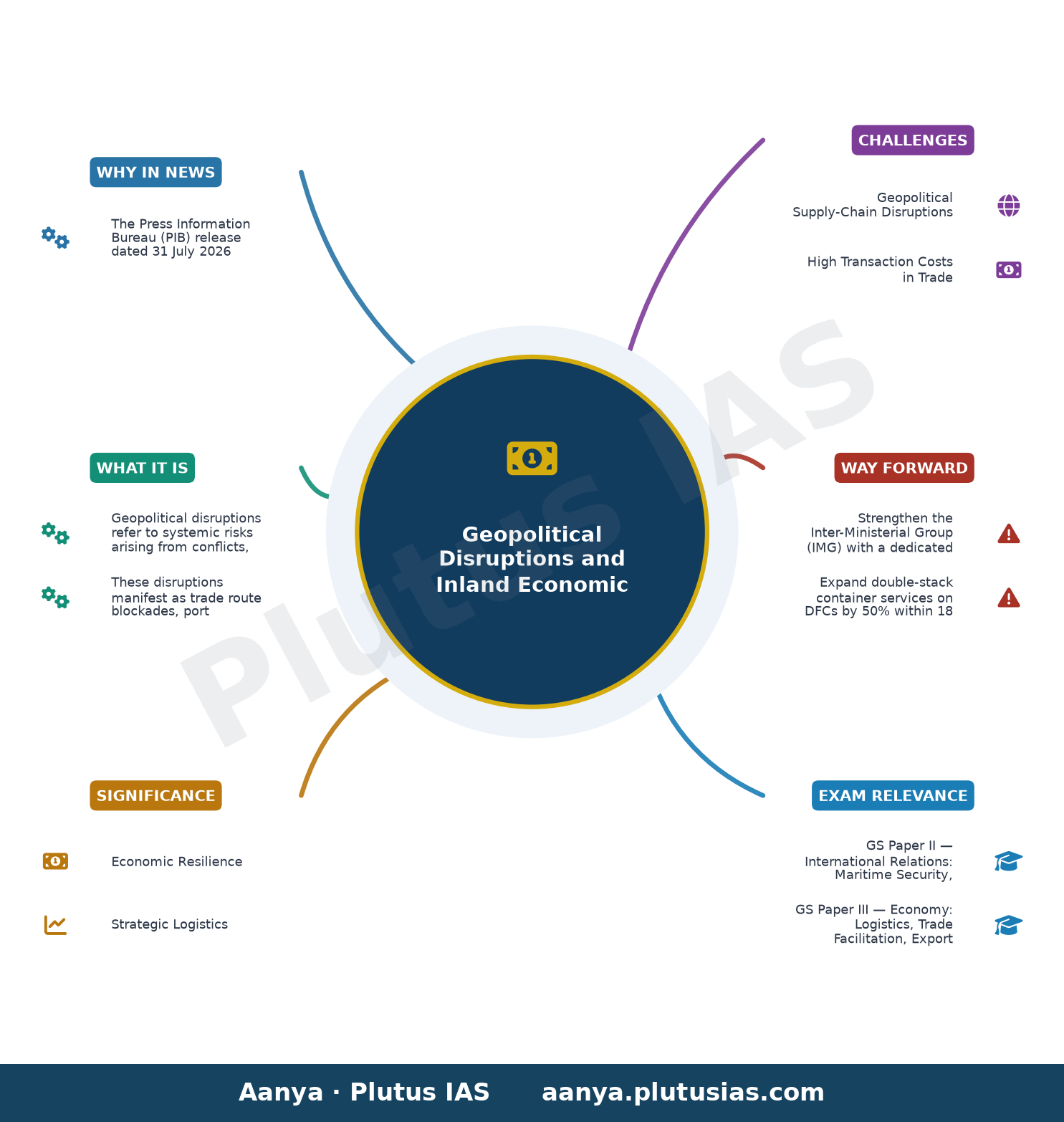
- GS Paper II — International Relations: Maritime Security, Supply Chain Disruptions, Geopolitical Risks | GS Paper III — Economy: Logistics, Trade Facilitation, Export Promotion Schemes, Port Infrastructure
- Prelims: Maritime Silk Road, Blue Economy, Sagarmala Project, National Logistics Policy, Export Promotion Capital Goods (EPCG) Scheme, Advance Authorisation Scheme, SEZs, FTWZs, RoDTEP Scheme, ECLGS 5.0, Double-Stack Container Services, Sovereign Guarantee for Marine Insurance Pool
- Essay: Geopolitical Fragmentation and the Resilience of Global Supply Chains, India’s Strategic Role in Reconfiguring Eurasian Trade Routes
Quick Revision: India’s response to geopolitical disruptions in maritime trade involves a multi-pronged strategy: institutional coordination (inter-ministerial groups), policy interventions (export schemes, duty exemptions), infrastructure upgrades (DFCs, port modernisation), and financial safeguards (sovereign guarantees, liquidity support) to ensure supply chain resilience.
Why is this in the news?
The Press Information Bureau (PIB) release dated 31 July 2026 highlights the Indian government’s institutional response to geopolitical disruptions affecting global maritime trade and inland economic corridors. It underscores the establishment of an inter-ministerial mechanism to assess supply chain vulnerabilities, mitigate logistical bottlenecks, and implement coordinated policy measures to ensure uninterrupted trade flows. This development is significant for UPSC aspirants as it reflects India’s proactive approach to safeguarding economic sovereignty amid evolving geopolitical tensions.
Background
- Geopolitical tensions in critical maritime chokepoints (e.g., Strait of Hormuz, Bab-el-Mandeb, South China Sea) have heightened supply chain vulnerabilities, disrupting global trade flows and increasing logistics costs.
- India’s strategic location along major trade routes (e.g., Indian Ocean, Malacca Strait) necessitates robust mechanisms to monitor and mitigate risks to maritime trade and inland logistics.
- The COVID-19 pandemic exposed fragilities in global supply chains, prompting governments worldwide to adopt resilience-building measures, including diversification of trade routes and strategic stockpiling.
- India’s ‘Sagarmala Project’ aims to modernise ports, enhance coastal shipping, and develop inland waterways to reduce logistics costs and improve trade efficiency.
- The National Logistics Policy (2022) seeks to integrate multi-modal logistics, reduce turnaround times at ports, and promote digitalisation to enhance supply chain resilience.
- Rising geopolitical risks have accelerated India’s focus on inland economic corridors (e.g., Dedicated Freight Corridors) to reduce dependence on vulnerable maritime routes.
What are Geopolitical Disruptions and Inland Economic Corridors?
- Geopolitical disruptions refer to systemic risks arising from conflicts, sanctions, or political instability in key regions that disrupt global trade, supply chains, and logistics networks.
- These disruptions manifest as trade route blockades, port closures, increased insurance premiums, and delays in cargo movement, leading to higher operational costs and supply chain fragmentation.
- Inland economic corridors are integrated transport networks (road, rail, inland waterways) designed to connect hinterlands to ports and international trade routes, reducing reliance on vulnerable maritime pathways.
- India’s inland economic corridors, such as the Dedicated Freight Corridors (DFCs), aim to enhance multi-modal connectivity, improve cargo handling efficiency, and lower logistics costs by leveraging rail and road infrastructure.
- The government’s institutional response includes an inter-ministerial group (IMC) under the Department of Commerce to assess risks, coordinate policy interventions, and ensure uninterrupted trade flows.
- Key policy measures include export promotion schemes (EPCG, Advance Authorisation), duty exemptions on critical inputs, and sovereign guarantees for marine insurance to mitigate financial risks in trade.
- The Reserve Bank of India (RBI) and financial institutions have extended export credit periods and introduced liquidity support schemes (e.g., ECLGS 5.0) to ease financing constraints for exporters.
- Port authorities have implemented fee waivers, streamlined customs procedures, and enhanced infrastructure (e.g., double-stack container services) to improve cargo clearance efficiency.
Key Features
| Feature | Significance |
|---|---|
| Inter-Ministerial Group (IMG) on Maritime Trade | Ensures coordinated policy responses to geopolitical disruptions in global maritime trade, integrating inputs from 12 ministries and agencies for real-time assessment of supply-chain vulnerabilities. |
| Export Promotion Capital Goods (EPCG) Scheme Extension | Temporarily extended export obligation period to 31 August 2026 for 1,017 EPCG and 7,400 Advance Authorisation holders, releasing ₹X crore in bank guarantees to ease liquidity constraints. |
| Domestic Maritime Insurance Pool (DMIP) | Approved sovereign guarantee of ~$150 million to reduce freight and insurance costs for exporters, enhancing competitiveness of Indian maritime logistics. |
| Port Tariff Concessions | 100% waiver on ground rent and demurrage, 80% on reefer charges at major ports, directly lowering transaction costs for trade during supply-chain disruptions. |
| Double-Stack Container Services on Dedicated Freight Corridors (DFC) | Accelerated clearance of ~10,000 stranded containers via DFC’s double-stack services, reducing rail transit time by ~30% and improving hinterland connectivity. |
Why it Matters
Economic Resilience
- Mitigates adverse impacts of geopolitical disruptions on India’s merchandise trade, which accounts for ~75% of total trade volume, by ensuring continuity in supply chains.
- Reduces transaction costs for exporters (freight, insurance, demurrage) through targeted fiscal and regulatory interventions, preserving export competitiveness.
- Enhances liquidity for MSME exporters via extensions in export credit periods (from 270 to 450 days) and ECLGS 5.0, preventing defaults in stressed markets.
Strategic Logistics
- Strengthens inland economic corridors by integrating port operations with rail and road networks, reducing dependence on vulnerable maritime chokepoints (e.g., Strait of Malacca).
- Facilitates rapid clearance of stranded containers via DFC and port concessions, ensuring minimal disruption to just-in-time manufacturing supply chains.
- Expands storage and transit facilities in SEZs/FTWZs for high-value goods (e.g., gems and jewellery), diversifying trade routes and reducing exposure to single-market risks.
Policy Coordination
- Demonstrates institutional agility through an inter-ministerial mechanism that aligns trade, transport, and financial policies in real time, reducing bureaucratic delays.
- Leverages sovereign guarantees (DMIP) to catalyse private sector participation in maritime insurance, addressing under-capitalisation risks in the sector.
- Integrates agricultural and processed food exports (APEDA helpline) with trade facilitation measures, supporting rural livelihoods dependent on agri-export value chains.
Challenges
1. Geopolitical Supply-Chain Disruptions
- Prolonged conflicts (e.g., Red Sea, Black Sea) disrupt critical maritime routes, increasing freight rates by 200–400% and delaying shipments by 2–4 weeks.
- Sanctions and retaliatory measures (e.g., on Russian oil) force rerouting of trade flows, raising operational costs and compliance burdens for Indian traders.
- Port congestion in alternative routes (e.g., Cape of Good Hope) exacerbates delays, straining inland logistics and storage infrastructure.
UPSC Link: GS3: Infrastructure – Logistics
2. High Transaction Costs in Trade
- Demurrage and detention charges at ports average 15–20% of total logistics costs, disproportionately impacting MSME exporters with thin margins.
- Maritime insurance premiums have surged due to geopolitical risks, increasing the cost of trade finance and reducing export viability for SMEs.
- Inefficiencies in customs clearance (e.g., delayed refunds, unclear procedures for diverted cargo) add to compliance costs and working capital strain.
UPSC Link: GS3: Trade Facilitation
3. Infrastructure Bottlenecks in Hinterland
- Limited double-stack container capacity on DFCs restricts throughput, leading to backlogs at ports and higher rail freight costs.
- Inadequate cold-chain infrastructure for perishable exports (e.g., horticulture, dairy) results in post-harvest losses of 20–30%, undermining APEDA’s export targets.
- Multi-modal connectivity gaps between ports, rail hubs, and warehouses increase last-mile costs, particularly for landlocked states.
UPSC Link: GS3: Infrastructure – Multi-modal
4. Regulatory and Compliance Burdens
- Complex export obligation norms under EPCG/Advance Authorisation schemes create compliance risks, with penalties for non-fulfilment deterring participation.
- Divergent interpretations of customs rules (e.g., for diverted cargo) lead to litigation and delays, increasing transaction uncertainty for traders.
- Lack of standardised risk assessment frameworks for geopolitical events complicates underwriting in maritime insurance, discouraging private sector investment.
UPSC Link: GS2: Government Policies – Trade
5. Financial Constraints for Exporters
- MSME exporters face liquidity crunches due to delayed payments from overseas buyers, exacerbated by geopolitical delays in shipments and customs clearance.
- Higher working capital requirements for inventory and freight payments strain cash flows, particularly for capital-intensive sectors (e.g., engineering goods).
- Limited access to trade credit insurance (pre-DMIP) increased the cost of capital for high-risk markets, constraining export growth.
UPSC Link: GS3: Financial Inclusion – Trade
6. Energy and Input Cost Volatility
- Disruptions in global oil and gas supply chains (e.g., via Strait of Hormuz) elevate fuel costs, increasing logistics expenses and inflationary pressures in domestic markets.
- Dependence on imported petrochemicals for manufacturing (e.g., plastics, fertilisers) exposes industries to supply shocks, affecting production and export competitiveness.
- Volatility in freight rates for energy products (e.g., LPG) disrupts domestic distribution, particularly in landlocked regions.
UPSC Link: GS3: Energy Security
Challenges — UPSC Perspective
| Issue | Concern |
|---|---|
| Maritime Route Diversions | Increased transit time and freight costs due to rerouting around conflict zones (e.g., Red Sea detours add 10–14 days to Europe-India voyages). |
| Port Congestion | Delays in clearance at major ports (e.g., JNPT, Mundra) due to backlogs, increasing demurrage charges and storage costs. |
| Customs Clearance Delays | Uncertainty in procedures for diverted cargo leads to prolonged inspections, higher compliance costs, and working capital blockages. |
| Cold-Chain Gaps | Inadequate refrigerated storage at ports and hinterland hubs results in spoilage of perishable exports (e.g., grapes, marine products). |
| Rail Freight Inefficiencies | Limited double-stack services on DFCs restrict container throughput, increasing rail freight costs and transit times. |
| Insurance Costs | Surging premiums for war-risk and piracy insurance reduce export margins, particularly for SMEs in high-risk sectors. |
Government Initiatives — Must-Memorise for Prelims
- Export Promotion Capital Goods (EPCG) Scheme
- Advance Authorisation Scheme
- Emergency Credit Line Guarantee Scheme (ECLGS) 5.0
- APEDA Export Helpline
- SEZ/FTWZ Storage Facilitation for Gems & Jewellery
Way Forward
- Strengthen the Inter-Ministerial Group (IMG) with a dedicated analytics wing to model geopolitical risk scenarios and pre-empt supply-chain disruptions.
- Expand double-stack container services on DFCs by 50% within 18 months, prioritising trade corridors linking ports to industrial hubs (e.g., Mumbai-Delhi, Chennai-Bengaluru).
- Establish a national cold-chain logistics grid with 100+ refrigerated warehouses at major ports and hinterland nodes to reduce perishable losses by 25%.
- Simplify customs procedures for diverted cargo through a single-window clearance portal with pre-approved risk assessment protocols.
- Increase sovereign guarantee coverage for DMIP to $500 million by 2028 to crowd in private insurers and stabilise premiums.
- Launch a trade credit insurance scheme for MSME exporters to cover geopolitical risks, reducing their exposure to payment defaults.
- Develop a national logistics data platform integrating port, rail, and customs data to enable real-time tracking of cargo and predictive analytics.
- Enhance multi-modal connectivity by mandating rail connectivity for all major ports and integrating them with national highways via dedicated freight corridors.
UPSC Value Addition
Keywords for Mains Answer-Writing
Geopolitical disruptions · Inland Economic Corridors · Maritime trade logistics · Supply chain resilience · Port infrastructure · Export promotion schemes · Multi-modal connectivity · Geopolitical risk mitigation · Maritime insurance · Trade facilitation measures · Container clearance efficiency · Logistics cost reduction · Inter-ministerial coordination · Global supply chain disruptions · Maritime security
Concept Flow
Geopolitical conflicts → Disruption of critical maritime routes (e.g., Red Sea, Black Sea) → Increased freight rates and transit delays → Higher logistics costs for Indian exporters → Supply-chain bottlenecks at ports and hinterland → Supply-chain bottlenecks → Port congestion and demurrage charges → Working capital strain for MSME exporters → Reduced export competitiveness → Decline in merchandise trade growth → Policy response → Inter-Ministerial Group (IMG) formed → Coordination among 12 ministries → Targeted fiscal measures (EPCG extension, DMIP) → Temporary relief for exporters → Sustained supply-chain resilience → Fiscal interventions → EPCG/Advance Authorisation extensions → Reduced export obligation compliance risks → Released bank guarantees → Improved liquidity for exporters → Infrastructure upgrades → Double-stack services on DFCs → Faster container clearance → Reduced rail transit times → Enhanced hinterland connectivity → Regulatory reforms → Customs clearance streamlining for diverted cargo → Single-window portal → Reduced compliance costs → Lower transaction uncertainty
Prelims Practice Questions
Q1. Consider the following statements regarding the institutional mechanism for monitoring geopolitical disruptions in maritime trade:
1. The Ministry of Ports, Shipping and Waterways leads an inter-ministerial group to assess impacts on global maritime trade and supply chains.
2. The group includes the Reserve Bank of India, Department for Promotion of Industry and Internal Trade, and Agricultural and Processed Food Products Export Development Authority.
3. The mechanism focuses solely on port operations and does not address insurance costs or freight charges.
How many of the above statements are correct?
- Only one
- Only two
- All three
- None
Answer: Only two — Statement 1 is correct as the Ministry of Ports, Shipping and Waterways coordinates the inter-ministerial group. Statement 2 is correct as the RBI, DPIIT, and APEDA are part of the group. Statement 3 is incorrect as the mechanism addresses insurance costs, freight charges, and supply chain continuity.
Q2. Assertion (A): The Government of India has extended the export obligation period for the EPCG and Advance Authorisation schemes to mitigate disruptions in global supply chains.
Reason (R): The extension aims to provide relief to exporters facing delays due to geopolitical disruptions and logistical bottlenecks.
In the context of the above two statements, which of the following is correct?
- Both A and R are true, and R is the correct explanation of A.
- Both A and R are true, but R is not the correct explanation of A.
- A is true, but R is false.
- A is false, but R is true.
Answer: Both A and R are true, and R is the correct explanation of A. — Assertion (A) is true as the export obligation period for EPCG and Advance Authorisation schemes was extended to 31 August 2026. Reason (R) correctly explains the rationale behind the extension, which is to mitigate disruptions in global supply chains and provide relief to exporters.
Q3. Match the following initiatives with their respective objectives in the context of geopolitical disruptions and inland economic corridors:
Column I
A. Extension of export obligation period for EPCG and Advance Authorisation
B. Reduction in ground rent and demurrage charges at major ports
C. Sovereign guarantee for Domestic Marine Insurance Pool
D. Emergency credit line guarantee scheme (ECLGS) 5.0 for MSMEs
Column II
1. Enhancing export competitiveness by reducing financial burden on exporters
2. Facilitating container clearance and reducing logistics costs
3. Strengthening maritime insurance framework to lower freight costs
4. Providing liquidity support to MSMEs amid supply chain disruptions
- A-1, B-2, C-3, D-4
- A-2, B-1, C-4, D-3
- A-3, B-4, C-1, D-2
- A-4, B-3, C-2, D-1
Answer: A-1, B-2, C-3, D-4 — A matches with 1 as the extension of export obligation period reduces financial burden on exporters. B matches with 2 as reduction in ground rent and demurrage charges facilitates container clearance. C matches with 3 as the sovereign guarantee strengthens the maritime insurance framework. D matches with 4 as ECLGS 5.0 provides liquidity support to MSMEs.
Mains Practice Question
✍ Geopolitical disruptions have increasingly impacted global maritime trade routes and supply chains. In this context, critically examine the role of inland economic corridors in enhancing India’s trade resilience and reducing dependency on vulnerable maritime routes. (15 Marks)
Approach: MODEL-ANSWER SKELETON:
1. **Introduction (2 Marks)**
– Define inland economic corridors and their significance in the context of geopolitical disruptions.
– Highlight the vulnerabilities of maritime trade routes (e.g., Suez Canal blockages, Red Sea tensions) and the need for alternative logistics infrastructure.
2. **India’s Inland Economic Corridors: Key Features (4 Marks)**
– **Multi-modal connectivity**: Role of Dedicated Freight Corridors (DFC), Bharatmala Pariyojana, and Sagarmala in integrating ports with hinterland.
– **Institutional frameworks**: Mention the inter-ministerial coordination mechanism under the Ministry of Ports, Shipping and Waterways for monitoring geopolitical risks and supply chain disruptions.
– **Policy measures**: Reference to trade facilitation schemes (EPCG, Advance Authorisation), reduction in port charges, and sovereign guarantees for maritime insurance.
3. **Enhancing Trade Resilience (5 Marks)**
– **Supply chain diversification**: How inland corridors reduce dependency on single maritime routes (e.g., reliance on Iranian/Chabahar port vs. alternate routes via Myanmar/Bangladesh).
– **Cost efficiency**: Impact of reduced logistics costs (e.g., 100% exemption on ground rent, 80% on reefer charges) and improved container clearance (e.g., 10,000 containers cleared via DFC).
– **Insurance and risk mitigation**: Role of Domestic Marine Insurance Pool (₹150 crore sovereign guarantee) in lowering freight costs and ensuring continuity of trade.
4. **Challenges and Limitations (3 Marks)**
– **Infrastructure gaps**: Inadequate last-mile connectivity, underdeveloped inland waterways, and bottlenecks in rail/road networks.
– **Geopolitical constraints**: Dependence on transit agreements with neighboring countries (e.g., Bangladesh, Nepal) and risks of regional instability.
– **Regulatory hurdles**: Complexity in coordinating across multiple ministries and agencies, and delays in implementation.
5. **Conclusion (1 Mark)**
– Summarise the strategic importance of inland economic corridors in mitigating geopolitical risks while acknowledging the need for sustained infrastructure development and policy coordination.
Source: PIB (Press Information Bureau)
Generated by AanyaAi for educational purpose.

- तमिलनाडु निजी विश्वविद्यालय संशोधन विधेयक 2026: विवाद क्यों? - September 21, 2026
- Tamil Nadu Private Universities Bill 2026: Key Amendments & Controversy Explained for UPSC - September 21, 2026
- स्वच्छ सागर सुरक्षित सागर 5.0: 15 लाख लोगों ने ली महासागर संरक्षण की शपथ, जानें पूरा विवरण - September 21, 2026

No Comments