


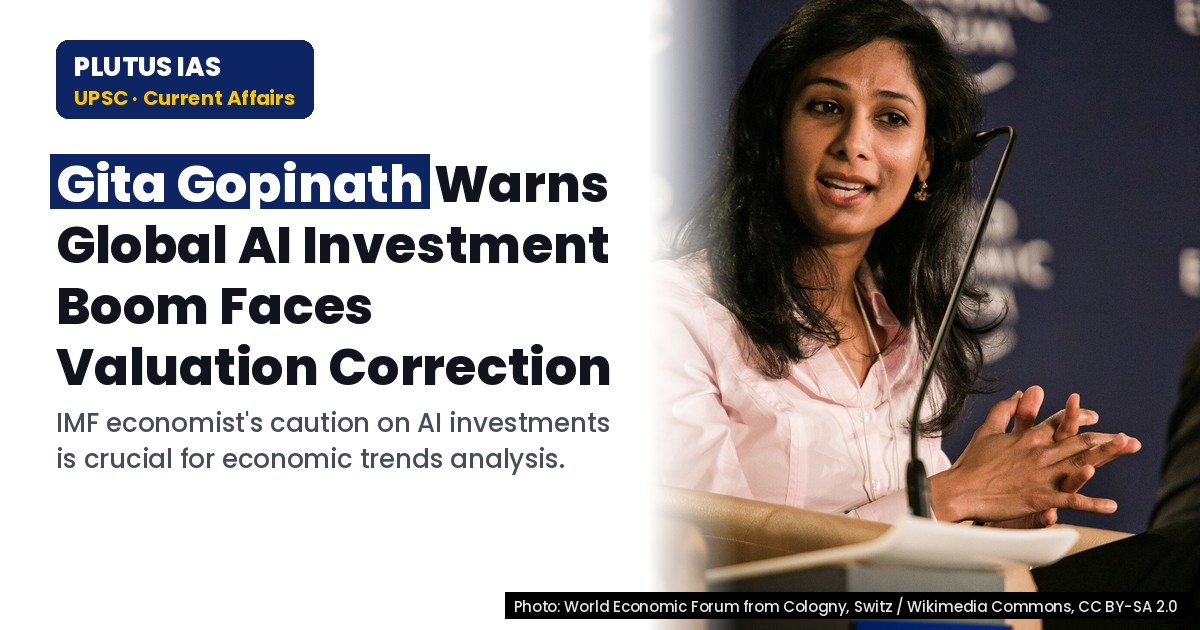
09 Nov Gita Gopinath Warns of Global AI Investment Correction
✎ A potential valuation correction in the global AI investment boom is anticipated due to hyper-competition and the challenge of generating sufficient profits to justify current high valuations, posing risks to interconnected…
Subject Relevance — Where This Topic Fits
- GS Paper III — Economy | GS Paper III — Science and Technology
- Prelims: Artificial Intelligence (AI), Valuation Correction, Economic Bubble, International Monetary Fund (IMF), Global Economy, Technological Investment
- Essay: The Future of Technology and its Economic Impact, Navigating Global Economic Volatility in the Digital Age
Quick Revision: A potential valuation correction in the global AI investment boom is anticipated due to hyper-competition and the challenge of generating sufficient profits to justify current high valuations, posing risks to interconnected economies.
Why is this in the news?
Gita Gopinath, a prominent economist and former International Monetary Fund (IMF) chief economist, has issued a caution regarding the global Artificial Intelligence (AI) investment boom. She suggests that the sector is approaching a potential valuation correction, as the substantial capital inflows into AI development may not yield commensurate returns amidst intense market competition. This warning highlights concerns about the sustainability of current investment trends and their potential systemic economic repercussions.
Background
- Significant global investment, projected to be nearly $1 trillion in 2026 alone, is being directed towards AI infrastructure and development, particularly in nations like the United States, South Korea, and Taiwan.
- The current investment landscape in AI is characterized by hyper-competition, raising questions about the ability of numerous competing firms and research laboratories to generate sufficient profits to justify their elevated valuations.
- A potential market correction in AI valuations could have substantial ramifications for economies heavily reliant on AI-driven wealth effects, such as the United States, potentially impacting economic growth.
- The interconnected nature of the global economy implies that a downturn in a major AI market or a significant AI player could trigger a ripple effect across worldwide markets.
- The circular flow of capital within the AI ecosystem, where investments in AI labs are often used to purchase components from other AI-related companies, creates a vulnerability to systemic shocks.
- Concerns have also been raised regarding ‘cognitive surrender,’ advocating for individuals to develop independent problem-solving skills rather than relying exclusively on AI tools.
Understanding Valuation Correction in Investment
- A valuation correction refers to a market event where the price of an asset or a market sector declines from an inflated level to a more realistic or fundamental value.
- It typically occurs when investor expectations regarding future earnings or growth prospects do not align with actual performance, leading to a reassessment of asset prices.
- In the context of the AI investment boom, a valuation correction would imply that the current high valuations of AI companies and projects are not justified by their projected profitability or return on investment.
- Factors contributing to a potential correction include excessive speculation, oversupply of capital, intense competition leading to reduced profit margins, and a failure of technological advancements to translate into sustainable commercial success.
- Such corrections can lead to significant wealth destruction, impact investor confidence, and potentially trigger broader economic slowdowns, especially in sectors or economies heavily exposed to the overvalued assets.
- The phenomenon highlights the importance of fundamental analysis and prudent investment strategies to avoid speculative bubbles and ensure sustainable economic growth.
- Historical examples of market corrections, such as the dot-com bubble burst, illustrate the potential for rapid and substantial declines in overvalued technology sectors.
Key Features
| Feature | Significance |
|---|---|
| Global AI Investment Boom | Characterised by substantial capital inflows into Artificial Intelligence infrastructure and development, projected to reach nearly $1 trillion globally in 2026. |
| Potential Valuation Correction | A forecast by former IMF chief economist Gita Gopinath, indicating that current AI company valuations may be unsustainable given the hyper-competitive landscape and challenges in generating commensurate profits. |
| Hyper-competitive Landscape | Numerous firms and labs are investing heavily in AI, leading to intense competition that may hinder individual entities from achieving sufficient profitability to justify investments. |
| Interconnectivity of AI Ecosystem | The circular flow of capital, exemplified by companies like Nvidia investing in AI labs which then purchase their chips, creates systemic risk where a downturn in one part can ripple across the market. |
| Impact on Major Economies | A significant market correction in AI valuations could severely affect economies heavily reliant on AI-driven wealth effects, potentially leading to zero or negative growth. |
| Cognitive Surrender | A caution against over-reliance on AI tools (e.g., ChatGPT, Claude) to the detriment of developing independent problem-solving skills among professionals. |
Why it Matters
Economic Implications
- The potential for a valuation correction in the AI sector could lead to significant financial market instability, impacting investor confidence and capital flows globally.
- A downturn in AI investments and valuations could decelerate economic growth, particularly in nations with substantial exposure to the technology sector like the United States, South Korea, and Taiwan.
- The interconnected nature of the global AI ecosystem means that a correction in one major player or segment could trigger a broader market contagion, affecting supply chains and investment cycles.
Technological Development
- While investments drive innovation, an unsustainable boom could lead to a ‘bust’ cycle, potentially slowing down long-term research and development in AI if funding becomes scarce post-correction.
- The caution against ‘cognitive surrender’ highlights the importance of human-AI collaboration, where AI serves as an augmentative tool rather than a replacement for critical human intellect and problem-solving.
Policy Considerations
- Governments and regulatory bodies may need to monitor AI investment trends closely to identify and mitigate systemic risks that could arise from speculative bubbles.
- There is a need to foster policies that encourage responsible AI development and deployment, ensuring that technological advancements are sustainable and contribute positively to economic stability and workforce development.
Challenges
1. Valuation Sustainability
- Difficulty for numerous competing AI firms to generate sufficient profits to justify their current high valuations amidst massive global investments.
- Risk of a market correction if returns on investment do not materialise as anticipated, leading to potential financial instability.
UPSC Link: Indian Economy and issues relating to planning, mobilisation of resources
2. Systemic Risk from Interconnectivity
- The circular flow of money within the AI ecosystem creates a vulnerability where the collapse of one major entity can have cascading effects across the entire market.
- High interconnectivity means a downturn in a major AI player in one country can rapidly spread globally, impacting diverse economies.
UPSC Link: Effects of liberalisation on the economy, changes in industrial policy and their effects on industrial growth
3. Workforce Adaptation and Skill Development
- The warning against ‘cognitive surrender’ highlights the challenge of ensuring that professionals develop independent problem-solving skills rather than becoming overly reliant on AI tools.
- Need for continuous reskilling and upskilling of the workforce to adapt to the evolving demands of an AI-driven economy, maintaining human critical thinking capabilities.
UPSC Link: Human Resource Development; issues relating to development and management of Social Sector/Services relating to Education
4. Global Economic Stability
- A significant AI market correction could severely impact economies heavily dependent on AI-driven wealth effects, potentially leading to economic contraction.
- The global nature of AI investment means that economic shocks originating from the AI sector could have widespread international repercussions.
UPSC Link: Indian Economy and issues relating to planning, mobilisation of resources, growth, development and employment
Challenges — UPSC Perspective
| Issue | Concern |
|---|---|
| AI Investment Overvaluation | Current market valuations of AI companies may not be sustainable given the intense competition and the difficulty in generating profits commensurate with investment scale. |
| Profitability in Hyper-competition | In a highly competitive AI landscape, many firms may struggle to achieve the necessary profitability to justify their substantial investments. |
| Systemic Risk | The interconnected nature of the AI ecosystem means a failure in one major component could trigger widespread market instability. |
| Economic Impact on AI-reliant Nations | Countries heavily dependent on AI-driven wealth effects face potential economic contraction if a market correction occurs. |
| Human Skill Erosion | Over-reliance on AI tools could lead to a decline in independent critical thinking and problem-solving abilities among professionals. |
Way Forward
- Promote robust regulatory frameworks to monitor and mitigate speculative excesses in emerging technology markets, including AI.
- Encourage diversified investment strategies to reduce over-concentration risks within specific technological sectors.
- Invest in continuous education and skill development programmes to foster critical thinking and adaptive capabilities in the workforce, complementing AI tools.
- Facilitate international cooperation to establish common standards and best practices for responsible AI development and investment.
- Support fundamental research and development in AI with a focus on long-term societal benefits rather than short-term speculative gains.
- Develop early warning systems and analytical tools to identify potential market bubbles and systemic risks in rapidly evolving tech sectors.
- Foster an ecosystem that balances innovation with prudent financial management, ensuring sustainable growth in the AI industry.
UPSC Value Addition
Keywords for Mains Answer-Writing
Artificial Intelligence investment · Valuation correction · Economic ripple effects · Technological innovation risks · Market speculation · Global economic interconnectivity · Sustainable economic growth · Digital economy challenges · Investment bubble · Cognitive surrender · Human capital development · Future of work
Concept Flow
Massive global investment in AI infrastructure and development. → Hyper-competitive landscape among numerous AI firms and labs. → Challenge for firms to generate sufficient profits to justify high valuations. → Potential for a market valuation correction in the AI sector. → Systemic risk due to interconnectivity within the AI ecosystem. → Possible negative impact on economies heavily reliant on AI-driven wealth effects. → Need for vigilance against ‘cognitive surrender’ in the workforce.
Prelims Practice Questions
Q1. Consider the following statements regarding Artificial Intelligence (AI) investment and its economic implications:
1. A ‘valuation correction’ in the context of AI investment implies that the market value of AI companies may decrease significantly from their current high levels.
2. High interconnectivity in the global economy suggests that a downturn in a major AI market, such as the United States, could have widespread international repercussions.
3. ‘Cognitive surrender’ refers to the over-reliance on AI tools, potentially hindering the development of independent problem-solving skills.
How many of the above statements are correct?
- Only one
- Only two
- All three
- None
Answer: All three — Statement 1 is correct: A valuation correction occurs when asset prices fall to reflect more realistic or lower expected future earnings. Statement 2 is correct: The globalised nature of modern economies means that shocks in one significant sector or region can propagate internationally. Statement 3 is correct: ‘Cognitive surrender’ as described by Gita Gopinath, highlights the risk of individuals becoming overly dependent on AI, thereby diminishing their critical thinking and problem-solving abilities.
Q2. Which of the following best describes the primary concern raised by Gita Gopinath regarding the global AI investment boom?
- The ethical implications of widespread AI deployment.
- The potential for AI to exacerbate income inequality.
- The risk that returns on AI investments may not justify the scale of capital poured into the technology.
- The geopolitical competition arising from AI development.
Answer: The risk that returns on AI investments may not justify the scale of capital poured into the technology. — Gita Gopinath’s primary concern, as stated in the news, is that the massive investments in AI may not yield sufficient profits to justify current valuations, leading to a potential market correction. While other options are valid concerns related to AI, they do not represent her specific warning in this context.
Mains Practice Question
✍ Examine the potential economic ramifications of a significant valuation correction in the Artificial Intelligence (AI) sector, particularly for highly interconnected global economies. Discuss the measures that can be adopted to foster sustainable innovation and mitigate speculative bubbles in emerging technologies. (15 Marks)
Approach: The answer should first define ‘valuation correction’ and explain its potential causes in the AI sector (e.g., hyper-competition, unfulfilled profit expectations). It must then detail the economic ramifications, including impacts on investment flows, employment, GDP growth (citing examples like the US economy’s reliance on AI-driven wealth effects), and the ‘circular flow of money’ within the AI ecosystem. The second part requires discussing measures for sustainable innovation and mitigating speculative bubbles. This should include regulatory frameworks, fostering diversified investment portfolios, promoting ethical AI development, enhancing transparency in valuation metrics, encouraging long-term research and development over short-term gains, and developing human capital to adapt to technological shifts (e.g., avoiding ‘cognitive surrender’). Reference to historical market bubbles (e.g., dot-com bubble) can provide context.
Source: orissapost.com
Generated by AanyaAi for educational purpose.
Related guides on our sites
- Best economics services coaching
- Best economics optional coaching
- Best economics optional coaching for upsc
- best teacher of economics optional

- Garh Ganga Mela: Yogi’s Directives for ‘Mini Kumbh’ - November 11, 2026
- दिल्ली में दिवाली प्रदूषण: पटाखों का 71%, वाहनों का 7% योगदान - November 11, 2026
- Elephants Return to Bandhavgarh: UPSC Environment Update - November 11, 2026

No Comments