


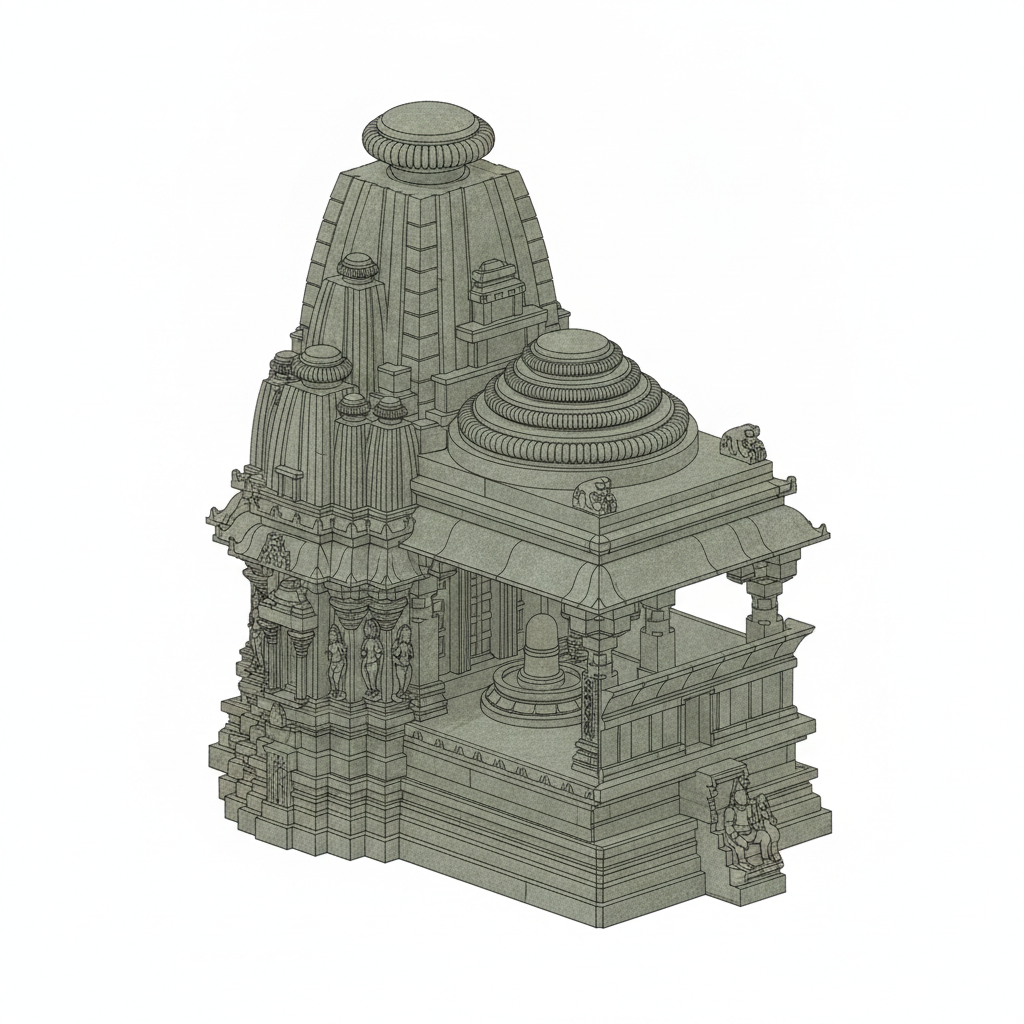
02 Sep Gollala Gudi Declared National Importance: UPSC Art & Culture Insights
✎ Gollala Gudi, a Kakatiya-era temple near Ramappa Temple, has been declared a site of national importance under the Ancient Monuments and Archaeological Sites and Remains Act, 1958, to ensure its conservation and integration into…
Subject Relevance — Where This Topic Fits
- GS Paper I — Indian Heritage and Culture | GS Paper I — Modern Indian History
- Prelims: Ancient Monuments and Archaeological Sites and Remains Act, 1958, ASI (Archaeological Survey of India), Kakatiya dynasty architecture, UNESCO World Heritage Sites, Lidar technology, Conservation of monuments
- Essay: Cultural heritage conservation: Balancing preservation and development, The role of institutions in safeguarding India’s historical legacy
Quick Revision: Gollala Gudi, a Kakatiya-era temple near Ramappa Temple, has been declared a site of national importance under the Ancient Monuments and Archaeological Sites and Remains Act, 1958, to ensure its conservation and integration into a unified heritage complex.
Why is this in the news?
The Archaeological Survey of India (ASI) declared Gollala Gudi, located near the Ramappa Temple in Palampet, Telangana, a site of national importance on September 2, 2026. This decision underscores the cultural and architectural significance of the structure, which shares stylistic and temporal affinities with the UNESCO World Heritage Site of Ramappa Temple. The move aligns with the ASI’s broader mandate to protect and conserve India’s archaeological heritage under the Ancient Monuments and Archaeological Sites and Remains Act, 1958.
Background
- The Kakatiya dynasty (12th–14th centuries CE) is renowned for its distinctive architectural style, characterised by the use of grey-green schist stones without mortar, known as *sangam* construction.
- The Ramappa Temple, inscribed as a UNESCO World Heritage Site in 2021, is a prime example of Kakatiya architecture and served as a catalyst for the conservation of nearby monuments.
- The ASI functions under the Ministry of Culture, Government of India, and is tasked with the protection and preservation of centrally protected monuments and sites.
- The Ancient Monuments and Archaeological Sites and Remains Act, 1958, provides the legal framework for the declaration of protected monuments and sites of national importance.
- The condition for Ramappa Temple’s UNESCO inscription included the protection of its surrounding cultural landscape, necessitating the declaration of adjacent monuments.
What is Gollala Gudi?
- Gollala Gudi is a 13th-century Kakatiya-era temple located in Palampet, Mulugu district, Telangana, approximately 200 metres from the Ramappa Temple.
- The temple shares architectural features with the Ramappa Temple, including the use of grey-green schist stones without mortar (*sangam* construction) and intricate sculptural detailing.
- The structure is primarily dedicated to Lord Shiva, as inferred from its iconography and epigraphic evidence, though its exact historical context remains a subject of study.
- The temple was in a dilapidated state prior to its declaration as a site of national importance, necessitating conservation measures such as documentation using Lidar technology and structural stabilisation.
- The ASI has proposed the creation of a unified complex integrating Gollala Gudi, the Ramappa Temple, and the nearby Shiva Temple, accessible through a single entrance to enhance visitor experience and conservation efficiency.
- The conservation plan involves dismantling and reassembling the temple structure, as 60% of the original stones are intact, while damaged stones will be replaced using traditional techniques.
- The declaration of Gollala Gudi as a site of national importance is a proactive measure to prevent further deterioration and to align with the UNESCO World Heritage Site’s broader cultural landscape requirements.
Key Features
| Feature | Significance |
|---|---|
| Declaration under AMASR Act, 1958 | Grants statutory protection to Gollala Gudi under national heritage laws, ensuring preservation and regulated access. |
| Architectural homogeneity with Ramappa Temple | Shared Kakatiya-era stone construction without mortar, reflecting regional craftsmanship and historical continuity. |
| Integration with Ramappa World Heritage Site | Fulfils UNESCO’s 2021 inscription condition to treat the temple complex as a unified heritage ensemble. |
| ASI conservation plan | Documentation via LiDAR, fencing, and phased restoration of 60% intact stones to prevent further decay. |
| State land transfer (16 acres) | Enables creation of a unified access complex for Ramappa, Shiva Temple, and Gollala Gudi under ASI management. |
Why it Matters
Cultural Heritage
- Preserves Kakatiya dynasty’s architectural legacy, complementing Ramappa Temple’s UNESCO recognition.
- Enhances Telangana’s cultural tourism by integrating three contiguous heritage sites under a single conservation framework.
- Validates indigenous construction techniques (stone without mortar) as a hallmark of medieval Indian engineering.
Legal and Institutional
- Expands ASI’s protected sites to 10 in Telangana, reinforcing statutory oversight under the Ancient Monuments and Archaeological Sites and Remains Act, 1958.
- Demonstrates inter-governmental coordination between state and central agencies for heritage conservation.
Economic
- Potential to boost local economy through heritage-based tourism, aligning with ‘Dekho Apna Desh’ initiatives.
- Creates employment opportunities in conservation, documentation, and tourism-related sectors.
Urban Planning
- Addresses fragmentation of heritage sites by consolidating access points, reducing haphazard development pressures.
Challenges
1. Conservation of Dilapidated Structures
- 60% of stones are intact but require meticulous reconstruction to match original architectural integrity.
- Risk of irreversible damage during restoration if not executed by trained ASI conservators.
UPSC Link: GS Paper 1: Indian Heritage
2. Balancing Tourism and Preservation
- Need to regulate footfall to prevent wear-and-tear while maximizing economic benefits.
- Risk of commercialization overshadowing heritage significance if not managed through sustainable tourism policies.
UPSC Link: GS Paper 3: Tourism Management
3. Inter-agency Coordination
- Ensuring seamless collaboration between ASI, state government, and local authorities for land use and access planning.
- Potential delays in implementation due to bureaucratic or logistical hurdles.
UPSC Link: GS Paper 2: Centre-State Relations
4. Funding and Resource Allocation
- Limited annual conservation budgets may constrain large-scale restoration projects.
- Dependence on central funds for heritage projects, necessitating prioritization among multiple sites.
UPSC Link: GS Paper 3: Public Expenditure Management
5. Public Awareness and Stakeholder Engagement
- Ensuring local communities perceive the site as an asset rather than an impediment to development.
- Addressing misconceptions about ASI’s role in restricting access to heritage properties.
UPSC Link: GS Paper 4: Ethical Governance
Challenges — UPSC Perspective
| Issue | Concern |
|---|---|
| Structural decay | Loss of original stones and mortar-less construction requires expert reconstruction. |
| Tourism pressure | Unregulated visitor influx may accelerate deterioration of fragile structures. |
| Land encroachment | Historical land records may conflict with declared protected area boundaries. |
| Skill gaps in conservation | Shortage of trained artisans familiar with medieval stone masonry techniques. |
| Funding gaps | Annual conservation budgets may be insufficient for multi-year restoration projects. |
Way Forward
- Constitute a multi-disciplinary ASI task force for phased restoration, including archaeologists, structural engineers, and heritage architects.
- Develop a heritage management plan with zoning for core, buffer, and tourism zones to balance access and preservation.
- Leverage corporate social responsibility (CSR) funds for conservation projects under the Swachh Bharat Mission 2.0 or similar initiatives.
- Integrate Gollala Gudi into Telangana’s tourism circuit under the ‘Pilgrimage Rejuvenation and Spiritual Augmentation Drive’ (PRASAD) scheme.
- Launch public awareness campaigns to educate locals and tourists about the site’s historical significance and conservation needs.
- Collaborate with academic institutions (e.g., IITs, JNAFAU) for LiDAR documentation and structural stability assessments.
- Establish a heritage cell within the state archaeology department to monitor site conditions and report violations under AMASR Act, 1958.
UPSC Value Addition
Keywords for Mains Answer-Writing
Gollala Gudi · Ramappa Temple · Archaeological Survey of India (ASI) · Ancient Monuments and Archaeological Sites and Remains Act, 1958 · sites of national importance · Kakatiya dynasty architecture · World Heritage Sites · conservation of heritage monuments · cultural heritage protection · Lidar technology in archaeology · multi-site heritage complexes · heritage tourism integration · heritage conservation policy
Concept Flow
Declaration of Gollala Gudi as a site of national importance under AMASR Act, 1958 → Statutory protection triggers ASI’s conservation mandate and access regulation → Integration with Ramappa Temple’s UNESCO World Heritage Site status → State government transfers 16 acres to ASI for unified complex development → Documentation via LiDAR and phased restoration of dilapidated structures → Balancing tourism promotion with heritage preservation to sustain cultural tourism → Economic and social benefits through heritage-led local development
Prelims Practice Questions
Q1. Consider the following statements regarding the declaration of sites of national importance by the Archaeological Survey of India (ASI):
1. The ASI can declare a site as of national importance under the Ancient Monuments and Archaeological Sites and Remains Act, 1958.
2. Once declared, the site is protected from commercial exploitation but may be used for public purposes with ASI approval.
3. The ASI is mandated to conduct conservation and maintenance of such sites but does not regulate access to them.
How many of the above statements are correct?
- Only one
- Only two
- All three
- None
Answer: Only two — Statement 1 is correct as the ASI derives its authority from the Ancient Monuments and Archaeological Sites and Remains Act, 1958. Statement 2 is incorrect because while commercial exploitation is prohibited, public access is regulated but not entirely barred. Statement 3 is incorrect as the ASI both regulates access and undertakes conservation.
Q2. Assertion (A): The Kakatiya dynasty is renowned for its distinctive architectural style, exemplified by the Ramappa Temple.
Reason (R): The Kakatiya temples are typically constructed using stone without binding mortar, relying on precise interlocking techniques.
Options:
A. Both A and R are true, and R is the correct explanation of A.
B. Both A and R are true, but R is not the correct explanation of A.
C. A is true but R is false.
D. A is false but R is true.
- A
- B
- C
- D
Answer: A — Both the assertion and reason are correct. The Kakatiya dynasty is indeed renowned for its architectural style, and the Ramappa Temple is a prime example. The reason correctly explains the assertion as the temples’ construction method using stone without mortar is a hallmark of Kakatiya architecture.
Q3. Match the following heritage conservation initiatives with their respective implementing agencies:
Column I (Initiative) | Column II (Agency)
— | —
1. Declaration of sites of national importance | A. Ministry of Culture
2. World Heritage Site inscription | B. Archaeological Survey of India (ASI)
3. Conservation of centrally protected monuments | C. UNESCO
4. Promotion of heritage tourism | D. State Departments of Archaeology
Options:
A. 1-B, 2-C, 3-A, 4-D
B. 1-A, 2-C, 3-B, 4-D
C. 1-B, 2-A, 3-C, 4-D
D. 1-A, 2-B, 3-D, 4-C
- A
- B
- C
- D
Answer: A — 1-B: The ASI declares sites of national importance under the Ancient Monuments Act. 2-C: UNESCO is responsible for World Heritage Site inscriptions. 3-A: The Ministry of Culture oversees conservation of centrally protected monuments. 4-D: State Departments of Archaeology promote heritage tourism at the local level.
Mains Practice Question
✍ The declaration of Gollala Gudi as a site of national importance by the Archaeological Survey of India (ASI) underscores the critical role of heritage conservation in contemporary India. Critically examine the significance of such declarations within the framework of the Ancient Monuments and Archaeological Sites and Remains Act, 1958. Also, assess the challenges in conserving multi-site heritage complexes like Ramappa and Gollala Gudi. (15 Marks)
Approach: MODEL-ANSWER SKELETON:
1. **Legal Framework and Significance of Declaration** (5 Marks)
– Purpose of the Ancient Monuments and Archaeological Sites and Remains Act, 1958: Protection of monuments of national importance (Section 3).
– Powers of the ASI: Declaration of sites of national importance, regulation of access, and conservation (Section 4).
– Significance: Legal sanctity, protection from encroachment, and integration into heritage management plans.
– Example: Gollala Gudi’s inclusion aligns with the Act’s objective to preserve Kakatiya-era architecture.
2. **Challenges in Conserving Multi-Site Heritage Complexes** (6 Marks)
– Structural degradation: Dilapidated state of Gollala Gudi (60% stones intact, 40% damaged).
– Technical challenges: Use of Lidar for documentation, need for scaffolding, and reconstruction of damaged portions.
– Coordination issues: Integration of multiple sites (Ramappa, Shiva Temple, Gollala Gudi) under a single entrance requires inter-agency and inter-state collaboration.
– Funding and resource constraints: Annual conservation plans and limited budget allocation.
– Balancing conservation with tourism: Regulating visitor access while ensuring preservation.
3. **Broader Implications and Way Forward** (4 Marks)
– Cultural heritage as a soft power: Enhancing India’s global image (e.g., Ramappa Temple’s UNESCO inscription).
– Community involvement: Engaging local communities in preservation efforts.
– Policy recommendations: Strengthening ASI’s capacity, leveraging technology (Lidar, 3D scanning), and promoting public-private partnerships for conservation.
Source: The Hindu
Generated by AanyaAi for educational purpose.
Related guides on our sites
- How to prepare for GS paper 1 for UPSC CSE mains exam
- Best UPSC coaching for IFOS exam
- Best mentorship programme for upsc
- UPSC+BA degree

- Gollala Gudi Declared National Importance: UPSC Art & Culture Insights - September 2, 2026
- आंध्र प्रदेश में साक्षरता दर राष्ट्रीय औसत से आगे, जानिए कैसे हुआ यह बदलाव - September 2, 2026
- Andhra Pradesh’s Literacy Surge: UPSC Perspective on Akshara Andhra Impact - September 2, 2026

No Comments