


14 Sep Government’s Decision to Keep Ratna Bhandar Report Secret Sparks Debate in Odisha
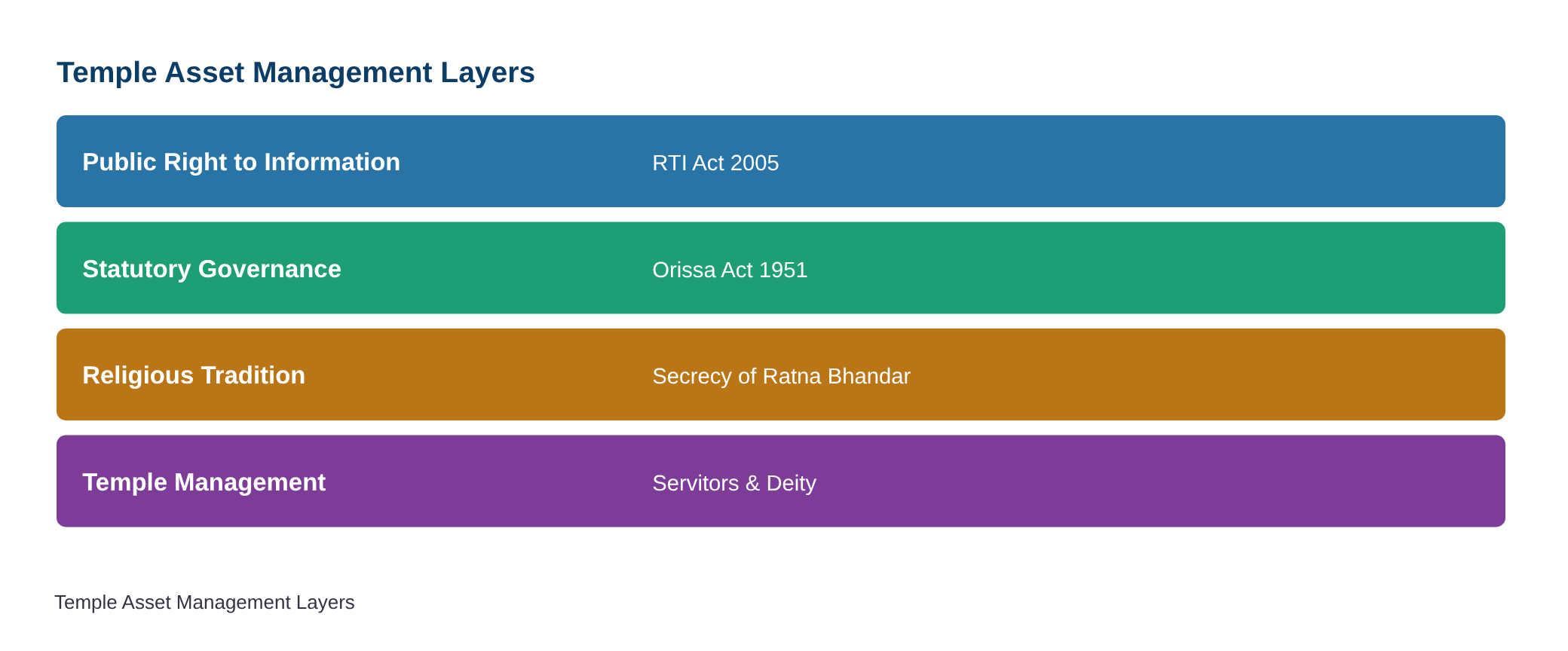
✎ The Ratna Bhandar of the Sri Jagannath Temple is a sacred treasury whose management is governed by the Orissa Hindu Religious Institutions and Charitable Endowments Act, 1951, balancing religious tradition with statutory…
Subject Relevance — Where This Topic Fits
- GS Paper II — Constitutional and Statutory Bodies (Article 26 and Religious Institutions) | GS Paper III — Government Budgeting and Financial Accountability | GS Paper IV — Ethics in Governance (Transparency vs. Secrecy in Religious Institutions)
- Prelims: Ratna Bhandar, Sri Jagannath Temple, Article 26 of the Constitution, Temple Trusts Act, Temple inventory and audit, Secrecy in religious institutions, Servitors (Daitapatis), Raghunath Besha, Orissa Hindu Religious Institutions and Charitable Endowments Act, 1951
- Essay: Transparency and accountability in the management of religious institutions: balancing faith, tradition, and public trust, Governance challenges in preserving cultural heritage: the case of temple treasuries
Quick Revision: The Ratna Bhandar of the Sri Jagannath Temple is a sacred treasury whose management is governed by the Orissa Hindu Religious Institutions and Charitable Endowments Act, 1951, balancing religious tradition with statutory oversight and public accountability.
Why is this in the news?
The ongoing phased inventory of ornaments in the Ratna Bhandar of the Sri Jagannath Temple in Puri has triggered public and servitor debate following the state government’s decision to withhold the inventory report from public disclosure. This decision, articulated by the state Law Minister, has elicited mixed reactions from temple servitors, with some questioning the necessity of secrecy in the modern era and others defending the traditional confidentiality of the treasury’s contents. The episode highlights the intersection of religious tradition, statutory governance, and the public’s right to information in the management of a major cultural and religious institution.
Background
- The Sri Jagannath Temple in Puri is one of the most revered Vaishnavite shrines in India, with a history dating back over a thousand years and a central role in the cultural and religious life of Odisha.
- The Ratna Bhandar (Treasure House) of the temple is a repository of jewels, ornaments, and precious items offered to the deity over centuries, traditionally maintained under strict secrecy and accessed only by designated temple functionaries.
- The management of the temple and its endowments is governed by the Orissa Hindu Religious Institutions and Charitable Endowments Act, 1951, which empowers the state government to oversee the administration of religious institutions and their properties.
- The temple’s rituals, including the Raghunath Besha (a specific adornment of the deities), are closely linked to the availability and condition of these ornaments, necessitating periodic inventory and maintenance.
- Previous inventories of the Ratna Bhandar were conducted in 1978, with limited public disclosure of findings, reflecting a long-standing tradition of confidentiality.
- The Right to Information (RTI) Act, 2005, provides a statutory framework for public access to information held by public authorities, but its application to religious institutions is nuanced and often contested.
What is the Ratna Bhandar of the Sri Jagannath Temple?
- The Ratna Bhandar is a designated treasury within the Sri Jagannath Temple complex in Puri, Odisha, housing a vast collection of jewels, ornaments, and precious items offered to the deities over centuries.
- It is one of the most significant treasuries of its kind in India, containing items of immense religious, cultural, and historical value, including gold, silver, gemstones, and ceremonial regalia.
- Access to the Ratna Bhandar is strictly controlled by temple tradition and statutory provisions, requiring the concurrence of multiple designated functionaries, including the Daitapatis (servitors) and temple authorities.
- The ornaments are integral to the temple’s daily and festival rituals, including the Raghunath Besha, during which the deities are adorned with specific jewels.
- The inventory and maintenance of the Ratna Bhandar are conducted periodically to ensure the preservation and security of the items, in accordance with temple traditions and statutory guidelines.
- The secrecy surrounding the Ratna Bhandar is rooted in historical practices, where the treasury was protected by the absence of external oversight and the sanctity of the deity’s possessions.
- The management of the Ratna Bhandar is governed by the Orissa Hindu Religious Institutions and Charitable Endowments Act, 1951, which vests the state government with supervisory authority over temple administration.
- The debate over transparency in the Ratna Bhandar’s inventory reflects broader tensions between traditional secrecy, statutory accountability, and the public’s right to information in the governance of religious institutions.
Key Features
| Feature | Significance |
|---|---|
| Ratna Bhandar Inventory Process | The phased counting and inventory of ornaments in the Sri Jagannath Temple’s Ratna Bhandar is being conducted under state government guidelines, ensuring alignment with temple rituals and administrative feasibility. |
| Secrecy of Inventory Report | The decision to withhold the inventory report from public disclosure has sparked debate, raising questions about transparency, accountability, and the management of religious assets. |
| Servitor Perspectives | Servitors of the temple hold divergent views—some advocate for public disclosure to enhance transparency, while others argue that secrecy is necessary to preserve ritual sanctity and security. |
| Historical Context of Ratna Bhandar | The Ratna Bhandar has historically operated under secrecy, with access restricted to a select few, reflecting traditional practices that contrast with modern expectations of transparency. |
| Security and Access Protocols | The Ratna Bhandar is secured by a three-key system, with the Lord Lokanath entrusted with its oversight, ensuring controlled and verifiable access to the treasury. |
Why it Matters
Religious and Cultural Significance
- The Ratna Bhandar houses ornaments and valuables dedicated to Lord Jagannath, a deity revered by millions of devotees, making its management a matter of deep religious and cultural importance.
- The secrecy surrounding the Ratna Bhandar aligns with traditional practices, where the sanctity of the deity’s possessions is prioritized over public disclosure.
- Public disclosure of the inventory could enhance trust among devotees regarding the preservation and use of temple assets for ritual purposes.
Administrative and Governance Implications
- The state government’s role in overseeing the inventory process underscores the intersection of religious administration with statutory governance, particularly in managing temple assets.
- The decision to withhold the inventory report raises questions about the balance between transparency and the preservation of religious sanctity, a challenge common to institutions managing sacred assets.
- The involvement of judicial and official scrutiny in the inventory process reflects evolving standards of accountability in the management of religious institutions.
Legal and Constitutional Dimensions
- The management of temple assets, including the Ratna Bhandar, falls under the purview of state legislation and constitutional provisions governing religious institutions and their properties.
- The debate over transparency versus secrecy touches upon the right to information (RTI) and its applicability to religious institutions, particularly when public funds or state oversight is involved.
Public Perception and Trust
- The mixed reactions from servitors highlight the tension between traditional secrecy and modern expectations of accountability, which can influence public trust in temple administration.
- A lack of transparency may fuel speculation or criticism, potentially undermining the credibility of temple authorities and the state government.
Challenges
1. Balancing Transparency and Secrecy
- Determining the appropriate level of disclosure for temple inventories without compromising religious sanctity or security protocols.
- Addressing public skepticism while respecting traditional practices that have historically shielded the Ratna Bhandar from scrutiny.
UPSC Link: GS Paper 2: Governance, Transparency & Accountability
2. Institutional Accountability in Religious Administration
- Ensuring that temple authorities, including servitors and state officials, adhere to modern governance standards while preserving religious traditions.
- Clarifying the roles and responsibilities of state agencies in overseeing temple assets to prevent conflicts of interest or mismanagement.
UPSC Link: GS Paper 2: Statutory Bodies & Temple Administration
3. Public Trust and Perception Management
- Mitigating potential backlash or criticism by proactively communicating the rationale behind the secrecy of the inventory report.
- Engaging with devotees and stakeholders to build consensus on the management of temple assets and the expectations of transparency.
UPSC Link: GS Paper 4: Ethics in Governance
4. Legal and Ethical Dilemmas in Religious Asset Management
- Navigating the application of the Right to Information (RTI) Act to religious institutions, particularly when assets are of public interest but managed under traditional secrecy.
- Ensuring that the use of temple assets aligns with their intended religious purposes while avoiding exploitation or misappropriation.
UPSC Link: GS Paper 2: Fundamental Rights & RTI
5. Security and Access Control Challenges
- Maintaining the integrity of the three-key system and other security protocols to prevent unauthorized access or tampering with the Ratna Bhandar’s contents.
- Balancing the need for modern security measures with traditional access protocols to ensure the safety of temple valuables.
UPSC Link: GS Paper 3: Internal Security & Asset Protection
Challenges — UPSC Perspective
| Issue | Concern |
|---|---|
| Transparency vs. Secrecy | Public disclosure of the inventory report could enhance trust but may conflict with traditional practices of secrecy in temple administration. |
| Role of State Government | The state’s involvement in overseeing the inventory raises questions about the extent of its authority over religious institutions. |
| Servitor Perspectives | Divergent views among servitors highlight the challenge of reconciling traditional beliefs with modern governance expectations. |
| Security Protocols | Ensuring the safety of the Ratna Bhandar’s contents while maintaining accessibility for ritual purposes is a critical concern. |
| Legal Ambiguity | The applicability of laws like the RTI Act to religious institutions remains a grey area, complicating efforts to balance transparency and tradition. |
Way Forward
- Conduct a structured dialogue with servitors, devotees, and legal experts to define the scope of transparency while respecting religious sanctity.
- Develop a clear policy framework for the disclosure of temple inventory reports, ensuring it aligns with constitutional provisions and statutory requirements.
- Enhance public communication efforts to explain the rationale behind the secrecy of the inventory report and the measures taken to safeguard temple assets.
- Strengthen security protocols for the Ratna Bhandar, including modern surveillance and access control systems, to prevent unauthorized access or tampering.
- Explore the possibility of releasing a redacted or summarized version of the inventory report to address public concerns while protecting sensitive information.
- Establish an independent oversight committee comprising legal, religious, and administrative experts to monitor the management of temple assets.
- Conduct periodic audits of the Ratna Bhandar’s contents to ensure accountability and deter mismanagement or misappropriation.
UPSC Value Addition
Keywords for Mains Answer-Writing
Ratna Bhandar · Sri Jagannath Temple · Puri · Temple treasures · Temple administration · Public disclosure · Temple rituals · Temple governance · Religious endowments · Constitutional provisions for religious institutions · Temple inventory · Transparency in religious institutions · Temple security · Temple servitors · Orissan temple administration · Temple wealth management
Constitutional & Policy Linkages
- Article 25: Freedom of Religion (Right to manage religious affairs)
- Article 26: Freedom to manage religious institutions and properties
- Article 29: Protection of cultural and religious rights of minorities
Concept Flow
Traditional secrecy in temple administration (Ratna Bhandar) → State government’s phased inventory process → Decision to withhold inventory report → Mixed reactions from servitors → Debate on transparency vs. sanctity → Legal and ethical dilemmas → Need for policy clarity → Way forward for governance and accountability.
Prelims Practice Questions
Q1. Consider the following statements regarding the Ratna Bhandar of the Sri Jagannath Temple in Puri:
1. The Ratna Bhandar is the treasure trove of the temple housing jewellery and ornaments.
2. Access to the Ratna Bhandar requires three keys held by different authorities.
3. The inventory of ornaments in the Ratna Bhandar is routinely made public by the temple authorities.
4. The counting and inventory of ornaments is conducted under state government guidelines.
How many of the above statements are correct?
- Only one
- Only two
- Only three
- All four
Answer: Only three — Statements 1, 2, and 4 are correct. Statement 3 is incorrect as the inventory report is not routinely made public, which is the subject of the current controversy.
Q2. Assertion (A): The Ratna Bhandar of the Sri Jagannath Temple in Puri is managed by a committee comprising temple servitors and state officials.
Reason (R): The management of temple treasures in India is governed by the provisions of the Places of Worship (Special Provisions) Act, 1991.
Options:
A. Both A and R are true, and R is the correct explanation of A.
B. Both A and R are true, but R is not the correct explanation of A.
C. A is true, but R is false.
D. A is false, but R is true.
Answer: ? — Assertion (A) is true as the Ratna Bhandar is managed by a combination of temple servitors and state officials. Reason (R) is false because the Places of Worship (Special Provisions) Act, 1991, does not govern the management of temple treasures; instead, it pertains to the maintenance of religious character of places of worship.
Q3. Match the following pairs related to the administration of religious institutions in India:
Column I (Institution) Column II (Relevant Provision/Authority)
A. Sri Jagannath Temple, Puri 1. Places of Worship (Special Provisions) Act, 1991
B. Golden Temple, Amritsar 2. Shiromani Gurdwara Parbandhak Committee
C. Shri Venkateswara Temple, Tirupati 3. Tirumala Tirupati Devasthanams Act, 1987
D. Ajmer Sharif Dargah 4. Dargah Khwaja Saheb Act, 2016
Options:
A. A-4, B-2, C-3, D-1
B. A-2, B-1, C-4, D-3
C. A-3, B-2, C-4, D-1
D. A-1, B-3, C-2, D-4
Answer: ? — The correct matches are: A-3 (Sri Jagannath Temple is governed by the Orissa Hindu Religious Endowments Act, 1951, and its administration is guided by the Tirumala Tirupati Devasthanams Act, 1987, as a model for temple administration in India), B-2 (Golden Temple is managed by the Shiromani Gurdwara Parbandhak Committee under the Sikh Gurdwaras Act, 1925), C-3 (Shri Venkateswara Temple is governed by the Tirumala Tirupati Devasthanams Act, 1987), and D-4 (Ajmer Sharif Dargah is governed by the Dargah Khwaja Saheb Act, 2016).
Mains Practice Question
✍ The disclosure of the inventory report of the Ratna Bhandar of the Sri Jagannath Temple in Puri has become a subject of public debate. Critically examine the arguments for and against the public disclosure of the inventory report of temple treasures, with reference to the principles of transparency, religious sanctity, and administrative governance. (15 Marks)
Approach: MODEL-ANSWER SKELETON:
1. **Introduction (2 marks)**: Define the Ratna Bhandar and its significance in the context of the Sri Jagannath Temple, Puri. Briefly outline the controversy surrounding the non-disclosure of the inventory report.
2. **Arguments FOR Public Disclosure (5 marks)**:
– **Transparency and Accountability**: Discuss the principle of transparency in public institutions, citing the Right to Information Act, 2005, and its applicability to religious institutions managing public funds or assets.
– **Public Trust and Devotee Confidence**: Explain how disclosure can enhance trust among devotees (4.5 crore Odias) and the general public, ensuring that temple wealth is managed responsibly.
– **Preventing Misuse and Corruption**: Highlight the risk of mismanagement or misappropriation of temple treasures in the absence of transparency, with historical precedents if any.
– **Constitutional Perspective**: Refer to Article 25 (Freedom of Religion) and Article 26 (Freedom to Manage Religious Affairs) of the Constitution, and how they balance with the public interest in transparency.
3. **Arguments AGAINST Public Disclosure (5 marks)**:
– **Religious Sanctity and Ritual Integrity**: Explain the traditional secrecy surrounding temple treasures, which are considered sacred and used in specific rituals (e.g., Raghunath Besha). Cite the views of servitors like Binayak Das Mahapatra.
– **Security Concerns**: Discuss the risks of public disclosure, including theft, vandalism, or threats to the security of the treasures.
– **Administrative Challenges**: Highlight the complexity of managing temple assets and the potential for disputes or legal challenges arising from public disclosure.
– **Historical Precedents**: Mention past instances where temple inventories were disclosed (e.g., 1978 counting) and the reasons for maintaining secrecy.
4. **Balancing the Two Perspectives (3 marks)**:
– Propose a middle path, such as partial disclosure (e.g., summary reports) or disclosure to a designated authority (e.g., a committee of devotees and officials) to balance transparency with sanctity.
– Refer to the role of the Orissa Hindu Religious Endowments Act, 1951, and the temple administration in ensuring responsible governance.
5. **Conclusion (2 marks)**: Summarize the key points and emphasize the need for a balanced approach that upholds both transparency and religious sanctity.
Source: orissapost.com
Generated by AanyaAi for educational purpose.
Related guides on our sites
- Current affairs for upsc 2026
- Best PSIR optional coaching for upsc
- Best economics optional coaching for upsc
- Best PSIR optional teacher for upsc

- हिमाचल में नदियों से रेत-बजरी निकालने पर सरकार ने लगाई रोक, जानिए नए नियम - September 22, 2026
- Himachal Govt Cracks Down on Illegal Sand Mining by Hydropower Firms - September 22, 2026
- प्रियदर्शिनी फ्री ट्रैवल स्कीम: 100 दिन में महिला सफर का बड़ा बदलाव, जानिए पूरा विश्लेषण - September 22, 2026

No Comments