


05 Aug Govt Denies Special Parliament Session on Women’s Reservation & Delimitation Bills
✎ The Women’s Reservation Bill and Delimitation Bills are constitutionally linked; delimitation must precede implementation of women’s reservation, and both require supermajority parliamentary support for passage.
Subject Relevance — Where This Topic Fits
- GS Paper II — Polity and Governance | GS Paper II — Constitutional Framework | GS Paper II — Parliament and State Legislatures
- Prelims: Women’s Reservation Bill, Delimitation Commission, Article 82, Article 330A, Article 332, Constitution (One Hundred and Fifth Amendment) Act, 2021, Nari Shakti Vandan Adhiniyam, Delimitation Act, 2002
- Essay: The Imperative of Gender Justice in Indian Democracy: Challenges and Opportunities, Federalism and Representation: Balancing Efficiency and Inclusivity in Parliamentary Systems
Quick Revision: The Women’s Reservation Bill and Delimitation Bills are constitutionally linked; delimitation must precede implementation of women’s reservation, and both require supermajority parliamentary support for passage.
Why is this in the news?
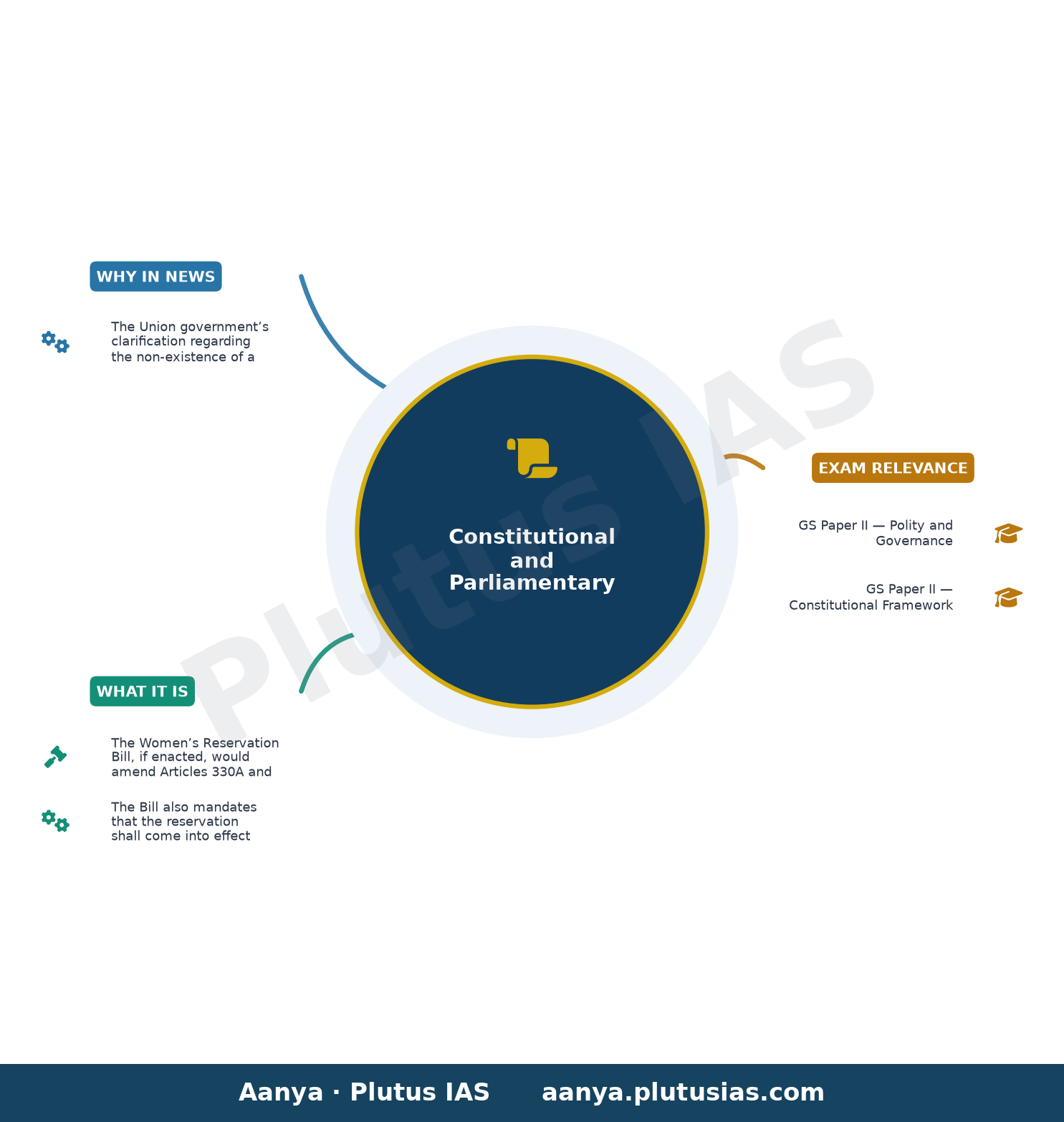
The Union government’s clarification regarding the non-existence of a special parliamentary session from August 16–18, 2026, to deliberate on the Women’s Reservation and Delimitation Bills underscores the procedural and political complexities surrounding these constitutional amendments. This development assumes significance in the context of ongoing legislative logjams, opposition demands for accountability on Delhi Police actions, and the broader discourse on electoral reforms and gender representation in India’s parliamentary democracy.
Background
- The Women’s Reservation Bill seeks to reserve one-third of seats in the Lok Sabha and State Legislative Assemblies for women, including provisions for sub-reservation for Scheduled Castes (SCs) and Scheduled Tribes (STs).
- The Delimitation Bill aims to redraw parliamentary and assembly constituencies based on the latest census data, a process mandated by Article 82 of the Constitution, which requires delimitation to be undertaken after each decennial census.
- The Women’s Reservation Bill was first introduced in 1996 and has seen multiple iterations, including its passage in the Rajya Sabha in 2010, but has remained pending in the Lok Sabha due to political and procedural hurdles.
- The delimitation process is governed by the Delimitation Act, 2002, and is conducted by the Delimitation Commission, a statutory body appointed by the President of India.
- Recent political developments, including opposition protests over alleged police excesses during a student march to Parliament on July 20, 2026, have further strained legislative proceedings, delaying discussions on critical bills.
Constitutional and Procedural Framework of Women’s Reservation and Delimitation Bills
- The Women’s Reservation Bill, if enacted, would amend Articles 330A and 332 of the Constitution to reserve seats for women in the Lok Sabha and State Legislative Assemblies, respectively, ensuring a minimum of one-third representation.
- The Bill also mandates that the reservation shall come into effect after the census conducted post-2026, ensuring that the delimitation process is completed first, as delimitation is a prerequisite for reserving seats under the Bill.
- Delimitation refers to the process of redrawing the boundaries of parliamentary and assembly constituencies to reflect changes in population distribution, as mandated by Article 82, which requires delimitation to be undertaken after each decennial census.
- The Delimitation Commission, constituted under the Delimitation Act, 2002, is responsible for determining the number and boundaries of constituencies. The Commission comprises a retired Supreme Court judge, the Chief Election Commissioner, and the respective State Election Commissioners.
- The Women’s Reservation Bill, if passed, would be a significant step toward achieving gender parity in elected bodies, aligning with India’s commitments under the Convention on the Elimination of All Forms of Discrimination Against Women (CEDAW) and the Sustainable Development Goals (SDG 5).
- The delimitation process is politically sensitive, as it directly impacts electoral outcomes and the balance of power among states and communities, necessitating consensus among political stakeholders.
- The Bills are intertwined: the Women’s Reservation Bill cannot be implemented without prior delimitation, as the reservation of seats is contingent upon the delimitation of constituencies.
UPSC Value Addition
Keywords for Mains Answer-Writing
Women’s Reservation Bill · Delimitation Bill · Parliamentary Sessions · Special Session of Parliament · Constitutional Amendments · Gender Justice · Representation of Women · Delimitation Commission · Parliamentary Deadlock · Opposition Demands · Constitutional Provisions for Sessions · Article 85 of the Constitution · Women’s Reservation Act 2023 · Delimitation Act 2002 · Federalism and Centre-State Relations · Parliamentary Procedures and Practices · Role of the Speaker and Chairman
Prelims Practice Questions
Q1. Consider the following statements regarding the Women’s Reservation Bill and the Delimitation Bill in India:
1. The Women’s Reservation Bill aims to reserve one-third of the seats in the Lok Sabha and State Legislative Assemblies for women.
2. The Delimitation Bill seeks to redraw the boundaries of parliamentary and assembly constituencies based on the latest census data.
3. Both bills require a special majority in Parliament and ratification by at least half of the State Legislatures to become law.
How many of the above statements are correct?
- Only one
- Only two
- All three
- None
Answer: All three — Statements 1 and 2 are correct. The Women’s Reservation Bill reserves one-third of seats for women in the Lok Sabha and State Legislative Assemblies, and the Delimitation Bill redraws constituency boundaries. Statement 3 is incorrect; the Women’s Reservation Bill does not require ratification by State Legislatures, while the Delimitation Bill does not require a special majority.
Q2. Assertion (A): The President of India can summon a special session of Parliament under Article 85 of the Constitution.
Reason (R): The President acts on the advice of the Council of Ministers in summoning Parliament sessions.
- A. Both A and R are true, and R is the correct explanation of A
- B. Both A and R are true, but R is NOT the correct explanation of A
- C. A is true, but R is false
- D. A is false, but R is true
Answer: B. Both A and R are true, but R is NOT the correct explanation of A — Both Assertion (A) and Reason (R) are true. Article 85 empowers the President to summon Parliament, and this power is exercised on the advice of the Council of Ministers, as per the constitutional scheme.
Q3. Match the following constitutional provisions with their respective subjects:
Column I (Provision) | Column II (Subject)
— | —
A. Article 85 | 1. Delimitation of constituencies
B. Article 330 | 2. Special majority for constitutional amendments
C. Article 368 | 3. Summoning of Parliament sessions
D. Delimitation Act, 2002 | 4. Reservation of seats for Scheduled Castes and Scheduled Tribes in the Lok Sabha
- A-3, B-4, C-2, D-1
- A-1, B-2, C-3, D-4
- A-4, B-3, C-2, D-1
- A-2, B-1, C-4, D-3
Answer: A-3, B-4, C-2, D-1 — The correct match is: A-3 (Article 85: Summoning of Parliament sessions), B-4 (Article 330: Reservation of seats for SCs and STs in the Lok Sabha), C-2 (Article 368: Special majority for constitutional amendments), D-1 (Delimitation Act, 2002: Delimitation of constituencies).
Mains Practice Question
✍ The announcement of a potential special session of Parliament to deliberate on the Women’s Reservation Bill and the Delimitation Bill has reignited debates on constitutional processes, federalism, and gender justice. Critically examine the significance of these bills in the context of India’s democratic framework and the challenges in their implementation. Also, analyse the role of Parliament in ensuring their passage. (15 Marks)
Approach: MODEL-ANSWER SKELETON:
1. **Introduction (2 marks)**: Briefly introduce the Women’s Reservation Bill (2023) and the Delimitation Bill, highlighting their objectives and constitutional relevance.
2. **Significance of the Bills (4 marks)**:
– **Women’s Reservation Bill**: Discuss its aim to enhance gender representation in legislatures, align with SDG 5 (Gender Equality), and address historical underrepresentation. Cite the 128th Constitutional Amendment Bill (2023) and its provisions.
– **Delimitation Bill**: Explain its role in redrawing constituency boundaries post-census, ensuring equitable representation, and its linkage to the 2021 Census (delayed due to COVID-19). Reference the Delimitation Act, 2002 and the role of the Delimitation Commission.
3. **Challenges in Implementation (5 marks)**:
– **Political and Social Challenges**: Highlight opposition from certain political quarters, concerns over caste-based reservations, and the need for consensus.
– **Constitutional and Procedural Challenges**: Discuss the requirement of a special majority (Article 368) for the Women’s Reservation Bill and the need for ratification by State Legislatures for the Delimitation Bill.
– **Federalism and Centre-State Relations**: Examine the role of States in delimitation and potential resistance from States with vested interests.
4. **Role of Parliament (4 marks)**:
– **Parliamentary Procedures**: Discuss the need for bipartisan support, the role of the Speaker/Chairman in facilitating debate, and the importance of consensus-building.
– **Recent Deadlocks**: Reference the ongoing logjam in Parliament, demands for statements by the Home Minister, and the role of the Opposition in shaping the discourse.
5. **Conclusion (2 marks)**: Summarise the transformative potential of these bills while acknowledging the procedural and political hurdles. Emphasise the need for constructive dialogue and constitutional compliance.
Source: Times of India
Generated by AanyaAi for educational purpose.

- यूएन महासभा में भारत के विदेश मंत्री जयशंकर के उच्चस्तरीय दौरे का महत्व - September 21, 2026
- मध्य प्रदेश: हाईकोर्ट ने बलात्कार मामले में आरोपी को डीएनए सबूत के आधार पर किया दोषमुक्त - September 21, 2026
- MP High Court Acquits Rape Convict Due to Negative DNA Evidence - September 21, 2026

No Comments