


31 Aug Govt may ease FDI norms in defence sector to boost Make in India
✎ FDI in defence sector is currently permitted up to 74% under the automatic route and beyond 74% via government approval, subject to security clearances from MHA and MoD, to attract technology and capital while ensuring strategic…
Subject Relevance — Where This Topic Fits
- GS Paper II — International Relations (Foreign Investment and Strategic Partnerships) | GS Paper III — Economy (Industrial Policy, FDI, Manufacturing and Exports)
- Prelims: Foreign Direct Investment (FDI), Defence Procurement Procedure (DPP), Automatic Route, Government Route, Strategic Partnership Model, Make in India, Defence Industrial Corridors, Defence Exports, Ministry of Defence, DPIIT
- Essay: Balancing National Security and Economic Liberalisation: The Case of FDI in Strategic Sectors, India’s Defence Industrialisation: From Imports to Indigenous Innovation
Quick Revision: FDI in defence sector is currently permitted up to 74% under the automatic route and beyond 74% via government approval, subject to security clearances from MHA and MoD, to attract technology and capital while ensuring strategic autonomy.
Why is this in the news?
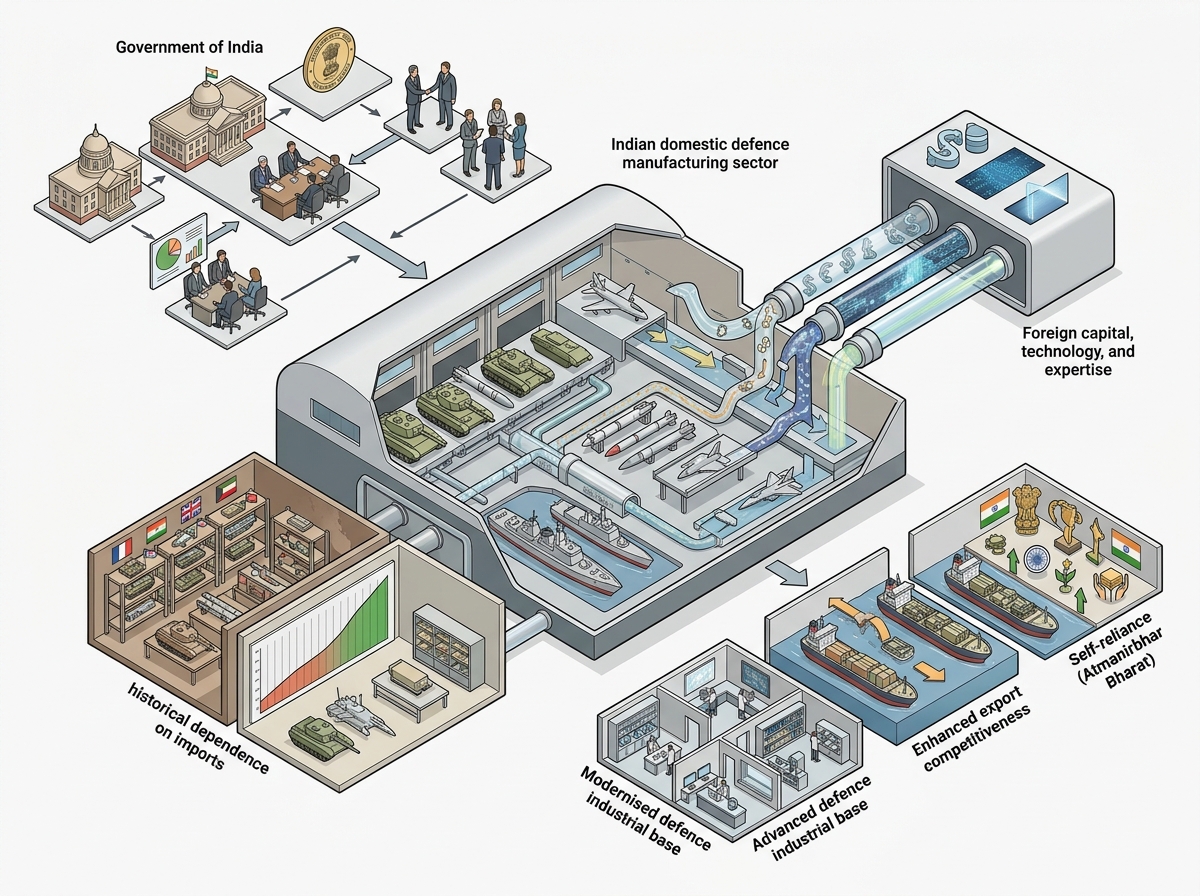
The Government of India is reportedly considering further liberalisation of Foreign Direct Investment (FDI) norms in the defence manufacturing sector. This potential policy adjustment is being pursued through stakeholder consultations led by the Department for Promotion of Industry and Internal Trade (DPIIT), with the objective of attracting greater foreign capital, technology, and expertise to bolster domestic defence production capabilities. The move aligns with broader national objectives of achieving self-reliance in defence (Atmanirbhar Bharat), enhancing export competitiveness, and modernising the defence industrial base.
Background
- The defence sector in India has historically been characterised by high import dependence, with significant expenditure directed towards procuring foreign military hardware.
- Foreign investment in defence manufacturing is governed by the Consolidated FDI Policy of India, which currently permits up to 74% FDI under the automatic route and beyond 74% through the government approval route, subject to security clearances.
- The Ministry of Home Affairs (MHA) and Ministry of Defence (MoD) jointly vet foreign investments for security implications, ensuring compliance with national security protocols.
- India’s defence exports have witnessed a substantial increase from ₹686 crore in 2013–14 to ₹38,424 crore in 2025–26, reflecting growing indigenous capabilities.
- The government has set ambitious targets: achieving ₹3 lakh crore annual defence production and ₹50,000 crore in defence exports by 2029.
What is Foreign Direct Investment (FDI) in the Defence Sector?
- FDI refers to investment made by a foreign entity into the domestic defence manufacturing sector, either through equity participation or long-term capital infusion.
- The current FDI policy in defence allows up to 74% investment under the automatic route, where no prior government approval is required.
- Investments exceeding 74% require government approval, particularly where the inflow is likely to bring advanced technology, enhance manufacturing capabilities, or alter the strategic ownership structure of the entity.
- Security clearances from the Ministry of Home Affairs (MHA) and Ministry of Defence (MoD) are mandatory to mitigate risks associated with foreign ownership, including technology transfer, data security, and national security concerns.
- FDI in defence is governed by the Consolidated FDI Policy of India, which is periodically revised to align with national strategic and industrial objectives.
- The policy distinguishes between the ‘automatic route’ and ‘government route’ based on the level of foreign investment and the associated technological implications.
- The policy aims to strike a balance between attracting foreign capital and safeguarding national security interests, particularly in sectors critical to strategic autonomy.
Key Features
| Feature | Significance |
|---|---|
| Current FDI cap of 74% (automatic route) | Balances foreign capital inflow with strategic control; maintains majority domestic ownership in critical defence projects. |
| Government approval route beyond 74% | Ensures scrutiny for investments likely to bring advanced technology or involve sensitive defence systems. |
| Security clearance by Ministry of Home Affairs | Mandatory vetting to mitigate risks to national security from foreign ownership of defence assets. |
| Ministry of Defence guidelines | Ensures alignment of FDI with indigenous defence manufacturing priorities and technology absorption. |
| Stakeholder consultations by DPIIT | Facilitates industry feedback to refine policy while maintaining transparency in regulatory adjustments. |
| Target of Rs 3 lakh crore annual defence production by 2029 | Drives self-reliance (Atmanirbhar Bharat) and reduces import dependence in defence manufacturing. |
Why it Matters
Economic
- Enhanced FDI can attract global defence majors, boosting capital inflows and job creation in defence manufacturing clusters.
- Increased investment may spur ancillary industries (e.g., aerospace, electronics) through supply chain integration.
- Potential to reduce defence import bill by fostering domestic production of high-tech equipment.
- Exports may rise (Rs 38,424 crore in 2025-26) if FDI enables competitive, globally marketable defence products.
Strategic
- Modern technology infusion through FDI can accelerate India’s defence indigenisation under ‘Make in India’ initiatives.
- Strategic autonomy is preserved via security clearances and government approvals for sensitive investments.
- Strengthens domestic defence industrial base, reducing reliance on foreign suppliers for critical platforms.
Policy
- Aligns with broader liberalisation trends in defence FDI (e.g., 2020 amendments allowing up to 74% automatic route).
- Demonstrates adaptive governance in response to evolving geopolitical and technological demands.
- Balances openness to foreign capital with safeguards for national security and technological sovereignty.
Challenges
1. Technology Transfer and Absorption
- Risk of FDI-led investments remaining assembly hubs without genuine technology transfer to Indian entities.
- Dependence on foreign OEMs for critical components may persist, undermining long-term indigenisation goals.
- Need for robust R&D partnerships to ensure domestic capability development beyond licensed production.
UPSC Link: GS3: Indigenisation and Technology Transfer
2. Security and Sovereignty Concerns
- Foreign ownership of defence assets could pose risks to classified technologies or supply chain integrity.
- Over-reliance on foreign investors may compromise India’s strategic decision-making autonomy in defence procurement.
- Balancing FDI liberalisation with stringent security vetting remains a policy challenge.
UPSC Link: GS3: National Security and Defence Industrial Base
3. Regulatory and Bureaucratic Hurdles
- Complexity in navigating multiple approvals (DPIIT, MoD, MHA) may deter genuine investors despite policy easing.
- Delays in security clearances or government approvals could undermine investor confidence.
- Need for streamlined processes to align with global best practices in defence FDI regimes.
UPSC Link: GS2: Regulatory Governance and Ease of Doing Business
4. Market Competition and MSME Integration
- Large FDI inflows may marginalise domestic MSMEs in the defence supply chain due to economies of scale advantages.
- Risk of monopolistic practices by foreign investors in niche defence segments.
- Ensuring equitable participation of private sector (45.16% of exports in 2025-26) in FDI-driven growth.
UPSC Link: GS3: MSMEs and Defence Manufacturing
5. Export Controls and Geopolitical Risks
- Stringent export controls (e.g., ITAR, Wassenaar Arrangement) may limit India’s ability to re-export defence products sourced via FDI.
- Geopolitical alignments (e.g., US-China tensions) could constrain technology access or market expansion for Indian firms.
- Need for diversified partnerships to mitigate supply chain disruptions in critical defence inputs.
UPSC Link: GS2: International Relations and Export Controls
Challenges — UPSC Perspective
| Issue | Concern |
|---|---|
| Technology Transfer Gaps | Risk of assembly-line production without substantive indigenisation or R&D capability building. |
| Security Vetting Bottlenecks | Potential delays in clearances may deter investors despite policy liberalisation. |
| MSME Marginalisation | Large-scale FDI could outcompete domestic small and medium enterprises in the defence ecosystem. |
| Regulatory Overlap | Multiple approval layers (DPIIT, MoD, MHA) may create compliance burdens for investors. |
| Export Restrictions | Geopolitical and regulatory export controls may limit market access for FDI-backed defence products. |
| Sovereignty Trade-offs | Balancing foreign investment with national control over critical defence technologies and supply chains. |
Way Forward
- Conduct structured stakeholder consultations to identify specific sectors where FDI can catalyse technology transfer without compromising security.
- Establish a single-window clearance mechanism for defence FDI to reduce bureaucratic delays and improve investor confidence.
- Incentivise joint ventures and technology-sharing agreements between foreign investors and domestic defence PSUs/MSMEs to ensure equitable growth.
- Expand the ‘Make in India’ defence production targets to include explicit milestones for indigenisation and R&D collaboration under FDI-led projects.
- Strengthen domestic R&D capabilities through public-private partnerships to reduce dependence on foreign technology for critical systems.
- Develop a clear export policy framework for FDI-backed defence products to leverage global markets while complying with international regimes.
- Enhance transparency in security clearance processes to provide predictable timelines for investors and mitigate regulatory uncertainty.
- Monitor the impact of FDI liberalisation on MSMEs and introduce safeguards (e.g., procurement quotas) to ensure their participation in the defence supply chain.
UPSC Value Addition
Keywords for Mains Answer-Writing
Foreign Direct Investment (FDI) liberalisation · Defence sector FDI policy · Automatic vs government-approval route in FDI · Defence Production and Export Promotion Policy · Ministry of Defence and Home Affairs security clearance · Defence Public Sector Undertakings (DPSUs) · Defence manufacturing ecosystem · Atmanirbhar Bharat in defence
Concept Flow
Liberalisation of FDI norms in defence sector → Increased foreign capital inflows → Potential technology transfer and indigenisation → Expansion of domestic defence manufacturing base → Growth in exports and reduction in import dependence → Alignment with Atmanirbhar Bharat goals → Enhanced strategic autonomy → Need for robust regulatory safeguards → Continuous policy refinement via stakeholder feedback.
Prelims Practice Questions
Q1. Consider the following statements regarding Foreign Direct Investment (FDI) in India’s defence sector:
1. FDI up to 74% is permitted through the automatic route in the defence sector.
2. Beyond 74%, FDI requires government approval and is subject to access to modern technology.
3. All FDI proposals in the defence sector require security clearance from the Ministry of Home Affairs.
4. The Ministry of Defence is the nodal authority for granting government approval for FDI beyond 74%.
How many of the above statements are correct?
- Only one
- Only two
- Only three
- All four
Answer: Only three — Statements 1, 2, and 3 are correct. Statement 4 is incorrect because the nodal authority for granting government approval for FDI beyond 74% is the Department for Promotion of Industry and Internal Trade (DPIIT), not the Ministry of Defence.
Q2. Assertion (A): The government is considering liberalisation of FDI norms in the defence sector to attract overseas investors.
Reason (R): India’s defence budget has increased from ₹2.53 lakh crore in 2013-14 to ₹7.85 lakh crore in 2026-27.
In the context of the above two statements, which one of the following is correct?
- Both A and R are true, and R is the correct explanation of A.
- Both A and R are true, but R is NOT the correct explanation of A.
- A is true, but R is false.
- A is false, but R is true.
Answer: A is true, but R is false. — Both Assertion (A) and Reason (R) are true. However, Reason (R) is not the correct explanation of Assertion (A) because the increase in the defence budget is a separate policy development and not the reason for considering FDI liberalisation.
Q3. Match the following pairs related to India’s defence sector policy:
Column I (Policy Aspect) | Column II (Government Body)
————————-|—————————
A. Security clearance for FDI in defence | 1. Department for Promotion of Industry and Internal Trade (DPIIT)
B. Government approval for FDI beyond 74% | 2. Ministry of Home Affairs
C. Export promotion in defence | 3. Ministry of Defence
D. Defence procurement | 4. Directorate General of Foreign Trade (DGFT)
Select the correct match:
- A-2, B-1, C-4, D-3
- A-1, B-2, C-3, D-4
- A-3, B-4, C-1, D-2
- A-4, B-3, C-2, D-1
Answer: A-2, B-1, C-4, D-3 — The correct matches are: A-2 (Security clearance is provided by the Ministry of Home Affairs), B-1 (Government approval for FDI beyond 74% is granted by DPIIT), C-4 (Export promotion is handled by DGFT), and D-3 (Defence procurement is managed by the Ministry of Defence).
Mains Practice Question
✍ The government is considering liberalisation of Foreign Direct Investment (FDI) norms in the defence sector to attract overseas investors. Critically examine the rationale behind this policy shift and its potential implications for India’s defence manufacturing ecosystem and national security. (15 Marks)
Approach: MODEL-ANSWER SKELETON:
1. **Rationale for FDI liberalisation in defence**
– Current FDI limits (74% automatic, beyond via government approval) and their limitations.
– Need for modern technology, capital, and global best practices to enhance indigenous defence manufacturing.
– Alignment with ‘Atmanirbhar Bharat’ and self-reliance goals in defence production.
– Evidence of growing defence exports (₹38,424 crore in 2025-26) and private sector contribution (45.16%).
2. **Potential benefits**
– Attracting foreign investment and technology transfer.
– Boosting defence exports and reducing import dependence.
– Enhancing competitiveness of domestic defence manufacturers.
– Job creation and skill development in the defence sector.
3. **Challenges and risks**
– National security concerns: Over-reliance on foreign entities for critical defence technologies.
– Stringent security clearances by the Ministry of Home Affairs and Ministry of Defence.
– Balancing FDI liberalisation with indigenous innovation and capacity-building.
– Ensuring that technology transfer agreements are equitable and not exploitative.
4. **Comparative perspective**
– Global examples: FDI policies in defence sectors of the USA, Russia, and Israel.
– Lessons from India’s past liberalisation attempts in defence FDI.
5. **Conclusion**
– Policy shift must be calibrated to balance economic growth with strategic autonomy.
– Emphasis on indigenisation through Transfer of Technology (ToT) clauses and joint ventures.
Source: orissapost.com
Generated by AanyaAi for educational purpose.
Related guides on our sites
- Current affairs for upsc 2026
- How to prepare for GS paper 1 for UPSC CSE mains exam
- Best UPSC coaching for IFOS exam
- Best mentorship programme for upsc

- उत्तराखंड राज्यपाल की पीएम मोदी से महत्वपूर्ण बैठक: जानिए मुख्य बिंदु - October 23, 2026
- How India’s Rs 20,000 Cr CCUS Budget Can Drive Net-Zero Goals - October 23, 2026
- पंजाब-हरियाणा में पराली जलाने पर सीएक्यूएम की सख्त समीक्षा, तुरंत उठाये गये कदमों पर जोर - October 23, 2026

No Comments