


30 Jul Govt Pushes FCRA & Births Deaths Bills Amid Parliament Logjam Fears
Subject Relevance — Where This Topic Fits
- GS Paper II — Parliament and State Legislatures — Structure, Functioning, Conduct of Business, Powers & Privileges and Issues Arising out of these | GS Paper III — Government Budgeting and Institutional Reforms
- Prelims: Foreign Contribution (Regulation) Act, 2010, Registration of Births and Deaths Act, 1969, Public Examinations (Prevention of Unfair Means) Act, 2024, Micro, Small and Medium Enterprises (MSME) Development Act, 2006, Parliamentary logjam, Unstarred Question, Voice Vote, Rajya Sabha vs Lok Sabha dynamics
- Essay: Parliamentary accountability in a vibrant democracy: Balancing legislative efficiency and democratic dissent, The role of opposition in shaping governance: A study of parliamentary disruption and its consequences
Quick Revision: The FCRA and Registration of Births and Deaths (Amendment) Bill are critical for enhancing transparency in foreign funding and improving demographic data integrity, respectively, while parliamentary logjams threaten legislative efficiency and reform momentum.
Why is this in the news?
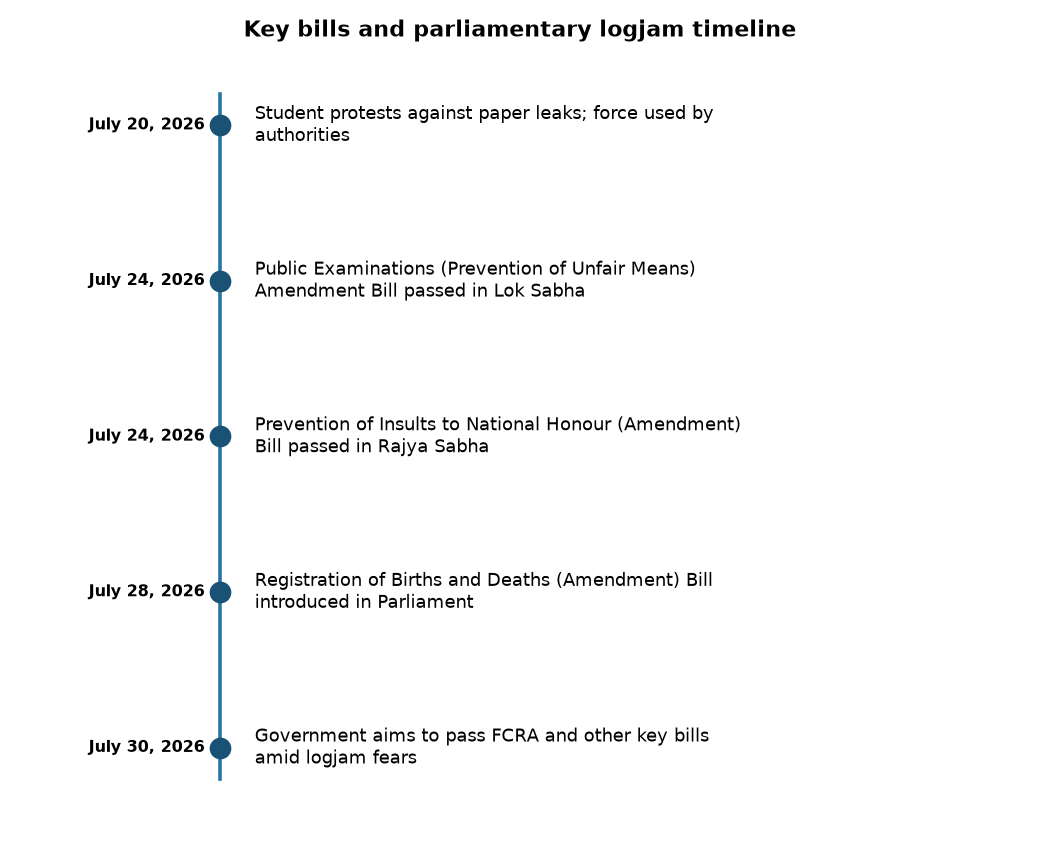
The Monsoon Session of Parliament has witnessed legislative disruptions, with opposition parties protesting the alleged use of force against student protesters during paper leak demonstrations. Despite this, the government is prioritising the passage of critical bills, including amendments to the Foreign Contribution (Regulation) Act (FCRA) and the Registration of Births and Deaths Act, amid concerns over a potential parliamentary logjam that could impede legislative productivity.
Background
- The Monsoon Session of Parliament is a critical legislative window for the government to advance key reforms, particularly in areas of electoral integrity, administrative compliance, and economic support for MSMEs.
- Opposition parties, particularly the Congress, have accused the government of using excessive force against student protesters, leading to demands for an apology from the Union Home Minister and the Leader of Opposition in the Lok Sabha.
- The government has framed the opposition’s obstructionist tactics as attempts to derail legislative progress, particularly on bills addressing paper leaks and national honour.
- The FCRA, originally enacted in 1976 and amended in 2010, regulates the receipt and utilisation of foreign contributions by individuals, associations, and companies in India, with stringent compliance requirements.
Key Bills Under Consideration: Legislative Objectives and Implications
- **Foreign Contribution (Regulation) Amendment Bill, 2026**: Aimed at further tightening the regulatory framework governing foreign contributions, this amendment seeks to enhance transparency, reduce misuse, and align with evolving geopolitical and security concerns. The FCRA’s provisions are critical for maintaining national sovereignty while ensuring that legitimate foreign aid reaches intended beneficiaries without compromising domestic interests.
- The **Registration of Births and Deaths (Amendment) Bill** proposes stricter timelines for registration, digitalisation of records, and penalties for non-compliance. This amendment aligns with the government’s Digital India initiative and aims to improve demographic data accuracy, which is essential for policy formulation, welfare schemes, and electoral rolls.
- The **Micro, Small and Medium Enterprises (MSME) Development (Amendment) Bill, 2026** seeks to address challenges faced by MSMEs, including access to credit, ease of doing business, and compliance burdens. The bill may introduce measures such as simplified registration processes, enhanced credit guarantees, and incentives for technological adoption, thereby fostering economic resilience and employment generation.
- The **Public Examinations (Prevention of Unfair Means) Amendment Bill, 2026** strengthens penalties for malpractices in public examinations, including paper leaks, impersonation, and tampering with answer sheets. This bill is a direct response to recurring incidents of examination fraud, which undermine meritocracy and public trust in recruitment processes.
- The **Prevention of Insults to National Honour (Amendment) Bill** expands the scope of offences under Section 2 of the original Act, including digital acts of disrespect to the National Flag, National Anthem, or the Constitution. This amendment reflects the government’s commitment to preserving national symbols in the digital age, where misinformation and symbolic violations can rapidly escalate into social unrest.
- Parliamentary logjams, characterised by disruptions, adjournments, or walkouts, impede legislative productivity and delay critical reforms. Such disruptions often stem from political disagreements, opposition demands for accountability, or procedural conflicts, as witnessed in the current session.
- The **FCRA** empowers the government to prohibit foreign contributions if they are deemed detrimental to public interest, national security, or sovereignty. The Act also mandates registration, reporting, and utilisation of funds, with penalties for non-compliance, including cancellation of registration and imprisonment.
- The **Registration of Births and Deaths Act, 1969** provides the legal framework for recording vital statistics, which are foundational for governance, welfare delivery, and demographic planning. The amendment seeks to modernise this framework by integrating technology and reducing bureaucratic delays.
Key Features
| Feature | Significance |
|---|---|
| Registration of Births and Deaths (Amendment) Bill, 2026 | Introduces stricter compliance frameworks for delayed registrations, enhancing accuracy in demographic data critical for welfare schemes and electoral rolls. |
| Foreign Contribution (Regulation) Amendment Bill, 2026 | Tightens regulations on foreign funding to NGOs, aiming to curb misuse while balancing transparency and civil society participation. |
| Public Examinations (Prevention of Unfair Means) Amendment Bill, 2026 | Strengthens penalties for malpractices in competitive exams, addressing systemic corruption and ensuring meritocracy in public sector recruitment. |
| Prevention of Insults to National Honour (Amendment) Bill | Expands scope of punishable acts under the Act, reinforcing national symbols’ sanctity amid rising incidents of disrespect. |
| Parliamentary Logjam and Opposition Disruptions | Highlights procedural bottlenecks in legislative functioning, reflecting underlying political polarisation and its impact on governance. |
Why it Matters
Legislative Governance
- Accelerates passage of critical bills, demonstrating government’s intent to legislate despite opposition obstructions.
- Exposes structural weaknesses in parliamentary procedures, necessitating reforms in anti-defection laws and time-bound discussions.
- Sets precedent for executive-legislative friction, influencing future bill introductions and opposition strategies.
Administrative Efficiency
- Enhanced demographic data accuracy through the Births and Deaths Amendment Bill aids in targeted welfare delivery and policy formulation.
- Stricter FCRA compliance ensures foreign funds are utilised transparently, reducing risks of diversion for anti-national activities.
- Public examinations reform curbs malpractices, restoring public trust in competitive examinations for civil services and other recruitments.
Political Economy
- FCRA amendments may impact NGOs’ operational freedom, influencing civil society’s role in governance and developmental discourse.
- Public examinations reform aligns with demands for merit-based recruitment, a cornerstone of efficient public sector functioning.
- Opposition’s obstructionist tactics may erode public confidence in parliamentary democracy, necessitating constructive engagement.
Constitutional and Democratic Values
- Parliamentary logjams underscore the need for institutional mechanisms to ensure smooth legislative functioning, preserving democratic accountability.
- Public examinations reform reflects constitutional commitment to equality of opportunity (Article 14 and 16) in public employment.
- FCRA amendments balance Article 19(1)(c) (freedom to associate) with reasonable restrictions under Article 19(2) for national security.
Challenges
1. Parliamentary Disruptions and Logjams
- Ongoing opposition obstructions delay critical legislation, undermining legislative productivity and governance.
- Procedural gridlocks exacerbate executive-legislative tensions, complicating consensus-building on socio-economic reforms.
- Public perception of parliamentary dysfunction may erode trust in democratic institutions, impacting electoral politics.
UPSC Link: Parliament and State Legislatures – Role and Functioning
2. Balancing Transparency and Operational Freedom in FCRA
- Overly stringent FCRA amendments may stifle legitimate civil society activities, limiting grassroots developmental impact.
- Risk of bureaucratic overreach in scrutinising foreign contributions, potentially leading to arbitrary denials of FCRA registration.
- Need to distinguish between genuine developmental NGOs and entities with ulterior motives without undermining civil liberties.
UPSC Link: Role of NGOs, SHGs, Associations and Institutions
3. Ensuring Meritocracy in Public Examinations
- Implementation challenges in detecting and penalising malpractices, including technological and institutional gaps.
- Potential for over-criminalisation, where harsh penalties may deter meritorious candidates from legitimate grievance redressal.
- Coordination between central and state agencies required to standardise examination protocols and curb regional disparities.
UPSC Link: Issues Relating to Development and Management of Social Sector/Services relating to Health, Education, Human Resources
4. Data Accuracy in Demographic Registrations
- Delayed registrations continue to plague rural and marginalised communities, delaying access to welfare benefits.
- Lack of digital infrastructure in remote areas hampers real-time data updation, exacerbating compliance challenges.
- Inter-state coordination required to prevent duplication or omission of records, ensuring seamless service delivery.
UPSC Link: Issues Relating to Poverty and Hunger
5. Political Polarisation and Governance
- Deepening ideological divides hinder constructive dialogue, impeding consensus on socio-economic reforms.
- Opposition’s obstructionist tactics may escalate into constitutional crises, testing the resilience of parliamentary democracy.
- Need for institutional reforms, such as time-bound discussions and anti-defection laws, to mitigate political gridlocks.
UPSC Link: Structure, Organisation and Functioning of the Executive and the Judiciary
Challenges — UPSC Perspective
| Issue | Concern |
|---|---|
| Opposition Disruptions | Systematic obstruction delays legislative agenda, undermining governance and public trust in institutions. |
| FCRA Compliance Burden | Excessive scrutiny may deter legitimate NGOs, impacting developmental projects and civil society participation. |
| Public Examination Malpractices | Corruption in exams undermines meritocracy, eroding public confidence in recruitment processes. |
| Delayed Demographic Registrations | Inaccurate or delayed data hampers welfare delivery and policy formulation, particularly in rural areas. |
| Political Polarisation | Ideological divides complicate consensus-building, stalling critical reforms and institutional trust. |
Way Forward
- Constitute a bipartisan parliamentary committee to recommend reforms in anti-defection laws and time-bound discussions to prevent logjams.
- Establish a digital grievance redressal mechanism for public examinations to swiftly address malpractices and restore meritocracy.
- Enhance digital infrastructure in rural areas to ensure real-time updation of birth and death registrations, reducing delays.
- Clarify FCRA amendment provisions to distinguish between legitimate NGOs and entities with anti-national agendas without stifling civil society.
- Promote inter-state coordination mechanisms to standardise demographic data collection and prevent duplication or omission.
- Encourage constructive opposition participation through pre-legislative consultations and thematic debates to reduce procedural obstructions.
- Strengthen institutional capacity of state agencies to implement FCRA amendments effectively, ensuring transparency without bureaucratic overreach.
- Mandate periodic reviews of parliamentary productivity metrics to assess the impact of reforms and identify bottlenecks.
UPSC Value Addition
Keywords for Mains Answer-Writing
Parliamentary logjam and disruption in legislative functioning · Foreign Contribution (Regulation) Amendment Bill, 2026 · Registration of Births and Deaths (Amendment) Bill, 2025 · Constitutional provisions governing parliamentary proceedings · Role of opposition in legislative scrutiny · Public Examinations (Prevention of Unfair Means) Amendment Bill, 2026 · Prevention of Insults to National Honour (Amendment) Bill · Parliamentary sovereignty and legislative efficiency · Use of force in student protests and parliamentary accountability · Constitutional amendments and their legislative process
Constitutional & Policy Linkages
- {‘Article 75(3)’: ‘Collective responsibility of ministers to Parliament’}
- {‘Article 80’: ‘Composition and role of Rajya Sabha’}
- {‘Article 105’: ‘Powers and privileges of Parliament’}
- {‘Article 19(1)(c)’: ‘Freedom to form associations’}
- {‘Article 21’: ‘Right to life and personal liberty (data privacy)’}
Concept Flow
Opposition disruptions in Parliament → Delay in legislative agenda → Government’s push for key bills (FCRA, Births & Deaths Amendment) → Public examinations reform passed amid protests → FCRA amendments proposed to curb foreign funding misuse → Births & Deaths Amendment introduced for stricter compliance → Political polarisation exacerbates logjams → Need for institutional reforms to ensure smooth governance
Prelims Practice Questions
Q1. Consider the following statements regarding the Foreign Contribution (Regulation) Act (FCRA), 2010:
1. The FCRA regulates the acceptance and utilisation of foreign contributions by individuals, associations, and companies.
2. The Act mandates that foreign contributions must be received only through designated banks.
3. The Act prohibits the transfer of foreign contributions to any other person or organisation.
4. The Act allows for the registration of foreign contributors without any prior approval from the government.
How many of the above statements are correct?
- Only one
- Only two
- Only three
- All four
Answer: Only three — Statements 1, 2, and 3 are correct as per the FCRA, 2010. Statement 4 is incorrect because foreign contributions require prior registration or prior permission from the government.
Q2. Assertion (A): The Speaker of the Lok Sabha has the power to adjourn the House sine die.
Reason (R): The Speaker’s authority to adjourn the House sine die is derived from Article 178 of the Constitution of India.
Options:
A. Both A and R are true, and R is the correct explanation of A.
B. Both A and R are true, but R is not the correct explanation of A.
C. A is true, but R is false.
D. A is false, but R is true.
Answer: ? — Assertion (A) is true as the Speaker has the power to adjourn the House sine die. However, Reason (R) is false because the authority is derived from the Rules of Procedure and Conduct of Business in the Lok Sabha, not Article 178.
Q3. Match the following bills with their respective objectives:
Column I (Bill) | Column II (Objective)
—————————————–|—————————————–
A. Registration of Births and Deaths | 1. To regulate foreign contributions
(Amendment) Bill, 2025 |
B. Foreign Contribution (Regulation) | 2. To prevent unfair means in public
Amendment Bill, 2026 | examinations
C. Public Examinations (Prevention of | 3. To amend compliance frameworks for
Unfair Means) Amendment Bill, 2026 | delayed registrations
D. Prevention of Insults to National | 4. To amend provisions related to
Honour (Amendment) Bill | national symbols and emblems
Options:
A. A-3, B-1, C-2, D-4
B. A-1, B-3, C-4, D-2
C. A-2, B-4, C-1, D-3
D. A-4, B-2, C-3, D-1
Answer: ? — A-3: The Registration of Births and Deaths (Amendment) Bill, 2025 aims to amend compliance frameworks for delayed registrations. B-1: The Foreign Contribution (Regulation) Amendment Bill, 2026 regulates foreign contributions. C-2: The Public Examinations (Prevention of Unfair Means) Amendment Bill, 2026 aims to prevent unfair means in public examinations. D-4: The Prevention of Insults to National Honour (Amendment) Bill amends provisions related to national symbols and emblems.
Mains Practice Question
✍ The functioning of Parliament in India is increasingly characterised by disruptions and logjams, often impeding legislative business. Critically examine the factors contributing to such disruptions and their implications for parliamentary democracy. Also, analyse the role of opposition parties in ensuring legislative accountability. (15 Marks)
Approach: MODEL-ANSWER SKELETON:
1. **Introduction (2 Marks)**
– Define parliamentary democracy and the role of Parliament in law-making.
– Briefly state the current trend of disruptions and logjams in Parliament.
2. **Factors Contributing to Disruptions (5 Marks)**
– **Politicisation of Legislative Business**: Opposition using disruptions to stall bills as a political strategy (e.g., recent paper leak protests and demands for Home Minister’s apology).
– **Lack of Consensus on Key Bills**: Polarisation over contentious bills like FCRA, Registration of Births and Deaths (Amendment), and Public Examinations (Prevention of Unfair Means) Bill.
– **Role of Parliamentary Rules**: Provisions under Rules 184, 185, and 193 of the Lok Sabha Rules and Rule 258 of the Rajya Sabha Rules that allow for disruptions.
– **Media and Public Pressure**: Amplification of protests and demands through media, influencing parliamentary proceedings.
– **Institutional Weaknesses**: Lack of effective mechanisms to curb unruly behaviour (e.g., absence of automatic suspension for repeated disruptions).
3. **Implications for Parliamentary Democracy (5 Marks)**
– **Erosion of Legislative Efficiency**: Delay in passing crucial bills (e.g., FCRA, Registration of Births and Deaths Amendment) affecting governance.
– **Weakening of Opposition’s Constructive Role**: Opposition’s focus on disruptions rather than scrutiny and debate.
– **Public Perception**: Erosion of trust in Parliament as an institution capable of functioning smoothly.
– **Judicial Intervention**: Potential for judicial review if Parliament fails to discharge its constitutional duties (e.g., Article 122 and 212).
– **Constitutional Consequences**: Violation of the basic structure doctrine if parliamentary sovereignty is undermined by frequent disruptions.
4. **Role of Opposition in Legislative Accountability (3 Marks)**
– **Scrutiny and Debate**: Opposition’s role in ensuring bills are thoroughly examined (e.g., demands for Home Minister’s statement on student protests).
– **Checks and Balances**: Opposition as a watchdog to prevent arbitrary legislation (e.g., scrutiny of FCRA amendments).
– **Limitations**: Overuse of disruptions to stall business, undermining the opposition’s constructive role.
5. **Conclusion (2 Marks)**
– Summarise the need for a balance between opposition’s scrutiny and smooth legislative functioning.
– Suggest reforms: Strengthening anti-defection laws, stricter enforcement of parliamentary discipline, and institutional mechanisms to address grievances without disruptions.
Source: Hindustan Times
Generated by AanyaAi for educational purpose.

- यूपी में पहली बार तेंदुओं का बधियाकरण: मानव-वन्यजीव संघर्ष रोकेगा अभियान - September 24, 2026
- UP’s Groundbreaking Leopard Sterilization Plan to Curb Human-Wildlife Conflict - September 24, 2026
- महाराष्ट्र में त्योहार जुलूसों पर बॉम्बे हाईकोर्ट का बड़ा फैसला: पटाखे, लेजर और संगीत पर रोक - September 24, 2026

No Comments