


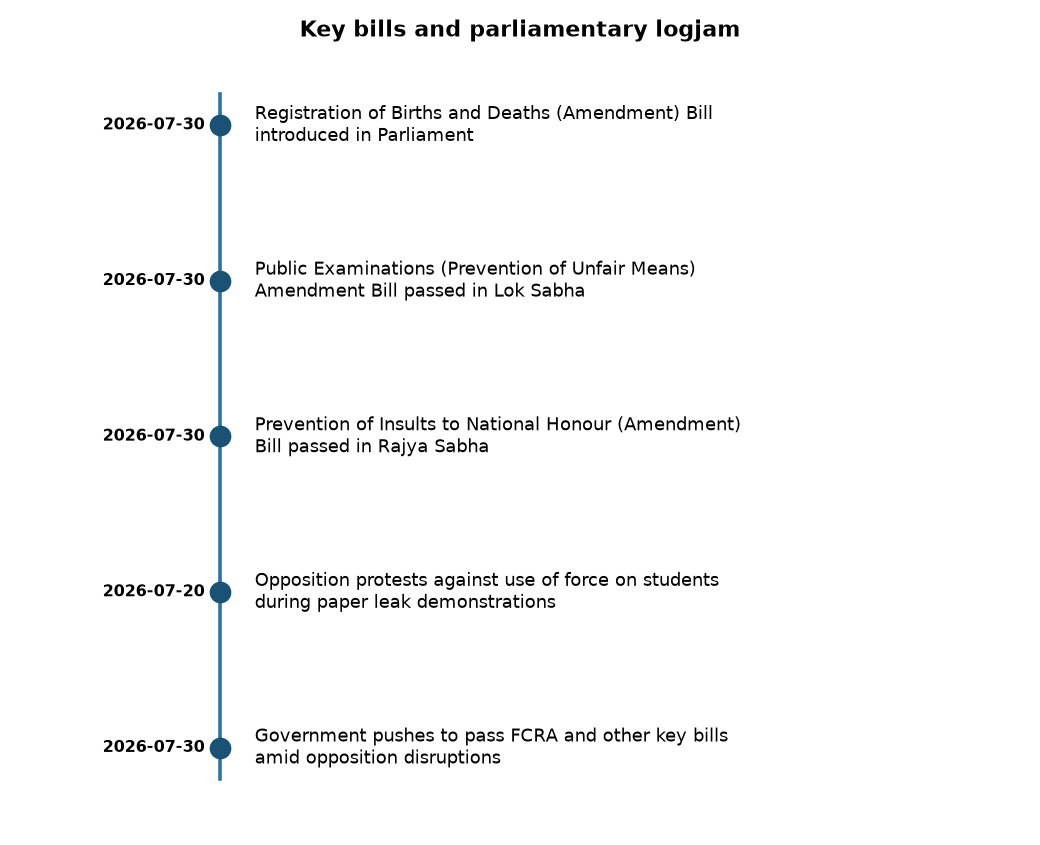
30 Jul Govt Pushes FCRA & Births Deaths Bills Amid Parliament Logjam Fears
Subject Relevance — Where This Topic Fits
- GS Paper II — Polity and Governance (Parliamentary Procedures, Bills and Amendments) | GS Paper III — Economic and Social Development (Regulatory Frameworks, MSMEs, FCRA)
- Prelims: Foreign Contribution (Regulation) Act, 2010, Registration of Births and Deaths Act, 1969, Public Examinations (Prevention of Unfair Means) Act, 2024, Prevention of Insults to National Honour Act, 1971, MSME Development Act, 2006, Parliamentary logjam, Money Bill, Voice vote, Opposition disruption, Paper leaks in examinations
- Essay: Parliamentary accountability and democratic governance, Balancing legislative efficiency with democratic dissent
Quick Revision: The Foreign Contribution (Regulation) Amendment Bill aims to tighten compliance norms for foreign funding to prevent misuse, while the Registration of Births and Deaths (Amendment) Bill seeks to digitise and streamline vital statistics registration for better governance.
Why is this in the news?
The Union Government’s intent to prioritise the passage of critical bills such as the Foreign Contribution (Regulation) Amendment Bill, and the Registration of Births and Deaths (Amendment) Bill, amid escalating parliamentary disruptions underscores the tension between legislative efficiency and democratic accountability. This development highlights the procedural challenges in Parliament, particularly the opposition’s demand for accountability on alleged excessive use of force during student protests, which risks derailing legislative business and delaying key reforms.
Background
- The Foreign Contribution (Regulation) Act (FCRA), 2010, regulates the acceptance and utilisation of foreign contributions by individuals, associations, and companies in India, ensuring transparency and preventing misuse for activities detrimental to national interest.
- The Registration of Births and Deaths Act, 1969, mandates the registration of all births and deaths in India, serving as a critical tool for demographic data collection, governance, and public health planning.
- Recent disruptions in Parliament, including protests over alleged excessive use of force (e.g., pellet guns) during student demonstrations against paper leaks, have intensified political polarisation and disrupted legislative proceedings.
- The Public Examinations (Prevention of Unfair Means) Amendment Bill, 2026, seeks to strengthen penalties for malpractices in public examinations, a response to recurring scandals involving question paper leaks and cheating.
- The Prevention of Insults to National Honour (Amendment) Bill aims to amend the 1971 Act to address evolving forms of disrespect to national symbols and institutions.
Key Bills Under Consideration: Legislative Intent and Implications
- The **Foreign Contribution (Regulation) Amendment Bill** seeks to amend the FCRA, 2010, to introduce stricter compliance norms, including enhanced due diligence for foreign contributions, mandatory registration for intermediaries, and provisions for suspension or cancellation of FCRA registration for non-compliance. The Bill aims to curb the misuse of foreign funds for activities prejudicial to public interest or sovereignty.
- The **Registration of Births and Deaths (Amendment) Bill** proposes to amend the 1969 Act to mandate digital registration, integrate Aadhaar for authentication, and impose stricter timelines for registration. This amendment is expected to improve the accuracy of vital statistics, facilitate better planning for social welfare schemes, and streamline the issuance of legal documents such as birth and death certificates.
- The **Public Examinations (Prevention of Unfair Means) Amendment Bill, 2026** introduces stringent penalties, including imprisonment and fines, for individuals and institutions involved in examination malpractices. The Bill also empowers investigative agencies to probe such offences, reflecting the government’s commitment to maintaining the integrity of competitive examinations.
- The **Prevention of Insults to National Honour (Amendment) Bill** seeks to modernise the 1971 Act by expanding the definition of ‘insults’ to include digital and symbolic acts (e.g., defacing or burning of national symbols online). The amendment aims to address contemporary forms of disrespect while balancing free speech concerns.
- Parliamentary logjams, driven by opposition demands for accountability (e.g., alleged use of pellet guns against students), risk delaying the passage of these bills, which are critical for governance, economic growth, and social welfare.
- The procedural dynamics of Parliament—such as voice votes, din, and opposition disruption—highlight the challenges in balancing legislative efficiency with democratic dissent, particularly in a polarised political environment.
- The government’s push for these amendments reflects a broader agenda to strengthen regulatory frameworks, enhance transparency, and address emerging socio-economic challenges through legislative reforms.
Key Features
| Feature | Significance |
|---|---|
| Registration of Births and Deaths (Amendment) Bill, 2026 | Introduces stricter compliance frameworks for delayed registrations, including digital verification and mandatory reporting, to enhance demographic data accuracy for welfare schemes and governance. |
| Foreign Contribution (Regulation) Amendment Bill, 2026 | Seeks to tighten regulations on foreign funding for NGOs and individuals, aiming to prevent misuse of funds while ensuring transparency in financial inflows. |
| Public Examinations (Prevention of Unfair Means) Amendment Bill, 2026 | Strengthens penalties for malpractices in public examinations, including paper leaks, to uphold meritocracy and public trust in recruitment processes. |
| Prevention of Insults to National Honour (Amendment) Bill | Expands definitions of acts that constitute disrespect to national symbols, aligning with evolving societal norms and legal interpretations. |
Why it Matters
Legislative Governance
- Demonstrates the government’s intent to prioritize key legislative reforms despite opposition disruptions, reflecting robust parliamentary functioning.
- Highlights the role of parliamentary sessions in advancing governance agendas, particularly in areas requiring statutory backing.
Administrative Efficiency
- The Registration of Births and Deaths Amendment Bill aims to streamline demographic data collection, crucial for targeted welfare delivery and policy formulation.
- The FCRA Amendment Bill seeks to enhance transparency in foreign funding, reducing risks of financial misappropriation and foreign interference.
Social Accountability
- The Public Examinations Amendment Bill addresses systemic corruption in recruitment, reinforcing ethical standards in public service appointments.
- The Prevention of Insults to National Honour Amendment Bill modernizes legal protections for national symbols, fostering civic responsibility.
Parliamentary Dynamics
- Exposes the tension between legislative efficiency and opposition-led disruptions, a recurring challenge in democratic governance.
- Underscores the role of parliamentary debates in shaping public policy, particularly on contentious issues like student protests and paper leaks.
Challenges
1. Parliamentary Logjam
- Opposition-led disruptions threaten the smooth passage of critical bills, delaying legislative agendas and governance reforms.
- Highlights the need for consensus-building mechanisms to prevent legislative paralysis during parliamentary sessions.
UPSC Link: Parliament and State Legislatures – Role and functioning
2. Public Trust and Governance
- Student protests over paper leaks and alleged use of force by authorities risk eroding public confidence in institutional integrity.
- Calls for accountability in law enforcement and administrative actions to maintain societal harmony and trust.
UPSC Link: Pressure Groups and Formal/Informal Associations
3. Legal and Ethical Dilemmas
- Balancing stringent regulations (e.g., FCRA) with the right to free speech and association, particularly for NGOs and civil society.
- Ensuring that amendments to laws like the Prevention of Insults to National Honour do not infringe upon constitutional freedoms.
UPSC Link: Fundamental Rights – Article 19
4. Implementation and Compliance
- Enforcing stricter compliance frameworks under the Registration of Births and Deaths Amendment Bill may face resistance from local authorities.
- Ensuring transparency in foreign funding mechanisms under the FCRA Amendment Bill requires robust monitoring and reporting systems.
UPSC Link: Government Policies and Interventions
Challenges — UPSC Perspective
| Issue | Concern |
|---|---|
| Parliamentary Disruptions | Delays in legislative passage, undermining governance efficiency. |
| Public Protests and Law Enforcement | Perceived misuse of force risks escalating social unrest and eroding trust in institutions. |
| Regulatory Overreach vs. Rights | Potential conflicts between stringent regulations (e.g., FCRA) and constitutional freedoms. |
| Implementation Gaps | Lack of robust mechanisms to enforce amendments, particularly in local governance and NGO sectors. |
Way Forward
- Facilitate structured dialogues between the government and opposition to mitigate disruptions and ensure constructive parliamentary debates.
- Strengthen institutional mechanisms for transparent and accountable law enforcement, particularly in handling public protests.
- Develop clear guidelines for the implementation of the Registration of Births and Deaths Amendment Bill to ensure seamless compliance.
- Enhance oversight frameworks for the FCRA Amendment Bill to prevent misuse while safeguarding legitimate civil society activities.
- Promote public awareness campaigns to explain the objectives and provisions of key amendments, fostering societal acceptance.
- Establish a dedicated parliamentary committee to review and address grievances related to paper leaks and examination malpractices.
- Encourage bipartisan consensus on amendments to laws like the Prevention of Insults to National Honour to balance legal rigor with constitutional freedoms.
UPSC Value Addition
Keywords for Mains Answer-Writing
Parliamentary logjam · Foreign Contribution (Regulation) Amendment Bill, 2026 · Registration of Births and Deaths (Amendment) Bill · Public Examinations (Prevention of Unfair Means) Amendment Bill, 2026 · Prevention of Insults to National Honour (Amendment) Bill · Role of Opposition in Parliament · Legislative process in India · Parliamentary accountability · Constitutional amendments · Role of Speaker and Chairman in Parliament
Constitutional & Policy Linkages
- Article 19(1)(a) – Freedom of speech and expression (balancing with regulatory amendments).
- Article 21 – Right to life and personal liberty (ensuring proportionality in law enforcement).
- Article 29 – Protection of interests of minorities (relevance to FCRA amendments).
Concept Flow
Parliamentary disruptions → Delayed legislative passage → Governance inefficiencies → Public trust erosion. → Student protests over paper leaks → Alleged use of force by authorities → Opposition demands accountability → Parliamentary logjam. → Introduction of key amendments (FCRA, Registration of Births and Deaths) → Opposition scrutiny → Debates on transparency and rights → Legislative gridlock. → Passage of Public Examinations Amendment Bill → Strengthened penalties for malpractices → Enhanced public trust in recruitment processes. → FCRA Amendment Bill → Tighter foreign funding regulations → Scrutiny of NGO activities → Potential conflicts with civil society freedoms. → Registration of Births and Deaths Amendment Bill → Digital verification and delayed registration penalties → Improved demographic data accuracy for welfare schemes.
Prelims Practice Questions
Q1. Consider the following statements regarding the Foreign Contribution (Regulation) Amendment Bill, 2026:
1. It seeks to prohibit public servants from receiving foreign contributions.
2. It mandates Aadhaar-based identification for all foreign contribution receipts.
3. It empowers the government to permit foreign contributions only to specific banks.
How many of the above statements are correct?
- Only one
- Only two
- All three
- None
Answer: All three — Statements 1 and 3 are correct as per the proposed amendments to the FCRA. Statement 2 is incorrect because the bill does not mandate Aadhaar-based identification for foreign contributions.
Q2. Assertion (A): The Registration of Births and Deaths (Amendment) Bill aims to digitise birth and death records nationwide.
Reason (R): The bill introduces stricter timelines for registration and compliance mechanisms.
- Both A and R are true, and R is the correct explanation of A.
- Both A and R are true, but R is not the correct explanation of A.
- A is true, but R is false.
- A is false, but R is true.
Answer: Both A and R are true, but R is not the correct explanation of A. — The bill indeed aims to digitise records (A) and introduces stricter timelines and compliance mechanisms (R), making R the correct explanation of A.
Q3. Which of the following bills was recently passed by the Lok Sabha with a voice vote?
- Foreign Contribution (Regulation) Amendment Bill, 2026
- Public Examinations (Prevention of Unfair Means) Amendment Bill, 2026
- Registration of Births and Deaths (Amendment) Bill
- Prevention of Insults to National Honour (Amendment) Bill
Answer: Public Examinations (Prevention of Unfair Means) Amendment Bill, 2026 — The Public Examinations (Prevention of Unfair Means) Amendment Bill, 2026 was passed with a voice vote in the Lok Sabha.
Mains Practice Question
✍ The functioning of Parliament in contemporary India is increasingly characterised by disruptions and logjams, often attributed to the adversarial role of the Opposition. Critically examine this proposition with reference to recent legislative developments, including the passage of key bills such as the Foreign Contribution (Regulation) Amendment Bill and the Registration of Births and Deaths (Amendment) Bill. Also, analyse the implications of such logjams for parliamentary accountability and governance. (15 Marks)
Approach: MODEL-ANSWER SKELETON:
1. **Introduction**: Define parliamentary logjam and its constitutional significance in India’s Westminster-style democracy. Mention recent instances of disruptions (e.g., paper leak protests, opposition demands for apologies).
2. **Causes of Logjams**:
– Adversarial politics: Role of Opposition in disrupting proceedings (cite Rahul Gandhi’s allegations, Congress’s demand for apology from Home Minister).
– Institutional friction: Clashes over procedural norms (e.g., use of force in protests, allegations of derailing bills).
– Legislative urgency: Government’s push to pass key bills (FCRA, RBDB Amendment) amid opposition resistance.
3. **Recent Legislative Developments**:
– **Public Examinations (Prevention of Unfair Means) Amendment Bill, 2026**: Purpose (harsher penalties for paper leaks) and passage dynamics (voice vote in Lok Sabha).
– **Foreign Contribution (Regulation) Amendment Bill, 2026**: Key provisions (prohibition for public servants, bank restrictions) and opposition concerns (misconceptions, lack of clarity).
– **Registration of Births and Deaths (Amendment) Bill**: Objectives (digitisation, stricter timelines) and opposition’s procedural objections.
4. **Implications for Parliamentary Accountability**:
– Erosion of deliberative democracy: Reduced time for scrutiny of bills.
– Executive dominance: Government’s use of majority to bypass opposition scrutiny.
– Public perception: Undermining trust in institutions (cite protests, allegations of force).
5. **Constitutional Safeguards and Role of Presiding Officers**:
– Speaker/Chairman’s powers under Rules of Procedure (e.g., Rule 374 for naming members, suspension powers).
– Need for consensus-building mechanisms (e.g., all-party meetings, time-sharing agreements).
6. **Conclusion**: Balance between legislative efficiency and democratic accountability. Suggest reforms (e.g., stricter anti-defection laws, time-bound debates) to mitigate logjams while preserving opposition’s role.
Source: Hindustan Times
Generated by AanyaAi for educational purpose.

- ‘स्वच्छता ही सेवा-2026’ अभियान: सरकारी विभागों में स्वच्छता क्रांति, जानिए मुख्य बिंदु - September 22, 2026
- DFPD Launches ‘Swachhata Hi Seva-2026’ Campaign for Clean India Mission - September 22, 2026
- नमस्ते योजना से स्वच्छता कर्मियों को मिली सुरक्षा, गरिमा और आजीविका सहायता - September 22, 2026

No Comments