


11 Sep Grama Panchayat Portals in Kozhikode Remain Outdated: UPSC Exam Focus
✎ Grama panchayats must modernise their digital portals to comply with constitutional mandates for decentralised governance and to ensure seamless delivery of e-services, as envisaged under the Digital India Programme and state-led…
Subject Relevance — Where This Topic Fits
- GS Paper II — Governance, Constitution, Polity, Social Justice and International Relations (Decentralisation and Local Governance) | GS Paper III — Science and Technology (Digital Governance and e-Governance)
- Prelims: Grama Panchayat, Local Self-Government Department, Information Kerala Mission, e-Governance, Digital Public Infrastructure, Panchayati Raj Institutions, Constitutional provisions (Part IX – Panchayats), Digital India Programme
- Essay: Role of Technology in Strengthening Grassroots Democracy, Challenges in Implementing Digital Governance in Rural India
Quick Revision: Grama panchayats must modernise their digital portals to comply with constitutional mandates for decentralised governance and to ensure seamless delivery of e-services, as envisaged under the Digital India Programme and state-led initiatives like Kerala’s Information Kerala Mission.
Why is this in the news?
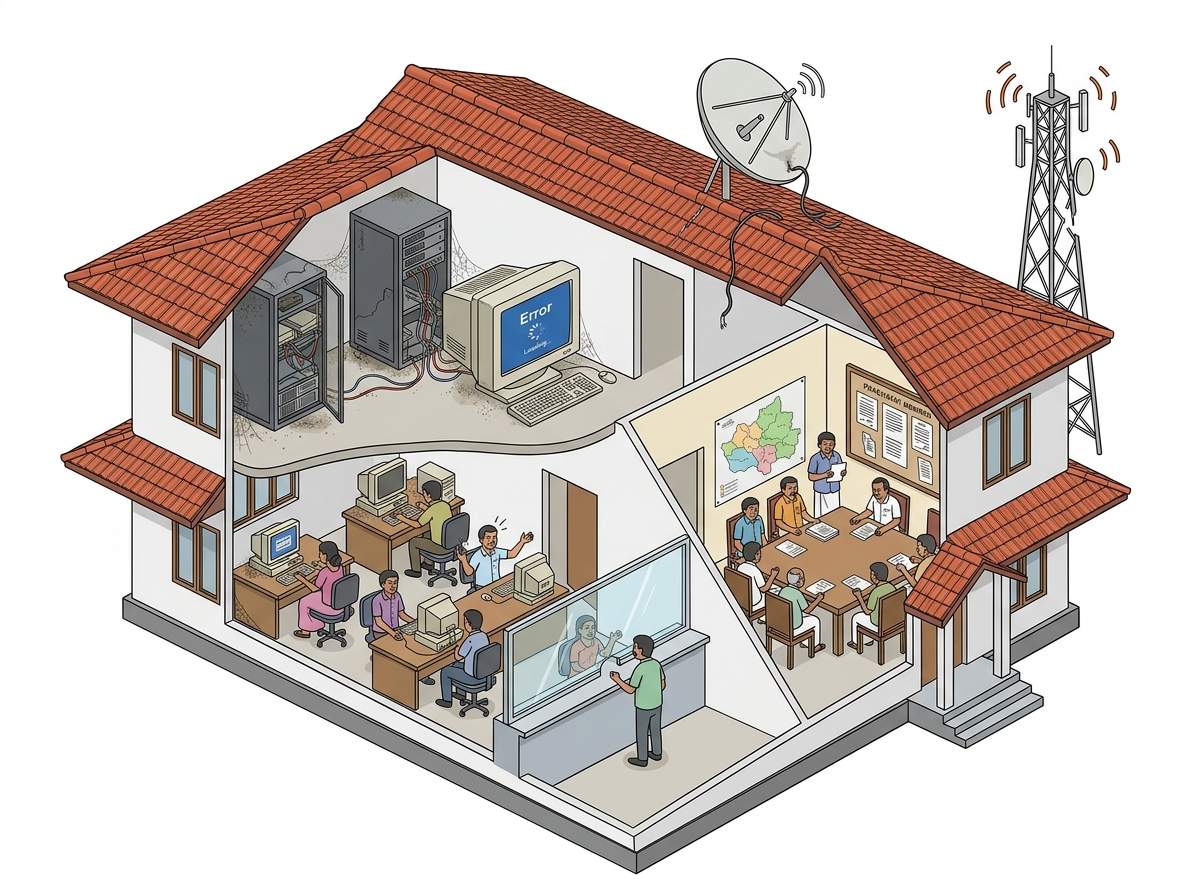
The news highlights the operational inefficiencies in grama panchayats in Kozhikode district due to obsolete and non-functional portals, which impede the delivery of online services to citizens. This underscores the broader challenge of digital governance at the grassroots level, where outdated information and technical limitations hinder transparency, accessibility, and efficiency in local administration.
Background
- Grama panchayats are the fundamental units of the Panchayati Raj system in India, established under Part IX of the Constitution (73rd Amendment Act, 1992) to ensure decentralised governance and citizen participation.
- The Local Self-Government Department in Kerala is responsible for overseeing the functioning of local bodies, including grama panchayats, and has initiated efforts to digitise their operations through portals and online services.
- The Information Kerala Mission (IKM) is a state-led initiative aimed at leveraging technology to enhance governance, service delivery, and transparency in local bodies across Kerala.
- Digital governance initiatives, such as the creation of common portals, are intended to streamline service delivery, reduce bureaucratic delays, and improve citizen access to administrative information and services.
- Obsolete portals with stale or non-functional data violate the principles of transparency and accountability in local governance, as mandated by constitutional provisions and statutory guidelines.
- The reliance on a single common portal for multiple grama panchayats often leads to inefficiencies due to lack of customisation, technical constraints, and inadequate maintenance.
What is Digital Governance in Grama Panchayats?
- Digital governance in grama panchayats refers to the use of information and communication technologies (ICTs) to enhance the delivery of public services, improve transparency, and facilitate citizen engagement at the grassroots level.
- Key components include online portals for information dissemination, e-services for certificate issuance (birth, death, marriage), tax payments, and social security schemes, as well as digital platforms for financial reporting and administrative updates.
- The 73rd Amendment Act, 1992, mandates the establishment of grama panchayats and empowers them to function as institutions of self-government, with a focus on participatory development and service delivery.
- Constitutional provisions such as Article 243G and Article 243W empower state legislatures to devolve functions and finances to panchayats, including the responsibility for digital governance initiatives.
- The Digital India Programme, launched in 2015, aims to transform India into a digitally empowered society and knowledge economy, with a focus on e-governance as a key pillar to improve service delivery and governance.
- State-specific missions, such as Kerala’s Information Kerala Mission (IKM), provide technical and financial assistance to local bodies to modernise their digital infrastructure and enhance service delivery.
- Effective digital governance in panchayats requires robust technical infrastructure, trained personnel, and regular updates to ensure that portals and services remain functional and relevant.
- Challenges include limited financial resources, lack of technical expertise, and inadequate maintenance, which often result in obsolete or non-functional portals, as highlighted in the Kozhikode case.
Key Features
| Feature | Significance |
|---|---|
| Common Portal by Local Self-Government Department | Provides basic data for grama panchayats but suffers from non-functionality or stale information, limiting citizen access to services. |
| Outdated Ward Member Details | Absence of updated information on newly elected ward members hinders transparency and citizen engagement in local governance. |
| Hyperlink Errors on Common Websites | Non-functional hyperlinks on grama panchayat portals obstruct access to essential e-services, including birth, death, and marriage certificates. |
| Digital Overhaul Requirement | Integration of all online services through a single window is necessary for efficient delivery of citizen-centric services. |
| Technical Assistance Models (e.g., Information Kerala Mission) | Demonstrates successful implementation of portal revamping in urban local bodies, offering a replicable framework for grama panchayats. |
Why it Matters
Administrative Efficiency
- Obsolete portals undermine the administrative capacity of grama panchayats to deliver timely and accurate services.
- Lack of updated data delays citizen access to critical documents such as certificates and social security benefits.
- Non-functional portals increase the administrative burden on local bodies to manually process requests.
Citizen Accessibility
- Citizens face difficulties in availing e-services due to non-functional or outdated portals, violating the principle of ease of doing business at the grassroots level.
- Outdated information on ward members and administrative matters erodes public trust in local governance institutions.
- Single-window integration of services is essential for reducing citizen effort and improving service delivery efficiency.
Digital Governance Imperative
- Digital transformation of local bodies is a prerequisite for achieving the goals of e-governance and inclusive development.
- Outdated portals hinder the realisation of the Digital India initiative’s objectives at the panchayat level.
- Technical assistance and capacity-building are critical for maintaining functional and updated digital infrastructure.
Challenges
1. Financial Constraints
- High costs associated with designing and maintaining unique portals for each grama panchayat.
- Limited budgetary allocations for digital infrastructure upgrades in rural local bodies.
- Dependency on external funding or technical assistance for portal revamping.
UPSC Link: GS-II: Local Governance
2. Technical Capacity Deficit
- Shortage of dedicated technical staff in grama panchayats to manage and update portals.
- Lack of in-house expertise to handle portal design, maintenance, and data updates.
- Reliance on common portals increases the risk of system-wide failures.
UPSC Link: GS-II: Local Governance
3. Data Staleness and Non-Functionality
- Outdated or incorrect data on portals leads to misinformation and service denials.
- Non-functional hyperlinks and portals disrupt access to essential services.
- Delayed updates on administrative matters such as ward member details and council meetings.
UPSC Link: GS-II: Transparency & Accountability
4. Citizen Awareness and Digital Literacy
- Low awareness among citizens about available online services and their access points.
- Digital literacy gaps hinder effective utilisation of e-governance portals.
- Lack of user-friendly interfaces in portals discourages citizen participation.
UPSC Link: GS-II: Inclusive Development
5. Interoperability and Integration
- Absence of a unified portal for grama panchayats complicates service delivery and citizen navigation.
- Lack of integration with state or national-level portals for seamless service access.
- Hyperlinks to external portals are often non-functional, creating a fragmented service ecosystem.
UPSC Link: GS-II: Digital Governance
Challenges — UPSC Perspective
| Issue | Concern |
|---|---|
| Financial Constraints | High costs of portal design and maintenance limit local bodies’ ability to upgrade digital infrastructure. |
| Technical Capacity Deficit | Shortage of skilled personnel in grama panchayats hampers portal management and data updates. |
| Data Staleness | Outdated or incorrect data on portals leads to misinformation and service denials. |
| Non-Functionality | Non-functional portals and hyperlinks obstruct access to essential e-services. |
| Citizen Awareness | Low digital literacy and awareness hinder effective utilisation of online services. |
| Interoperability | Lack of integration with state/national portals creates a fragmented service ecosystem. |
Way Forward
- Constitute dedicated technical teams in grama panchayats for portal management and data updates.
- Allocate budgetary provisions for portal revamping and maintenance under the Panchayat Development Fund.
- Leverage technical assistance from state missions (e.g., Information Kerala Mission) for capacity-building and portal design.
- Implement a phased rollout of single-window portals with integrated e-services for grama panchayats.
- Conduct digital literacy campaigns to enhance citizen awareness and utilisation of online services.
- Establish a grievance redressal mechanism for portal-related issues to ensure timely resolution.
- Promote interoperability with state and national e-governance portals for seamless service delivery.
- Mandate regular audits of portal functionality and data accuracy to maintain service integrity.
UPSC Value Addition
Keywords for Mains Answer-Writing
Grama Panchayats · Digital Public Infrastructure · Local Governance · e-Governance · Information Kerala Mission · Panchayati Raj Institutions · Common Service Centres · Service Delivery · Digital Divide · Constitutional Provisions for Local Governance · 73rd Constitutional Amendment Act · Panchayat Websites · Citizen-Centric Governance · Administrative Reforms · Public Service Delivery · Digital Transformation in Rural India
Concept Flow
Outdated digital infrastructure in grama panchayats → Non-functional or stale portals → Citizen inability to access e-services → Erosion of trust in local governance → Need for digital overhaul → Capacity-building and technical assistance → Single-window portal integration → Enhanced service delivery and transparency
Prelims Practice Questions
Q1. Consider the following statements regarding the 73rd Constitutional Amendment Act, 1992:
1. It mandates the establishment of a three-tier Panchayati Raj system in rural India.
2. It provides for the reservation of seats for women in Panchayati Raj institutions.
3. It empowers the State Election Commissions to conduct elections to Panchayati Raj institutions.
4. It grants financial powers to Panchayati Raj institutions to levy taxes and collect revenue.
How many of the above statements are correct?
- Only one
- Only two
- Only three
- All four
Answer: All four — Statements 1, 2, and 3 are correct as per the 73rd Amendment Act. Statement 4 is partially correct but the Act does not grant unrestricted financial powers; it empowers Panchayats to levy taxes but within the framework of State laws.
Q2. Assertion (A): The Information Kerala Mission (IKM) is a state-level initiative aimed at enhancing digital governance in Kerala.
Reason (R): The IKM provides technical assistance to local bodies for digitizing administrative processes and improving service delivery.
In the context of the above two statements, which one of the following is correct?
- Both A and R are true, and R is the correct explanation of A
- Both A and R are true, but R is not the correct explanation of A
- A is true but R is false
- A is false but R is true
Answer: Both A and R are true, and R is the correct explanation of A — Both Assertion (A) and Reason (R) are correct, and Reason (R) accurately explains Assertion (A). The IKM is indeed a state-level initiative and provides technical assistance to local bodies for digitization.
Q3. Match the following pairs related to Panchayati Raj institutions with their correct descriptions:
Column I (Institution) | Column II (Description)
— | —
1. Grama Sabha | A. Executive body of the Panchayat
2. Panchayat Samiti | B. Village-level assembly of all voters
3. Zilla Parishad | C. Block-level body coordinating Panchayats
4. Standing Committees | D. District-level body overseeing Panchayats
Select the correct match:
- 1-B, 2-C, 3-D, 4-A
- 1-A, 2-B, 3-C, 4-D
- 1-D, 2-A, 3-B, 4-C
- 1-C, 2-D, 3-A, 4-B
Answer: 1-B, 2-C, 3-D, 4-A — The correct matches are: 1-B (Grama Sabha is the village-level assembly), 2-C (Panchayat Samiti is the block-level body), 3-D (Zilla Parishad is the district-level body), and 4-A (Standing Committees are executive bodies).
Mains Practice Question
✍ The digital transformation of local governance in India, particularly through the revamping of Grama Panchayat portals, is essential for enhancing service delivery and citizen participation. Critically examine the challenges in achieving this transformation, with reference to the constitutional framework for local governance and the role of digital public infrastructure. (15 Marks)
Approach: MODEL-ANSWER SKELETON:
1. **Constitutional Framework and Local Governance**:
– Briefly outline the 73rd Constitutional Amendment Act, 1992, and its provisions for decentralisation, including the establishment of three-tier Panchayati Raj institutions (Grama Panchayats, Panchayat Samitis, Zilla Parishads).
– Highlight the mandate for devolution of powers, functions, and finances to Panchayats under Article 243G.
2. **Digital Public Infrastructure (DPI) and Local Governance**:
– Define DPI and its role in enhancing governance efficiency, transparency, and citizen-centric service delivery.
– Cite examples of successful DPI initiatives such as the Information Kerala Mission (IKM) and Common Service Centres (CSCs).
3. **Challenges in Digital Transformation of Grama Panchayats**:
– **Technical and Financial Constraints**: High costs of designing and maintaining portals, lack of dedicated technical staff, and limited financial autonomy of Panchayats.
– **Capacity Gaps**: Inadequate training of Panchayat officials and lack of awareness among citizens regarding digital services.
– **Data Management Issues**: Outdated or stale data on portals, non-functional links, and lack of real-time updates.
– **Digital Divide**: Unequal access to digital infrastructure and literacy among rural populations.
4. **Role of State and Central Governments**:
– Discuss the role of state governments in providing technical and financial support (e.g., IKM in Kerala).
– Highlight the need for a centralised framework for standardising digital platforms while allowing local customisation.
5. **Way Forward**:
– Suggest measures such as capacity-building programs, public-private partnerships for technical support, and incentivising Panchayats to adopt digital platforms.
– Emphasise the importance of citizen feedback mechanisms and regular audits of digital portals.
6. **Conclusion**:
– Summarise the critical need for a balanced approach combining constitutional mandates, technological advancements, and grassroots participation to achieve effective digital governance in rural India.
Source: The Hindu
Generated by AanyaAi for educational purpose.
Related guides on our sites
- Best PSIR optional coaching for upsc
- Best PSIR optional teacher for upsc
- Best teacher of PSIR optional for upsc
- Best PSIR optional coaching in delhi for UPSC

- केरल की इकोसेंस छात्रवृत्तियां: 46,000 छात्रों को अपशिष्ट प्रबंधन में सशक्त बना रही हैं - September 14, 2026
- Kerala’s EcoSens Scholarships Empower 46,000 Students in Waste Management - September 14, 2026
- यूपीएससी तैयारी: गुजरात में गोडावण संरक्षण के लिए नया केंद्र, जानें क्या हुआ - September 14, 2026

No Comments