


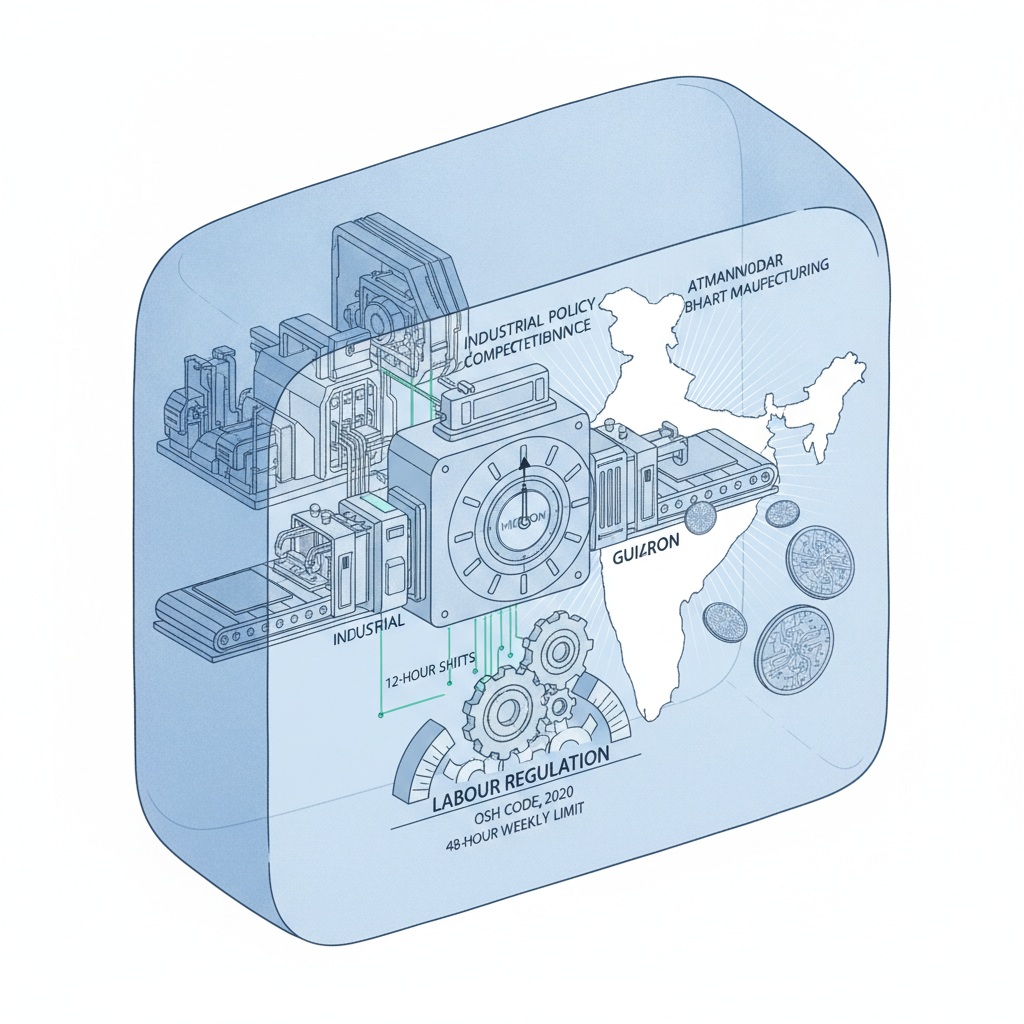
20 Aug Gujarat Approves 12-Hour Shifts for Micron’s Sanand Semiconductor Plant
Semiconductor facility12-hour shiftsOSH CodeLabour regulationIndustrial policy✎ The Gujarat government’s approval for 12-hour shifts at Micron’s Sanand facility is a conditional exemption under the OSH Code, 2020, ensuring adherence to the 48-hour weekly working limit and worker consent, while balancing…
Subject Relevance — Where This Topic Fits
- GS Paper III — Indian Economy (Industrial Policy, Labour Reforms, Ease of Doing Business) | GS Paper III — Science and Technology (Semiconductor Manufacturing, Atmanirbhar Bharat)
- Prelims: OSH Code 2020, Semiconductor Manufacturing Policy, Labour Welfare Provisions, Ease of Doing Business, Cleanroom Technology, Factory Act Exemptions, Micron Technology, Sanand Industrial Cluster
- Essay: Ethical Dimensions of Industrial Growth vs. Labour Rights, Balancing Economic Development and Social Justice in Policy Design
Quick Revision: The Gujarat government’s approval for 12-hour shifts at Micron’s Sanand facility is a conditional exemption under the OSH Code, 2020, ensuring adherence to the 48-hour weekly working limit and worker consent, while balancing industrial growth with labour welfare.
Why is this in the news?
The Gujarat government’s decision to permit the Micron Semiconductor facility in Sanand to operate 12-hour shifts, while adhering to the 48-hour weekly limit under the Occupational Safety, Health and Working Conditions (OSH) Code, 2020, underscores the intersection of industrial policy, labour regulation, and economic competitiveness in India’s semiconductor sector. This development is significant as it highlights the state’s proactive approach to attracting high-technology investments while ensuring compliance with statutory labour safeguards.
Background
- The semiconductor industry is a critical component of India’s Atmanirbhar Bharat initiative, aimed at reducing import dependence and fostering self-reliance in high-technology manufacturing.
- Gujarat has emerged as a key destination for semiconductor investments, with the state government actively promoting ease of doing business through policy incentives and regulatory flexibility.
- The Occupational Safety, Health and Working Conditions (OSH) Code, 2020, consolidates and replaces 13 existing labour laws, including the Factories Act, 1948, to streamline compliance and enhance worker safety.
- The OSH Code, 2020, came into force nationwide on November 21, 2025, empowering state governments to grant exemptions to industries under specific conditions, subject to safeguards for workers.
- The semiconductor manufacturing process requires uninterrupted production cycles due to the high precision and cleanroom standards involved, necessitating flexible work arrangements.
- Micron Technology’s Sanand facility is part of a global manufacturing network, with the first phase including over 500,000 square feet of cleanroom space, one of the world’s largest single-floor semiconductor assembly and test cleanrooms.
What is the Occupational Safety, Health and Working Conditions (OSH) Code, 2020?
- The OSH Code, 2020, is a central legislation that consolidates and modernises 13 existing labour laws, including the Factories Act, 1948, the Mines Act, 1952, and the Building and Other Construction Workers (Regulation of Employment and Conditions of Service) Act, 1996.
- The Code introduces a unified framework for regulating working conditions, safety, health, and welfare provisions across industries, with the objective of simplifying compliance and reducing regulatory burden on businesses.
- Key provisions include the regulation of working hours, overtime, leave entitlements, and the establishment of safety committees in workplaces.
- The Code empowers state governments to exempt factories from certain provisions, subject to conditions that ensure worker welfare, such as maintaining the weekly working limit of 48 hours and providing paid leave for the remaining days.
- The Code requires employers to maintain records of overtime, leave, and safety inspections, and to comply with the directives of the Chief Inspector-cum-Facilitator for Factories.
- The OSH Code is part of India’s broader labour reform agenda, aimed at improving the ease of doing business while ensuring the protection of workers’ rights and safety.
Key Features
| Feature | Significance |
|---|---|
| 12-hour work shifts | Enables continuous production cycles in semiconductor fabrication, critical for global supply chain integration and reducing lead times. |
| Voluntary written consent of workers | Ensures compliance with labour rights while allowing operational flexibility under the OSH Code, 2020. |
| 48-hour weekly limit | Maintains statutory compliance with the OSH Code, balancing productivity with worker welfare. |
| Separate record maintenance | Facilitates regulatory oversight and ensures transparency in workforce management. |
| Rest interval compliance | Mandates adherence to OSH Code and Gujarat-specific rules to prevent worker fatigue and ensure safety. |
Why it Matters
Economic/Strategic
- Positions Gujarat as a key hub in India’s semiconductor ecosystem, aligning with national objectives of self-reliance in critical technology.
- Enhances Gujarat’s competitiveness in attracting high-value manufacturing investments, particularly in electronics and semiconductor assembly.
- Supports Micron’s global manufacturing network by enabling uninterrupted production, crucial for meeting international demand.
- Contributes to employment generation in high-skilled and semi-skilled sectors, fostering industrial growth in the state.
Industrial Policy
- Demonstrates the application of the OSH Code, 2020, in balancing labour flexibility with worker protection in high-tech industries.
- Highlights the role of state governments in granting exemptions under the OSH Code to promote industrial growth while safeguarding labour rights.
- Sets a precedent for other states to adopt similar measures in strategic sectors, provided statutory limits are respected.
Labour and Employment
- Balances operational efficiency with worker welfare through structured exemptions under the OSH Code, 2020.
- Emphasises the importance of voluntary consent and paid leave for workers to mitigate fatigue and ensure long-term productivity.
- Reinforces the need for robust record-keeping and regulatory compliance to prevent exploitation in high-pressure manufacturing environments.
Challenges
1. Regulatory Compliance and Oversight
- Risk of violations in shift management, rest intervals, or record-keeping, leading to legal action or withdrawal of approval.
- Need for stringent monitoring by the Chief Inspector-cum-Facilitator for Factories to ensure adherence to OSH Code provisions.
- Potential for disputes over voluntary consent, necessitating transparent processes and worker grievance redressal mechanisms.
UPSC Link: GS Paper 2: Labour Laws and Industrial Relations
2. Worker Welfare and Fatigue Management
- Long working hours may lead to physical and mental fatigue, impacting productivity and safety in semiconductor fabrication.
- Requirement for adequate rest intervals and paid leave to mitigate health risks, particularly in high-precision manufacturing environments.
- Need for periodic health assessments and counselling to address occupational stress in extended shift work.
UPSC Link: GS Paper 1: Human Development and Welfare
3. Infrastructure and Supply Chain Readiness
- Dependence on uninterrupted power, water, and logistics to sustain 12-hour shifts without disruptions.
- Pressure on local infrastructure, including housing, transportation, and healthcare, to support a growing workforce.
- Risk of supply chain bottlenecks in semiconductor components, affecting production continuity.
UPSC Link: GS Paper 3: Infrastructure and Industrial Development
4. State-Level Policy Coordination
- Need for alignment with central labour policies to avoid conflicts or inconsistencies in enforcement.
- Coordination between state labour departments and industrial authorities to ensure seamless implementation of exemptions.
- Potential for inter-state competition in granting exemptions, necessitating a balanced approach to attract investments without compromising labour standards.
UPSC Link: GS Paper 2: Federalism and Centre-State Relations
5. Global Competitiveness and Trade Implications
- Pressure to maintain cost competitiveness while adhering to labour laws, impacting pricing and market positioning.
- Risk of trade barriers or sanctions if labour standards are perceived as inadequate by international partners.
- Need to balance domestic production incentives with global supply chain demands to sustain semiconductor exports.
UPSC Link: GS Paper 3: Globalisation and Trade
Challenges — UPSC Perspective
| Issue | Concern |
|---|---|
| Shift fatigue and health risks | Prolonged working hours may lead to occupational hazards and reduced productivity. |
| Regulatory enforcement gaps | Inadequate monitoring could result in violations of OSH Code provisions. |
| Worker consent authenticity | Ensuring voluntary consent without coercion remains a challenge. |
| Infrastructure strain | Local amenities may struggle to support a growing workforce in high-tech zones. |
| Supply chain disruptions | Dependence on global inputs may pose risks to uninterrupted production. |
| Inter-state policy divergence | Competitive exemptions could dilute labour standards across states. |
Way Forward
- Strengthen the monitoring mechanism of the Chief Inspector-cum-Facilitator for Factories to ensure strict compliance with OSH Code provisions.
- Conduct periodic health assessments and counselling sessions for workers engaged in extended shifts to mitigate fatigue-related risks.
- Enhance infrastructure in industrial hubs like Sanand, including housing, transportation, and healthcare, to support the growing workforce.
- Establish a grievance redressal mechanism for workers to report violations or coercion in shift assignments.
- Promote skill development programs to enhance the employability of local workers in high-tech semiconductor manufacturing.
- Coordinate with central agencies to align state-level exemptions with national labour policies and avoid policy conflicts.
- Invest in renewable energy and sustainable practices to reduce operational costs and environmental impact in semiconductor fabrication.
- Encourage research and development collaborations between industry and academia to improve production efficiency and worker safety.
UPSC Value Addition
Keywords for Mains Answer-Writing
Occupational Safety, Health and Working Conditions (OSH) Code, 2020 · semiconductor manufacturing · labour rights and flexibility · 48-hour weekly work limit · 12-hour work shifts · Ease of Doing Business · Gujarat semiconductor policy · Micron Technology Sanand facility · voluntary consent of workers · Chief Inspector-cum-Facilitator for Factories
Constitutional & Policy Linkages
- [‘Article 24 – Prohibition of Child Labour’, ‘Ensures protection of workers under 18 years from hazardous employment.’]
- [‘Article 42 – Just and Humane Conditions of Work’, ‘Mandates state intervention to ensure fair labour practices.’]
- [‘Article 43A – Participation of Workers in Management’, ‘Encourages worker welfare through structured engagement.’]
Concept Flow
Gujarat’s semiconductor policy → OSH Code, 2020 provisions → Exemption for 12-hour shifts → Micron’s Sanand facility approval → Continuous production → Global supply chain integration. → Worker welfare safeguards → Voluntary consent → 48-hour weekly limit → Paid leave for remaining days → Fatigue mitigation. → Regulatory oversight → Chief Inspector-cum-Facilitator for Factories → Record maintenance → Compliance checks → Legal action for violations. → Infrastructure development → Housing, healthcare, transport → Workforce sustainability → Industrial growth. → State-level policy → Competitiveness in semiconductor sector → Attraction of high-value investments → Employment generation. → Labour rights → OSH Code compliance → Worker safety → Productivity balance → Economic growth.
Prelims Practice Questions
Q1. Consider the following statements regarding the Occupational Safety, Health and Working Conditions (OSH) Code, 2020:
1. The Code came into force across India on November 21, 2025.
2. It prescribes a maximum of 48 working hours per week for employees.
3. State governments can exempt factories from certain provisions under the Code without any safeguards.
4. The Code mandates that only workers who voluntarily provide written consent can work on 12-hour shifts.
How many of the above statements are correct?
- Only one
- Only two
- Only three
- All
Answer: Only three — Statements 1, 2, and 4 are correct. Statement 3 is incorrect because the Code allows exemptions subject to safeguards, not unconditionally.
Q2. Assertion (A): The Gujarat government’s approval for 12-hour shifts at the Micron Semiconductor facility is granted under the OSH Code, 2020.
Reason (R): The OSH Code, 2020, empowers state governments to exempt factories from certain provisions while ensuring the weekly work limit of 48 hours is not exceeded.
Options:
A. Both A and R are true, and R is the correct explanation of A.
B. Both A and R are true, but R is not the correct explanation of A.
C. A is true, but R is false.
D. A is false, but R is true.
Answer: ? — Both A and R are true, and R correctly explains A as the exemption is granted under the OSH Code, 2020, with safeguards on weekly work hours.
Q3. Match the following provisions of the OSH Code, 2020 with their respective descriptions:
Column I (Provision)
1. Maximum weekly working hours
2. Exemption powers for state governments
3. Voluntary consent for 12-hour shifts
4. Role of Chief Inspector-cum-Facilitator for Factories
Column II (Description)
A. 48 hours
B. Can grant exemptions subject to safeguards
C. Required for workers opting for 12-hour shifts
D. Maintains records and ensures compliance
Options:
A. 1-A, 2-B, 3-C, 4-D
B. 1-B, 2-A, 3-D, 4-C
C. 1-C, 2-D, 3-A, 4-B
D. 1-D, 2-C, 3-B, 4-A
Answer: ? — The correct match is: 1-A (maximum weekly hours), 2-B (exemption powers), 3-C (voluntary consent), 4-D (role of Chief Inspector).
Mains Practice Question
✍ The Gujarat government’s decision to permit 12-hour shifts at the Micron Semiconductor facility in Sanand under the OSH Code, 2020, reflects a balance between industrial growth and labour rights. Critically examine this proposition with reference to the provisions of the OSH Code, 2020, and its implications for India’s semiconductor manufacturing ecosystem. (15 Marks)
Approach: MODEL-ANSWER SKELETON:
1. **Context and Background**: Briefly introduce the OSH Code, 2020, its objectives (Ease of Doing Business, labour welfare), and the semiconductor sector’s significance for India’s self-reliance (e.g., PLI scheme, global supply chain disruptions).
2. **Provisions of the OSH Code, 2020**:
– **Weekly work limit**: 48 hours with overtime restrictions (Sections 24-26).
– **Exemption powers**: State governments can exempt factories under Section 103, subject to safeguards (e.g., written consent, paid leave for remaining days).
– **Safeguards**: Voluntary consent (Section 25), rest intervals, record-keeping by Chief Inspector-cum-Facilitator for Factories (Section 104).
3. **Rationale for Gujarat’s Decision**:
– **Industrial growth**: Semiconductor sector’s role in economic growth, employment generation, and India’s global competitiveness.
– **Flexibility**: 12-hour shifts as a tool to achieve uninterrupted production in capital-intensive industries (e.g., cleanroom operations).
– **Labour welfare**: Ensuring safeguards (paid leave, consent) to mitigate exploitation risks.
4. **Critique and Challenges**:
– **Labour rights vs. flexibility**: Potential for coercion despite voluntary consent; long shifts may impact worker health and productivity.
– **Enforcement**: Role of Chief Inspector-cum-Facilitator for Factories in monitoring compliance; penalties for violations (Section 105).
– **Comparative perspective**: Contrast with global practices (e.g., EU’s Working Time Directive’s 48-hour weekly limit with stricter enforcement).
5. **Broader Implications**:
– **Semiconductor ecosystem**: Gujarat’s leadership in semiconductor investments (e.g., Micron’s Sanand facility) and its impact on India’s semiconductor policy.
– **Policy precedence**: Whether such exemptions could set a precedent for other states/industries, balancing growth and worker welfare.
6. **Conclusion**: Weigh the trade-offs between industrial efficiency and labour protection, emphasizing the need for robust enforcement mechanisms and periodic reviews.
Source: The Indian Express
Generated by AanyaAi for educational purpose.

- मद्रास उच्च न्यायालय में ‘वेट्ट्री पयणम’ योजना को असंवैधानिक घोषित करने की मांग - October 4, 2026
- Gurugram’s groundwater extraction exceeds limit by 212%; HC seeks ban - October 4, 2026
- स्वतंत्रता सेनानी श्यामजी कृष्ण वर्मा की जन्म जयंती पर पीएम का श्रद्धांजलि - October 4, 2026

No Comments