


11 Sep Gujarat Assembly Passes Bill to Regulate Private Aided Schools Under Education Act
✎ The Gujarat Secondary and Higher Secondary Education (Amendment) Bill, 2026, extends regulatory oversight to private aided schools, standardises staff qualifications, enhances penalties for violations, and ensures reservation…
Subject Relevance — Where This Topic Fits
- GS Paper II — Governance, Transparency and Accountability | GS Paper IV — Ethics, Integrity and Aptitude in Governance | GS Paper III — Human Resource Development and Education
- Prelims: Education Act, 1972, Aided private schools, Reservation policy in recruitment, Special educators for differently-abled students, Penalties for regulatory violations, Board of Secondary Education, Gujarat
- Essay: The Role of State Regulation in Ensuring Quality and Equity in Education, Balancing Autonomy and Accountability in Private Aided Institutions
Quick Revision: The Gujarat Secondary and Higher Secondary Education (Amendment) Bill, 2026, extends regulatory oversight to private aided schools, standardises staff qualifications, enhances penalties for violations, and ensures reservation compliance and inclusivity in education.
Why is this in the news?
The Gujarat Assembly’s passage of the Gujarat Secondary and Higher Secondary Education (Amendment) Bill, 2026, marks a significant governance intervention to regulate private aided secondary and higher secondary schools under the Gujarat Secondary and Higher Secondary Education Act, 1972. The amendment introduces stricter compliance mechanisms, enhanced penalties for violations, and provisions for inclusive education, reflecting the state’s commitment to standardising educational governance and ensuring equitable access to quality education.
Background
- The Gujarat Secondary and Higher Secondary Education Act, 1972, originally framed to regulate government and aided schools, had limited applicability to private aided institutions, creating regulatory gaps in governance standards.
- Private aided schools in Gujarat, though receiving financial assistance from the state, operated with varying degrees of compliance to state-mandated educational and administrative norms, leading to inconsistencies in quality and equity.
- The Right to Education (RTE) Act, 2009, and subsequent judicial interpretations have emphasised the state’s responsibility to ensure quality education in all recognised institutions, including private aided schools.
- Gujarat’s reservation policy in public employment, as mandated by the Constitution (Article 16), requires implementation in all state-aided institutions to ensure social justice and inclusivity.
- The amendment aligns with the National Education Policy (NEP) 2020’s emphasis on standardising educational governance and enhancing accountability in private-aided institutions.
- Prior to this amendment, penalties for regulatory violations in private aided schools were nominal, often insufficient to deter non-compliance or malpractice.
What is the Gujarat Secondary and Higher Secondary Education (Amendment) Bill, 2026?
- The Bill amends the Gujarat Secondary and Higher Secondary Education Act, 1972, to extend its regulatory scope to private aided secondary and higher secondary schools, ensuring uniform governance standards across all state-aided institutions.
- It mandates that the qualification criteria for principals, teachers, special educators, and non-teaching staff in aided schools shall be determined by the state government, ensuring standardisation of human resource quality.
- For non-granted private schools (those not receiving full state aid), the state government will only prescribe qualifications for key personnel, retaining institutional autonomy in other administrative matters.
- The Bill introduces enhanced penalties for regulatory violations, including fines up to ₹10 lakh for illegal appointments and imprisonment up to two years for operating unregistered schools.
- A provision for the recruitment of special educators for students with disabilities is included, aligning with the Rights of Persons with Disabilities Act, 2016, and ensuring inclusive education.
- The amendment ensures the full implementation of the state’s reservation policy in the recruitment of staff in aided schools, promoting social equity in employment.
- It strengthens the state’s oversight of school discontinuation by imposing a fine of ₹20 lakh for failing to provide six months’ prior notice to the Board of Secondary Education, Gujarat.
Key Features
| Feature | Significance |
|---|---|
| Extension of Gujarat Secondary and Higher Secondary Education Act, 1972 | Bridges regulatory gap by including government-aided private schools, ensuring uniform governance under a single legal framework. |
| Enhanced penalties for unauthorised education operations | Deters illegal schooling by raising fines from ₹1,000 to ₹15 lakh and introducing imprisonment up to 2 years for running unregistered schools. |
| Mandatory reservation in staff recruitment | Ensures compliance with state reservation policies in hiring for principals, teachers, and non-teaching staff in aided schools. |
| Qualification norms for educators and administrators | Centralises control over teacher/principal eligibility criteria in aided schools, with state-determined standards. |
| Special educator recruitment for differently-abled students | Strengthens inclusive education provisions by mandating dedicated staff for special needs within the school ecosystem. |
Why it Matters
Governance and Regulatory Framework
- Establishes parity between government and aided private schools under a unified regulatory regime, reducing jurisdictional ambiguities.
- Enhances accountability of school administrators through stricter penalties and mandatory compliance with state policies.
- Standardises qualification benchmarks for educators, ensuring minimum competency levels across the state’s secondary education sector.
Social Justice and Inclusion
- Mandates reservation in staff recruitment, reinforcing constitutional principles of equality and affirmative action in educational institutions.
- Formalises provisions for special educators, addressing the rights of differently-abled students under the Rights of Persons with Disabilities Act, 2016.
Economic Implications
- Reduces systemic inefficiencies by curbing unregistered and unregulated schools, which often exploit loopholes in fee structures and quality standards.
- Potential long-term cost savings for the exchequer by preventing malpractices that lead to resource misallocation in education funding.
Policy Coherence
- Aligns with the National Education Policy (NEP) 2020’s emphasis on standardisation and accountability in school education.
- Complements the Right to Education (RTE) Act’s objectives by extending regulatory oversight to aided private institutions.
Challenges
1. Implementation Bottlenecks
- Risk of administrative delays in notifying detailed rules for qualification norms and reservation compliance post-enactment.
- Potential resistance from private school managements due to increased regulatory burden and financial penalties.
- Need for robust monitoring mechanisms to ensure adherence to the Act’s provisions across diverse school categories.
UPSC Link: GS-II: Role of State in Education
2. Resource Constraints
- Limited capacity of state education departments to conduct periodic inspections and audits of aided schools.
- Financial burden on the state exchequer for enforcing enhanced penalties and supporting special educator recruitment.
UPSC Link: GS-II: Public Expenditure Management
3. Equity vs. Autonomy Debate
- Balancing state control with institutional autonomy in curriculum delivery and management of aided schools.
- Ensuring that stricter regulations do not stifle innovation or reduce parental choice in school selection.
UPSC Link: GS-II: Education and Human Resource Development
4. Legal and Jurisdictional Challenges
- Potential conflicts with existing private school management acts or trust deeds governing aided institutions.
- Need for clear delineation of powers between state education boards and local authorities in enforcement.
UPSC Link: GS-II: Constitutional Provisions on Education
Challenges — UPSC Perspective
| Issue | Concern |
|---|---|
| Administrative capacity | State education departments may lack personnel to enforce new provisions effectively. |
| Financial sustainability | Enhanced penalties and special educator recruitment could strain state budgets. |
| Institutional resistance | Private aided schools may challenge regulatory overreach through legal or political means. |
| Monitoring mechanisms | Ensuring real-time compliance requires digital tracking and third-party audits. |
| Parental awareness | Lack of public understanding may reduce compliance with registration norms. |
Way Forward
- State government to notify detailed rules within 90 days, specifying qualification norms, reservation quotas, and penalty structures.
- Establish a dedicated task force under the Gujarat Secondary Education Board to conduct quarterly audits of aided schools.
- Launch a public awareness campaign to educate stakeholders on the Act’s provisions and compliance requirements.
- Develop a digital portal for real-time reporting of school registrations, staff appointments, and fee structures.
- Allocate dedicated funds in the state budget for special educator recruitment and infrastructure upgrades in aided schools.
- Constitute a grievance redressal mechanism to address disputes between schools and the education department.
- Collaborate with NGOs and special education experts to design inclusive curricula and teacher training modules.
UPSC Value Addition
Keywords for Mains Answer-Writing
Right to Education · Education Act · Private aided schools · Reservation policy in education · Teacher recruitment norms · Special educators for differently-abled · Regulatory framework for schools · School registration and de-registration · Punitive provisions in education governance · State legislative competence in education · Constitutional provisions on education (Article 21A, DPSP) · Education as a concurrent subject · Quality assurance in school education · Inclusive education framework · Government-aided institutions governance
Constitutional & Policy Linkages
- [‘Article 29(2): Cultural and Educational Rights’, “Protects minorities’ right to establish educational institutions.”]
- [‘Article 46: Promotion of Educational and Economic Interests’, ‘Directs the State to promote education among weaker sections.’]
- [‘Article 15(4): Special Provisions for Advancement’, ‘Permits state reservations in educational institutions.’]
Concept Flow
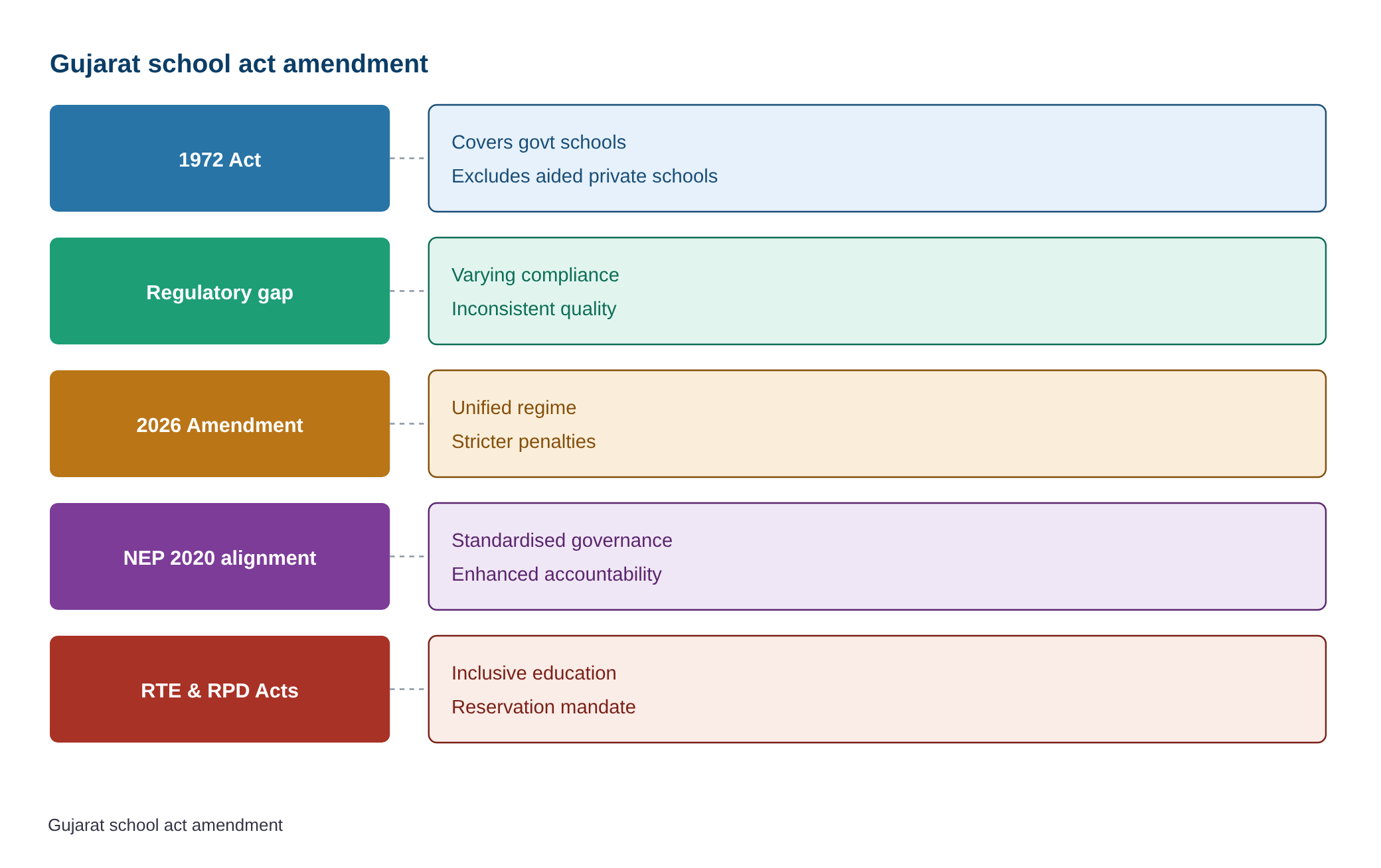
Gujarat Secondary and Higher Secondary Education Act, 1972 → Exclusion of aided private schools → Regulatory vacuum → Policy amendment → Inclusion of aided schools under Act → Enhanced penalties and reservation mandates → Compliance challenges → Implementation roadmap.
Prelims Practice Questions
Q1. Consider the following statements regarding the Gujarat Secondary and Higher Secondary Education (Amendment) Bill, 2026:
1. The Bill brings private aided secondary and higher secondary schools under the Gujarat Secondary and Higher Secondary Education Act, 1972.
2. The Bill proposes to enhance the fine for imparting education through an unregistered school to a maximum of ₹15 lakh.
3. The Bill empowers the state government to decide the qualifications of all staff (teaching and non-teaching) in both aided and non-granted schools.
4. The Bill introduces imprisonment for discontinuation of a school without prior notice to the board.
How many of the above statements are correct?
- Only one
- Only two
- Only three
- All four
Answer: All four — Statements 1, 2, and 4 are correct. Statement 3 is incorrect because the Bill empowers the state government to decide qualifications only for aided schools, while for non-granted schools, it decides only the qualifications of the principal, teachers, special educators, and non-teaching staff.
Q2. Assertion (A): The Gujarat Secondary and Higher Secondary Education (Amendment) Bill, 2026 enhances punitive provisions for school administrators violating norms.
Reason (R): The Bill seeks to ensure stricter compliance with reservation policies in staff recruitment and improve governance in government-aided schools.
Options:
A. Both A and R are true, and R is the correct explanation of A.
B. Both A and R are true, but R is not the correct explanation of A.
C. A is true, but R is false.
D. A is false, but R is true.
Answer: ? — Both the assertion and reason are true. The Bill does enhance punitive provisions (e.g., fines up to ₹10 lakh for illegal appointments). The reason correctly explains the intent behind these provisions, which is to ensure stricter compliance with reservation policies and improve governance in aided schools.
Mains Practice Question
✍ Critically examine the constitutional and policy dimensions of bringing private aided schools under the ambit of a state education act. Analyse the implications for inclusive education, teacher governance, and regulatory compliance. Also, discuss the rationale behind enhanced punitive provisions in such legislative amendments. (15 Marks)
Approach: MODEL-ANSWER SKELETON:
1. **Constitutional Framework**:
– Education as a Concurrent Subject (Article 246 read with 7th Schedule, List III).
– Fundamental Right under Article 21A (Right to Education) and Directive Principles (Article 45).
– State’s legislative competence to regulate aided institutions under Entry 25, List II (State List).
2. **Policy Rationale**:
– Ensuring uniformity in educational standards and governance across aided schools.
– Implementation of reservation policies in staff recruitment (Article 16, 340).
– Addressing gaps in inclusive education (RTE Act, 2009; Rights of Persons with Disabilities Act, 2016).
3. **Governance and Teacher Norms**:
– State’s power to prescribe qualifications for principals, teachers, and special educators (as per the Bill).
– Recruitment norms under state reservation policies (e.g., Gujarat’s reservation matrix).
– Role of state in ensuring quality and accountability in aided institutions.
4. **Punitive Provisions**:
– Need for deterrence against malpractices (e.g., unregistered schools, illegal appointments).
– Balance between regulatory strictness and administrative feasibility.
– Comparison with existing provisions (e.g., fines under RTE Act, 2009).
5. **Critical Analysis**:
– Potential challenges: administrative burden, resistance from private managements, legal challenges.
– Benefits: improved inclusivity, better governance, and alignment with national education goals.
– Judicial precedents: Supreme Court rulings on aided institutions (e.g., T.M.A. Pai Foundation v. State of Karnataka, 2002; P.A. Inamdar v. State of Maharashtra, 2005).
6. **Conclusion**:
– The legislative amendment aligns with constitutional and policy objectives but requires careful implementation to avoid unintended consequences.
Source: The Indian Express
Gujarat PCS (GPSC) — State PCS Practice
Prelims: Which of the following is a key provision of the Gujarat Bill that seeks to bring private aided schools under the scope of the Gujarat Education Act?
- Private aided schools will now be required to follow state-prescribed syllabus and textbooks
- Private aided schools will be exempted from all government regulations
- Private aided schools will be fully funded by the state government
- Private aided schools will be allowed to operate without any state oversight
Answer: Private aided schools will now be required to follow state-prescribed syllabus and textbooks — The Bill mandates that private aided schools comply with state-prescribed syllabus and textbooks to ensure uniformity in education standards.
Mains: Critically examine the implications of bringing private aided schools under the Gujarat Education Act. Discuss the potential benefits and challenges for stakeholders, including students, parents, and school management.
Generated by AanyaAi for educational purpose.
Related guides on our sites
- Current affairs for upsc 2026
- Best PSIR optional coaching for upsc
- Best PSIR optional teacher for upsc
- Best teacher of PSIR optional for upsc

- मद्रास उच्च न्यायालय में ‘वेट्ट्री पयणम’ योजना को असंवैधानिक घोषित करने की मांग - October 4, 2026
- Gurugram’s groundwater extraction exceeds limit by 212%; HC seeks ban - October 4, 2026
- स्वतंत्रता सेनानी श्यामजी कृष्ण वर्मा की जन्म जयंती पर पीएम का श्रद्धांजलि - October 4, 2026

No Comments