


15 Sep Gujarat to Host World Circular Economy Forum 2026: Key Highlights for UPSC
✎ Circular economy is a systemic approach that decouples economic growth from resource consumption by prioritising reuse, repair, and recycling, with India’s Mission LiFE and EPR-based waste management rules as key policy…
Subject Relevance — Where This Topic Fits
- GS Paper III — Environment and Sustainable Development | GS Paper III — Economy (Circular Economy, Resource Efficiency) | GS Paper II — International Organisations and Global Governance
- Prelims: Circular Economy, Extended Producer Responsibility (EPR), Mission LiFE, Waste Management Rules 2016, Resource Efficiency, Vasudhaiva Kutumbakam, Gandhinagar Declaration (if applicable), Plastic Waste Management Rules, E-Waste (Management) Rules, Battery Waste Management Rules
- Essay: Sustainable Development: Balancing Growth and Environmental Conservation, Global Resource Governance in the 21st Century
Quick Revision: Circular economy is a systemic approach that decouples economic growth from resource consumption by prioritising reuse, repair, and recycling, with India’s Mission LiFE and EPR-based waste management rules as key policy instruments.
Why is this in the news?
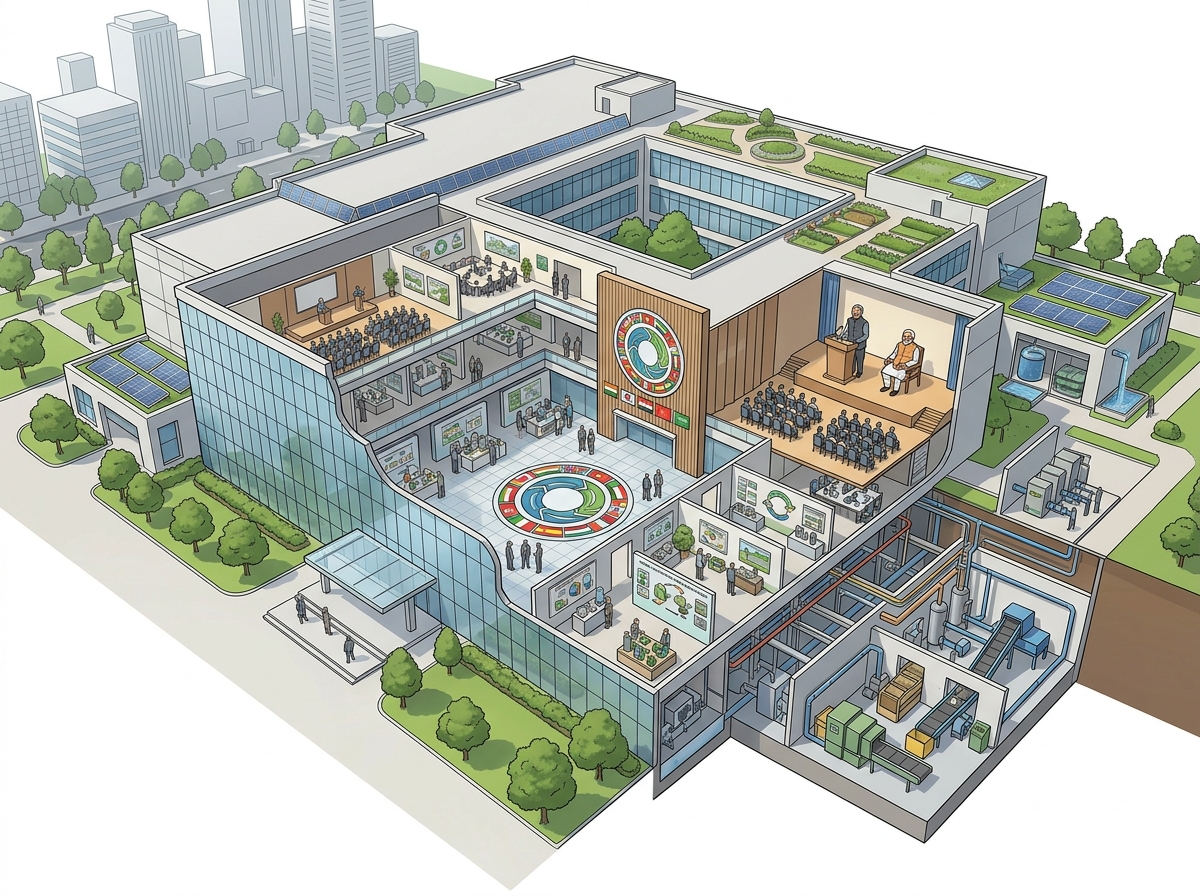
The World Circular Economy Forum (WCEF) 2026, inaugurated in Gandhinagar by the Union Minister for Environment, Forest and Climate Change and the Chief Minister of Gujarat, marks a significant milestone in India’s engagement with global circular economy discourse. The event, themed ‘Circular Economy: Transforming for People and Prosperity,’ underscores India’s commitment to integrating circularity into national policy frameworks such as Mission LiFE, while positioning the country as a leader in sustainable resource management on the global stage. The forum’s emphasis on practical solutions and cross-sectoral collaboration aligns with India’s domestic initiatives in waste management, extended producer responsibility, and resource efficiency, reflecting a broader shift toward decoupling economic growth from environmental degradation.
Background
- The concept of circular economy has gained global traction as a paradigm shift from the traditional linear ‘take-make-dispose’ model to a regenerative system that prioritises reuse, repair, refurbishment, and recycling of materials.
- India’s engagement with circular economy principles is not new; traditional practices such as ‘kabadiwala’ systems, ‘upcycling’ of temple offerings, and community-led waste segregation have long embedded circularity in socio-cultural and economic frameworks.
- India’s regulatory framework for waste management has evolved significantly, with the introduction of sector-specific rules such as the E-Waste (Management) Rules (2016), Plastic Waste Management Rules (2016), and Battery Waste Management Rules (2022), all of which incorporate Extended Producer Responsibility (EPR) mechanisms.
- Gujarat’s proactive role in circular economy initiatives, including waste-to-wealth projects and integration of traditional knowledge with modern technology, provides a model for other states in aligning economic growth with environmental sustainability.
What is the World Circular Economy Forum (WCEF) and India’s Role in Promoting Circularity?
- The World Circular Economy Forum (WCEF) is an international platform established by Sitra (Finnish Innovation Fund) to foster collaboration among governments, businesses, and civil society in advancing circular economy solutions. It serves as a knowledge-sharing hub for policy innovations, technological advancements, and financing mechanisms that enable resource efficiency and waste reduction.
- WCEF 2026, themed ‘Circular Economy: Transforming for People and Prosperity,’ focuses on translating circular principles into practical, scalable solutions that enhance livelihoods, economic resilience, and environmental sustainability. The forum’s agenda includes sessions on policy frameworks, circular business models, and cross-sectoral partnerships.
- The forum highlights India’s traditional circular practices, such as the ‘kabadiwala’ system, temple offering recycling, and community-led waste management, as foundational elements that modern policies seek to formalise and scale. These practices exemplify the principle of ‘waste to wealth,’ where discarded materials are repurposed into productive resources.
- India’s approach to circularity is framed within the ethos of ‘Vasudhaiva Kutumbakam’ (the world is one family), emphasising global cooperation in knowledge exchange, technology transfer, and financing mechanisms to address transboundary waste challenges.
- The WCEF 2026 in Gandhinagar serves as a platform to showcase Gujarat’s initiatives in circular economy, including waste-to-energy projects, plastic waste management, and integration of circularity in urban planning, which can be replicated across other states.
Key Features
| Feature | Significance |
|---|---|
| Global platform for circular economy | First-of-its-kind international forum in South Asia, signalling India’s leadership in sustainable resource management and global consensus-building on circularity. |
| Multi-stakeholder participation | Convenes governments, private sector, academia, and civil society to foster collaborative solutions across sectors and geographies. |
| Thematic focus on ‘Circular Economy for People and Prosperity’ | Aligns with SDG 12 (Responsible Consumption and Production) and integrates social equity with economic growth in resource management. |
| Integration with Mission LiFE | Demonstrates how individual lifestyle choices and systemic circularity reinforce each other under India’s global sustainability initiative. |
| Cultural resonance with traditional practices | Highlights India’s indigenous knowledge systems (e.g., repair, reuse, upcycling) as foundational to modern circular economy models. |
Why it Matters
Economic and Strategic
- Positions India as a global hub for circular economy innovation, attracting investment and technology transfer in waste-to-wealth sectors.
- Reduces import dependence on critical raw materials by enhancing domestic resource efficiency and recycling infrastructure.
- Supports India’s commitment to net-zero targets under the Paris Agreement by decarbonising supply chains through circularity.
Environmental
- Mitigates environmental degradation by reducing landfill pressure, soil/water pollution, and greenhouse gas emissions from resource extraction and waste disposal.
- Promotes biodiversity conservation by lowering the demand for virgin materials and associated habitat destruction.
Social and Governance
- Creates formal and informal employment opportunities in recycling, repair, and upcycling sectors, particularly in informal economies.
- Enhances public awareness of sustainable consumption patterns, aligning with Mission LiFE’s behavioural change agenda.
Technological and Innovation
- Accelerates R&D in green technologies, digital tracking of material flows (e.g., blockchain for waste management), and circular design principles.
- Facilitates knowledge-sharing between developed and developing nations to adapt circular solutions to local contexts.
Challenges
1. Regulatory Fragmentation
- Inconsistent enforcement of waste management rules across states hinders uniform implementation of circular economy policies.
- Overlapping mandates between central ministries (e.g., MoEFCC, DPIIT) and local bodies create compliance burdens and inefficiencies.
UPSC Link: GS III: Environmental Pollution
2. Informal Sector Dominance
- Informal waste pickers and recyclers lack formal recognition, access to finance, and safety standards, limiting their integration into formal value chains.
- Absence of social security nets for workers in transitioning sectors risks livelihood disruptions.
UPSC Link: GS III: Employment
3. Technological and Infrastructure Gaps
- Limited advanced recycling facilities (e.g., for e-waste, plastics) and inadequate waste segregation at source impede circularity.
- High capital costs for circular infrastructure deter private investment without clear revenue models.
UPSC Link: GS III: Science & Technology
4. Consumer Behaviour and Awareness
- Low public awareness of circular economy principles and resistance to behavioural changes (e.g., preference for disposable goods).
- Lack of incentives (e.g., deposit schemes, tax rebates) to encourage repair, reuse, and responsible disposal.
UPSC Link: GS III: Social Empowerment
5. Global Trade and Supply Chain Barriers
- Non-tariff barriers (e.g., standards, certifications) restrict cross-border trade of recycled materials and circular products.
- Geopolitical risks in critical material supply chains (e.g., rare earth metals) necessitate diversification strategies.
UPSC Link: GS II: International Relations
Challenges — UPSC Perspective
| Issue | Concern |
|---|---|
| Policy Coordination | Lack of a unified national framework for circular economy, leading to jurisdictional conflicts and implementation gaps. |
| Data Deficiency | Absence of robust material flow data systems to track waste generation, recycling rates, and circularity metrics. |
| Financing Constraints | High upfront costs for circular infrastructure and limited access to green finance for MSMEs in waste management. |
| Skill Gaps | Shortage of trained professionals in circular design, repair technologies, and sustainable supply chain management. |
| Urban-Rural Divide | Concentration of recycling facilities in urban areas, leaving rural regions with unmanaged waste and missed economic opportunities. |
Way Forward
- Establish a National Circular Economy Mission under NITI Aayog to harmonise policies, standards, and funding across ministries and states.
- Strengthen Extended Producer Responsibility (EPR) frameworks with mandatory recycling targets, digital tracking, and penalties for non-compliance.
- Integrate circular economy principles into school and university curricula, and launch public campaigns to foster behavioural change (Mission LiFE 2.0).
- Incentivise formalisation of the informal waste sector through skill development, social security, and access to credit (e.g., PM Vishwakarma Yojana for waste workers).
- Invest in R&D for low-cost, scalable recycling technologies (e.g., plastic-to-fuel, e-waste metal extraction) and digital platforms for material traceability.
- Develop state-level circular economy action plans with dedicated budgets, leveraging convergence with existing schemes like Swachh Bharat Mission 2.0.
- Promote public-private partnerships (PPPs) for waste-to-wealth projects, including viability gap funding for infrastructure in Tier-2/3 cities.
- Harmonise standards with global circular economy certifications (e.g., ISO 59000 series) to facilitate trade and attract foreign direct investment.
UPSC Value Addition
Keywords for Mains Answer-Writing
Circular Economy · Mission LiFE · Extended Producer Responsibility (EPR) · Sustainable Development · Resource Efficiency · Waste Management · Vasudhaiva Kutumbakam · G20 Principles on Circular Economy · Gujarat Model of Circularity · Global South Leadership in Sustainability · Circularity in Traditional Indian Practices · Circular Economy Index · Paris Agreement and Circularity · Digital Compliance for Sustainability · UNEP and Circular Economy Frameworks
Constitutional & Policy Linkages
- Directive Principles of State Policy (Article 48A) – Protection and improvement of environment and safeguarding forests and wildlife.
Concept Flow
Global recognition of resource scarcity and environmental degradation → Rise of circular economy as a systemic solution → India’s leadership via Mission LiFE and WCEF 2026 → Integration of traditional knowledge with modern policy frameworks → Policy reforms (EPR, waste management rules) → Infrastructure development and technological innovation → Formalisation of informal sector and skill enhancement → Behavioural change and public awareness → Sustainable supply chains and reduced import dependence → Contribution to SDGs and climate goals.
Prelims Practice Questions
Q1. Consider the following statements regarding the World Circular Economy Forum (WCEF):
1. WCEF 2026 is being organised for the first time in South Asia.
2. The theme of WCEF 2026 is ‘Circular Economy: Transforming for People and Prosperity’.
3. The forum is being organised in Gandhinagar, Gujarat.
4. The forum is being organised under the aegis of the United Nations Environment Programme (UNEP).
How many of the above statements are correct?
- Only one
- Only two
- Only three
- All four
Answer: All four — Statements 1, 2, and 3 are correct. Statement 4 is incorrect as the forum is not explicitly stated to be organised under the aegis of UNEP in the provided source.
Q2. Assertion (A): The concept of circular economy is inherently collaborative and requires the sharing of knowledge, technology, finance, and accountability across borders and sectors.
Reason (R): Circular economy principles emphasize the need for global cooperation to achieve sustainable resource management and waste reduction.
- Both A and R are true, and R is the correct explanation of A.
- Both A and R are true, but R is not the correct explanation of A.
- A is true, but R is false.
- A is false, but R is true.
Answer: Both A and R are true, but R is not the correct explanation of A. — Both the Assertion and Reason are true, and the Reason correctly explains the Assertion. Circular economy’s collaborative nature is a core principle, as highlighted in the context of WCEF 2026.
Q3. Match the following principles of circular economy with their descriptions:
Column I (Principles)
A. Repair before replacement
B. Reuse before disposal
C. Recycle before destruction
D. Resource efficiency
Column II (Descriptions)
1. Maximising the use of resources by minimising waste generation.
2. Prioritising the repair of damaged items to extend their lifespan.
3. Ensuring materials are repurposed or reused before being discarded.
4. Converting waste materials into new products to reduce landfill use.
- {‘A’: 2, ‘B’: 3, ‘C’: 4, ‘D’: 1}
- {‘A’: 3, ‘B’: 2, ‘C’: 1, ‘D’: 4}
- {‘A’: 2, ‘B’: 1, ‘C’: 4, ‘D’: 3}
- {‘A’: 4, ‘B’: 3, ‘C’: 2, ‘D’: 1}
Answer: {‘A’: 2, ‘B’: 3, ‘C’: 4, ‘D’: 1} — The correct match is: A-2 (Repair before replacement), B-3 (Reuse before disposal), C-4 (Recycle before destruction), D-1 (Resource efficiency).
Mains Practice Question
✍ Critically examine the significance of the World Circular Economy Forum (WCEF) 2026 being hosted in India for the first time in South Asia. Analyse how this aligns with India’s global leadership in sustainability and the implementation of Mission LiFE. Also, discuss the challenges in operationalising circular economy principles in a developing economy like India. (15 Marks)
Approach: MODEL-ANSWER SKELETON:
1. **Introduction (2 Marks)**
– Define Circular Economy: A system that aims to eliminate waste and the continual use of resources through principles of reduce, reuse, repair, and recycle.
– Contextualise WCEF 2026: Hosting in Gandhinagar, Gujarat, under the theme ‘Circular Economy: Transforming for People and Prosperity’.
2. **India’s Global Leadership in Sustainability (4 Marks)**
– Mission LiFE (Lifestyle for Environment): Launched by PM Modi, it promotes sustainable lifestyles and circularity as a mass movement.
– G20 Principles on Circular Economy: India’s role in shaping global frameworks for resource efficiency.
– Vasudhaiva Kutumbakam: India’s emphasis on global cooperation for sustainable solutions.
– Gujarat’s Model: Highlight Gujarat’s initiatives in waste management, solar energy, and traditional circular practices (e.g., Somnath Temple’s resource optimisation).
3. **Challenges in Operationalising Circular Economy (5 Marks)**
– **Infrastructure Gaps**: Lack of formal recycling and waste segregation systems, especially in informal sectors.
– **Policy Implementation**: Weak enforcement of Extended Producer Responsibility (EPR) norms and regulatory frameworks.
– **Economic Viability**: High initial costs for circular technologies and lack of incentives for businesses to adopt circular models.
– **Public Awareness**: Low awareness among citizens about circular practices and their benefits.
– **Informal Sector Dominance**: Over 90% of waste management in India is handled by the informal sector, which lacks formal integration.
4. **Way Forward (4 Marks)**
– Strengthening EPR frameworks and digital compliance systems (e.g., Plastic Waste Management Rules, 2022).
– Promoting public-private partnerships for circular economy projects.
– Leveraging traditional knowledge (e.g., ‘Kachra to Kanchan’ concept) for grassroots-level circularity.
– Integrating circular economy principles into education and skill development programs.
5. **Conclusion (1 Mark)**
– Summarise the potential of WCEF 2026 to catalyse global and domestic circular economy transitions while acknowledging the structural challenges that need addressing.
Source: PIB (Press Information Bureau)
Gujarat PCS (GPSC) — State PCS Practice
Prelims: Which of the following is a key objective of the World Circular Economy Forum (WCEF) 2026, as highlighted during its announcement in Gandhinagar by the Union Environment Minister and Gujarat Chief Minister?
- Promoting linear economic models for rapid industrial growth
- Advancing the transition to a circular economy to reduce waste and enhance resource efficiency
- Focusing solely on traditional manufacturing practices without sustainability considerations
- Encouraging single-use plastic consumption to boost economic activity
Answer: Advancing the transition to a circular economy to reduce waste and enhance resource efficiency — The WCEF 2026 aims to advance the circular economy model, emphasizing waste reduction and sustainable resource use, aligning with global sustainability goals.
Mains: Discuss the significance of Gujarat hosting the World Circular Economy Forum (WCEF) 2026 for the state’s economic and environmental policies. Highlight how this initiative aligns with Gujarat’s existing sustainability frameworks and its potential impact on local industries and employment.
Generated by AanyaAi for educational purpose.
Related guides on our sites
- Best economics optional coaching for upsc
- Best economics optional teacher for upsc
- How to prepare for GS paper 1 for UPSC CSE mains exam
- Best UPSC coaching for IFOS exam

- यूपीएससी परीक्षा दृष्टिकोण: आवासन मंत्रालय का विशेष अभियान 6 में योगदान - September 17, 2026
- MoHUA to Launch Special Campaign 6 from Oct 2-31, 2026: Key Focus Areas - September 17, 2026
- मुजफ्फरपुर सेप्टिक टैंक दुर्घटना: एनएचआरसी ने लिया स्वतः संज्ञान, दो सप्ताह में रिपोर्ट मांगी - September 17, 2026

No Comments