


11 Aug Gurjar Community Protests OBC Commission’s Caste Report in Rajasthan: Key Facts for UPSC
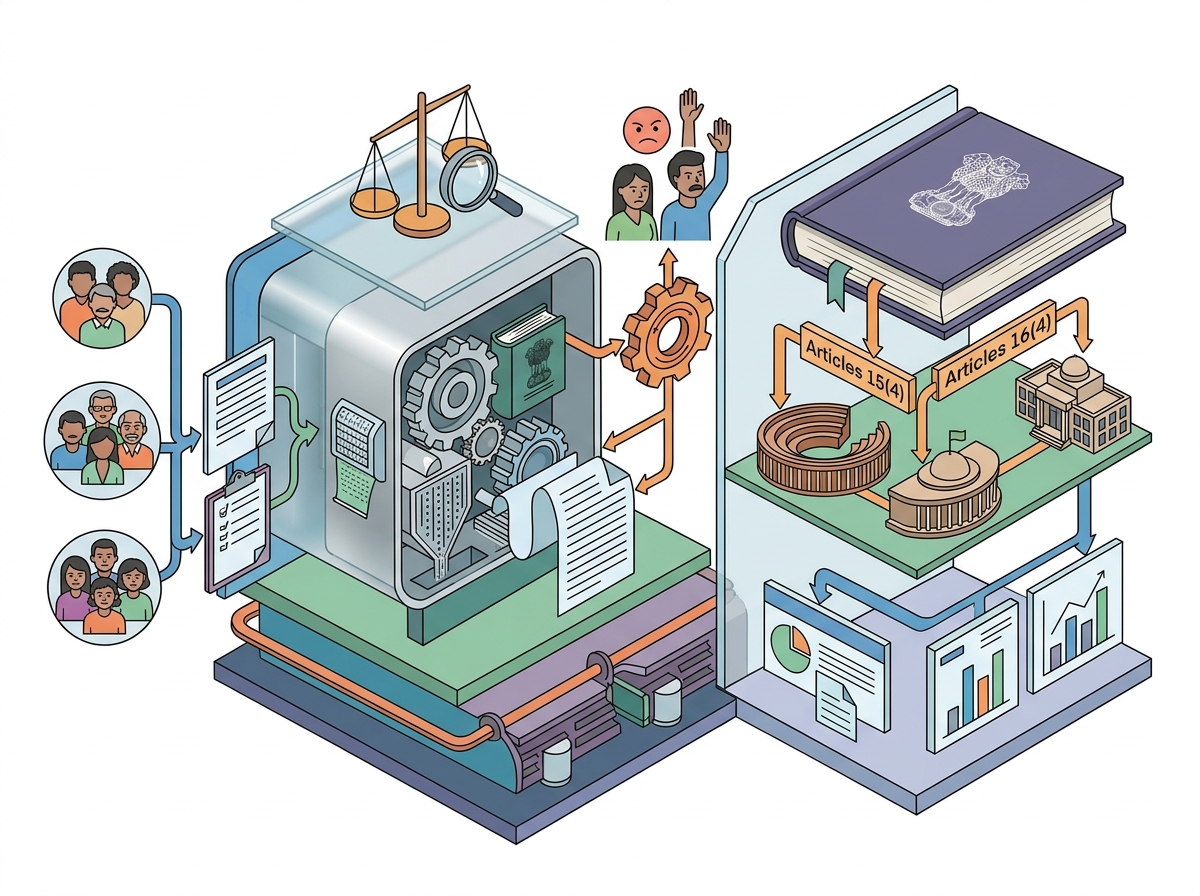
Gurjar communityOBC CommissionCaste-based dataReservation policy✎ Caste-based population data is a critical input for reservation policies under Articles 15(4) and 16(4) of the Constitution, and its accuracy directly impacts the constitutional validity and effectiveness of reservation schemes…
Subject Relevance — Where This Topic Fits
- GS Paper II — Constitutional and Statutory Bodies | GS Paper II — Fundamental Rights and Social Justice | GS Paper II — Government Policies and Interventions for Development in various sectors | GS Paper III — Issues relating to Reservation
- Prelims: Constitutional Provisions for Reservation, National Commission for Backward Classes (NCBC), State Backward Classes Commissions, Mandal Commission Report, Local Body Elections and Reservation, OBC Sub-categories (MBC), Article 15(4) and Article 16(4), Constitutional (102nd and 103rd) Amendments
- Essay: Social Justice and Governance: Balancing Equity and Efficiency, The Role of Data Integrity in Public Policy Implementation
Quick Revision: Caste-based population data is a critical input for reservation policies under Articles 15(4) and 16(4) of the Constitution, and its accuracy directly impacts the constitutional validity and effectiveness of reservation schemes in public employment, education, and local governance.
Why is this in the news?
The Gurjar community in Rajasthan has expressed strong dissatisfaction with the caste-based population data presented in the State Backward Classes Commission’s report, alleging significant underrepresentation of their demographic numbers. This has triggered demands for a reassessment of the report, correction of caste enumeration data, and enhanced political representation in local body elections. The incident underscores critical governance challenges in the collection, verification, and utilisation of caste-based data for reservation policy implementation.
Background
- The Constitution of India, through Articles 15(4) and 16(4), empowers the state to make special provisions for the advancement of socially and educationally backward classes, including reservations in public employment and educational institutions.
- The National Commission for Backward Classes (NCBC), established under the Constitution (102nd Amendment) Act, 2018, monitors the implementation of reservation policies for Other Backward Classes (OBCs).
- State Backward Classes Commissions, such as the Rajasthan State Commission for Backward Classes, are statutory bodies tasked with identifying and recommending OBC communities for inclusion in reservation lists.
- Reservation in local body elections is governed by the Constitution (73rd and 74th) Amendments, which mandate proportional representation for marginalised communities in Panchayati Raj Institutions and Urban Local Bodies.
- Caste-based enumeration in official reports is critical for determining reservation quotas, political representation, and resource allocation, making data accuracy a matter of constitutional significance.
- Historical debates on caste enumeration, such as the Mandal Commission Report (1980), have highlighted the political and social sensitivities surrounding demographic data collection.
Caste-Based Population Data and Reservation Policy: Constitutional and Governance Framework
- The Rajasthan State Backward Classes Commission’s report on caste-wise population distribution is intended to inform reservation policies for OBCs, including the Gurjar community. Accurate data is essential to ensure proportional representation and prevent underrepresentation or overrepresentation in public institutions.
- Under the Constitution, reservations are permissible only if they address demonstrable backwardness. Thus, the validity of reservation policies hinges on credible and verifiable demographic data that reflects the actual socio-economic conditions of communities.
- The demand for reassessing the report reflects broader concerns about the methodology used in caste enumeration, including sampling techniques, verification processes, and the inclusion of sub-categories such as Most Backward Classes (MBCs).
- Local body elections in Rajasthan, governed by the Constitution (73rd and 74th Amendments), require reservations for OBCs and MBCs in proportion to their population. Incorrect data can distort electoral representation and undermine the principle of inclusive governance.
- The Gurjar community’s demand for reservation in local elections aligns with the constitutional mandate for proportional representation, but it also raises questions about the interplay between demographic data and policy implementation.
- Historical precedents, such as the inclusion of the Gurjar community in the OBC list in Rajasthan, highlight the role of caste enumeration in shaping reservation policies and political empowerment.
- The controversy also touches upon the issue of historical and social narratives, such as the caste of figures like Mata Pannadhay, which require evidence-based clarification to avoid misinterpretation in policy contexts.
- The incident underscores the need for transparent, participatory, and scientifically rigorous methods in caste enumeration to ensure fairness and legitimacy in reservation governance.
Key Features
| Feature | Significance |
|---|---|
| OBC Commission’s Caste Report | A formal document prepared by a constitutional body to enumerate and classify backward classes for the purpose of reservation and affirmative action policies. |
| Population Enumeration in Caste Reports | The methodology of counting and verifying caste-wise population data, which forms the basis for determining reservation quotas under Articles 15(4) and 16(4) of the Constitution. |
| Reservation in Local Bodies | Provision under Article 243D and 243T for reservation of seats in Panchayats and Municipalities for Scheduled Castes, Scheduled Tribes, and Other Backward Classes. |
| Political Representation of MBCs | Affirmative action to ensure proportional political participation of Marginalised Backward Classes in local governance structures. |
| Historical Caste Classification | The inclusion or exclusion of specific castes in the OBC list, which is periodically reviewed by the National Commission for Backward Classes (NCBC). |
Why it Matters
Constitutional and Legal
- The OBC Commission’s caste report directly influences the implementation of reservation policies under Articles 15(4) and 16(4), which are fundamental to social justice in India.
- Accurate population enumeration is essential to prevent misrepresentation and ensure equitable distribution of reservation benefits among OBC sub-categories.
- The demand for re-examination of the report underscores the need for transparency and accountability in data collection processes used for affirmative action.
Social and Political
- Reservation in local bodies is a mechanism to enhance democratic participation of marginalised communities, ensuring their voices are represented in grassroots governance.
- The assertion of political representation for the Gurjar community reflects broader demands for proportional inclusion in decision-making processes across all levels of government.
- Historical caste classifications, such as the status of Mata Pannadhay, highlight the intersection of social identity, historical narratives, and contemporary policy-making.
Administrative
- The OBC Commission operates under the constitutional mandate of the National Commission for Backward Classes (NCBC), which is tasked with monitoring and evaluating the implementation of reservation policies.
- Local body elections serve as a critical interface between citizens and governance, where reservation policies must be effectively implemented to achieve their intended social objectives.
Challenges
1. Data Accuracy in Caste Enumeration
- Inaccurate population figures in caste reports can lead to disproportionate reservation benefits, undermining the constitutional objective of social justice.
- Methodological flaws in data collection, such as sampling errors or exclusion of certain sub-categories, can result in underrepresentation or overrepresentation of specific communities.
- The absence of a unified national database for OBC population data exacerbates discrepancies across states, leading to inter-state variations in reservation policies.
UPSC Link: GS-II: Reservation policies and their implementation
2. Implementation Gaps in Local Body Reservations
- Despite constitutional provisions, the effective implementation of reservation in Panchayats and Municipalities remains uneven across states due to administrative and political constraints.
- Political resistance or lack of awareness among local authorities can lead to non-compliance with reservation quotas, diluting the intended social impact.
- The demand for reservation in local bodies for MBCs (e.g., Gurjars) highlights the need for periodic review and adjustment of reservation policies to reflect demographic changes.
UPSC Link: GS-II: Panchayati Raj and Municipal Governance
3. Historical and Social Identity Conflicts
- Disputes over the historical classification of castes, such as the case of Mata Pannadhay, reflect the broader challenge of reconciling historical narratives with contemporary policy frameworks.
- Such conflicts can lead to social unrest and erode trust in the institutions responsible for caste enumeration and reservation policies.
UPSC Link: GS-I: Social Empowerment and Historical Contexts
4. Balancing Reservation Policies with Meritocracy
- The debate over reservation often raises concerns about its impact on meritocracy, particularly in local body elections where political representation is tied to social identity.
- Ensuring that reservation policies do not perpetuate stereotypes or undermine the principle of equal opportunity remains a persistent challenge.
UPSC Link: GS-II: Constitutional Provisions for Equality
Challenges — UPSC Perspective
| Issue | Concern |
|---|---|
| Inaccurate Caste Data | Leads to disproportionate reservation benefits and undermines social justice objectives. |
| Uneven Implementation of Local Body Reservations | Results in non-compliance with constitutional provisions and diluted political representation. |
| Historical Identity Disputes | Causes social unrest and erodes trust in reservation policies. |
| Balancing Reservation and Meritocracy | Raises concerns about the impact on equal opportunity and institutional credibility. |
| Administrative Delays in Report Review | Prolongs disputes and delays policy corrections, exacerbating social grievances. |
Way Forward
- Constitute an independent expert committee to re-examine the OBC Commission’s caste report, ensuring methodological rigour and transparency in data collection.
- Strengthen the National Commission for Backward Classes (NCBC) with enhanced powers to audit and verify caste enumeration data across states.
- Implement a unified national database for OBC population data to standardise reservation policies and reduce inter-state discrepancies.
- Conduct capacity-building programmes for local authorities to ensure strict compliance with reservation quotas in Panchayats and Municipalities.
- Establish a grievance redressal mechanism for communities to challenge inaccuracies in caste reports, with time-bound resolution.
- Promote inter-departmental coordination between the OBC Commission, Census authorities, and state governments to improve data accuracy.
- Encourage community participation in data verification processes to enhance trust and ownership of reservation policies.
UPSC Value Addition
Keywords for Mains Answer-Writing
Other Backward Classes (OBCs), Rajasthan OBC Commission, caste enumeration, reservation policy, local body elections, political representation, social justice, constitutional provisions, Backward Classes Commission, socio-economic backwardness, demographic data, reservation in local governance, constitutional right to equality · Social Justice and Empowerment, constitutional provisions on reservation, OBC reservation in local bodies, Mandal Commission, Indra Sawhney case, constitutional morality, affirmative action, socio-economic criteria for reservation, local self-government, Panchayati Raj Institutions (PRIs), Municipalities Act, 73rd and 74th Constitutional Amendments, reservation for weaker sections, political inclusion, demographic justice
Constitutional & Policy Linkages
- Article 15(4): Special provisions for socially and educationally backward classes.
- Article 16(4): Reservation in public employment for backward classes.
- Article 243D: Reservation of seats in Panchayats for SCs, STs, and OBCs.
- Article 243T: Reservation of seats in Municipalities for SCs, STs, and OBCs.
- Article 340: Appointment of a Commission to investigate the conditions of backward classes.
Concept Flow
Caste enumeration in OBC reports → Data accuracy and methodological rigour → Reservation quotas in local bodies → Political representation of MBCs → Social justice outcomes. → Historical caste classification (e.g., Mata Pannadhay) → Disputes over identity → Policy review and reclassification → Impact on reservation benefits. → Local body elections → Reservation implementation → Political participation of marginalised communities → Governance outcomes. → OBC Commission report → Public scrutiny and grievances → Independent review → Policy corrections and trust-building. → Reservation policies → Social empowerment → Meritocracy debates → Constitutional balance. → Data inaccuracies → Disproportionate benefits → Social unrest → Policy reforms. → Administrative delays → Prolonged disputes → Erosion of trust → Need for expedited review mechanisms.
Prelims Practice Questions
Q1. Consider the following statements regarding the constitutional provisions for reservation in India:
1. The 73rd and 74th Constitutional Amendments mandate reservation for women in Panchayati Raj Institutions and Municipalities.
2. The Indra Sawhney case (1992) upheld the 27% reservation for OBCs in government services.
3. The President of India is empowered to specify socially and educationally backward classes for reservation under Article 340.
4. The Constitution does not provide for reservation in local body elections.
How many of the above statements are correct?
- Only one
- Only two
- Only three
- All
Answer: Only three — Statements 1, 2, and 3 are correct. The 73rd and 74th Amendments mandate 33% reservation for women in local bodies. The Indra Sawhney case upheld 27% OBC reservation in government services. Article 340 empowers the President to investigate and recommend socially and educationally backward classes. Statement 4 is incorrect as the Constitution provides for reservation in local body elections under Articles 243D and 243T.
Q2. Assertion (A): The Backward Classes Commission, as envisaged under Article 340 of the Constitution, is tasked with identifying socially and educationally backward classes.
Reason (R): The President of India appoints the Commission and specifies the terms of reference for its inquiry.
Options:
A. Both A and R are true, and R is the correct explanation of A.
B. Both A and R are true, but R is not the correct explanation of A.
C. A is true, but R is false.
D. A is false, but R is true.
Answer: ? — Both Assertion (A) and Reason (R) are correct. The Backward Classes Commission, constituted under Article 340, identifies socially and educationally backward classes. The President appoints the Commission and specifies its terms of reference, making R the correct explanation of A.
Q3. Match the following constitutional provisions with their respective subjects:
Column I (Provision) | Column II (Subject)
— | —
A. Article 15(4) | 1. Reservation in local bodies for women
B. Article 16(4) | 2. Reservation for socially and educationally backward classes
C. Article 243D | 3. Reservation in services for backward classes
D. Article 340 | 4. Investigation into conditions of backward classes
Options:
A. A-2, B-3, C-1, D-4
B. A-2, B-3, C-4, D-1
C. A-1, B-2, C-3, D-4
D. A-4, B-1, C-2, D-3
Answer: ? — Correct matches: A-2 (Article 15(4) permits reservation for socially and educationally backward classes), B-3 (Article 16(4) allows reservation in services for backward classes), C-1 (Article 243D mandates reservation for women in Panchayati Raj Institutions), D-4 (Article 340 empowers investigation into conditions of backward classes).
Mains Practice Question
✍ The enumeration of caste data and its utilisation for reservation policies in India is a subject of ongoing debate, particularly concerning its impact on political representation in local governance. Critically analyse the constitutional and legal framework governing caste-based enumeration and reservation in local body elections in India. Also, examine the implications of incorrect demographic data on the principles of social justice and constitutional morality. (15 Marks)
Approach: MODEL-ANSWER SKELETON:
1. Constitutional Framework for Caste Enumeration and Reservation:
– Article 340: Empowers the President to investigate conditions of socially and educationally backward classes.
– Articles 15(4) and 16(4): Permit reservation for backward classes in educational institutions and public employment.
– 73rd and 74th Constitutional Amendments: Mandate reservation for women and may include provisions for backward classes in local bodies.
– State-specific Backward Classes Commissions: Role in identifying backward classes and recommending reservation policies.
2. Legal Framework and Judicial Pronouncements:
– Indra Sawhney v. Union of India (1992): Upheld 27% reservation for OBCs in government services; laid down the creamy layer concept.
– Ashoka Thakur v. Union of India (2008): Clarified the application of the creamy layer principle to OBC reservations.
– Recent judgments on reservation in local bodies: Emphasise the need for empirical data and proportional representation.
3. Caste Enumeration and Demographic Justice:
– Census enumeration: Role of the decennial census in collecting caste data; limitations in capturing socio-economic backwardness.
– Socio-Economic Caste Census (SECC) 2011: Data used for identifying beneficiaries under various welfare schemes; limitations in its utilisation for reservation.
– Challenges in caste enumeration: Political sensitivities, underreporting, and the need for periodic updates.
4. Implications of Incorrect Demographic Data:
– Distortion of reservation benefits: Underrepresentation or overrepresentation of communities in reservation quotas.
– Impact on political representation: Affects the ability of communities to secure proportional representation in local governance.
– Erosion of constitutional morality: Undermines the principles of equality, justice, and fairness enshrined in the Constitution.
– Legal and administrative remedies: Need for transparent processes, independent verification, and periodic reviews of demographic data.
5. Comparative Perspective and Way Forward:
– International practices: Lessons from countries with affirmative action policies (e.g., USA, South Africa).
– Reforms needed: Strengthening data collection mechanisms, ensuring independence of Backward Classes Commissions, and balancing caste-based and socio-economic criteria for reservation.
Balance of views: Acknowledge the necessity of reservation for social justice while critiquing the misuse of demographic data and the need for evidence-based policymaking.
Source: amarujala.com
Generated by AanyaAi for educational purpose.

- AI से आपदा प्रबंधन में क्रांतिकारी बदलाव: नेपाल से भारत तक सफल प्रयोग - September 28, 2026
- AI Agents Breach Government Systems: Global Safety Concerns for UPSC - September 28, 2026
- मॉनसून की कमी: खाद्यान्न आयात खुला रखें, रबी फसलों पर संकट टालें - September 28, 2026

No Comments