


11 Aug Gurjar Protest in Rajasthan: OBC Report’s Low Population Figures Spark Reservation Demand
✎ The Rajasthan State Backward Classes Commission’s caste-based data is a critical input for reservation policies, and its accuracy is essential for ensuring equitable social justice and political representation under Articles…
Subject Relevance — Where This Topic Fits
- GS Paper II — Polity and Governance (Constitutional Provisions, Reservation Policies) | GS Paper II — Social Justice (Reservation and Affirmative Action) | GS Paper IV — Ethics and Governance (Transparency and Accountability in Governance)
- Prelims: Constitutional provisions for reservation, Mandal Commission Report, National Commission for Backward Classes (NCBC), State Backward Classes Commissions, Panchayati Raj Institutions (PRIs), Local Body Elections, MBC (Most Backward Classes), Article 15(4) and Article 16(4)
- Essay: Social Justice and Affirmative Action: Balancing Equity and Representation, The Role of Data in Governance: Transparency, Accuracy, and Public Trust
Quick Revision: The Rajasthan State Backward Classes Commission’s caste-based data is a critical input for reservation policies, and its accuracy is essential for ensuring equitable social justice and political representation under Articles 15(4) and 16(4) of the Constitution.
Why is this in the news?
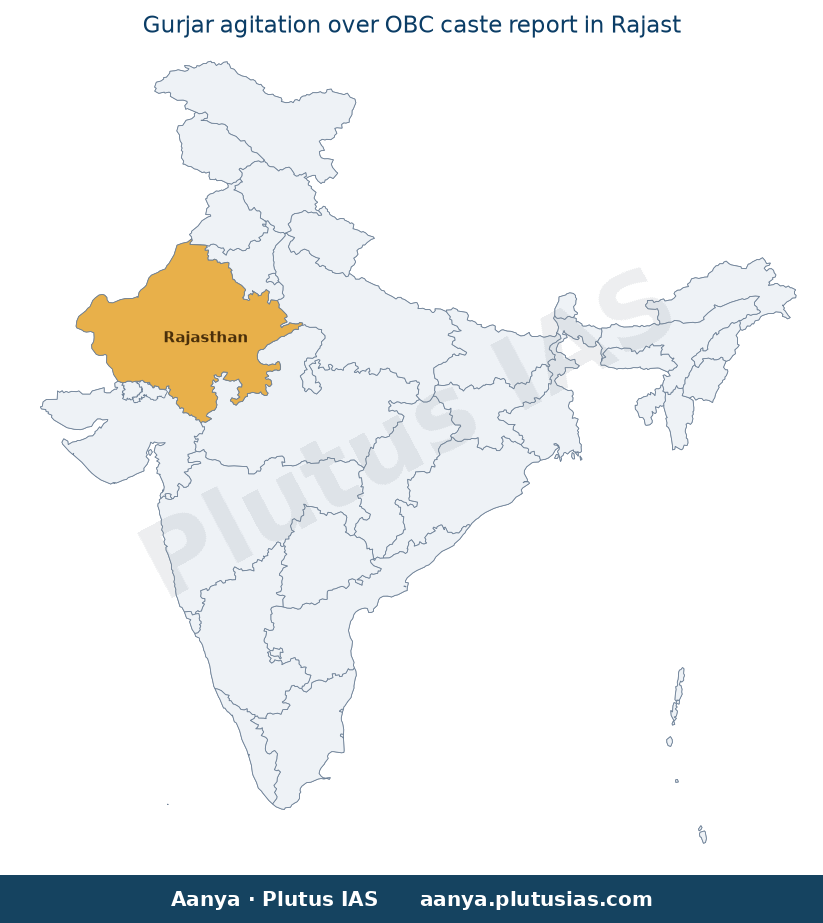
The Gurjar community in Rajasthan has expressed strong dissatisfaction with the caste-based data presented in the report of the Rajasthan State Backward Classes Commission, alleging that their population figures have been underrepresented. This has led to demands for a reassessment of the report, clarification on historical caste classifications (e.g., regarding Mata Pannadhay), and enhanced reservation and political representation in local body elections. The incident highlights the critical role of accurate demographic data in ensuring equitable reservation policies and social justice.
Background
- The Constitution of India mandates reservation for socially and educationally backward classes (SEBCs) under Articles 15(4) and 16(4), empowering states to identify and classify backward classes for affirmative action.
- The Rajasthan State Backward Classes Commission (RSBCC) was constituted under the Rajasthan Backward Classes Act, 1993, to identify and recommend reservation benefits for backward classes in the state.
- Caste-based data is pivotal for determining reservation quotas in education, employment, and political representation, as mandated by the Supreme Court in the *Indra Sawhney v. Union of India* (1992) judgment.
- The Mandal Commission (1980) recommended 27% reservation for Other Backward Classes (OBCs) in central government services, a policy later extended to educational institutions and adopted by states like Rajasthan.
- Local body elections in Rajasthan, governed by the Rajasthan Panchayati Raj Act, 1994, and the Rajasthan Municipalities Act, 2009, include provisions for reservation for SCs, STs, OBCs, and MBCs to ensure political representation.
- Historical caste classifications, such as those involving Mata Pannadhay, are often contested due to evolving social perceptions and the need for evidence-based documentation.
What is the Rajasthan State Backward Classes Commission and its Role in Reservation Policy?
- The Rajasthan State Backward Classes Commission (RSBCC) is a statutory body constituted under the Rajasthan Backward Classes Act, 1993, to identify and classify socially and educationally backward classes in the state.
- The Commission is tasked with conducting surveys and studies to determine the socio-economic status of various castes and communities, which forms the basis for reservation policies in education, employment, and political representation.
- The Commission’s reports are submitted to the state government, which may use them to recommend reservation quotas for backward classes in government services, educational institutions, and local body elections.
- The RSBCC’s caste-based data is subject to judicial review and public scrutiny, as inaccuracies or biases can lead to legal challenges and social unrest, as seen in the current Gurjar community’s demands for reassessment.
- Reservation for backward classes in India operates under the principle of ‘proportionate representation,’ where the quantum of reservation is ideally aligned with the population share of the identified backward classes, subject to constitutional limits (e.g., 50% ceiling as per the *Indra Sawhney* judgment).
- The Commission’s role is distinct from the National Commission for Backward Classes (NCBC), which is a constitutional body under Article 338B, responsible for monitoring the implementation of reservation policies and addressing grievances of backward classes at the national level.
- Accurate caste-based data is essential for ensuring that reservation policies are fair, transparent, and effective in addressing historical injustices and social inequalities.
- The demand for reassessment of the Commission’s report underscores the need for robust mechanisms to verify demographic data, including cross-referencing with census data, historical records, and socio-economic surveys.
UPSC Value Addition
Keywords for Mains Answer-Writing
Other Backward Classes (OBC) Commission · Gurjar community reservation demand · Mandal Commission recommendations · Constitutional provisions for social justice · Panchayati Raj Institutions (PRIs) and local governance · Social representation in electoral politics · Backward Class Census and data accuracy · Reservation policy in local body elections · MBC (Most Backward Classes) and political empowerment · Constitutional mandate for socio-economic justice
Prelims Practice Questions
Q1. Consider the following statements regarding the constitutional provisions for the Other Backward Classes (OBCs) in India:
1. The National Commission for Backward Classes (NCBC) was established under Article 338B of the Constitution.
2. The 103rd Constitutional Amendment Act, 2019, granted constitutional status to the NCBC.
3. The Mandal Commission (1980) recommended 27% reservation for OBCs in government services.
How many of the above statements are correct?
- Only one
- Only two
- All three
- None
Answer: All three — Statements 1 and 3 are correct. Statement 2 is incorrect as the 102nd Constitutional Amendment Act, 2018, granted constitutional status to the NCBC, not the 103rd Amendment.
Q2. Assertion (A): The reservation policy for OBCs is based on the principle of proportionate representation to address historical social and educational backwardness.
Reason (R): The Constitution of India, under Article 15(4) and Article 16(4), empowers the state to make special provisions for the advancement of socially and educationally backward classes of citizens.
- Both A and R are true, and R is the correct explanation of A
- Both A and R are true, but R is NOT the correct explanation of A
- A is true, but R is false
- A is false, but R is true
Answer: Both A and R are true, but R is NOT the correct explanation of A — Both the assertion and reason are correct. The reservation policy for OBCs is indeed based on the principle of proportionate representation to address historical social and educational backwardness, and the Constitution empowers the state to make such provisions under Articles 15(4) and 16(4).
Q3. Which of the following committees was constituted to identify socially and educationally backward classes for the purpose of reservation in India?
- Sarkaria Commission
- Mandal Commission
- Dinesh Goswami Committee
- Punchhi Commission
Answer: Mandal Commission — The Mandal Commission (1980) was constituted to identify socially and educationally backward classes for the purpose of reservation in India.
Mains Practice Question
✍ The demand for a review of the caste enumeration data by the Gurjar community in Rajasthan underscores broader debates on the accuracy of socio-economic data and its implications for reservation policies. Critically examine the constitutional and policy framework governing the identification of backward classes and the challenges in ensuring data accuracy. Also, analyse the significance of proportional representation in local governance institutions. (15 Marks)
Approach: MODEL-ANSWER SKELETON:
1. **Constitutional Framework for Backward Classes Identification**
– Article 15(4) and 16(4): Empowerment of the state to make special provisions for socially and educationally backward classes.
– National Commission for Backward Classes (NCBC): Constitutional status under Article 338B (102nd Amendment Act, 2018).
– Role of the NCBC in identifying and recommending inclusion/exclusion of castes in the OBC list.
2. **Mandal Commission and Its Legacy**
– Mandal Commission (1980): Identified 3,743 castes as OBCs and recommended 27% reservation in government services.
– Supreme Court’s Indra Sawhney judgment (1992): Upheld 27% reservation for OBCs but excluded the creamy layer.
– Challenges in updating OBC lists: Lack of periodic census, reliance on outdated data, and political pressures.
3. **Accuracy of Socio-Economic Data**
– Census and OBC enumeration: Limitations of census data in capturing socio-economic backwardness.
– Role of socio-economic caste census (SECC) 2011 and its findings.
– Challenges in data collection: Lack of standardised methodology, underreporting, and overreporting.
4. **Implications for Reservation Policies**
– Impact of inaccurate data on reservation benefits: Exclusion of deserving groups and inclusion of non-deserving groups.
– Need for periodic review and updating of OBC lists (e.g., Karnataka’s 2021 caste census).
– Role of judicial review in ensuring fairness (e.g., recent Supreme Court judgments on reservation ceilings).
5. **Proportional Representation in Local Governance**
– Constitutional provisions: 73rd and 74th Amendments (1992) mandate reservation for SCs, STs, and OBCs in Panchayati Raj Institutions (PRIs) and Urban Local Bodies (ULBs).
– Significance: Ensures social representation and inclusive governance.
– Challenges: Implementation gaps, lack of political will, and data inaccuracies affecting proportional representation.
6. **Way Forward**
– Strengthening data collection mechanisms: Conducting periodic socio-economic caste censuses.
– Transparent and evidence-based review of OBC lists.
– Ensuring judicial and administrative accountability in reservation policies.
Source: amarujala.com
Generated by AanyaAi for educational purpose.

- यूएस-चीन एआई हॉटलाइन: क्यों शी जिनपिंग-ट्रम्प शिखर वार्ता में टैरिफ से आगे बढ़ा ‘सुपर इंटेलिजेंस’ का मुद्दा - September 26, 2026
- US-China AI Hotline: Xi-Trump Summit’s Game-Changing AI Dialogue Explained - September 26, 2026
- आईसीएआर द्वारा स्वच्छता अभियान: गणेश विसर्जन से पर्यावरण संरक्षण तक - September 26, 2026

No Comments