


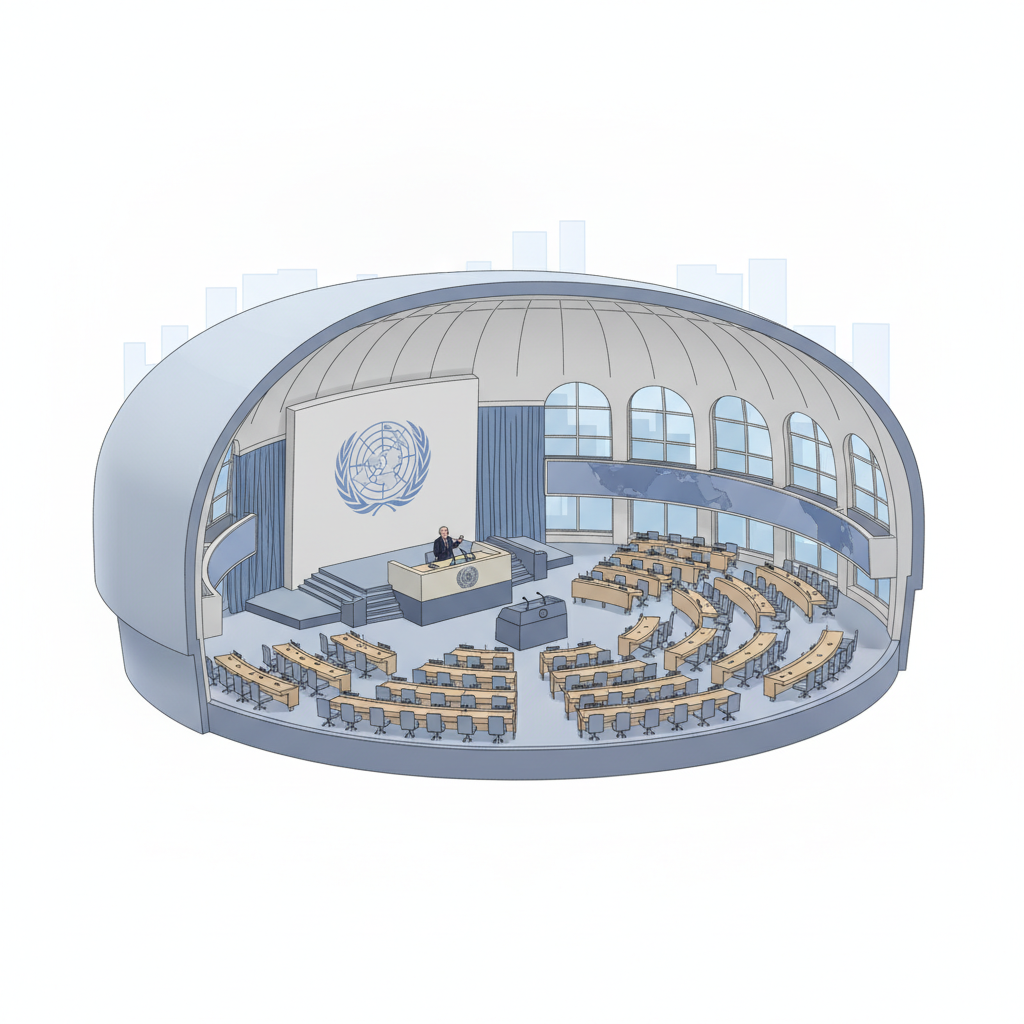
22 Sep Guterres urges interdependence at UNGA amid global crises: Key takeaways for UPSC
✎ The United Nations General Assembly, as the world’s largest multilateral forum, remains the primary institutional mechanism for addressing global challenges through dialogue, consensus-building, and non-binding resolutions…
Subject Relevance — Where This Topic Fits
- GS Paper II — International Relations: Role of the United Nations, Multilateralism, Global Governance, Peace and Conflict Resolution | GS Paper III — Environment and Ecology: Global Warming and Climate Action | GS Paper III — Economy: Global Supply Chains, Economic Inequality, and Trade Disruptions
- Prelims: United Nations General Assembly (UNGA), Antonio Guterres, Multilateralism, Great Power Competition, Climate Change, Global Supply Chain Disruptions, Economic Inequality, Peacekeeping Operations
- Essay: The erosion of multilateralism in the 21st century: Causes and consequences, Interdependence as the only viable path to global stability in an era of fragmentation
Quick Revision: The United Nations General Assembly, as the world’s largest multilateral forum, remains the primary institutional mechanism for addressing global challenges through dialogue, consensus-building, and non-binding resolutions, despite its limited enforcement powers.
Why is this in the news?
The 81st session of the United Nations General Assembly (UNGA) opened on 22 September 2026 with a keynote address by outgoing Secretary-General António Guterres, who underscored the existential imperative of interdependence in addressing accelerating global challenges such as armed conflicts, climate change, artificial intelligence governance, and economic fragmentation. His remarks, delivered against the backdrop of widening geopolitical fault lines and the impending conclusion of his second term, signal a critical juncture for multilateral institutions in maintaining collective security and sustainable development.
Background
- The United Nations General Assembly (UNGA) is the principal deliberative organ of the United Nations, comprising all 193 member states, each with an equal vote, and convenes annually in its regular session at UN Headquarters in New York.
- The UNGA serves as a platform for member states to address global challenges, negotiate resolutions, and coordinate international responses through consensus or majority voting, though its resolutions are generally non-binding.
- The concept of multilateralism—cooperation among three or more states based on agreed rules—has faced increasing strain in recent decades due to rising great-power competition, unilateralist tendencies, and the proliferation of regional conflicts.
- Climate change, now at 1.2°C above pre-industrial levels, has intensified extreme weather events, food insecurity, and displacement, exacerbating existing inequalities and straining global supply chains.
- The global economy has experienced repeated shocks in the 2020s, including the COVID-19 pandemic, the Russia-Ukraine war, and disruptions in critical shipping routes such as the Red Sea and the Panama Canal, leading to inflationary pressures and slowed growth.
- The UN Secretary-General, as the chief administrative officer of the United Nations, is appointed by the UNGA on the recommendation of the Security Council for a five-year term, renewable once, and plays a pivotal role in agenda-setting and diplomatic mediation.
What is the United Nations General Assembly (UNGA)?
- The UNGA is the main deliberative, policymaking, and representative organ of the United Nations, established in 1945 under the UN Charter to promote international cooperation in political, economic, social, cultural, and humanitarian spheres.
- It operates on the principle of sovereign equality of all member states, with each country having one vote, and decisions on important questions require a two-thirds majority, while procedural matters are decided by simple majority.
- The UNGA convenes annually in its regular session, typically commencing on the third Tuesday of September, and may also hold special sessions or emergency special sessions to address urgent global issues.
- The UNGA’s agenda includes thematic debates, the adoption of resolutions, the consideration of reports from other UN organs, and the election of non-permanent members to the UN Security Council, among other functions.
- While UNGA resolutions are not legally binding, they carry significant moral and political weight, reflecting the collective will of the international community and often guiding the actions of member states and UN agencies.
- The UNGA also plays a crucial role in the selection and appointment of the UN Secretary-General, the judges of the International Court of Justice, and the admission of new member states to the United Nations.
- The UNGA’s work is supported by six main committees: Disarmament and International Security; Economic and Financial; Social, Humanitarian, and Cultural; Special Political and Decolonization; Administrative and Budgetary; and Legal.
- The UNGA’s annual session includes the General Debate, where heads of state and government deliver statements outlining their national priorities and positions on global issues, providing a platform for diplomatic engagement and consensus-building.
Key Features
| Feature | Significance |
|---|---|
| UN General Assembly (UNGA) High-Level Segment | Serves as the principal deliberative organ of the United Nations, where member states address global challenges, articulate priorities, and negotiate multilateral responses. |
| Secretary-General’s Address | Provides a platform for the UN’s chief administrative officer to outline thematic priorities, assess global risks, and advocate for collective action under the UN Charter. |
| Interdependence as a Governance Paradigm | Represents a normative framework emphasizing interconnectedness in economic, political, and technological domains to address transnational threats and systemic vulnerabilities. |
| Termination of Secretary-General’s Tenure | Marks the conclusion of a five-year mandate, triggering the selection process for the next UN Secretary-General under Article 97 of the UN Charter. |
| Simultaneous Global Crises | Highlights the convergence of armed conflicts (e.g., Ukraine, Gaza), climate change, economic fragmentation, and technological disruptions requiring coordinated governance. |
Why it Matters
Multilateral Governance
- Reaffirms the UN’s role as the sole universal platform for diplomatic engagement, where sovereign states deliberate on shared threats despite geopolitical divergences.
- Demonstrates the tension between national sovereignty and the necessity of collective action in addressing issues with global externalities (e.g., climate change, pandemics).
- Underscores the UN’s normative authority to frame global agendas, as seen in the Sustainable Development Goals (SDGs) and the Paris Agreement.
Normative Framework of Interdependence
- Positions interdependence as a counter-narrative to unilateralism and great-power competition, advocating for institutionalized cooperation in trade, technology, and security.
- Links economic integration (e.g., supply chains, digital connectivity) to peace and stability, framing fragmentation as a systemic risk.
- Aligns with the UN Charter’s preamble, which commits member states to ‘practice tolerance and live together in peace with one another as good neighbours’.
Institutional Continuity and Transition
- The impending transition in UN leadership introduces uncertainty about the organization’s strategic direction, particularly amid rising multipolarity and institutional fatigue.
- Highlights the selection process for the Secretary-General, governed by Article 97, which requires Security Council recommendation followed by General Assembly approval.
Global Risk Landscape
- Illustrates the compounding nature of contemporary threats—armed conflicts, climate change, and technological disruption—requiring integrated policy responses.
- Exposes the limitations of military power in resolving conflicts, as emphasized by the Secretary-General, necessitating diplomatic and economic instruments.
Challenges
1. Great-Power Rivalry and Multilateral Paralysis
- Persistent geopolitical tensions (e.g., US-China, Russia-NATO) undermine consensus-building in the UN, particularly in the Security Council.
- The veto power of permanent members (P5) often stymies action on issues like Syria, Ukraine, or Gaza, despite overwhelming international support for resolutions.
UPSC Link: UNSC P5 veto power and Chapter VII of the UN Charter
2. Climate Change and Resource Scarcity
- Accelerating global warming intensifies humanitarian crises (e.g., droughts, floods) and exacerbates conflicts over water and arable land.
- The UN’s climate governance framework (e.g., COP process) faces challenges in translating pledges into binding commitments due to national economic interests.
UPSC Link: UNFCCC and Paris Agreement implementation
3. Economic Fragmentation and Supply Chain Disruptions
- Geopolitical tensions (e.g., US-China trade war, Russia-Ukraine war) disrupt global supply chains, leading to inflation, food insecurity, and slowed economic growth.
- The UN’s role in advocating for open trade systems (e.g., WTO reforms) is constrained by protectionist policies and the erosion of multilateral trade norms.
UPSC Link: WTO dispute settlement mechanism and trade fragmentation
4. Technological Disruptions and Governance Gaps
- Rapid advancements in AI, cyber warfare, and digital surveillance outpace regulatory frameworks, creating risks of misuse and unintended consequences.
- The UN’s efforts to establish global norms (e.g., AI ethics guidelines) are hindered by divergent national approaches and corporate influence.
UPSC Link: UN Global Digital Compact and AI governance
5. UN Reform and Institutional Efficacy
- Calls for UNSC reform (e.g., expansion of permanent membership) remain unfulfilled due to divergent national interests and the veto power of existing members.
- The UN’s financial sustainability is challenged by late or non-payment of assessed contributions by member states, particularly during economic downturns.
UPSC Link: UN Charter reform and Article 109
Challenges — UPSC Perspective
| Issue | Concern |
|---|---|
| Security Council Veto Power | Enables permanent members to block resolutions on critical issues, undermining the UN’s ability to act decisively. |
| Climate Finance Gaps | Developed nations’ failure to meet $100 billion annual climate finance commitments exacerbates trust deficits between Global North and South. |
| Digital Divide and AI Governance | Unequal access to technology and divergent regulatory approaches risk exacerbating global inequalities and security threats. |
| Humanitarian Funding Shortfalls | Chronic underfunding of UN humanitarian appeals (e.g., for Sudan, Gaza) leads to prolonged suffering and displacement crises. |
| Multilateral Trade Fragmentation | Rise of regional trade blocs and bilateral agreements weakens the WTO’s role in ensuring a rules-based global trading system. |
Way Forward
- Strengthen UN-led mediation mechanisms to de-escalate conflicts in Ukraine, Gaza, and Sudan through neutral diplomatic channels.
- Advocate for a binding international treaty on AI governance to address ethical, security, and equity concerns in technological development.
- Accelerate implementation of the Paris Agreement by linking climate finance commitments to measurable outcomes in vulnerable nations.
- Reform the UN Security Council to enhance representation and reduce the overreliance on veto power, particularly for issues with humanitarian implications.
- Promote a global compact on supply chain resilience to mitigate economic fragmentation and ensure equitable access to critical resources.
- Enhance UN’s early-warning systems for pandemics, climate disasters, and cyber threats to enable timely, coordinated responses.
- Encourage member states to fulfill assessed contributions promptly to ensure the UN’s operational continuity and crisis response capacity.
UPSC Value Addition
Keywords for Mains Answer-Writing
United Nations General Assembly · multilateralism · global governance · interdependence · Antonio Guterres · UN Secretary-General · climate change · geopolitical fragmentation · economic globalisation · sustainable development · UN Charter principles · collective security · sovereignty and cooperation · global public goods
Constitutional & Policy Linkages
- [‘Article 1(3) UN Charter – Maintenance of international peace and security’]
- [‘Article 2(1) UN Charter – Sovereign equality of member states’]
- [‘Article 109 UN Charter – UN Charter review conferences’]
- [‘Article 97 UN Charter – Appointment of the Secretary-General’]
Concept Flow
Rising global interdependence (economic, technological, environmental) → Increased systemic vulnerabilities (supply chains, climate change, AI) → Intensified geopolitical competition → Erosion of multilateral trust → Paralysis in UN decision-making → Escalation of conflicts and crises → Urgent need for renewed commitment to interdependence and institutional reform.
Prelims Practice Questions
Q1. Consider the following statements regarding the United Nations General Assembly (UNGA):
1. The UNGA is the main deliberative, policymaking and representative organ of the United Nations.
2. Each member state has one vote in the UNGA.
3. Decisions on important questions, including recommendations on peace and security, require a two-thirds majority of members present and voting.
4. The UNGA has the power to enforce its decisions through binding resolutions.
How many of the above statements are correct?
- Only one
- Only two
- Only three
- All
Answer: Only three — Statements 1, 2, and 3 are correct. The UNGA is the principal deliberative organ of the UN, each member has one vote, and important questions require a two-thirds majority. Statement 4 is incorrect as UNGA resolutions are generally recommendatory and not binding.
Q2. Assertion (A): The United Nations Charter, under Article 2(4), prohibits the threat or use of force against the territorial integrity or political independence of any state.
Reason (R): This provision is a cornerstone of the UN’s collective security system and aims to maintain international peace and security.
Options:
A. Both A and R are true, and R is the correct explanation of A.
B. Both A and R are true, but R is not the correct explanation of A.
C. A is true, but R is false.
D. A is false, but R is true.
Answer: ? — Both A and R are true. Article 2(4) of the UN Charter indeed prohibits the use of force, and this is a fundamental principle of the UN’s collective security framework. R correctly explains A.
Q3. Match the following UN organs with their primary functions:
Column I (UN Organ) Column II (Primary Function)
A. International Court of Justice 1. Elects non-permanent members to the Security Council
B. Economic and Social Council 2. Adjudicates disputes between states
C. Security Council 3. Coordinates economic, social, and environmental policies
D. Secretariat 4. Implements UN policies and programmes
Options:
A. A-2, B-3, C-1, D-4
B. A-1, B-2, C-3, D-4
C. A-3, B-1, C-4, D-2
D. A-4, B-2, C-1, D-3
Answer: ? — Correct matching: A-2 (ICJ adjudicates disputes), B-3 (ECOSOC coordinates economic and social policies), C-1 (Security Council elects non-permanent members), D-4 (Secretariat implements UN policies).
Mains Practice Question
✍ The Secretary-General of the United Nations has emphasised the need for a world built on interdependence in the face of growing geopolitical fragmentation and global challenges. Critically examine the concept of interdependence in international relations and assess the extent to which the United Nations Charter provides a normative framework to sustain such interdependence. (15 Marks)
Approach: MODEL-ANSWER SKELETON:
1. **Definition and Concept of Interdependence**:
– Define interdependence in IR: mutual dependence among states in economic, political, social, and environmental spheres (Keohane & Nye’s complex interdependence).
– Distinguish between sensitivity and vulnerability interdependence.
– Link to contemporary challenges: climate change, AI governance, pandemics, and supply chain disruptions.
2. **UN Charter as a Normative Framework**:
– **Article 1(1)**: Maintenance of international peace and security through collective measures.
– **Article 2(1)**: Sovereign equality of states as the foundation of interdependence.
– **Article 55**: Promotion of higher standards of living, full employment, and conditions of economic and social progress.
– **Article 56**: Members pledge to take joint and separate action to achieve the purposes of Article 55.
– **Chapter IX (International Economic and Social Co-operation)**: ECOSOC’s role in coordinating policies.
3. **Institutional Mechanisms for Interdependence**:
– **UNGA**: Deliberative platform for all states, ensuring inclusivity (Article 9-22).
– **UNSC**: Primary responsibility for peace and security, but limited by P5 veto (Article 24).
– **Secretariat**: Implementation arm under Article 97-101.
– **Specialised Agencies**: WHO, UNEP, WTO (observer status) for sectoral interdependence.
4. **Challenges to UN’s Interdependence Framework**:
– **Great Power Politics**: P5 veto undermines collective decision-making (e.g., Syria, Ukraine).
– **Sovereignty vs. Intervention**: Tension between non-interference (Article 2(7)) and R2P doctrine.
– **Economic Unilateralism**: Rise of protectionism and trade wars (e.g., US-China tensions).
– **Climate Inaction**: Failure to meet Paris Agreement targets despite UNFCCC processes.
5. **Reforms for Strengthening Interdependence**:
– **UNSC Reform**: Expand permanent membership to reflect contemporary power structures.
– **Veto Restrictions**: Voluntary restraint or code of conduct for P5.
– **Enhanced ECOSOC Role**: Greater coordination with Bretton Woods institutions.
– **Technology Governance**: Proposals for a UN-led AI governance framework.
6. **Conclusion**:
– Interdependence is an empirical reality but faces normative and institutional constraints.
– The UN Charter provides a robust framework, but its effectiveness depends on political will and structural reforms. The Secretary-General’s call aligns with the Charter’s spirit but requires renewed commitment to multilateralism.
Source: orissapost.com
Generated by AanyaAi for educational purpose.
Related guides on our sites
- Current affairs for upsc 2026
- Best PSIR optional coaching for upsc
- Best PSIR optional teacher for upsc
- Best teacher of PSIR optional for upsc

- PM Modi Praises Youth-Led Nasha Mukt Yuva Abhiyan Momentum - September 27, 2026
- राजनाथ सिंह का बड़ा बयान: भारत किसी की ज़मीन कब्ज़ा नहीं करेगा, लेकिन सुरक्षा पर होगा कठोर - September 27, 2026
- Exercise Tarang Shakti 2026: India’s Mega Multi-Nation Air Power Showcase - September 27, 2026

No Comments