


26 Sep Haiti’s PM Urges UN for Full Backing Against Gangs at UNGA 2026
✎ Haiti’s security crisis demands a dual approach: strengthening national institutions through training and DDR mechanisms while securing full deployment of the UN-authorized multinational security mission to curb gang violence and…
Subject Relevance — Where This Topic Fits
- GS Paper II — International Relations | GS Paper II — Regional and Global Groupings | GS Paper III — Security Challenges and Their Management
- Prelims: Haiti, Port-au-Prince, Transnational Crime, UN Security Council, Gang Violence, Disarmament, Demobilization and Reintegration (DDR), Illicit Arms Trafficking, Economic Dependence, Democratic Backsliding
- Essay: The Role of International Institutions in Addressing State Fragility, Balancing Sovereignty and External Intervention in Crisis Management
Quick Revision: Haiti’s security crisis demands a dual approach: strengthening national institutions through training and DDR mechanisms while securing full deployment of the UN-authorized multinational security mission to curb gang violence and restore democratic governance.
Why is this in the news?
The Prime Minister of Haiti addressed the UN General Assembly in September 2026, describing the country’s ongoing security crisis as a ‘watershed moment’ and urging sustained international support for a multinational security force. The statement underscores Haiti’s struggle with gang violence, institutional fragility, and the need for coordinated global action to restore stability and democratic governance.
Background
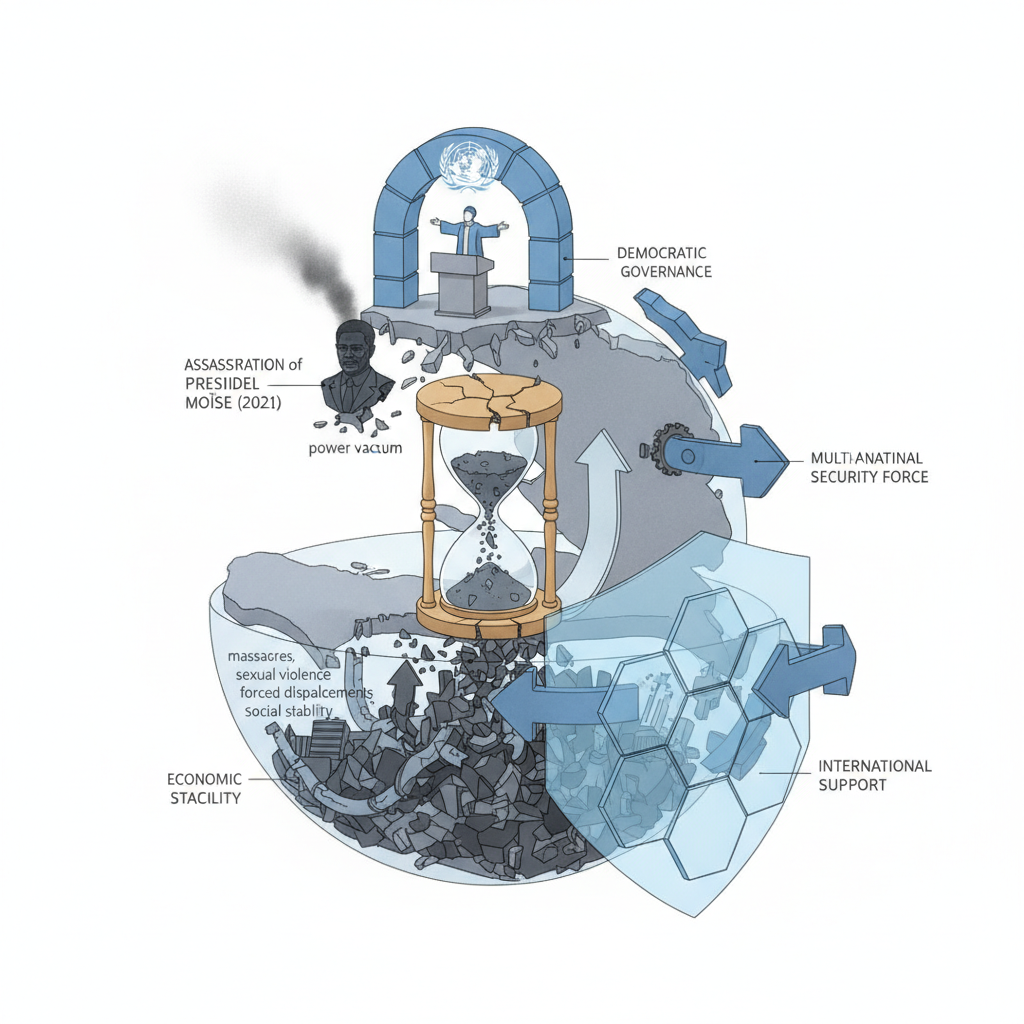
- Haiti has experienced prolonged political instability, economic decline, and escalating gang violence, exacerbated by the assassination of President Jovenel Moïse in 2021 and the subsequent power vacuum.
- Gang violence in Haiti has intensified since 2020, with reports of massacres, sexual violence, forced displacements, and the collapse of state authority in large parts of the capital, Port-au-Prince.
- The Haitian government has prioritized the training and expansion of its national security forces, including police and military personnel, to restore law and order and reduce reliance on external intervention.
- Illicit arms trafficking, primarily from the United States and other regional sources, has fueled gang violence, with weapons often smuggled via porous borders and maritime routes.
- Economic recovery in Haiti remains critically dependent on structural reforms, investment in job creation, and a shift from aid dependency to sustainable partnerships with international actors.
What is the Current Security and Governance Crisis in Haiti?
- Gang Violence and State Collapse: Armed gangs in Haiti have seized control of key infrastructure, including ports and fuel depots, disrupting supply chains and exacerbating humanitarian crises. The state’s inability to curb gang dominance has led to widespread insecurity, particularly in urban areas like Port-au-Prince.
- Illicit Arms Trafficking: Transnational criminal networks facilitate the smuggling of firearms into Haiti, primarily from the United States, exacerbating gang violence. Addressing this requires international cooperation to disrupt supply chains and enforce stricter border controls.
- Disarmament, Demobilization, and Reintegration (DDR): The Haitian government has reactivated the National Commission for DDR to address the proliferation of armed groups. Specialized judicial hubs have been established to prosecute financial crimes, mass atrocities, and sexual violence linked to gang activities.
- Democratic Governance and Elections: Restoring stability in Haiti is contingent on the resumption of credible, inclusive, and transparent elections. The electoral process, currently underway, aims to re-establish democratic legitimacy and reduce reliance on emergency governance structures.
- Economic Transformation: The Prime Minister’s call to shift from aid dependency to investment and production reflects Haiti’s need for structural economic reforms. Job creation, particularly for youth and women, is critical to reducing gang recruitment and fostering long-term stability.
- International Partnerships: Haiti’s recovery requires a reorientation of its economic relationships with global partners, emphasizing sustainable investment over short-term aid to build resilience and self-reliance.
Key Features
| Feature | Significance |
|---|---|
| Watershed Moment Declaration | Signals critical juncture in Haiti’s security crisis, necessitating immediate and sustained international support to prevent state failure. |
| National Security Capacity Building | Haiti’s initiative to train 19,000 security personnel (4,000 police + 15,000 soldiers) aims to establish self-sustaining law enforcement and military institutions. |
| International Security Force Mandate | Urgent requirement for a fully operational 5,500-personnel ‘gang suppression force’ with necessary equipment and resources to counter transnational criminal networks. |
| Specialized Judicial Hubs | Establishment of two judicial centres to address financial crimes, mass atrocities, and sexual violence, enhancing accountability and rule of law. |
| Disarmament and Reintegration Commission | Reactivation of national mechanisms for demobilization and reintegration of armed groups to dismantle gang structures and reduce violence. |
Why it Matters
Geopolitical Stability
- Haiti’s instability poses risks to regional security, particularly in the Caribbean, due to potential spillover effects of gang violence and illicit arms trafficking.
- A failed state scenario in Haiti could trigger mass migration flows, exacerbating humanitarian crises in neighboring nations and straining global refugee frameworks.
International Law and Governance
- The UN’s role in authorizing and supporting a security force aligns with Chapter VII of the UN Charter, which permits collective action to restore international peace and security.
- Haiti’s appeal for partnership over aid reflects principles of sovereignty and self-determination enshrined in the UN Charter (Article 2(1) and Article 2(7)).
Humanitarian Crisis
- Gang violence has displaced over 200,000 people since 2021, creating acute shortages in food, healthcare, and shelter, necessitating coordinated humanitarian intervention.
- Attacks on women and children underscore systemic gender-based violence, requiring gender-responsive security and judicial responses.
Economic Development
- Shifting from aid dependency to investment-based partnerships can catalyze long-term economic recovery, particularly in sectors like agriculture, manufacturing, and renewable energy.
- Job creation for youth and women is critical to reducing recruitment into gangs, aligning with Sustainable Development Goal 8 (Decent Work and Economic Growth).
Challenges
1. Transnational Arms Trafficking
- Illicit weapons entering Haiti via criminal networks fuel gang warfare, necessitating international cooperation under frameworks like the UN Programme of Action on Small Arms.
- Weak border controls and porous maritime routes in the Caribbean facilitate smuggling, requiring enhanced maritime surveillance and interdiction capabilities.
UPSC Link: GS3: Internal Security, GS2: International Organisations
2. Institutional Capacity Deficit
- Haiti’s security forces remain under-resourced, with only 2,000 of 4,000 trained police officers and 1,500 soldiers currently operational, impeding effective law enforcement.
- Judicial and penal systems lack capacity to handle mass crimes, leading to impunity and perpetuation of cycles of violence.
UPSC Link: GS2: Governance, GS3: Security Challenges
3. Political Transition and Electoral Integrity
- Restoring democratic governance requires credible, inclusive elections, but logistical challenges, security threats, and political fragmentation pose significant hurdles.
- The absence of a functioning parliament since 2020 complicates legislative support for security and economic reforms.
UPSC Link: GS2: Indian Constitution – Federalism, GS2: Election Commission of India
4. Economic Fragility and Aid Dependency
- Haiti’s GDP contracted by 1.7% in 2025, with inflation exceeding 50%, exacerbating poverty and limiting fiscal space for security and development spending.
- Over-reliance on foreign aid undermines local economic resilience and discourages private investment in critical sectors.
UPSC Link: GS3: Indian Economy – Development Issues
5. Humanitarian Access Constraints
- Gang-controlled territories restrict movement of aid workers, leading to severe shortages in food, medical supplies, and shelter for displaced populations.
- Climate-induced disasters (e.g., hurricanes) compound vulnerabilities, requiring integrated disaster risk reduction strategies.
UPSC Link: GS2: Humanitarian Law, GS3: Disaster Management
Challenges — UPSC Perspective
| Issue | Concern |
|---|---|
| Gang Suppression Force Deployment | Delay in achieving full operational strength (5,500 personnel) risks prolonging violence and eroding public confidence in international support. |
| Judicial System Overload | Specialized hubs face backlog of cases, leading to prolonged pre-trial detention and denial of justice for victims of mass atrocities. |
| Youth Unemployment and Radicalization | Lack of economic opportunities increases vulnerability to gang recruitment, particularly among marginalized communities. |
| Climate-Conflict Nexus | Environmental degradation (e.g., deforestation, soil erosion) exacerbates resource scarcity, fueling inter-community conflicts and gang expansion. |
| Regional Coordination Gaps | Inconsistent policies among Caribbean nations on arms trafficking and migration complicate collective responses to Haiti’s crisis. |
Way Forward
- Accelerate deployment of the UN-backed gang suppression force with full personnel, equipment, and logistical support to restore immediate security.
- Strengthen Haiti’s security institutions through sustained training, equipping, and institutional reforms, including vetting and professionalization of forces.
- Enhance international cooperation to disrupt illicit arms trafficking networks via intelligence-sharing, maritime interdiction, and border management.
- Expand specialized judicial hubs with additional judges, prosecutors, and forensic capabilities to expedite trials for mass crimes and sexual violence.
- Promote economic recovery through targeted investments in infrastructure, agriculture, and renewable energy, with a focus on job creation for youth and women.
- Support electoral processes with technical and security assistance to ensure free, credible, and inclusive elections, including voter education and logistical planning.
- Integrate climate resilience into recovery plans, including reforestation, disaster risk reduction, and sustainable land-use policies to mitigate resource-based conflicts.
UPSC Value Addition
Keywords for Mains Answer-Writing
Haiti gang violence · international security assistance · transnational organised crime · UN peacekeeping mandate · state-building in fragile states · illicit arms trafficking · judicial capacity in post-conflict states · economic recovery and peacebuilding · democratic transition in Haiti · sustainable security institutions
Concept Flow
Gang violence and transnational arms trafficking → State failure and humanitarian crisis → International intervention under UN Charter Chapter VII → Capacity building of national security institutions → Judicial reform and disarmament → Economic recovery and electoral restoration → Sustainable peace and development.
Prelims Practice Questions
Q1. Consider the following statements regarding Haiti’s current security crisis and international response:
1. Haiti’s Prime Minister has called for the renewal of the mandate of a gang suppression force with full deployment of 5,500 personnel.
2. The Haitian Government has trained over 4,000 police officers and plans to train 15,000 additional soldiers over the next three years.
3. The international community has fully operationalised the proposed security force with the required personnel and equipment.
How many of the above statements are correct?
- Only one
- Only two
- All three
- None
Answer: Only two — Statement 1 is correct as the Haitian PM explicitly called for the renewal and full deployment of the gang suppression force. Statement 2 is correct as the PM stated that 2,000 police officers have been trained and 1,500 soldiers have completed training, with plans to train 15,000 additional soldiers. Statement 3 is incorrect as the PM highlighted that the force is not yet fully operational or at planned strength.
Q2. Assertion (A): The Haitian Government has established specialised judicial hubs to address financial crimes, mass crimes, and sexual violence as part of efforts to combat impunity.
Reason (R): Haiti’s security crisis is exacerbated by transnational criminal networks involved in illicit weapons trafficking.
In the context of the above statements, which of the following is correct?
- Both A and R are true, and R is the correct explanation of A
- Both A and R are true, but R is not the correct explanation of A
- A is true, but R is false
- A is false, but R is true
Answer: A is true, but R is false — Assertion (A) is true as the Haitian PM mentioned the establishment of two specialised judicial hubs. Reason (R) is also true as the PM highlighted the role of transnational criminal networks in illicit weapons trafficking. However, (R) does not directly explain (A), as the hubs address judicial capacity, not weapons trafficking.
Q3. Match the following initiatives undertaken by the Haitian Government with their respective objectives:
Column I (Initiative) | Column II (Objective)
1. Training 4,000 police officers and 15,000 soldiers | A. Strengthening judicial capacity
2. Establishing specialised judicial hubs | B. Enhancing national security institutions
3. Reactivating the national commission for disarmament, demobilisation and reintegration | C. Promoting economic recovery
4. Shifting from aid to investment and job creation | D. Combating impunity and arms trafficking
Select the correct match:
- 1-B, 2-A, 3-D, 4-C
- 1-A, 2-B, 3-C, 4-D
- 1-C, 2-D, 3-A, 4-B
- 1-D, 2-C, 3-B, 4-A
Answer: 1-B, 2-A, 3-D, 4-C — 1-B: Training police and soldiers strengthens national security institutions. 2-A: Specialised judicial hubs address judicial capacity. 3-D: The commission focuses on disarmament and demobilisation to combat impunity and arms trafficking. 4-C: Shifting from aid to investment promotes economic recovery.
Mains Practice Question
✍ The Haitian Prime Minister has described Haiti’s current situation as a ‘watershed moment’ requiring sustained international support and strengthened national institutions to address gang violence and state fragility. Critically examine the challenges and strategies involved in state-building in fragile contexts like Haiti, with reference to security sector reform, judicial capacity, and economic recovery. (15 Marks)
Approach: MODEL-ANSWER SKELETON:
1. **Introduction**: Define state-building in fragile contexts and its core components (security, governance, economic recovery).
2. **Security Sector Reform (SSR)**:
– Explain SSR as a multi-dimensional process (training security forces, disarmament, demobilisation, reintegration).
– Cite Haiti’s initiatives: training 4,000 police officers and 15,000 soldiers, reactivating the disarmament commission.
– Challenges: lack of full operationalisation of international security force, weapons trafficking, and transnational criminal networks.
– Reference: UN peacekeeping mandates and the need for sustained international support.
3. **Judicial Capacity and Rule of Law**:
– Discuss the role of judicial hubs in addressing impunity (financial crimes, mass crimes, sexual violence).
– Highlight the link between judicial capacity and state legitimacy.
– Challenges: corruption, weak institutional infrastructure, and the need for international legal assistance.
4. **Economic Recovery and Democratic Transition**:
– Explain the shift from aid dependency to investment and job creation as a peacebuilding strategy.
– Discuss the role of elections in restoring democratic governance and social cohesion.
– Challenges: economic stagnation, youth unemployment, and the need for inclusive growth.
5. **Synthesis**: Weigh the interplay between security, governance, and economic factors in state-building. Argue that no single pillar can succeed in isolation; a holistic approach is essential.
6. **Conclusion**: Summarise key challenges and strategies, emphasising the need for long-term commitment from both national and international actors.
Source: news.un.org
Generated by AanyaAi for educational purpose.
Related guides on our sites
- Best PSIR optional coaching for upsc
- Best PSIR optional teacher for upsc
- Best teacher of PSIR optional for upsc
- Best PSIR optional coaching in delhi for UPSC

- Haiti’s PM Urges UN for Full Backing Against Gangs at UNGA 2026 - September 26, 2026
- सुपर एल नीनो: 4.51 लाख अतिरिक्त मौतों के अनुमान की गणना कैसे हुई? - September 26, 2026
- Super El Nino: 451,000 Excess Deaths Explained for UPSC & State PCS - September 26, 2026

No Comments