


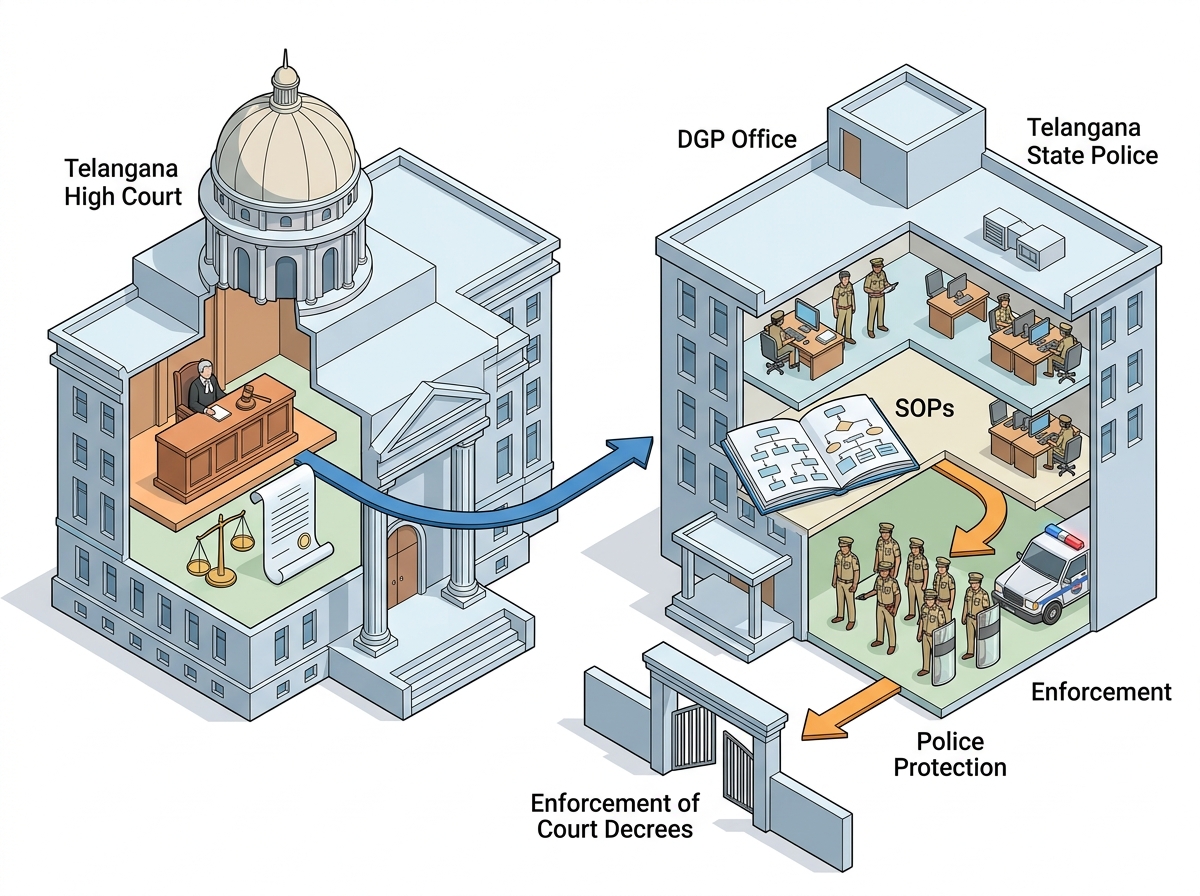
04 Sep HC directs Telangana DGP to frame SOPs for police protection in decree enforcement
✎ Standard Operating Procedures (SOPs) for police enforcement of judicial decrees are institutional protocols mandated by the Civil Procedure Code, 1908, to ensure timely and uniform execution of court orders, particularly in…
Subject Relevance — Where This Topic Fits
- GS Paper II — Judiciary and Judicial Process | GS Paper III — Public Administration and Law and Order
- Prelims: Decree enforcement, Executing courts, Standard Operating Procedures (SOPs), Judicial writs, Police protection, Civil Procedure Code, 1908
- Essay: Role of the judiciary in upholding constitutional rights vs. executive accountability in law enforcement
Quick Revision: Standard Operating Procedures (SOPs) for police enforcement of judicial decrees are institutional protocols mandated by the Civil Procedure Code, 1908, to ensure timely and uniform execution of court orders, particularly in property disputes requiring police protection, thereby preventing contempt of court and reducing judicial overload.
Why is this in the news?
The Telangana High Court has directed the Director General of Police to formulate Standard Operating Procedures (SOPs) for district police officials to ensure timely and effective enforcement of court decrees, highlighting systemic delays and non-compliance that compel decree holders to approach higher courts for relief. This judicial intervention underscores the need for institutional mechanisms to bridge the gap between judicial pronouncements and executive implementation, particularly in property disputes where enforcement often requires police protection.
Background
- Under the Civil Procedure Code, 1908, executing courts are empowered to enforce decrees through mechanisms such as police assistance under Section 74 and Order XXI, Rule 32, which mandates police protection where necessary to prevent obstruction or breach of peace.
- Despite legal provisions, delays and non-compliance in police enforcement of judicial orders have led to a surge in writ petitions before High Courts, creating judicial overload and undermining the efficacy of the lower judiciary.
- The Telangana High Court has observed a recurrent pattern where decree holders are compelled to approach higher courts for enforcement of orders passed by executing courts, indicating systemic inefficiencies in the implementation chain.
- The case in question involved a couple from Yadadri Bhongir district who secured a decree for property rights but faced non-compliance from local police authorities despite explicit judicial directions.
- The High Court’s directive to the DGP reflects a broader governance challenge: ensuring inter-institutional coordination between the judiciary and the police to uphold the rule of law and prevent contempt of court.
- This issue is not confined to Telangana; similar challenges have been reported in other states, suggesting a pan-Indian need for standardized protocols to streamline decree enforcement.
What are Standard Operating Procedures (SOPs) for Police Enforcement of Judicial Decrees?
- SOPs are pre-defined, uniform protocols that outline the roles, responsibilities, and timelines for police officials in enforcing judicial decrees, particularly where police protection or assistance is required to prevent obstruction or breach of peace.
- These procedures are designed to ensure consistency in law enforcement actions, reduce discretionary delays, and provide clear guidance to police personnel on executing court orders without recourse to higher judicial intervention.
- Key components of such SOPs typically include: identification of decree types requiring police assistance, timelines for compliance, escalation mechanisms for non-compliance, and accountability measures for erring officials.
- The Civil Procedure Code, 1908, empowers executing courts to direct police assistance under Section 74 (power to issue warrants) and Order XXI, Rule 32 (delivery of possession through police), making SOPs a critical tool for operationalizing these provisions.
- SOPs also serve as a preventive measure against contempt of court by ensuring that police authorities act promptly and in accordance with judicial directions, thereby upholding the dignity of the judiciary.
- The formulation of SOPs aligns with the constitutional mandate under Article 226 (High Court’s power to issue writs) and Article 32 (Supreme Court’s power to issue writs), as courts seek to minimize the need for judicial intervention in enforcement matters.
- Effective SOPs must balance the need for swift enforcement with the protection of civil liberties, ensuring that police actions do not infringe upon constitutional rights while executing judicial orders.
- The Telangana High Court’s directive to the DGP reflects a judicial expectation that SOPs will institutionalize best practices, reducing the burden on higher courts and enhancing public trust in the justice delivery system.
Key Features
| Feature | Significance |
|---|---|
| Standard Operating Procedures (SOPs) for police protection | SOPs provide a structured framework to ensure consistent and effective enforcement of judicial decrees, reducing ad-hoc responses and litigation burden on higher courts. |
| Judicial enforcement of civil decrees | Ensures that civil court orders are executed in letter and spirit, upholding the rule of law and protecting property rights of decree holders. |
| Role of District Police in decree enforcement | Police act as an executive arm to implement judicial orders, bridging the gap between judicial pronouncements and ground-level compliance. |
| High Court’s suo motu observation on systemic gaps | Highlights endemic deficiencies in the enforcement mechanism, necessitating systemic reforms rather than case-specific resolutions. |
| Appeal mechanism against single-judge orders | Provides a structured process for aggrieved parties to challenge enforcement orders, ensuring checks and balances in judicial administration. |
Why it Matters
Judicial Administration
- Strengthens the credibility of civil courts by ensuring timely enforcement of their decrees, thereby reducing public trust deficits in the judicial system.
- Reduces the backlog of cases in higher courts by addressing enforcement gaps at the district level, thereby improving judicial efficiency.
- Clarifies the responsibilities of police authorities in executing judicial orders, preventing arbitrary inaction or delays in decree enforcement.
Rule of Law
- Reinforces the principle that judicial orders must be complied with, irrespective of the socio-economic status of the parties involved, ensuring equality before law.
- Prevents self-help remedies and vigilantism by ensuring state-backed enforcement of property rights through police protection.
- Promotes legal certainty by standardising police responses to decree enforcement requests, reducing discretionary delays.
Governance and Accountability
- Enhances accountability of police officials by defining clear SOPs for decree enforcement, reducing scope for inaction or collusion.
- Encourages systemic introspection at the administrative level (e.g., DGP, Home Department) to address recurring enforcement failures.
- Facilitates data-driven policy formulation by identifying patterns of non-compliance across districts.
Challenges
1. Systemic delays in decree enforcement
- Frequent reliance on higher courts for enforcement indicates a breakdown in the district-level execution machinery.
- Delays erode public confidence in the judiciary and incentivise extra-legal remedies.
- Resource constraints in police forces may impede timely provision of protection, especially in remote areas.
UPSC Link: GS-II: Judiciary – Judicial Delays and Reforms
2. Lack of standardised SOPs for police protection
- Absence of uniform guidelines leads to inconsistent enforcement, with some districts acting promptly while others remain unresponsive.
- Creates ambiguity in the roles of SP, SHO, and SDPO, leading to jurisdictional disputes or inaction.
- Increases litigation burden on higher courts, diverting judicial resources from substantive matters.
UPSC Link: GS-II: Police Reforms – Standard Operating Procedures
3. Accountability deficits in police enforcement
- Police officials may prioritise other duties over decree enforcement due to lack of clear directives or incentives.
- Fear of reprisal or political interference can deter officers from acting impartially in property disputes.
- Inadequate training on civil procedure and judicial orders may hinder effective enforcement.
UPSC Link: GS-III: Internal Security – Police Accountability
4. Resource and capacity constraints
- Limited manpower and infrastructure in police forces may prevent simultaneous deployment for multiple decree enforcement requests.
- Geographical challenges in rural or tribal areas can delay response times, exacerbating enforcement gaps.
- Financial constraints may limit the availability of auxiliary support (e.g., escorts, logistical aid) for police protection.
UPSC Link: GS-III: Security Challenges – Police Modernisation
5. Collusion and vested interests
- Local power structures or vested interests may obstruct enforcement to protect unauthorised possession or illegal activities.
- Lack of transparency in police actions can enable collusion between officers and influential parties.
- Delayed enforcement may be exploited to manipulate property records or transfer titles illegally.
UPSC Link: GS-II: Governance – Transparency and Accountability
Challenges — UPSC Perspective
| Issue | Concern |
|---|---|
| Inconsistent police response to decree enforcement | Leads to selective compliance, undermining the uniformity of law application. |
| High dependency on higher courts for enforcement | Increases judicial workload and delays resolution of substantive disputes. |
| Jurisdictional ambiguities among police officials (SP, SHO, SDPO) | Results in buck-passing and inaction, delaying enforcement. |
| Resource constraints in police forces | Compromises the ability to provide timely protection, especially in remote areas. |
| Potential for collusion in enforcement | Undermines the integrity of the enforcement process and property rights. |
| Lack of training on civil procedure for police officers | Leads to misinterpretation of judicial orders or procedural errors in enforcement. |
Way Forward
- Draft and notify SOPs for police protection in decree enforcement, specifying timelines, roles of SP/SHO/SDPO, and escalation mechanisms.
- Conduct mandatory training programmes for police officers on civil procedure, judicial orders, and the importance of timely enforcement.
- Establish a state-level monitoring cell under the DGP to track enforcement requests, identify systemic delays, and recommend corrective measures.
- Strengthen inter-departmental coordination between the judiciary, police, and revenue authorities to streamline property dispute resolution.
- Implement a digital tracking system for decree enforcement requests, enabling real-time monitoring and grievance redressal.
- Conduct periodic audits of police stations to assess compliance with enforcement SOPs and identify training or resource gaps.
- Sensitise local communities and civil society organisations on legal remedies for property disputes to reduce reliance on extra-legal measures.
- Explore the use of auxiliary forces (e.g., home guards, civil defence) for supplementary protection in high-risk areas.
UPSC Value Addition
Keywords for Mains Answer-Writing
Judicial enforcement · Executing courts · Police protection for decree holders · Standard Operating Procedures in police administration · Right to enforcement of court decrees · Judicial administration and executive coordination · Civil Procedure Code, 1908 · Constitutional right to access justice · Police accountability in judicial process · Judicial activism in enforcement of decrees
Constitutional & Policy Linkages
- Article 21: Right to Life and Personal Liberty (ensuring timely enforcement of judicial orders to protect property rights).
- Article 32: Writs for enforcement of fundamental rights (highlighting the role of higher courts in addressing enforcement failures).
- Article 226: High Court’s writ jurisdiction (empowering HCs to direct police action for decree enforcement).
Concept Flow
Decree holder obtains a civil court order for property rights → Executing court directs police (SP/SHO/SDPO) to provide protection → Police inaction or delay leads to non-compliance → Decree holder approaches High Court for enforcement → HC observes systemic gaps and directs DGP to frame SOPs → DGP drafts SOPs, incorporating timelines and accountability measures → SOPs implemented, reducing litigation and improving enforcement.
Prelims Practice Questions
Q1. Consider the following statements regarding the enforcement of court decrees in India:
1. The Code of Civil Procedure, 1908, empowers executing courts to direct police authorities to provide protection for the enforcement of decrees.
2. The Supreme Court of India has held that police protection for decree holders is a fundamental right under Article 21 of the Constitution.
3. The High Courts can issue writs under Article 226 of the Constitution to ensure compliance with executing court orders.
How many of the above statements are correct?
- Only one
- Only two
- All three
- None
Answer: All three — Statements 1 and 3 are correct. Statement 2 is incorrect as police protection for decree holders is not a fundamental right under Article 21, though it is a procedural right under the Code of Civil Procedure, 1908, and enforceable through writ jurisdiction under Article 226.
Q2. Assertion (A): The Code of Civil Procedure, 1908, empowers the executing court to direct the police to provide protection for enforcing a decree.
Reason (R): The police are bound to comply with such directions as part of their duty under the Constitution to ensure the rule of law.
Options:
A. Both A and R are true, and R is the correct explanation of A.
B. Both A and R are true, but R is not the correct explanation of A.
C. A is true, but R is false.
D. A is false, but R is true.
Answer: ? — Assertion (A) is true as Section 74 of the Code of Civil Procedure, 1908, empowers executing courts to direct police protection. However, Reason (R) is an overstatement; while police must comply with judicial directions, their duty under the Constitution is broader and not limited to executing court orders alone.
Q3. Match the following provisions with their respective functions in the context of enforcement of court decrees:
Column I (Provisions)
1. Section 74, Code of Civil Procedure, 1908
2. Article 226, Constitution of India
3. Section 151, Code of Civil Procedure, 1908
Column II (Functions)
A. Empowers courts to issue directions for police protection
B. Provides inherent power to courts to make orders for ends of justice
C. Enables High Courts to issue writs for enforcement of rights
- 1-A, 2-C, 3-B; 1-B, 2-A, 3-C; 1-C, 2-A, 3-B; 1-A, 2-B, 3-C
- 1-A, 2-C, 3-B
- 1-B, 2-C, 3-A
- 1-C, 2-A, 3-B
- 1-A, 2-B, 3-C
Answer: 1-A, 2-C, 3-B; 1-B, 2-A, 3-C; 1-C, 2-A, 3-B; 1-A, 2-B, 3-C — Section 74 of the Code of Civil Procedure, 1908, empowers executing courts to direct police protection (1-A). Article 226 of the Constitution enables High Courts to issue writs for enforcement of rights (2-C). Section 151 provides inherent power to courts to make orders for ends of justice (3-B).
Mains Practice Question
✍ The Telangana High Court has directed the Director General of Police to frame Standard Operating Procedures (SOPs) for police protection to decree holders to enforce executing court orders. In this context, critically examine the role of the executive in ensuring the enforcement of judicial decrees in India. Also, analyse the constitutional and statutory framework governing this process. (15 Marks)
Approach: MODEL-ANSWER SKELETON:
1. **Introduction (2 marks)**
– Briefly define the issue: enforcement of judicial decrees and the role of police protection.
– Contextualise with the Telangana High Court’s directive for SOPs and the recurring problem of decree holders approaching courts for enforcement.
2. **Statutory Framework (4 marks)**
– **Code of Civil Procedure, 1908:**
– Section 74: Powers of executing courts to direct police protection.
– Section 151: Inherent powers of courts to ensure justice.
– **Constitutional Provisions:**
– Article 226: Writ jurisdiction of High Courts to enforce rights.
– Article 32: Writ jurisdiction of the Supreme Court.
– Article 51A (Fundamental Duties): Emphasises the duty to uphold the rule of law.
– **Police Act, 1861:** Duty of police to assist in the administration of justice.
3. **Executive’s Role and Challenges (5 marks)**
– **Executive’s Obligations:**
– Police as an organ of the state bound by judicial directions.
– Need for SOPs to streamline police action and reduce litigation.
– **Challenges:**
– Lack of uniform SOPs across states leading to ad-hoc enforcement.
– Police discretion and potential reluctance to intervene in civil disputes.
– Resource constraints and prioritisation of law-and-order over civil enforcement.
– Inter-jurisdictional conflicts between civil courts and police authorities.
4. **Judicial Activism and Accountability (3 marks)**
– Courts stepping in to ensure compliance when executive fails (e.g., Telangana HC’s directive).
– Concept of judicial activism in enforcement of decrees.
– Need for executive accountability and institutional mechanisms to monitor compliance.
5. **Way Forward (1 mark)**
– Recommendations: Uniform SOPs, training for police, digital tracking of decrees, and periodic reviews by DGPs and High Courts.
Source: The Hindu
Generated by AanyaAi for educational purpose.
Related guides on our sites
- Current affairs for upsc 2026
- How to prepare for GS paper 1 for UPSC CSE mains exam
- Best UPSC coaching for IFOS exam
- Best mentorship programme for upsc

- स्वावलंबन 2026: भारतीय नौसेना की तकनीकी क्रांति और आत्मनिर्भरता पर विशेष फोकस - October 24, 2026
- Digital India BHASHINI’s Multilingual AI Solutions for UPSC Research - October 24, 2026
- कर्नाटक उच्च न्यायालय का बड़ा फैसला: 34 साल तक दैनिक वेतन पर काम करने वाली महिला टाइपिस्ट की सेवा नियमित करने का आदेश - October 24, 2026

No Comments