


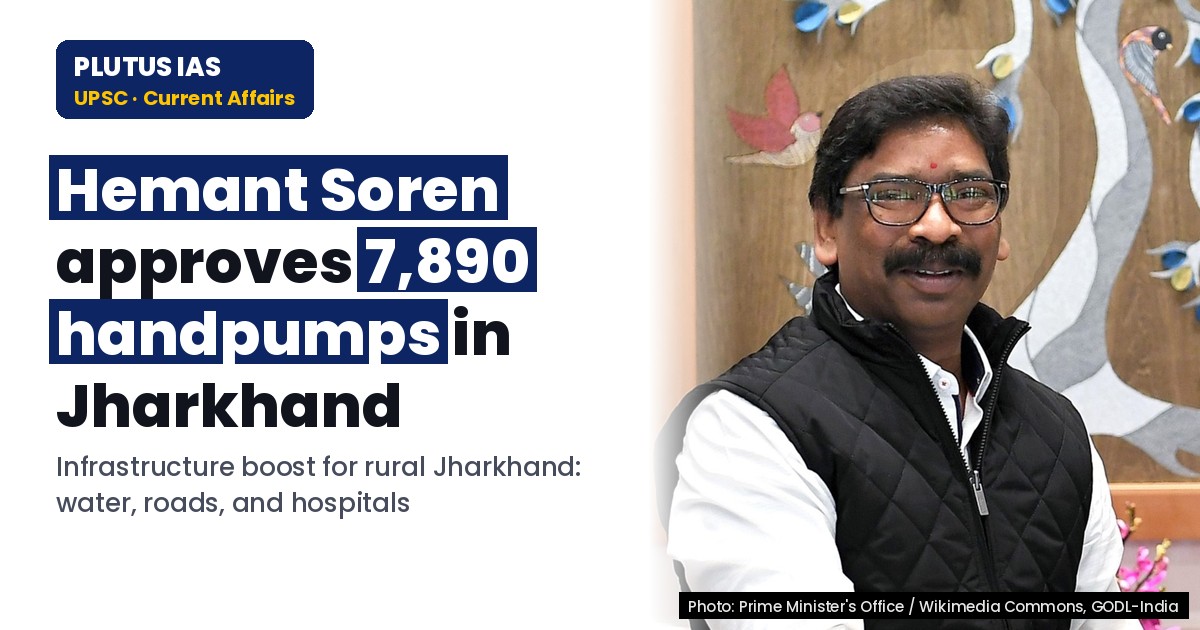
28 Oct Hemant Soren Cabinet Approves 7,890 Handpumps & Road Widening in Jharkhand
✎ The Jharkhand Cabinet’s decisions underscore the state’s commitment to achieving Sustainable Development Goals (SDGs) 6 (Clean Water and Sanitation), 9 (Industry, Innovation, and Infrastructure), and 3 (Good Health and…
Subject Relevance — Where This Topic Fits
- GS Paper II — Governance, Constitution, and Social Justice | GS Paper III — Infrastructure, Rural Development, and Human Resource Development
- Prelims: Jal Jeevan Mission (JJM), Pradhan Mantri Gram Sadak Yojana (PMGSY), National Health Mission (NHM), State Public Service Commissions (SPSC), Centrally Sponsored Schemes (CSS), District Mineral Foundation (DMF), Public Financial Management System (PFMS), Right to Information (RTI), Judicial Review, Pension Reforms
- Essay: Role of State Governments in Achieving Sustainable Development Goals (SDGs), Balancing Economic Growth and Social Equity: Lessons from State-Level Interventions
Quick Revision: The Jharkhand Cabinet’s decisions underscore the state’s commitment to achieving Sustainable Development Goals (SDGs) 6 (Clean Water and Sanitation), 9 (Industry, Innovation, and Infrastructure), and 3 (Good Health and Well-being) through targeted infrastructure and institutional reforms.
Why is this in the news?
The Jharkhand Cabinet, led by Chief Minister Hemant Soren, approved a series of infrastructure and welfare projects on 27 October 2026, including the installation of 7,890 handpumps across 263 blocks, road widening in Giridih district, the construction of a 500-bed hospital in Jamshedpur, and the revival of the Lotia Reservoir Scheme. These decisions reflect the state’s focus on improving basic amenities, healthcare, and administrative efficiency, aligning with national schemes such as the Jal Jeevan Mission and PMGSY.
Background
- Jharkhand, a mineral-rich eastern state, faces persistent challenges in rural water supply, road connectivity, and healthcare infrastructure despite its resource endowments.
- The state’s per capita water availability is below the national average, with significant disparities between urban and rural areas, necessitating targeted interventions like handpump installations.
- Road infrastructure in Jharkhand is critical for connecting remote tribal and mining areas, with many stretches prone to erosion and poor maintenance, impacting mobility and economic activity.
- The healthcare sector in Jharkhand suffers from a shortage of tertiary care facilities, particularly in industrial hubs like Jamshedpur, where demand outstrips existing capacity.
- Institutional reforms, including pension benefits for daily-wage employees and the regularisation of contractual staff, are essential to address human resource gaps in governance.
- The state’s fiscal health, while improving, requires careful prioritisation of expenditure to balance developmental needs with revenue constraints.
Key Decisions of the Jharkhand Cabinet: Governance, Infrastructure, and Social Welfare
- **Drinking Water Supply**: Approval of ₹965.47 crore for installing 7,890 handpumps across 263 blocks under the Jal Jeevan Mission (JJM), aimed at ensuring piped water supply to rural households. This aligns with the national target of providing functional tap connections to all rural households by 2024.
- Road Infrastructure Development: Administrative approval for widening, strengthening, and reconstructing three major roads in Giridih district at an estimated cost of ₹114.61 crore. This initiative supports the Pradhan Mantri Gram Sadak Yojana (PMGSY) objectives of improving rural connectivity and reducing travel time.
- Healthcare Expansion: Revised administrative approval of ₹5,453.83 crore for constructing a 500-bed hospital building at MGM Medical College, Jamshedpur, to address the shortage of tertiary care facilities in the industrial belt of East Singhbhum.
- Institutional and Administrative Reforms: Approval of amendments to the Jharkhand State Probation Service Rules, 2026, to streamline recruitment and service conditions for probationary officers, enhancing governance efficiency.
- Judicial Compliance and Pension Reforms: Modification of resolutions to ensure compliance with High Court orders regarding pension benefits for daily-wage employees, including the regularisation of 16 contractual staff and the payment of retirement benefits.
- Capacity Building and Skill Development: Approval for providing apprenticeship training to polytechnic students in collaboration with the Jharkhand Government Tool Room (JGTR), aligning with the Skill India Mission and National Apprenticeship Promotion Scheme (NAPS).
- Infrastructure for Medical Education: Approval of ₹2,841.72 crore for the Jharkhand Medico City, a multi-specialty healthcare and educational hub, to integrate medical services, research, and training under one roof.
- Fiscal and Institutional Autonomy: Registration of the Jharkhand Institute of Fiscal Studies as an autonomous institution, enhancing research capabilities in state finances and policy formulation.
Key Features
| Feature | Significance |
|---|---|
| Installation of 7,890 handpumps across 263 blocks | Addresses acute potable water scarcity in rural Jharkhand, aligning with SDG 6 (Clean Water and Sanitation) and the National Rural Drinking Water Programme (NRDWP). |
| Widening and strengthening of three major roads in Giridih district | Enhances regional connectivity, reduces travel time, and supports economic integration of hinterland areas with urban centres. |
| Approval for 500-bed hospital at MGM Medical College, Jamshedpur | Expands tertiary healthcare capacity in eastern India, addressing the doctor-patient ratio deficit and reducing outmigration for medical treatment. |
| Revival of Lotia Reservoir Scheme with ₹321.706 crore allocation | Augments irrigation potential, stabilises agricultural output, and mitigates drought vulnerability in Hazaribagh district. |
| Establishment of Jharkhand Government Tool Room (JGTR) for polytechnic students | Promotes skill development in precision engineering, aligning with the National Skill Qualification Framework (NSQF) and Atal Innovation Mission. |
Why it Matters
Infrastructure Development
- Directly contributes to the Pradhan Mantri Gram Sadak Yojana (PMGSY) Phase-IV objectives of rural road connectivity and all-weather access.
- Enhances public health outcomes by ensuring reliable water supply and expanding healthcare infrastructure.
- Strengthens irrigation capacity, reducing farmer distress and promoting crop diversification in rain-fed regions.
Governance and Institutional Capacity
- Demonstrates administrative commitment to decentralised decision-making through block-level interventions.
- Highlights the role of state-level planning in complementing centrally sponsored schemes (e.g., NRDWP, PMKSY).
- Showcases inter-departmental coordination in integrating water, road, and health infrastructure projects.
Socio-Economic Impact
- Improves quality of life in rural Jharkhand by reducing drudgery (e.g., water fetching) and healthcare access barriers.
- Stimulates local employment through construction and maintenance activities, aligning with the Garib Kalyan Rojgar Abhiyaan.
- Supports agricultural productivity, potentially increasing rural incomes and reducing migration to urban areas.
Environmental Sustainability
- Revival of Lotia Reservoir promotes water conservation and sustainable agricultural practices in a drought-prone district.
- Handpump installations reduce reliance on groundwater extraction, mitigating long-term aquifer depletion risks.
Challenges
1. Implementation Bottlenecks
- Risk of cost overruns and delays due to terrain challenges (e.g., hilly regions in Giridih) and procurement bottlenecks.
- Need for robust monitoring mechanisms to ensure equitable distribution of handpumps across 263 blocks.
- Ensuring timely completion of the 500-bed hospital to avoid prolonged healthcare access gaps.
UPSC Link: GS-III: Infrastructure Development
2. Funding and Fiscal Sustainability
- Dependence on state budget allocations may strain Jharkhand’s fiscal space, necessitating innovative financing (e.g., convergence with CSR funds).
- Long-term maintenance of irrigation infrastructure (Lotia Reservoir) requires dedicated funds beyond initial capital expenditure.
UPSC Link: GS-III: Fiscal Federalism
3. Technical and Human Resource Constraints
- Shortage of skilled labour for road construction and hospital infrastructure in rural Jharkhand.
- Need for capacity building in local bodies to manage and maintain new assets post-completion.
UPSC Link: GS-II: Governance
4. Equity and Inclusion
- Ensuring marginalised communities (e.g., Scheduled Tribes, women) benefit equitably from water and road projects.
- Addressing digital divide in monitoring handpump functionality and road quality via GIS-based systems.
UPSC Link: GS-II: Inclusive Growth
Challenges — UPSC Perspective
| Issue | Concern |
|---|---|
| Geographical terrain (e.g., Giridih’s hilly areas) | Increases construction costs and delays in road widening projects. |
| Delayed land acquisition for reservoir revival | Threatens timely completion of Lotia Reservoir Scheme. |
| Limited technical staff for hospital construction | May lead to suboptimal design or prolonged project timelines. |
| Seasonal water scarcity in rural blocks | Compromises handpump functionality during peak summer months. |
| Lack of local ownership in maintenance | Risk of asset degradation post-completion due to inadequate O&M funds. |
Government Initiatives — Must-Memorise for Prelims
- National Rural Drinking Water Programme (NRDWP)
- Pradhan Mantri Gram Sadak Yojana (PMGSY) Phase-IV
- Pradhan Mantri Krishi Sinchayee Yojana (PMKSY)
- Garib Kalyan Rojgar Abhiyaan
Way Forward
- Constitute district-level task forces to oversee road widening and handpump installation timelines.
- Integrate GIS-based monitoring systems to track project progress and asset performance in real time.
- Launch skill development programmes in collaboration with JGTR to address local labour shortages.
- Establish a dedicated maintenance fund for irrigation and healthcare infrastructure post-completion.
- Conduct community consultations to identify priority water and road needs in each block.
- Leverage CSR funds from industries (e.g., Tata Steel, SAIL) for co-financing of projects.
- Develop a phased roadmap for hospital construction to ensure phased healthcare delivery.
- Strengthen inter-departmental coordination between PWD, PHED, and Health departments.
UPSC Value Addition
Keywords for Mains Answer-Writing
Jharkhand Cabinet Decisions · Rural Water Supply Infrastructure · Chapakal Scheme · Road Widening Projects · Public Health Infrastructure · State Development Schemes · Jharkhand Government Initiatives · Public Works Department · Rural Drinking Water · Infrastructure Development · State Budget Allocation · Administrative Reforms in Jharkhand · Multi-Departmental Governance · Public Service Delivery
Constitutional & Policy Linkages
- Article 243G: Empowers Panchayats to plan and implement rural infrastructure projects.
- Article 243W: Delegates functions to municipalities, including urban road maintenance.
Concept Flow
State Cabinet approval → Policy decision → Budget allocation → Tendering → Implementation → Monitoring → Impact assessment. → Water scarcity → Handpump installation → Reliable potable water → Reduced drudgery → Improved health outcomes. → Poor road connectivity → Widening projects → Enhanced mobility → Economic integration → Rural development. → Agricultural distress → Irrigation revival → Crop diversification → Higher farm incomes → Reduced migration. → Healthcare gaps → Hospital construction → Tertiary care access → Reduced outmigration → Demographic dividend.
Prelims Practice Questions
Q1. Consider the following statements regarding the Chapakal Scheme in Jharkhand:
1. The scheme aims to install 7,890 handpumps across 263 blocks in the state.
2. The total financial outlay approved for the scheme is ₹965.47 crore.
3. The scheme is part of the National Rural Drinking Water Programme (NRDWP).
How many of the above statements are correct?
- Only one
- Only two
- All three
- None
Answer: Only two — Statement 1 is correct as the scheme proposes to install 7,890 handpumps. Statement 2 is incorrect; the approved outlay is ₹965.47 crore, not ₹965.47 lakh. Statement 3 is incorrect; the scheme is a state-specific initiative and not explicitly linked to NRDWP.
Q2. Assertion (A): The Jharkhand Cabinet approved the widening of three major roads in Giridih district with an administrative sanction exceeding ₹114.61 crore.
Reason (R): The road widening projects are part of the state’s infrastructure development strategy to improve connectivity and economic integration.
- Both A and R are true, and R is the correct explanation of A
- Both A and R are true, but R is not the correct explanation of A
- A is true but R is false
- A is false but R is true
Answer: Both A and R are true, but R is not the correct explanation of A — Both the assertion and reason are factually accurate. The road widening projects are indeed part of Jharkhand’s broader infrastructure development strategy aimed at improving connectivity, which justifies the administrative sanction.
Q3. Match the following initiatives approved by the Jharkhand Cabinet with their respective budget allocations:
Column I (Initiative) Column II (Budget Allocation)
A. Installation of 7,890 handpumps 1. ₹545.38 crore
B. Widening of roads in Giridih district 2. ₹965.47 crore
C. Construction of 500-bed hospital in Jamshedpur 3. ₹114.61 crore
D. Infrastructure development of Jharkhand Medico City 4. ₹284.17 crore
- A-2, B-3, C-1, D-4
- A-1, B-2, C-3, D-4
- A-4, B-3, C-1, D-2
- A-2, B-1, C-3, D-4
Answer: A-2, B-3, C-1, D-4 — A matches with 2 (₹965.47 crore for handpumps), B with 3 (₹114.61 crore for road widening), C with 1 (₹545.38 crore for the hospital), and D with 4 (₹284.17 crore for Medico City).
Mains Practice Question
✍ The Jharkhand Cabinet’s recent approval of multiple infrastructure and public welfare projects—including the installation of 7,890 handpumps, road widening, and the construction of a 500-bed hospital—reflects a multi-dimensional approach to governance. Critically examine the significance of such decentralised, state-led initiatives in addressing rural water supply challenges, improving connectivity, and enhancing public health infrastructure. Also, analyse the potential challenges in the implementation of these projects and suggest measures to ensure their effective delivery. (15 Marks)
Approach: MODEL-ANSWER SKELETON:
1. **Introduction (2 marks)**
– Briefly contextualise the role of state governments in addressing grassroots developmental challenges, citing the constitutional provisions (Article 243G, 7th Schedule, State List).
– Highlight the importance of decentralised governance in India’s federal structure.
2. **Significance of the Initiatives (5 marks)**
– **Rural Water Supply (Handpumps):**
– Link to Sustainable Development Goal 6 (Clean Water and Sanitation) and India’s Jal Jeevan Mission (though state-specific).
– Discuss the impact on reducing water-borne diseases, improving school attendance (especially for girls), and economic productivity in rural areas.
– **Road Widening:**
– Explain how improved connectivity fosters economic integration, reduces logistics costs, and enhances access to markets and healthcare.
– Reference the Pradhan Mantri Gram Sadak Yojana (PMGSY) and its objectives.
– **Public Health Infrastructure (500-bed Hospital):**
– Address the critical shortage of healthcare facilities in Jharkhand, particularly in tribal and remote areas.
– Discuss the role of tertiary care institutions in reducing out-of-pocket expenditure and improving health outcomes.
3. **Challenges in Implementation (4 marks)**
– **Funding and Resource Constraints:**
– Discuss the reliance on state budgets and potential fiscal limitations.
– Mention the need for convergence with central schemes (e.g., NRDWP, PMGSY).
– **Bureaucratic and Administrative Hurdles:**
– Highlight delays in land acquisition, environmental clearances, and procurement processes.
– Reference the role of the Jharkhand State Pollution Control Board and other regulatory bodies.
– **Technical and Logistical Issues:**
– Discuss challenges in sourcing materials, skilled labour, and maintenance of infrastructure post-completion.
– **Community Engagement:**
– Emphasise the need for participatory planning to ensure sustainability and local ownership.
4. **Measures for Effective Delivery (4 marks)**
– **Strengthening Institutional Capacity:**
– Propose the creation of dedicated project management units (PMUs) with technical and financial expertise.
– Recommend capacity-building for local bodies (Panchayati Raj Institutions) under the 73rd Amendment.
– **Technology and Innovation:**
– Suggest the use of GIS mapping for project planning and monitoring.
– Advocate for the adoption of low-cost, durable technologies in water supply and road construction.
– **Monitoring and Accountability:**
– Propose real-time monitoring through platforms like the Public Financial Management System (PFMS) and social audits.
– Recommend the establishment of grievance redressal mechanisms for timely resolution of issues.
– **Multi-Stakeholder Partnerships:**
– Encourage collaboration with NGOs, private sector, and civil society for resource mobilisation and expertise.
– Highlight the role of Public-Private Partnerships (PPPs) in scaling up infrastructure projects.
5. **Conclusion (2 marks)**
– Summarise the transformative potential of state-led initiatives in addressing developmental gaps.
– Emphasise the need for a balanced approach that combines top-down planning with bottom-up participation to ensure inclusive and sustainable development.
Source: amarujala.com
Jharkhand PCS (JPSC) — State PCS Practice
Prelims: Under the recent decisions of the Hemant Soren Cabinet, which of the following initiatives has been approved to enhance water accessibility in rural Jharkhand?
- Installation of 7890 hand pumps (चापाकल)
- Launch of a state-wide piped water supply scheme
- Construction of 500 new water treatment plants
- Distribution of 1 lakh water filters to households
Answer: Installation of 7890 hand pumps (चापाकल) — The cabinet approved the installation of 7890 hand pumps to improve rural water accessibility.
Mains: Discuss the significance of the Hemant Soren Cabinet’s decision to approve the installation of 7890 hand pumps and road widening projects in Jharkhand. How do these initiatives align with the state’s developmental priorities and address the needs of tribal and rural communities?
Generated by AanyaAi for educational purpose.
Related guides on our sites
- Current affairs for upsc 2026
- Best PSIR optional coaching for upsc
- Best PSIR optional teacher for upsc
- Best teacher of PSIR optional for upsc

- NAMASTE Scheme: Enhancing Sanitation Workers’ Livelihoods & Safety - November 14, 2026
- एमएसएमई का विशेष अभियान 6.0: स्वच्छता और लंबित मामलों का निपटारा - November 14, 2026
- Sea Vigil-26: Coastal Defence Drills Off Visakhapatnam - November 14, 2026

No Comments