


17 Aug Himachal Monsoon Damage: 110 Roads Blocked, 217 Water Schemes Hit | UPSC Current Affairs
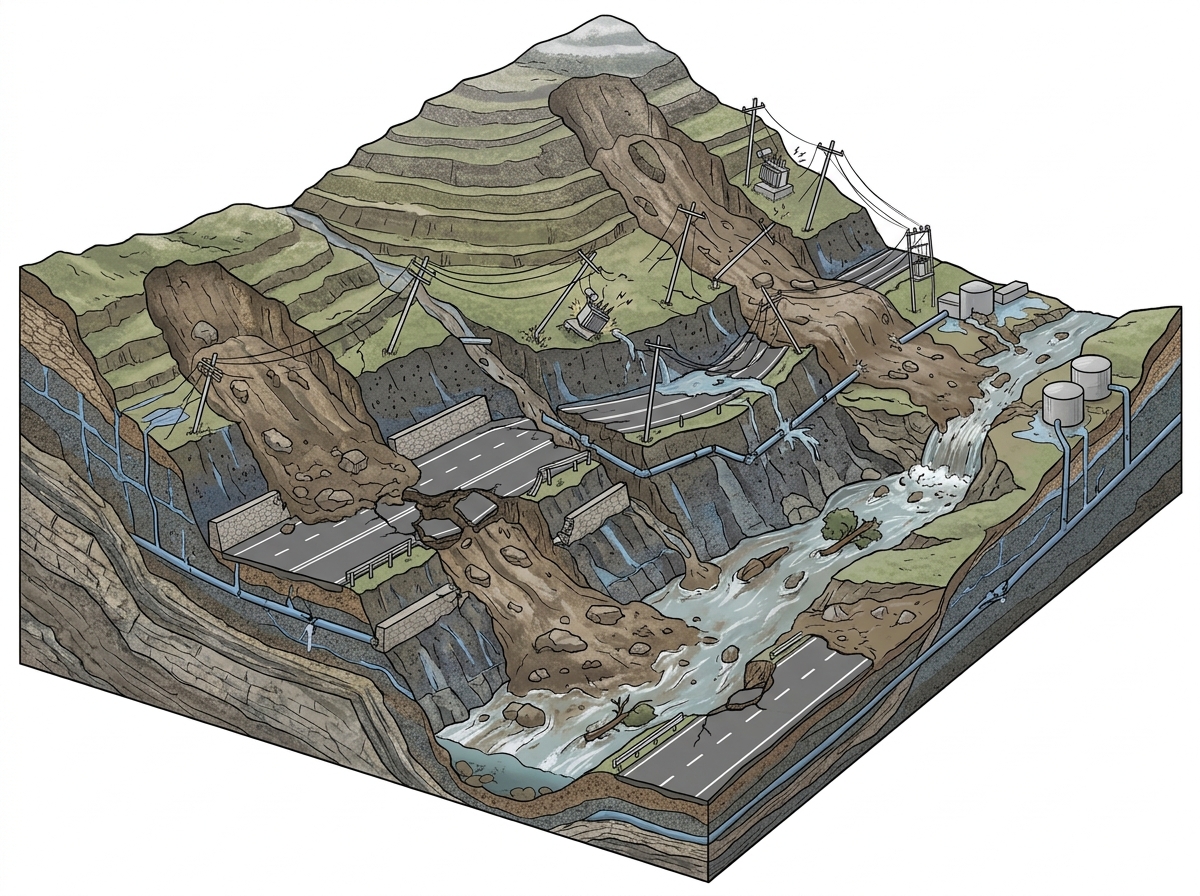
Road networkElectricity transformersWater supply schemesLandslidesFlash floods✎ Monsoon-induced disasters in Himachal Pradesh disrupt critical infrastructure due to the state’s fragile Himalayan terrain, necessitating robust disaster management frameworks, climate-resilient planning, and inter-agency…
Subject Relevance — Where This Topic Fits
- GS Paper II — Governance, Constitution, Polity, Social Justice and International Relations (Disaster Management) | GS Paper III — Environment, Disaster Management, Infrastructure
- Prelims: Landslides, Cloudburst, Disaster Management Act, 2005, National Disaster Response Force (NDRF), Hazardous terrain, Hydro-meteorological hazards, Road connectivity in hilly regions, Power distribution infrastructure, Urban water supply systems
- Essay: Resilience in governance: Balancing development and environmental sustainability, The Himalayas: A fragile ecosystem under stress
Quick Revision: Monsoon-induced disasters in Himachal Pradesh disrupt critical infrastructure due to the state’s fragile Himalayan terrain, necessitating robust disaster management frameworks, climate-resilient planning, and inter-agency coordination for effective response and recovery.
Why is this in the news?
Heavy monsoon rainfall in Himachal Pradesh has severely disrupted critical infrastructure, with 110 roads closed, 91 electricity transformers affected, and 217 potable water schemes impacted as of 17 August 2026. The cumulative economic loss from monsoon-related disasters in the state has exceeded ₹973 crore, underscoring the systemic vulnerabilities of hilly regions to hydro-meteorological hazards and the challenges in maintaining essential services during extreme weather events.
Background
- Himachal Pradesh, a predominantly mountainous state in the Himalayan belt, is highly susceptible to monsoon-induced disasters such as landslides, cloudbursts, and flash floods due to its steep terrain, fragile geology, and high rainfall intensity.
- The state’s road network, power distribution infrastructure, and water supply systems are particularly vulnerable to disruptions caused by extreme weather, given their exposure to landslides, soil erosion, and riverine flooding.
- Monsoon season in Himachal Pradesh typically spans from June to September, with peak rainfall occurring in July and August, often leading to localized or widespread infrastructure failures.
- The state’s topography necessitates the construction of roads, bridges, and tunnels in geologically unstable zones, increasing the risk of damage during heavy rainfall.
- The Disaster Management Act, 2005, mandates the establishment of State Emergency Operations Centres (SEOCs) for real-time monitoring, coordination, and response to disasters, including monsoon-related incidents.
- Climate change has intensified the frequency and intensity of extreme weather events in the Himalayas, exacerbating the challenges of disaster preparedness and infrastructure resilience.
Understanding Monsoon-Related Disasters in Mountainous Regions: Infrastructure Vulnerabilities and Governance Responses
- Landslides and cloudbursts are the primary hydro-meteorological hazards in Himachal Pradesh during the monsoon, triggered by excessive rainfall, unstable slopes, and poor drainage systems.
- Road closures disrupt connectivity in remote and rural areas, isolating communities, hindering emergency response, and impeding economic activities such as agriculture and tourism.
- Electricity transformers (DTRs) are susceptible to damage from landslides, waterlogging, and power line failures, leading to widespread outages and affecting both urban and rural populations.
- Potable water schemes are impacted by contamination from floodwaters, damage to pipelines, and disruption of water treatment facilities, posing public health risks such as waterborne diseases.
- The state’s disaster management framework relies on early warning systems, real-time monitoring through SEOCs, and rapid response mechanisms, including the deployment of the National Disaster Response Force (NDRF) and state disaster response teams.
- Geological surveys and risk assessments are critical for identifying vulnerable zones and prioritizing infrastructure development in safer locations or with reinforced designs.
- Community-based disaster preparedness, including awareness campaigns and training in first aid and evacuation, enhances resilience at the grassroots level.
- Climate-resilient infrastructure, such as flexible road designs, elevated power lines, and modular water supply systems, can mitigate the impact of extreme weather events.
- Inter-state coordination is essential, as monsoon-related disasters in Himachal Pradesh often have cascading effects on neighboring states due to shared river basins and migration of hazards.
Key Features
| Feature | Significance |
|---|---|
| Closure of 110 roads | Disruption of connectivity in rural and remote areas, impeding emergency services, supply chains, and daily commute. |
| Failure of 91 electricity transformers | Interruption in power supply affecting households, healthcare facilities, and critical infrastructure such as water pumping stations. |
| Impact on 217 potable water schemes | Compromised access to safe drinking water, increasing health risks and sanitation challenges. |
| Cumulative loss of ₹973 crore | Economic setback due to infrastructure damage, agricultural losses, and rehabilitation costs during the monsoon season. |
| District-wise distribution of disruptions | Mandi and Kullu districts most affected, highlighting regional vulnerability to extreme weather events. |
Why it Matters
Economic
- Disruptions in road networks impede the movement of goods and services, particularly in agrarian and tourism-dependent regions like Himachal Pradesh.
- Power outages disrupt industrial and commercial activities, leading to productivity losses and financial burdens on businesses.
- Agricultural losses due to delayed monsoon or excessive rainfall affect crop yields, threatening food security and rural incomes.
Strategic/Infrastructure
- Road closures in hilly terrains pose challenges for disaster response and evacuation operations, necessitating robust infrastructure resilience.
- Failure of transformers highlights the need for decentralized and climate-resilient power distribution systems in vulnerable regions.
- Water supply disruptions underscore the importance of integrated water resource management and climate-adaptive infrastructure.
Social
- Restricted access to potable water increases the risk of waterborne diseases, particularly in densely populated or remote areas.
- Power outages affect essential services such as hospitals, schools, and communication networks, exacerbating socio-economic inequalities.
- Disruptions disproportionately impact marginalized communities, including women, children, and the elderly, who are more vulnerable to climate-induced risks.
Environmental
- Intense monsoon rainfall and associated landslides reflect the increasing frequency of extreme weather events, likely linked to climate change.
- Damage to infrastructure may lead to long-term environmental degradation, including soil erosion and loss of biodiversity.
Challenges
1. Climate-Resilient Infrastructure
- Hilly terrains and fragile ecosystems in Himachal Pradesh require infrastructure designs that account for landslides, cloudbursts, and flash floods.
- Retrofitting existing roads, bridges, and power lines to withstand extreme weather events is a significant challenge.
- Lack of integrated planning between state agencies and local communities exacerbates vulnerability to climate-induced disruptions.
UPSC Link: GS III: Disaster Management
2. Power Distribution Vulnerability
- Aging and overloaded electricity infrastructure in hilly regions is highly susceptible to damage during monsoon seasons.
- Decentralized power generation, such as micro-hydro projects, can mitigate risks but require substantial investment and policy support.
- Ensuring uninterrupted power supply to critical facilities, such as hospitals and water treatment plants, remains a persistent challenge.
UPSC Link: GS III: Energy Infrastructure
3. Water Security in Hilly Regions
- Geographical constraints and seasonal variability make it difficult to ensure year-round access to potable water in remote areas.
- Climate change-induced erratic rainfall patterns further strain existing water supply systems.
- Community-based water management initiatives and rainwater harvesting systems can enhance resilience but require widespread adoption.
UPSC Link: GS II: Water Resources
4. Disaster Preparedness and Response
- Limited real-time data and early warning systems hinder effective disaster preparedness and response in hilly terrains.
- Coordinated efforts between state agencies, local authorities, and communities are essential for timely evacuations and relief operations.
- Post-disaster rehabilitation and reconstruction efforts often face delays due to logistical challenges and resource constraints.
UPSC Link: GS III: Disaster Management
5. Economic Resilience of Rural Communities
- Agrarian and tourism-dependent economies in Himachal Pradesh are highly vulnerable to climate-induced disruptions.
- Lack of insurance mechanisms and financial safety nets exacerbates the economic burden on affected communities.
- Diversification of livelihoods and skill development can enhance economic resilience but require long-term policy interventions.
UPSC Link: GS III: Indian Economy
Challenges — UPSC Perspective
| Issue | Concern |
|---|---|
| Geographical vulnerability | Hilly terrains and fragile ecosystems increase susceptibility to landslides and flash floods. |
| Aging infrastructure | Overloaded roads, bridges, and power lines are highly susceptible to damage during extreme weather events. |
| Climate change impacts | Increasing frequency of extreme weather events strains existing infrastructure and disaster response systems. |
| Resource constraints | Limited financial and technical resources hinder the implementation of climate-resilient infrastructure. |
| Coordination gaps | Lack of integrated planning between state agencies and local communities exacerbates vulnerability. |
| Community awareness | Low awareness of disaster preparedness and climate adaptation measures limits effective response. |
Way Forward
- Enhance climate-resilient infrastructure by retrofitting roads, bridges, and power lines to withstand extreme weather events.
- Invest in decentralized power generation, such as micro-hydro projects, to reduce dependency on vulnerable grid systems.
- Strengthen early warning systems and real-time data monitoring to improve disaster preparedness and response.
- Promote community-based water management initiatives, including rainwater harvesting and watershed management.
- Implement comprehensive insurance mechanisms to provide financial safety nets for affected communities.
- Conduct regular vulnerability assessments and risk mapping to identify and prioritize high-risk areas for intervention.
- Foster inter-agency coordination and capacity-building programs to enhance disaster response and rehabilitation efforts.
- Encourage diversification of livelihoods in agrarian and tourism-dependent regions to build economic resilience.
UPSC Value Addition
Keywords for Mains Answer-Writing
Disaster Management Act, 2005 · State Emergency Operations Centre (SEOC) · National Disaster Response Force (NDRF) · Geological Survey of India (GSI) · National Disaster Management Authority (NDMA) · Landslide susceptibility mapping · Hydro-meteorological hazards · Critical Infrastructure Resilience · Public Health Engineering Department (PHED) · Himalayan ecosystem fragility · Multi-hazard risk assessment · Infrastructure resilience planning
Constitutional & Policy Linkages
- [‘Article 21: Right to Life and Personal Liberty (includes access to essential services).’]
- [‘Article 38: Directive Principles of State Policy (promotion of welfare and equitable distribution of resources).’]
- [‘Article 47: Duty of the State to improve public health and nutrition standards.’]
Concept Flow
Intense monsoon rainfall → Landslides and cloudbursts → Damage to roads, power lines, and water supply infrastructure. → Disruption of connectivity → Impeded movement of goods, services, and emergency response teams. → Power outages → Disruption of critical infrastructure, including water pumping stations and healthcare facilities. → Compromised water supply → Increased risk of waterborne diseases and sanitation challenges. → Economic losses → Impact on agrarian and tourism-dependent economies, exacerbating socio-economic inequalities. → Climate change exacerbation → Increased frequency of extreme weather events, necessitating resilient infrastructure and adaptive policies.
Prelims Practice Questions
Q1. Consider the following statements regarding the Disaster Management Act, 2005:
1. The Act mandates the establishment of a National Disaster Management Authority (NDMA) under the Chairmanship of the Prime Minister.
2. The Act empowers the State Governments to constitute State Disaster Management Authorities (SDMAs) with the Chief Minister as Chairperson.
3. The Act does not provide for the creation of District Disaster Management Authorities (DDMAs).
4. The Act establishes the National Disaster Response Force (NDRF) as a specialized force for disaster response.
How many of the above statements are correct?
- Only one
- Only two
- Only three
- All four
Answer: Only three — Statements 1 and 2 are correct as per Sections 3 and 14 of the Disaster Management Act, 2005. Statement 3 is incorrect as Section 25 mandates the constitution of DDMAs. Statement 4 is incorrect as the NDRF is constituted under the Ministry of Home Affairs and is not established by the Act itself.
Q2. Assertion (A): The Himalayan region is highly susceptible to landslides and cloudbursts due to its fragile geological structure and heavy monsoon rainfall.
Reason (R): The Geological Survey of India (GSI) conducts landslide susceptibility mapping to identify high-risk zones for preemptive mitigation.
Code:
- Both A and R are true, and R is the correct explanation of A
- Both A and R are true, but R is not the correct explanation of A
- A is true, but R is false
- A is false, but R is true
Answer: Both A and R are true, and R is the correct explanation of A — The Himalayas are geologically young and fragile, making them highly susceptible to landslides and cloudbursts during monsoons (A is true). The GSI indeed conducts landslide susceptibility mapping to identify high-risk zones, which aids in preemptive mitigation (R is true). R correctly explains A as the mapping informs risk assessment and mitigation strategies.
Mains Practice Question
✍ The recurrent disruption of critical infrastructure—roads, electricity, and water supply—during monsoon seasons in Himalayan states like Himachal Pradesh underscores systemic vulnerabilities in disaster risk governance. Critically analyse the institutional and policy frameworks governing disaster management in India, with particular reference to the role of the National Disaster Management Authority (NDMA), State Emergency Operations Centres (SEOCs), and local governance mechanisms. Also, suggest measures to enhance the resilience of critical infrastructure in such ecologically fragile regions. (15 Marks)
Approach: MODEL-ANSWER SKELETON:
1. **Institutional Framework**:
– NDMA (Section 3, Disaster Management Act, 2005): Role in policy formulation, guidelines, and coordination; National Disaster Response Force (NDRF) for rescue operations.
– SEOCs: State-level coordination hubs for real-time monitoring and response (e.g., Himachal SEOC report cited in the news).
– Local Governance: District Disaster Management Authorities (DDMAs) under Section 25; Gram Panchayats’ role in community-based preparedness.
2. **Policy Gaps**:
– Over-reliance on reactive measures (e.g., road closures, transformer repairs) vs. proactive risk reduction (e.g., landslide susceptibility mapping by GSI, early warning systems).
– Fragmentation in implementation: Centre-State-local coordination challenges; lack of standardized protocols for infrastructure resilience.
3. **Critical Infrastructure Resilience**:
– **Roads**: Geotechnical audits, slope stabilization, and alternative routes (e.g., Himachal’s 110 closed roads require such measures).
– **Electricity**: Underground cabling in landslide-prone areas; decentralized microgrids powered by renewable energy.
– **Water Supply**: Rainwater harvesting, decentralized treatment plants, and redundant pipeline systems (e.g., 217 affected water schemes in Himachal).
4. **Suggestions**:
– **Technology Integration**: Use of GIS, remote sensing, and IoT for real-time monitoring of infrastructure (e.g., Himachal’s SEOC data).
– **Community Participation**: Training of local volunteers in disaster response and maintenance of critical infrastructure.
– **Funding and Incentives**: Dedicated disaster risk reduction funds under the 15th Finance Commission; incentivizing states for resilient infrastructure.
5. **Conclusion**: Balance between structural (engineering solutions) and non-structural (policy, community engagement) measures is essential. Cite examples like Kerala’s flood management or Uttarakhand’s cloudburst preparedness plans.
Source: amarujala.com
Generated by AanyaAi for educational purpose.

- Mangrove Revival Mission in Keralam’s Mayyanad: Lessons from Past Failures - October 3, 2026
- एल नीनो से निपटने के लिए पारिस्थितिकी तंत्र निगरानी जरूरी क्यों? - October 3, 2026
- Gujarat UCC Bill: Key Features for UPSC & State PCS Exam - October 3, 2026

No Comments