


09 Aug How AI Can Bridge India’s Healthcare Gap: UPSC & PCS Analysis
✎ AI in healthcare augments specialist capacity by enabling accurate, scalable diagnostics and clinical decision support, particularly in underserved regions, but its efficacy depends on robust data governance, regulatory clarity…
Subject Relevance — Where This Topic Fits
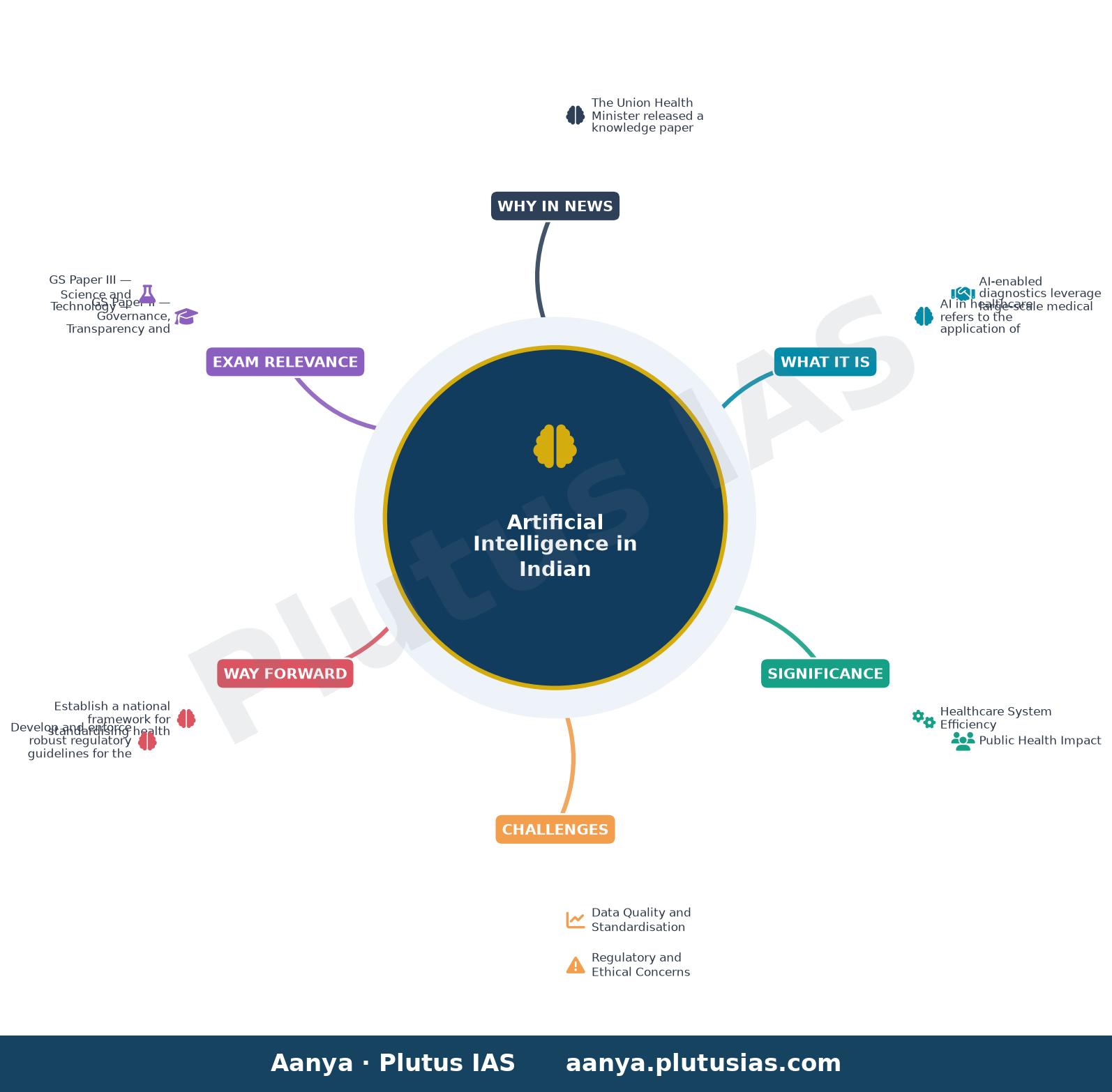
- GS Paper II — Governance, Transparency and Accountability | GS Paper III — Science and Technology — Developments and their Applications and Effects in Everyday Life
- Prelims: Ayushman Bharat Digital Mission (ABDM), IndiaAI Mission, National Medical Devices Policy 2023, SAHI, BODH, AI-enabled diagnostics, non-communicable diseases (NCDs), health workforce shortages
- Essay: The Role of Artificial Intelligence in Transforming Public Health Systems in Developing Economies
Quick Revision: AI in healthcare augments specialist capacity by enabling accurate, scalable diagnostics and clinical decision support, particularly in underserved regions, but its efficacy depends on robust data governance, regulatory clarity, and equitable integration into existing health systems.
Why is this in the news?
The Union Health Minister released a knowledge paper titled ‘AI in MedTech: Revolutionizing Healthcare Through Artificial Intelligence’ at the 9th edition of India Medical Device 2026, highlighting AI’s potential to address India’s critical healthcare challenges, including a severe shortage of specialists, rising burden of non-communicable diseases, and inequitable access to quality care. The report underscores AI’s role as an augmentative tool rather than a replacement for medical professionals, emphasizing its capacity to extend specialist expertise to underserved regions through diagnostic and decision-support systems.
Background
- India’s healthcare system faces a structural deficit in specialist capacity, with 9.6 doctors and 27.2 nurses per 10,000 population against global averages of 18.3 and 40.5, respectively.
- The burden of non-communicable diseases (NCDs) such as cardiovascular diseases, diabetes, and cancer now accounts for over 65% of deaths in India, exacerbating demand for long-term and specialized care.
- The population aged 60 years and above is projected to exceed 230 million by 2036, intensifying the need for geriatric and chronic disease management infrastructure.
- Despite expansion in healthcare infrastructure, critical gaps persist in diagnostic and imaging capacity, including only 4 MRI scanners per million people compared to a global average of 19.
What is AI in Healthcare and How Does It Address India’s Specialist Capacity Gap?
- AI in healthcare refers to the application of machine learning, deep learning, and natural language processing algorithms to assist clinicians in diagnosis, treatment planning, and patient management, thereby augmenting rather than replacing human expertise.
- AI-enabled diagnostics leverage large-scale medical imaging (e.g., X-rays, MRIs, CT scans) and pathology reports to identify abnormalities with accuracy comparable to or exceeding human specialists in certain contexts, particularly in resource-constrained settings.
- AI systems can process vast datasets to predict disease progression, personalize treatment regimens, and optimize hospital resource allocation, thereby improving clinical outcomes and operational efficiency.
- The primary applications of AI in Indian healthcare include radiology (e.g., detecting tuberculosis, breast cancer), pathology (e.g., analyzing blood smears for malaria), and screening for NCDs such as diabetic retinopathy and cardiovascular risks.
- AI tools like computer-aided detection (CAD) systems and clinical decision support systems (CDSS) are designed to extend specialist expertise to primary and secondary care facilities, reducing the need for patient referrals to tertiary hospitals.
- The integration of AI with telemedicine platforms enables remote consultations and second-opinion services, particularly beneficial in rural and underserved urban areas where specialist availability is limited.
- AI-driven predictive analytics can forecast disease outbreaks, optimize vaccine distribution, and support public health surveillance, aligning with India’s goal of achieving universal health coverage (UHC) under the Ayushman Bharat initiative.
- Challenges in AI adoption include ensuring data privacy, addressing algorithmic bias, establishing interoperability with existing health information systems, and developing robust regulatory and reimbursement mechanisms.
Key Features
| Feature | Significance |
|---|---|
| AI-enabled diagnostics | Extends specialist expertise to primary and secondary healthcare, improving early detection and reducing diagnostic errors. |
| Clinical decision support systems | Assists healthcare professionals in evidence-based decision-making, enhancing treatment precision. |
| Screening automation | Facilitates mass screening for chronic diseases like diabetes and cancer, particularly in underserved areas. |
| Predictive analytics for chronic diseases | Helps identify high-risk populations and enables preventive interventions, reducing long-term healthcare costs. |
| Integration with Ayushman Bharat Digital Mission | Enables seamless data exchange and interoperability across healthcare providers, improving continuum of care. |
Why it Matters
Healthcare System Efficiency
- Augments limited specialist capacity by automating routine diagnostic tasks, thereby reducing the workload on human doctors.
- Enhances diagnostic accuracy through pattern recognition in medical imaging and clinical data, mitigating human error.
- Facilitates decentralised healthcare delivery by enabling smaller hospitals and clinics to access advanced diagnostic tools remotely.
Public Health Impact
- Addresses the rising burden of non-communicable diseases (NCDs) by enabling early detection and continuous monitoring.
- Reduces healthcare disparities between urban and rural populations by deploying AI in underserved regions.
- Supports the management of an ageing population by predicting age-related health risks and enabling proactive care.
Economic Implications
- Lowers healthcare costs by reducing unnecessary hospitalisations and optimising resource allocation through predictive analytics.
- Stimulates growth in the MedTech sector, creating employment opportunities in AI-driven healthcare innovation.
- Enhances productivity in healthcare delivery by automating administrative and diagnostic processes.
Policy and Governance
- Provides a framework for integrating AI into national health priorities, aligning with the National Medical Devices Policy 2023.
- Supports the implementation of the Ayushman Bharat Digital Mission by enabling standardised, interoperable health data systems.
- Encourages public-private partnerships to accelerate the adoption of AI technologies in healthcare infrastructure.
Challenges
1. Data Quality and Standardisation
- AI systems require high-quality, standardised health data for training and validation, which is currently lacking in many healthcare settings.
- Inconsistent data formats across institutions hinder the scalability and reliability of AI models.
- Ensuring data privacy and security while enabling large-scale data sharing remains a critical challenge.
UPSC Link: GS2: Health Systems
2. Regulatory and Ethical Concerns
- The absence of a robust regulatory framework for AI in healthcare raises concerns about accountability and patient safety.
- Ethical dilemmas arise regarding the use of AI in clinical decision-making, particularly in cases of misdiagnosis or bias in algorithms.
- Need for clear guidelines on the certification, validation, and deployment of AI-enabled medical devices.
UPSC Link: GS4: Ethics
3. Infrastructure and Accessibility Gaps
- Limited digital infrastructure in rural and remote areas restricts the deployment of AI technologies.
- High costs of AI-enabled medical devices and software may exacerbate existing healthcare inequalities.
- Training and capacity-building for healthcare professionals to effectively utilise AI tools remain inadequate.
UPSC Link: GS2: Health Infrastructure
4. Reimbursement and Financial Sustainability
- Lack of clear reimbursement mechanisms for AI-enabled healthcare services discourages adoption by healthcare providers.
- Uncertainty about the long-term cost-effectiveness of AI interventions poses financial sustainability challenges.
- Need for public and private investment to support the integration of AI into existing healthcare systems.
UPSC Link: GS3: Economic Development
5. Public Trust and Acceptance
- Skepticism among patients and healthcare professionals regarding the reliability and safety of AI-driven diagnostics.
- Cultural and linguistic barriers may hinder the acceptance of AI tools in diverse healthcare settings.
- Need for transparent communication about the capabilities and limitations of AI to build public trust.
UPSC Link: GS4: Governance
Challenges — UPSC Perspective
| Issue | Concern |
|---|---|
| Data Privacy | Risk of breaches in sensitive health data due to inadequate cybersecurity measures. |
| Algorithmic Bias | Potential for AI models to perpetuate or amplify biases present in training data, leading to unequal healthcare outcomes. |
| High Initial Costs | Substantial investment required for AI infrastructure, limiting adoption in resource-constrained settings. |
| Regulatory Lag | Delay in policy frameworks to govern AI deployment, creating legal and ethical ambiguities. |
| Digital Divide | Unequal access to AI-enabled healthcare tools between urban and rural populations. |
Government Initiatives — Must-Memorise for Prelims
- National Medical Devices Policy, 2023
Way Forward
- Establish a national framework for standardising health data to ensure interoperability and quality for AI applications.
- Develop and enforce robust regulatory guidelines for the certification, validation, and deployment of AI in healthcare.
- Invest in digital infrastructure, particularly in rural and remote areas, to enable the deployment of AI-enabled healthcare tools.
- Create reimbursement mechanisms for AI-driven healthcare services to incentivise adoption by providers and insurers.
- Launch capacity-building programmes for healthcare professionals to enhance their proficiency in utilising AI tools.
- Promote public-private partnerships to accelerate the development and deployment of AI technologies in healthcare.
- Conduct pilot projects in diverse healthcare settings to assess the feasibility, cost-effectiveness, and impact of AI interventions.
- Raise awareness among the public and healthcare professionals about the benefits, limitations, and ethical considerations of AI in healthcare.
UPSC Value Addition
Keywords for Mains Answer-Writing
Artificial Intelligence in healthcare · Ayushman Bharat Digital Mission · National Medical Devices Policy 2023 · Non-communicable diseases (NCDs) in India · Healthcare workforce shortage in India · AI-enabled diagnostics · Healthcare infrastructure deficit · Telemedicine and AI integration · Regulatory framework for AI in healthcare · Health data governance in India
Concept Flow
Rising burden of non-communicable diseases and demographic shifts increase demand for healthcare services. → Shortages of doctors, nurses, and hospital beds exacerbate healthcare access inequalities, particularly in rural areas. → Ayushman Bharat Digital Mission and other initiatives lay the groundwork for integrating AI into healthcare systems. → AI-enabled diagnostics and clinical decision support systems are deployed to extend specialist expertise to primary and secondary care. → Standardised health data and regulatory frameworks enable scalable and ethical adoption of AI technologies. → Public-private partnerships and reimbursement mechanisms drive the financial sustainability of AI in healthcare. → Improved healthcare outcomes, reduced costs, and enhanced efficiency are realised through AI integration.
Prelims Practice Questions
Q1. Consider the following statements regarding the healthcare workforce in India as per the report cited in the news:
1. India has 9.6 doctors per 10,000 population, below the global average of 18.3.
2. The number of nursing personnel in India is 27.2 per 10,000 population, compared to the global average of 40.5.
3. India has 15.9 hospital beds per 10,000 population, significantly lower than the global average of 33.
4. The report highlights that India has 4 MRI scanners per million people, against the global average of 19.
How many of the above statements are correct?
- Only one
- Only two
- Only three
- All
Answer: All — Statements 1, 2, 3, and 4 are all correct as per the data provided in the report. The report explicitly compares India’s healthcare workforce and infrastructure metrics with global averages.
Q2. Assertion (A): The National Medical Devices Policy, 2023, aims to foster the integration of AI in healthcare.
Reason (R): The policy emphasizes the need for AI-ready health data and a predictable regulatory framework for AI-enabled technologies.
Options:
A. Both A and R are true, and R is the correct explanation of A.
B. Both A and R are true, but R is NOT the correct explanation of A.
C. A is true, but R is false.
D. A is false, but R is true.
Answer: ? — Both the assertion and reason are true. The National Medical Devices Policy, 2023, indeed aims to foster AI integration in healthcare, and the reason correctly explains this aim by highlighting the need for AI-ready health data and regulatory frameworks.
Q3. Match the following initiatives with their respective objectives in the context of AI in healthcare:
Column I (Initiative) | Column II (Objective)
1. Ayushman Bharat Digital Mission | A. Establish a national digital health ecosystem
2. IndiaAI Mission | B. Promote AI-driven innovation and research
3. SAHI | C. Develop a scalable AI model for healthcare diagnostics
4. National Medical Devices Policy, 2023 | D. Strengthen the medical devices sector and integrate AI
Options:
1-A, 2-B, 3-C, 4-D
1-B, 2-A, 3-D, 4-C
1-C, 2-D, 3-A, 4-B
1-D, 2-C, 3-B, 4-A
Answer: ? — 1-A: Ayushman Bharat Digital Mission aims to establish a national digital health ecosystem. 2-B: IndiaAI Mission promotes AI-driven innovation and research. 3-C: SAHI (Scalable AI for Healthcare Initiatives) develops scalable AI models for diagnostics. 4-D: National Medical Devices Policy, 2023, strengthens the medical devices sector and integrates AI.
Mains Practice Question
✍ Critically examine the role of Artificial Intelligence (AI) in addressing India’s healthcare challenges, particularly in bridging the gap between demand and supply of healthcare services. Also, assess the regulatory and infrastructural prerequisites for the successful integration of AI in the healthcare ecosystem. (15 Marks)
Approach: MODEL-ANSWER SKELETON:
1. **Introduction (2 Marks)**
– Briefly outline India’s healthcare challenges: rising NCDs (65% of deaths), ageing population (230 million by 2036), and severe shortages in doctors (9.6/10,000 vs global 18.3), nurses (27.2/10,000 vs 40.5), and hospital beds (15.9/10,000 vs 33).
– Define AI in healthcare: augmentation of specialist capacity, not replacement; focus on diagnostics, clinical decision-making, and screening.
2. **AI as a Catalyst for Healthcare Access (4 Marks)**
– **AI-enabled diagnostics**: Extend specialist expertise to primary/secondary healthcare (e.g., radiology, pathology). Cite examples like AI models for tuberculosis detection or diabetic retinopathy screening.
– **Telemedicine integration**: AI-powered chatbots (e.g., Swayam) and remote diagnostics to reduce urban-rural disparities.
– **Productivity gains**: Automate routine tasks (e.g., EHR management) to free up clinicians for complex cases.
– **Cost-effectiveness**: Lower per-capita healthcare costs by reducing unnecessary hospitalizations and improving early detection.
3. **Regulatory and Infrastructural Prerequisites (5 Marks)**
– **Health Data Governance**: Need for standardized, interoperable, and secure health data (Ayushman Bharat Digital Mission). Highlight challenges like data privacy (Digital Information Security in Healthcare Act, DISHA) and consent mechanisms.
– **Regulatory Framework**: Predictable approval pathways for AI tools (e.g., ICMR guidelines, CDSCO regulations). Contrast with global models (FDA’s AI/ML framework).
– **Reimbursement Mechanisms**: Insurance coverage for AI-enabled diagnostics (e.g., Ayushman Bharat Pradhan Mantri Jan Arogya Yojana).
– **Infrastructure Deficits**: Address shortages in digital infrastructure (e.g., rural internet penetration, power reliability) and skilled workforce (AI/ML training programs).
– **Ethical Considerations**: Bias in AI models, accountability for errors, and transparency in decision-making.
4. **Challenges and Limitations (3 Marks)**
– **Data Quality**: Dependence on high-quality, representative datasets; risk of algorithmic bias.
– **Acceptance and Trust**: Resistance from clinicians and patients due to perceived lack of transparency or reliability.
– **Legal Liability**: Unclear accountability in cases of AI-driven misdiagnosis or errors.
– **Digital Divide**: Risk of exacerbating inequalities if AI tools are concentrated in urban/private sectors.
5. **Conclusion (1 Mark)**
– AI is a **complementary tool**, not a panacea. Its success hinges on robust governance, equitable access, and integration with existing healthcare systems. Recommend a phased rollout with pilot projects in underserved regions (e.g., aspirational districts).
Source: Times of India
Generated by AanyaAi for educational purpose.

- विदेश मंत्री जयशंकर की यूरोप के चार विदेश मंत्रियों से द्विपक्षीय वार्ता, भारत-ईयू एफटीए पर चर्चा - September 24, 2026
- मद्रास उच्च न्यायालय ने अनामलाई के खिलाफ मामले को रद्द किया: राजनीतिक टिप्पणियों पर न्यायिक फैसला - September 24, 2026
- Madras HC quashes case against Annamalai over Thevar remarks: UPSC Polity Analysis - September 24, 2026

No Comments