


09 Aug How AI Can Transform India’s Healthcare System for UPSC 2026
✎ AI in Indian healthcare is an augmentative tool designed to multiply specialist capacity by extending diagnostic and clinical decision-support capabilities to underserved regions, complementing existing infrastructure rather than…
Subject Relevance — Where This Topic Fits
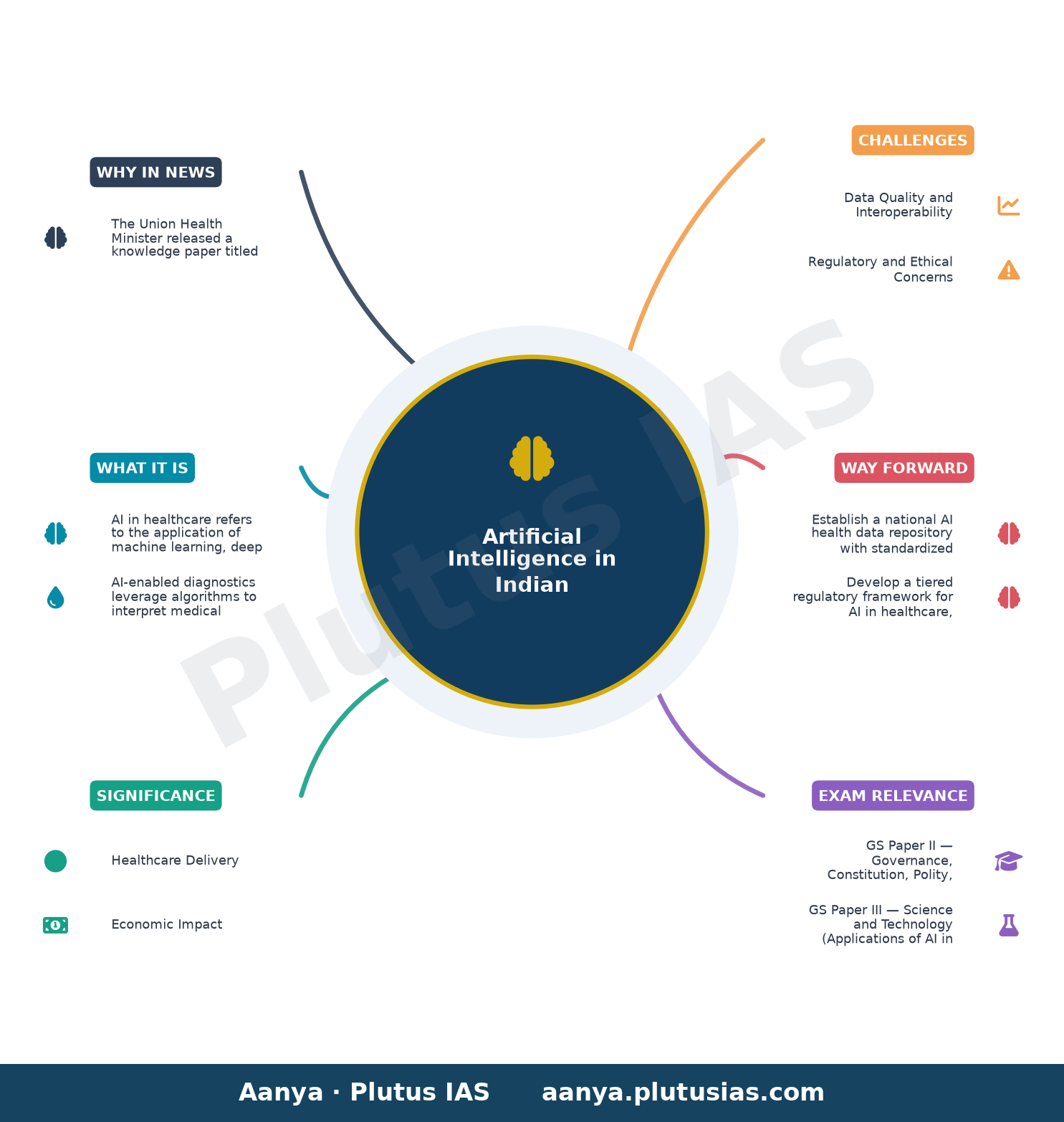
- GS Paper II — Governance, Constitution, Polity, Social Justice and International Relations (Health Sector Governance) | GS Paper III — Science and Technology (Applications of AI in Healthcare), Economy (Healthcare Infrastructure and Public Expenditure)
- Prelims: Ayushman Bharat Digital Mission, IndiaAI Mission, National Medical Devices Policy 2023, SAHI initiative, BODH initiative, Non-Communicable Diseases (NCDs), MRI scanners per million population, Doctors per 10,000 population
- Essay: The Role of Technology in Addressing Societal Inequities: A Case Study of AI in Indian Healthcare, Public Health Infrastructure in India: Challenges and the Promise of AI
Quick Revision: AI in Indian healthcare is an augmentative tool designed to multiply specialist capacity by extending diagnostic and clinical decision-support capabilities to underserved regions, complementing existing infrastructure rather than replacing human expertise.
Why is this in the news?
The Union Health Minister released a knowledge paper titled ‘AI in MedTech: Revolutionizing Healthcare Through Artificial Intelligence’ at the 9th edition of India Medical Device 2026, highlighting AI’s potential to address India’s critical healthcare challenges, including specialist shortages, rising non-communicable diseases, and uneven access to quality care. The report underscores AI’s role as an augmentative tool rather than a replacement for medical professionals, with a focus on extending specialist expertise to underserved regions.
Background
- India’s healthcare system faces persistent shortages of doctors (9.6 per 10,000 population), nurses (27.2 per 10,000), and hospital beds (15.9 per 10,000), compared to global averages of 18.3, 40.5, and 33 respectively.
- Non-communicable diseases (NCDs) account for over 65% of deaths in India, with projections indicating a demographic shift toward an ageing population (230 million aged 60+ by 2036), exacerbating demand for long-term and specialist care.
- The National Medical Devices Policy 2023 and Ayushman Bharat Digital Mission (ABDM) have laid the groundwork for digital health integration, including AI applications.
- The IndiaAI Mission and initiatives like SAHI (Scalable AI for Health Innovation) and BODH (Bridging Oncology Data for Health) are fostering AI adoption in healthcare through pilot projects and capacity-building.
- Regulatory and reimbursement frameworks for AI-enabled medical technologies remain underdeveloped, limiting scalability despite technological readiness.
What is AI in Healthcare?
- AI in healthcare refers to the application of machine learning, deep learning, and natural language processing to analyse medical data, assist in diagnostics, and support clinical decision-making, thereby augmenting rather than replacing human expertise.
- AI-enabled diagnostics leverage algorithms to interpret medical imaging (e.g., X-rays, MRIs), detect anomalies, and prioritise cases for specialist review, particularly in resource-constrained settings.
- Clinical decision support systems (CDSS) utilise AI to provide evidence-based recommendations for treatment protocols, drug interactions, and risk stratification, improving accuracy and reducing human error.
- Predictive analytics in AI models forecast disease outbreaks, patient deterioration, and readmission risks by analysing historical and real-time health data, enabling proactive interventions.
- AI-powered robotic surgery and telemedicine platforms extend specialist care to remote and rural areas, reducing the need for physical patient transfers and improving access to tertiary care.
- Natural language processing (NLP) facilitates the extraction of structured data from unstructured clinical notes, enabling efficient electronic health record (EHR) management and longitudinal patient tracking.
- AI-driven drug discovery accelerates the identification of therapeutic targets and repurposing of existing drugs, reducing the time and cost of bringing new treatments to market.
- Ethical considerations include data privacy, algorithmic bias, transparency in decision-making, and the need for robust regulatory oversight to ensure equitable and safe deployment.
Key Features
| Feature | Significance |
|---|---|
| AI-enabled diagnostics | Augments specialist capacity by assisting in early detection and screening, particularly in primary and secondary healthcare settings |
| Ayushman Bharat Digital Mission (ABDM) | Establishes a unified digital health infrastructure, enabling interoperability and data exchange for AI integration |
| IndiaAI Mission | Provides strategic direction and funding for AI development, including healthcare applications |
| National Medical Devices Policy, 2023 | Creates a regulatory and innovation ecosystem for medical technology, including AI-driven devices |
| SAHI and BODH initiatives | Facilitate AI adoption in rural and underserved areas through capacity building and pilot projects |
Why it Matters
Healthcare Delivery
- Addressing the critical shortage of specialists (e.g., radiologists, pathologists) by enabling AI-assisted diagnostics in remote regions
- Reducing diagnostic errors through machine learning models trained on large, diverse datasets
- Expanding access to tertiary care expertise in primary healthcare centres via telemedicine and AI tools
Economic Impact
- Potential to reduce healthcare costs by automating routine diagnostics and triaging cases efficiently
- Creation of high-skilled jobs in AI development, data annotation, and healthcare technology deployment
- Attraction of investment in India’s MedTech sector, positioning the country as a global hub for AI-driven healthcare solutions
Demographic Transition
- Mitigating the impact of an ageing population (projected 230 million aged 60+ by 2036) through early detection of chronic diseases like diabetes and cardiovascular conditions
- Supporting long-term care management for non-communicable diseases (NCDs), which now account for over 65% of deaths in India
Policy and Governance
- Leveraging existing digital health frameworks (e.g., ABDM) to create scalable AI solutions with minimal friction
- Establishing regulatory sandboxes for AI validation, ensuring safety and efficacy before widespread deployment
Challenges
1. Data Quality and Interoperability
- Lack of standardized, high-quality health data across regions and institutions hinders AI model training and validation
- Fragmented electronic health records (EHRs) impede seamless data exchange between public and private healthcare providers
UPSC Link: GS-II Health Infrastructure
2. Regulatory and Ethical Concerns
- Absence of a clear regulatory framework for AI in healthcare, including liability for AI-driven diagnostic errors
- Ethical dilemmas surrounding patient consent, data privacy, and algorithmic bias in diagnostic tools
UPSC Link: GS-II Health Technology
3. Infrastructure and Accessibility
- Limited digital literacy and internet connectivity in rural areas restrict AI tool adoption
- Inadequate computational infrastructure in public hospitals to deploy resource-intensive AI models
UPSC Link: GS-II Health Infrastructure
4. Human Resource Gaps
- Shortage of trained personnel to develop, deploy, and maintain AI systems in healthcare settings
- Resistance from medical professionals due to perceived threats to job security and clinical autonomy
UPSC Link: GS-II Health Workforce
5. Reimbursement and Sustainability
- Lack of clear reimbursement policies for AI-enabled diagnostics, discouraging private sector investment
- High initial costs of AI deployment may deter adoption in resource-constrained public health systems
UPSC Link: GS-III Science and Tech
Challenges — UPSC Perspective
| Issue | Concern |
|---|---|
| Data Privacy | Risk of breaches in sensitive health data due to inadequate cybersecurity measures |
| Algorithmic Bias | Potential for AI models to perform poorly on underrepresented populations, exacerbating healthcare inequities |
| High Initial Costs | Barriers to entry for small hospitals and clinics due to expensive AI infrastructure and licensing |
| Skill Deficit | Insufficient training programs for healthcare professionals to effectively utilise AI tools |
| Regulatory Lag | Delays in approving AI-based medical devices due to evolving but unclear guidelines |
Government Initiatives — Must-Memorise for Prelims
- Ayushman Bharat Digital Mission (ABDM)
- IndiaAI Mission
- National Medical Devices Policy, 2023
Way Forward
- Establish a national AI health data repository with standardized formats and robust privacy safeguards
- Develop a tiered regulatory framework for AI in healthcare, including clear pathways for validation and approval
- Invest in digital infrastructure (e.g., high-speed internet, cloud computing) in rural and underserved areas
- Launch targeted training programs for healthcare professionals to integrate AI tools into clinical workflows
- Create public-private partnerships to subsidise AI deployment costs for public health facilities
- Formulate reimbursement policies for AI-enabled diagnostics to incentivise adoption by insurers and hospitals
- Promote indigenous AI development through grants and incubators to reduce dependence on foreign technology
UPSC Value Addition
Keywords for Mains Answer-Writing
Artificial Intelligence in healthcare · Ayushman Bharat Digital Mission · Non-communicable diseases (NCDs) burden · Healthcare workforce shortages · AI-enabled diagnostics · Medical device policy 2023 · Healthcare access inequalities · AI-ready health data · Regulatory framework for AI in medicine · Chronic disease management
Concept Flow
Chronic disease burden and demographic ageing → Increased demand for specialist care → Shortage of doctors and infrastructure → AI-assisted diagnostics as a scalable solution → Ayushman Bharat Digital Mission → Standardised health data → AI model training and validation → Improved diagnostic accuracy in primary care → Regulatory sandboxes → Safe pilot deployment → Evidence generation → Scalable adoption in public health systems → Public-private partnerships → Funding and expertise → AI tool deployment → Reduced healthcare inequalities → Workforce training → Clinical integration → Trust building → Sustainable AI adoption in healthcare
Prelims Practice Questions
Q1. Consider the following statements regarding India’s healthcare infrastructure and AI applications:
1. India has 9.6 doctors per 10,000 population compared to the global average of 18.3.
2. The National Medical Devices Policy, 2023, aims to regulate AI applications in healthcare.
3. AI is intended to replace doctors in primary healthcare settings.
4. The Ayushman Bharat Digital Mission provides the foundational data infrastructure for AI in healthcare.
How many of the above statements are correct?
- Only one
- Only two
- Only three
- All
Answer: Only three — Statements 1, 2, and 4 are correct. Statement 3 is incorrect as AI is not intended to replace doctors but to assist them.
Q2. Assertion (A): The burden of non-communicable diseases (NCDs) in India has surpassed that of communicable diseases.
Reason (R): The report highlights that over 65% of deaths in India are now attributed to NCDs such as heart disease, diabetes, and cancer.
Options:
A. Both A and R are true, and R is the correct explanation of A.
B. Both A and R are true, but R is not the correct explanation of A.
C. A is true, but R is false.
D. A is false, but R is true.
- A
- B
- C
- D
Answer: A — Both the assertion and reason are true, and the reason correctly explains the assertion.
Q3. Match the following initiatives with their respective objectives:
Column I (Initiative) | Column II (Objective)
— | —
1. Ayushman Bharat Digital Mission | A. Regulatory framework for medical devices
2. IndiaAI Mission | B. AI-driven healthcare diagnostics and decision support
3. National Medical Devices Policy, 2023 | C. Digital health infrastructure and interoperability
4. SAHI | D. National AI strategy and ecosystem development
Options:
A. 1-C, 2-D, 3-A, 4-B
B. 1-A, 2-B, 3-C, 4-D
C. 1-D, 2-C, 3-B, 4-A
D. 1-B, 2-A, 3-D, 4-C
- A
- B
- C
- D
Answer: A — 1-C (Ayushman Bharat Digital Mission focuses on digital health infrastructure), 2-D (IndiaAI Mission aims to develop the AI ecosystem), 3-A (National Medical Devices Policy regulates medical devices), 4-B (SAHI is an AI-enabled diagnostic tool).
Mains Practice Question
✍ Artificial Intelligence is poised to revolutionise healthcare delivery in India, particularly in addressing the widening gap in access to specialist care. Critically analyse the potential of AI in bridging this gap, while also examining the structural, ethical, and regulatory challenges that must be overcome for its successful integration into routine clinical practice. (15 Marks)
Approach: MODEL-ANSWER SKELETON:
1. **Context and Need (2 Marks)**
– Reference data: India’s healthcare workforce shortages (9.6 doctors per 10,000 vs. global 18.3) and rising NCD burden (>65% of deaths).
– Demographic challenge: Population aged 60+ projected to cross 230 million by 2036.
– Role of Ayushman Bharat Digital Mission and National Medical Devices Policy, 2023, in creating foundational infrastructure.
2. **AI’s Role in Bridging the Gap (4 Marks)**
– **Diagnostics and Screening**: AI-enabled tools (e.g., radiology, pathology) for early detection of NCDs (cancer, diabetes, cardiovascular diseases).
– **Extending Specialist Capacity**: Telemedicine and AI-assisted decision support for primary and secondary healthcare centres.
– **Productivity and Efficiency**: Reduction in diagnostic errors, streamlining workflows, and optimising resource allocation.
– **Accessibility**: Overcoming geographical barriers by deploying AI in rural and underserved areas.
3. **Structural Challenges (4 Marks)**
– **Data Quality and Availability**: Need for AI-ready health data; challenges in standardisation, interoperability, and data privacy.
– **Regulatory Framework**: Absence of clear guidelines for AI validation, certification, and liability in case of errors.
– **Reimbursement Mechanisms**: Lack of structured reimbursement policies for AI-enabled technologies.
– **Infrastructure Gaps**: Limited availability of high-speed internet and computing resources in rural areas.
4. **Ethical and Social Concerns (3 Marks)**
– **Bias and Fairness**: Risk of algorithmic bias if trained on non-representative datasets.
– **Accountability**: Who is liable for errors—doctors, developers, or institutions?
– **Doctor-Patient Trust**: Potential erosion of trust if AI recommendations are perceived as ‘black boxes’.
– **Job Displacement**: Fear of AI replacing healthcare workers in routine tasks.
5. **Way Forward and Conclusion (2 Marks)**
– Strengthen AI-ready data ecosystems (e.g., ABDM, health stacks).
– Develop robust regulatory frameworks (e.g., guidelines by ICMR, CDSCO).
– Promote public-private partnerships for pilot-to-scale transitions.
– Invest in digital literacy and infrastructure in rural areas.
– Emphasise AI as a ‘force multiplier’ rather than a replacement for doctors.
Source: Times of India
Generated by AanyaAi for educational purpose.

- UPSC Civil Services (Main) Examination 2026 — Mechanical Engineering Optional Paper I: Question Paper | Plutus IAS - September 24, 2026
- सुप्रीम कोर्ट ने टीएमसी नाम और चुनाव चिह्न विवाद पर चुनाव आयोग से समयसीमा मांगी, 28 सितंबर को सुनवाई - September 24, 2026
- UPSC Civil Services (Main) Examination 2026 — Chemistry Optional Paper I: Questions with Model Answers | Plutus IAS - September 24, 2026

No Comments