


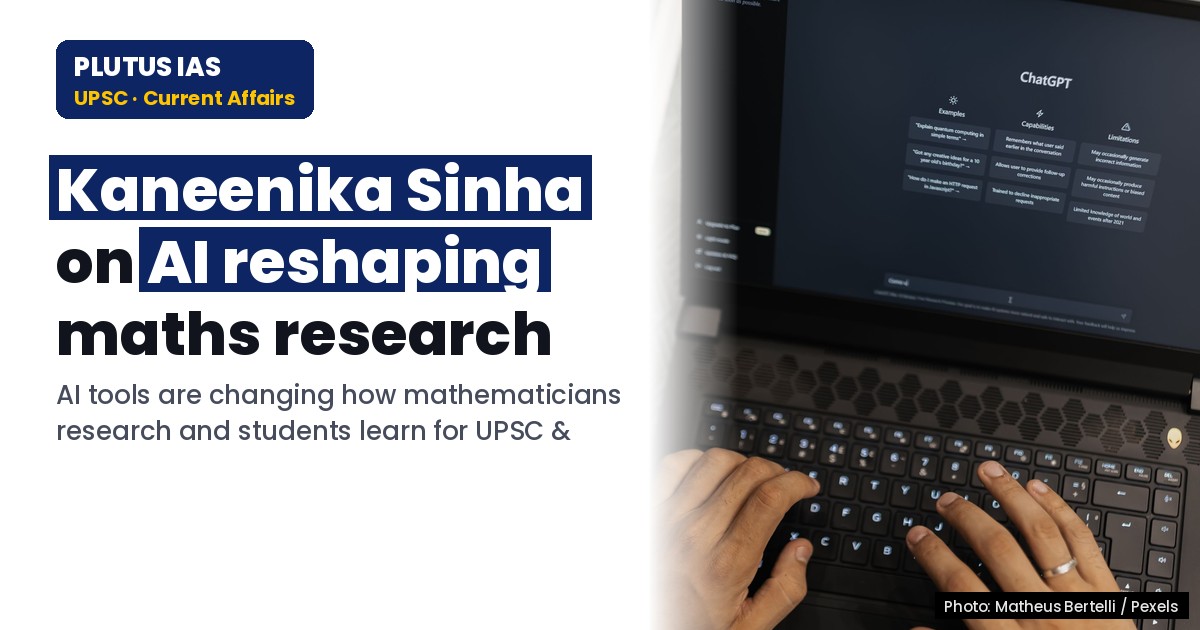
14 Oct How AI is Transforming Mathematical Research and Education for UPSC & PCS
✎ AI is transforming mathematical research by accelerating proof generation and idea exploration, but its integration demands robust ethical and pedagogical frameworks to preserve intellectual rigour and independent thinking.
Subject Relevance — Where This Topic Fits
- GS Paper III — Science and Technology (Applications of AI in Research and Education) | GS Paper II — Governance (Regulation of Emerging Technologies and Ethical Considerations)
- Prelims: Artificial Intelligence (AI), Machine Learning (ML), arXiv, mathematical proofs, OpenAI, preprints, computational mathematics, research ethics
- Essay: The Role of Artificial Intelligence in Shaping Future Research Paradigms, Ethics and Accountability in the Age of AI-Driven Discovery
Quick Revision: AI is transforming mathematical research by accelerating proof generation and idea exploration, but its integration demands robust ethical and pedagogical frameworks to preserve intellectual rigour and independent thinking.
Why is this in the news?
The release of 722 AI-generated mathematical preprints by OpenAI in October 2026 has catalysed a critical discourse on the role of AI in mathematical research, its implications for pedagogical practices, and the future of mathematical careers. This development underscores the need for a structured examination of AI’s capabilities, limitations, and ethical considerations in academic research.
Background
- Mathematical research has historically relied on human intuition, rigorous proof construction, and peer review to validate discoveries.
- The integration of AI in research workflows has accelerated with advancements in large language models (LLMs) capable of generating complex mathematical proofs.
- OpenAI’s release of 722 AI-generated mathematical preprints in October 2026 marks a significant milestone, prompting discussions on the authenticity, utility, and evaluation of AI-assisted research.
- The mathematical community faces dual challenges: leveraging AI to enhance discovery while safeguarding the integrity of research and the cognitive development of students.
- In India, where educational infrastructure varies widely, AI tools are seen as potential equalisers to bridge gaps in mentorship and access to advanced mathematical resources.
- The arXiv preprint repository, a cornerstone of open-access research dissemination, is central to this discourse, as it grapples with the influx of AI-generated content.
What is the Role of Artificial Intelligence in Mathematical Research?
- AI systems, particularly large language models, are increasingly capable of generating mathematical proofs, brainstorming research questions, and connecting disparate mathematical ideas.
- These tools function as ‘sounding boards’ for researchers, enabling rapid exploration of hypotheses and theoretical frameworks, akin to collaborative discussions among mathematicians.
- AI-generated preprints, such as those released by OpenAI, represent a paradigm shift in how mathematical discoveries are documented and shared, though their validity and originality require rigorous scrutiny.
- The primary advantage of AI in research lies in its ability to process vast datasets and identify patterns or connections that may elude human researchers, thereby accelerating discovery cycles.
- However, the reliance on AI raises concerns about the erosion of independent critical thinking, particularly among students who may outsource cognitive processes to AI tools.
- The mathematical community must establish new frameworks for evaluating AI-assisted research, focusing not only on correctness but also on the novelty, depth, and interpretability of results.
- Institutional and policy responses are needed to address the ethical implications of AI in research, including issues of authorship, transparency, and the potential for AI to perpetuate biases or errors.
- The integration of AI in mathematical education necessitates a balanced approach, where tools are used to augment learning without undermining the development of foundational problem-solving skills.
Key Features
| Feature | Significance |
|---|---|
| AI-generated proofs | Enables rapid generation of mathematical proofs, accelerating research and discovery cycles in mathematics. |
| Conversational AI assistants | Facilitates real-time brainstorming, explanation-seeking, and idea-generation for mathematicians and students. |
| Preprint repositories (e.g., arXiv) | Serves as a critical platform for disseminating AI-generated mathematical results for community evaluation. |
| Cross-disciplinary integration | AI can connect mathematical ideas across fields at scales previously unmanageable by human researchers. |
| Learning augmentation tool | Acts as a supplementary resource for students in regions with limited access to expert guidance. |
Why it Matters
Scientific Research & Innovation
- AI-driven proof generation may reduce the time lag between hypothesis formulation and validation in mathematical research.
- Potential to uncover novel mathematical structures or relationships by processing vast datasets beyond human cognitive limits.
- Raises questions about the definition of ‘original research’ and the criteria for evaluating AI-assisted mathematical work.
Educational Transformation
- AI tools can democratise access to mathematical reasoning, particularly in under-resourced educational settings.
- Risk of over-reliance on AI may undermine the development of independent analytical and problem-solving skills among students.
- Need for revised pedagogical frameworks to integrate AI as a learning aid without compromising foundational cognitive training.
Career & Skill Development
- Future mathematicians may require hybrid skill sets combining deep mathematical intuition with AI literacy and computational tools.
- Emergence of new career pathways in AI-assisted mathematical research, including roles in verification, validation, and synthesis.
- Potential displacement of traditional research roles if AI systems achieve parity or superiority in proof generation.
Institutional & Infrastructure
- Institutions must invest in AI infrastructure tailored to mathematical research, including high-performance computing and domain-specific datasets.
- Need for standardised protocols to assess the validity, originality, and significance of AI-generated mathematical outputs.
- Ethical and governance frameworks required to address authorship, attribution, and intellectual property in AI-assisted research.
Challenges
1. Over-reliance on AI in Mathematical Reasoning
- Risk of students and researchers outsourcing critical thinking to AI, leading to atrophy of independent problem-solving abilities.
- AI-generated proofs may lack interpretability or conceptual depth, reducing their educational or theoretical value.
- Difficulty in distinguishing between AI-generated insights and human-derived breakthroughs in research outputs.
UPSC Link: GS Paper 3 – Science & Tech
2. Validation & Quality Assurance of AI Outputs
- Lack of robust peer-review mechanisms for AI-generated mathematical preprints, as seen in the OpenAI release of 722 preprints.
- Potential for proliferation of incorrect or misleading results due to unsupervised AI generation.
- Need for interdisciplinary collaboration between mathematicians and computer scientists to develop verification tools.
UPSC Link: GS Paper 3 – Science & Tech
3. Equity and Access in AI-Assisted Research
- Disparities in access to AI tools may widen the research gap between institutions with and without resources.
- Students in rural or underfunded educational settings may face reduced opportunities for mentorship despite AI tools.
- Requirement for policy interventions to ensure equitable distribution of AI resources in mathematical education.
UPSC Link: GS Paper 2 – Governance
4. Ethical and Governance Concerns
- Ambiguity in authorship and ownership of AI-generated mathematical proofs and discoveries.
- Potential for misuse of AI in generating deceptive or plagiarised research outputs.
- Need for ethical guidelines to govern the use of AI in academic and research settings.
UPSC Link: GS Paper 4 – Ethics
5. Adaptation of Educational Frameworks
- Curriculum design must evolve to incorporate AI literacy while preserving foundational mathematical training.
- Assessment methods need revision to evaluate both human and AI-assisted contributions in student work.
- Teacher training programs must be updated to integrate AI tools effectively into pedagogical practices.
UPSC Link: GS Paper 2 – Education
Challenges — UPSC Perspective
| Issue | Concern |
|---|---|
| AI-generated proofs | Risk of reduced human engagement in mathematical reasoning and discovery. |
| Preprint proliferation | Overwhelming volume of unverified results complicating peer review and validation. |
| Equity in access | Unequal distribution of AI tools may exacerbate research disparities. |
| Ethical ambiguity | Unclear authorship and ownership of AI-assisted mathematical work. |
| Curriculum lag | Educational frameworks may not keep pace with AI advancements in research. |
| Verification mechanisms | Lack of standardised tools to assess the validity of AI-generated proofs. |
Way Forward
- Develop AI literacy modules for mathematics students and researchers to ensure responsible and informed use of AI tools.
- Establish interdisciplinary working groups comprising mathematicians, computer scientists, and ethicists to draft guidelines for AI-assisted research.
- Invest in high-performance computing infrastructure and domain-specific datasets to support AI-driven mathematical research in India.
- Revise academic curricula to integrate AI as a supplementary tool while preserving core mathematical training and independent thinking.
- Create peer-review protocols tailored for AI-generated mathematical outputs, including automated verification tools and human oversight mechanisms.
- Promote public-private partnerships to democratise access to AI tools for students and researchers in under-resourced institutions.
- Conduct longitudinal studies to assess the long-term impact of AI on mathematical creativity, problem-solving, and career trajectories.
- Formulate ethical guidelines for authorship, attribution, and intellectual property in AI-assisted mathematical research.
UPSC Value Addition
Keywords for Mains Answer-Writing
Artificial Intelligence in mathematical research · AI-generated mathematical proofs · Mathematical education and AI tools · Independent thinking in mathematics · arXiv preprints and AI · OpenAI’s mathematical preprints · Ethical dimensions of AI in research · Cognitive skills and AI-assisted learning · Mathematical creativity and AI · AI infrastructure for research in India
Concept Flow
AI capabilities in mathematical proof generation → Acceleration of research and discovery cycles. → Integration of AI into mathematical education → Potential for democratising access to learning resources. → Proliferation of AI-generated preprints → Challenges in validation and peer-review processes. → Over-reliance on AI → Risk of erosion of independent analytical and problem-solving skills. → Need for revised educational frameworks → Adaptation of curricula and assessment methods. → Ethical and governance concerns → Requirement for standardised protocols and guidelines. → Institutional investment in AI infrastructure → Development of verification tools and equitable access mechanisms.
Prelims Practice Questions
Q1. Consider the following statements regarding the use of Artificial Intelligence (AI) in mathematical research:
1. AI can generate mathematical proofs and preprints.
2. arXiv hosts a collection of AI-generated mathematical preprints released by OpenAI in October 2026.
3. AI tools are universally accepted as substitutes for human cognition in mathematical research.
How many of the above statements are correct?
- Only one
- Only two
- All
- None
Answer: Only two — Statement 1 is correct as AI is increasingly capable of generating mathematical proofs. Statement 2 is incorrect; the collection of AI-generated preprints was released by OpenAI but not hosted on arXiv. Statement 3 is incorrect as AI tools are seen as aids, not substitutes, for human cognition.
Q2. Assertion (A): AI tools in mathematical research are primarily used to outsource independent thinking and cognitive processes.
Reason (R): Researchers like Kaneenika Sinha advocate for using AI as a learning aid while cautioning against outsourcing cognitive functions.
In the context of the above statements, which of the following is correct?
- Both A and R are true, and R is the correct explanation of A
- Both A and R are true, but R is not the correct explanation of A
- A is true, but R is false
- A is false, but R is true
Answer: ? — Assertion (A) is incorrect as AI tools are not meant to outsource independent thinking; they are used as aids. Reason (R) is correct as it aligns with the cautionary stance of researchers like Sinha.
Q3. Match the following terms related to AI and mathematical research with their correct descriptions:
Column I
1. arXiv
2. OpenAI
3. AI-generated proofs
4. Cognitive outsourcing
Column II
A. Platform for sharing research preprints
B. Organisation known for releasing AI-generated mathematical preprints
C. Mathematical proofs created by AI systems
D. Delegation of independent thinking to AI tools
Select the correct match:
- 1-A, 2-B, 3-C, 4-D
- 1-B, 2-A, 3-D, 4-C
- 1-C, 2-D, 3-A, 4-B
- 1-D, 2-C, 3-B, 4-A
Answer: 1-A, 2-B, 3-C, 4-D — 1-A (arXiv is a platform for sharing research preprints), 2-B (OpenAI is the organisation that released AI-generated mathematical preprints), 3-C (AI-generated proofs are proofs created by AI systems), 4-D (Cognitive outsourcing refers to delegating independent thinking to AI tools).
Mains Practice Question
✍ Artificial Intelligence is increasingly being integrated into mathematical research, generating proofs and preprints at scale. Critically examine the implications of this integration for mathematical education, research training, and the future of independent mathematical thinking in India. (15 Marks)
Approach: MODEL-ANSWER SKELETON:
1. Introduction (2 marks): Define AI in mathematical research and its emerging role (cite OpenAI’s 2026 release of AI-generated preprints).
2. AI as a Research Tool (3 marks): Explain how AI aids in generating proofs, brainstorming ideas, and connecting mathematical concepts (reference Kaneenika Sinha’s use of AI as a ‘conversation with a fellow mathematician’).
3. Implications for Mathematical Education (3 marks): Discuss the dual role of AI as a learning aid and potential risk to independent thinking; reference concerns about cognitive outsourcing and the need for students to retain creative and analytical skills.
4. Research Training and Assessment (3 marks): Examine challenges in assessing AI-assisted research, including the need to evaluate not just correctness but also novelty and synthesis of ideas (reference arXiv’s role in hosting and evaluating preprints).
5. Infrastructure and Ethical Considerations in India (2 marks): Highlight the need for dedicated AI infrastructure in India and ethical dimensions, including the risk of over-reliance on AI tools.
6. Balanced View and Conclusion (2 marks): Summarise the transformative potential of AI while emphasising the importance of human oversight and independent inquiry in mathematical research.
Source: The Indian Express
Generated by AanyaAi for educational purpose.
Related guides on our sites
- Current affairs for upsc 2026
- How to prepare for GS paper 1 for UPSC CSE mains exam
- Best UPSC coaching for IFOS exam
- Best mentorship programme for upsc

- NAMASTE Scheme: Enhancing Sanitation Workers’ Livelihoods & Safety - November 14, 2026
- एमएसएमई का विशेष अभियान 6.0: स्वच्छता और लंबित मामलों का निपटारा - November 14, 2026
- Sea Vigil-26: Coastal Defence Drills Off Visakhapatnam - November 14, 2026

No Comments