


10 Aug How India’s Education System Must Adapt to AI for UPSC & State PCS Success
✎ AI-ready education demands a dual focus: leveraging AI to enhance teaching while equipping students with critical competencies to use AI responsibly, ensuring academic integrity and workforce readiness.
Subject Relevance — Where This Topic Fits
- GS Paper II — Governance, Administration and Challenges (e.g., Digital Governance, AI Policy) | GS Paper III — Science and Technology (e.g., AI and Education, Technological Disruption in Sectors)
- Prelims: Artificial Intelligence (AI), Generative AI, AI literacy, Academic integrity, Pedagogical innovation, Assessment reform, Digital divide, National Education Policy (NEP) 2020, Skill development, Workforce readiness
- Essay: The intersection of technology and human capability: Can AI enhance learning without eroding critical thinking?, Reimagining education for the AI era: Balancing innovation with accountability
Quick Revision: AI-ready education demands a dual focus: leveraging AI to enhance teaching while equipping students with critical competencies to use AI responsibly, ensuring academic integrity and workforce readiness.
Why is this in the news?
The article highlights the urgent need for India’s education system to evolve from a restrictive stance on AI tools to a proactive framework that integrates AI responsibly into teaching, learning, and assessment. It underscores the inadequacy of traditional academic integrity measures in an era where AI-generated content can mimic original work, thereby necessitating a paradigm shift in how learning outcomes are evaluated and validated. The discussion is particularly salient given the rapid adoption of AI tools by students and the growing demand for AI-ready graduates in the workforce.
Background
- The proliferation of generative AI tools (e.g., LLMs, coding assistants) has democratised content creation, making it difficult to distinguish between human and AI-generated work in academic submissions.
- Studies indicate that 11% of over 200 million student papers contain AI-written language in at least 20% of the submission, while 3% have 80% or more AI-generated text, raising concerns about academic integrity.
- AI is increasingly recognised as a critical skill for the future workforce, with 62% of higher education students believing responsible AI use is essential for career success and 80% viewing AI as important for their future.
- Global surveys reveal that while faculty engagement with AI is high, there is a significant gap in institutional support, governance frameworks, and AI literacy among educators.
- The debate has shifted from whether to ban AI in education to how to regulate its use effectively, ensuring it augments learning without compromising judgement, accountability, or originality.
What is AI-Ready Education and Why Does It Matter?
- AI-ready education refers to a pedagogical and assessment framework that equips students to use AI tools responsibly, critically, and ethically while ensuring that learning outcomes reflect genuine understanding rather than AI-generated outputs.
- The core objective is to distinguish between AI as a tool for learning augmentation and AI as a crutch that undermines independent thought, problem-solving, and academic integrity.
- AI-ready graduates must demonstrate competencies beyond tool usage, including prompt literacy, source verification, bias detection, data privacy awareness, and the ability to critically evaluate and improve AI-generated outputs.
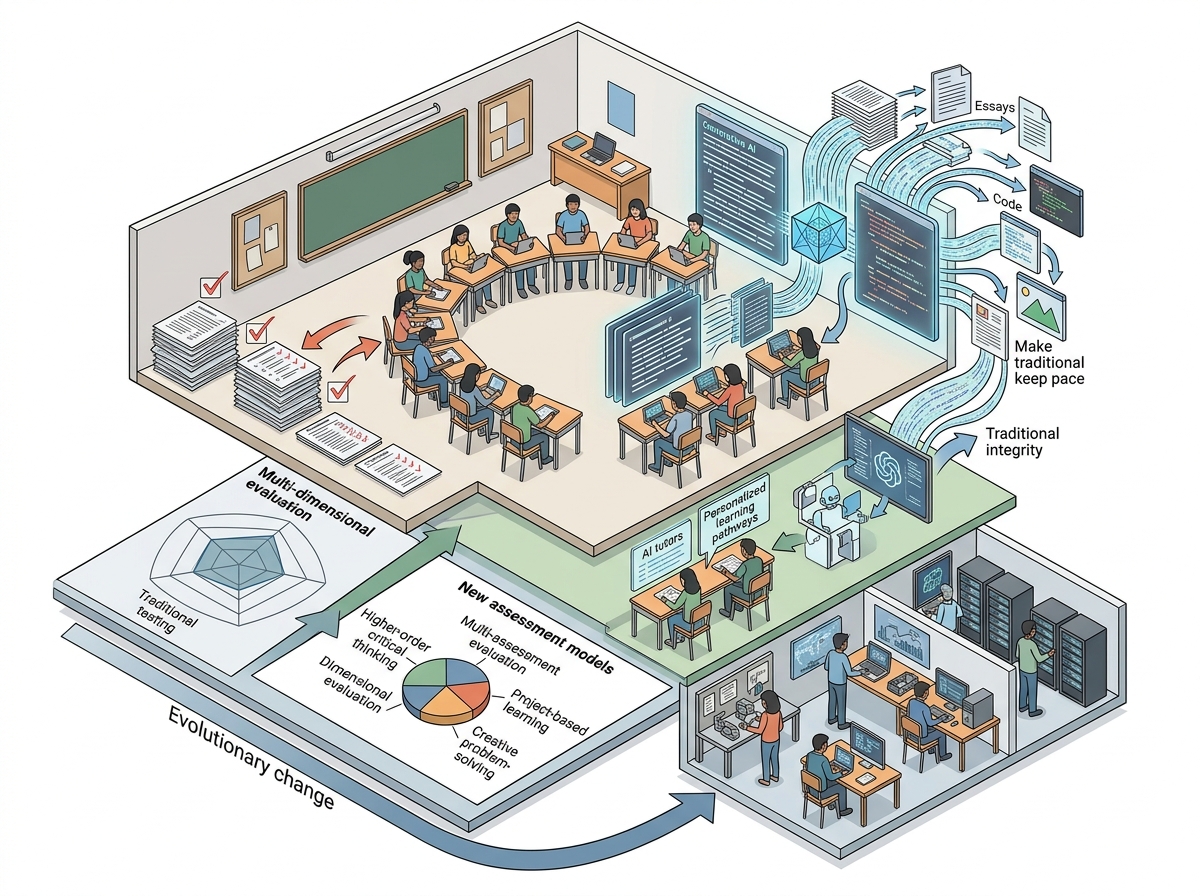
- Two parallel strategies are essential: (1) Using AI to enhance teaching (e.g., personalised feedback, adaptive learning, AI-generated case studies) and (2) Teaching students to use AI effectively (e.g., prompt engineering, critical analysis of AI outputs, responsible citation).
- Institutions must redefine assessment paradigms to focus on the process of learning and the ability to explain, defend, apply, and improve AI-assisted work, rather than merely evaluating the final output.
- Faculty readiness is equally critical, as educators must be trained to integrate AI into pedagogy, redesign assignments, and foster a culture of responsible AI use in the classroom.
- AI governance in education requires clear policies on where AI is permitted, when disclosure is required, and how students should verify and improve AI-generated work, balancing innovation with accountability.
- The shift from banning AI to shaping its use aligns with the broader goal of preparing students for a workforce where AI literacy is as fundamental as numeracy or literacy.
Key Features
| Feature | Significance |
|---|---|
| AI literacy in curriculum | Ensures students develop critical skills to evaluate, verify, and ethically utilise AI outputs, fostering responsible innovation. |
| Redesigned assessment frameworks | Shifts focus from product authenticity to process validation, measuring comprehension, application, and improvement of AI-assisted work. |
| Faculty AI integration training | Equips educators to leverage AI tools for pedagogy, reducing administrative burden and enhancing interactive learning. |
| Institutional AI governance policies | Defines permissible AI use, disclosure norms, and accountability mechanisms to maintain academic integrity. |
| Prompt literacy and source verification | Teaches students to craft precise queries and cross-check AI-generated content against credible sources, mitigating misinformation risks. |
Why it Matters
Educational Transformation
- Reorients pedagogy from rote learning to higher-order cognitive skills like critical analysis, synthesis, and ethical reasoning in an AI-mediated environment.
- Bridges the gap between traditional assessment methods and modern workplace demands, where AI proficiency is increasingly indispensable.
- Enhances inclusivity by providing personalised learning pathways through AI-driven adaptive assessments and feedback mechanisms.
Economic Competitiveness
- Positions India’s workforce as AI-ready, aligning with global trends where 62% of higher education students recognise responsible AI use as career-critical.
- Reduces the risk of skill obsolescence by embedding AI literacy in foundational education, ensuring graduates remain adaptable in evolving job markets.
- Supports industries reliant on AI-driven innovation, such as IT, healthcare, and manufacturing, by producing graduates capable of leveraging AI tools effectively.
Academic Integrity
- Preserves the credibility of academic credentials by distinguishing between AI-assisted learning and AI-generated deception, ensuring trust in educational outcomes.
- Encourages transparency through mandatory disclosure of AI usage, fostering a culture of accountability among students and faculty.
- Mitigates the proliferation of AI-generated misinformation in academic submissions, which currently affects 11% of student papers to varying degrees.
Ethical and Societal Impact
- Promotes responsible AI adoption by embedding ethical considerations—such as bias detection, data privacy, and intellectual property—into educational practices.
- Prepares students to address societal challenges where AI plays a transformative role, from healthcare diagnostics to climate modelling.
- Encourages a balanced approach to AI integration, avoiding over-reliance on automation while harnessing its potential for equitable development.
Challenges
1. Academic Integrity Erosion
- Rising instances of AI-generated submissions (e.g., 3% of papers with 80%+ AI content) threaten the authenticity of academic work and the validity of assessments.
- Difficulty in distinguishing between genuine student effort and AI-assisted outputs complicates grading and undermines trust in educational credentials.
- Lack of standardised policies on AI disclosure creates ambiguity, leading to inconsistent enforcement and potential misuse.
UPSC Link: GS Paper 2: Governance – Issues relating to quality of education
2. Faculty Preparedness Gap
- Only 31% of faculty members globally report adequate institutional support for AI integration, highlighting a critical readiness deficit.
- Insufficient training in AI tools limits educators’ ability to redesign curricula, leverage AI for pedagogy, or guide students on responsible AI use.
- Resistance to change among traditional faculty may hinder adoption, exacerbating disparities in AI literacy across institutions.
UPSC Link: GS Paper 2: Governance – Role of civil services in education reform
3. Ethical and Security Risks
- Unverified AI outputs may propagate biases, misinformation, or inaccuracies, particularly in domains like law, medicine, or social sciences.
- Data privacy concerns arise from the use of AI tools that process sensitive student information, necessitating robust safeguards.
- Intellectual property violations may occur if AI-generated content is improperly cited or attributed, leading to legal and ethical dilemmas.
UPSC Link: GS Paper 3: Ethics – Challenges in digital governance
4. Equity and Accessibility Barriers
- Unequal access to AI tools across socio-economic groups risks exacerbating educational disparities, particularly in rural or under-resourced institutions.
- High costs of premium AI platforms may limit adoption in public education systems, widening the digital divide.
- Language barriers and cultural biases in AI systems could marginalise non-English speakers or minority communities.
UPSC Link: GS Paper 1: Social Justice – Digital divide and inclusive education
5. Assessment Redesign Complexity
- Traditional assessment methods (e.g., written exams, essays) are ill-suited to evaluate AI-assisted work, requiring innovative approaches like viva voce or project-based assessments.
- Balancing AI assistance with human judgement in grading demands significant institutional resources and expertise.
- Subjectivity in evaluating AI-generated content may lead to inconsistent outcomes, undermining fairness in assessments.
UPSC Link: GS Paper 2: Governance – Reforming examination systems
Challenges — UPSC Perspective
| Issue | Concern |
|---|---|
| AI-generated submissions | Threatens authenticity of academic work and complicates assessment validity. |
| Faculty AI literacy deficit | Limits pedagogical innovation and student guidance on responsible AI use. |
| Ethical risks in AI outputs | Risks propagating biases, misinformation, or inaccuracies in educational content. |
| Digital divide in AI access | Exacerbates educational disparities across socio-economic and regional lines. |
| Assessment framework obsolescence | Traditional methods fail to measure AI-assisted learning effectively. |
| Data privacy concerns | Sensitive student information may be compromised through AI tool usage. |
Way Forward
- Institutions must adopt explicit AI governance policies that define permissible use, disclosure requirements, and accountability mechanisms for students and faculty.
- Curriculum redesign should integrate AI literacy modules, focusing on prompt engineering, source verification, bias detection, and ethical AI use.
- Faculty development programmes must be institutionalised to enhance AI integration in teaching, assessment, and administrative tasks.
- Assessment frameworks should evolve to evaluate process over product, incorporating viva voce, project-based evaluations, and AI-assisted work verification.
- Collaborative platforms (e.g., AI literacy hubs) should be established to share best practices, case studies, and training resources across institutions.
- Pilot programmes in select universities should test AI governance models, assessment reforms, and faculty training initiatives before scaling up.
- Partnerships with AI developers and ed-tech firms can provide subsidised access to tools, ensuring equitable adoption across socio-economic strata.
- Public awareness campaigns should educate students, parents, and employers on the importance of AI literacy and responsible AI use in education.
UPSC Value Addition
Keywords for Mains Answer-Writing
Artificial Intelligence in Education · AI governance in higher education · Academic integrity and AI · AI literacy for students · Assessment reforms in AI era · Prompt literacy and source verification · AI readiness of graduates · Faculty readiness for AI integration · Ethical use of AI tools · AI and academic trust · Bias detection in AI outputs · Data privacy in AI-enabled learning
Concept Flow
Rising AI adoption in education → Challenges to academic integrity and assessment validity → Inadequate faculty preparedness → Gaps in pedagogical innovation and student guidance → Ethical risks in AI outputs → Potential for misinformation and bias propagation → Digital divide in AI access → Widening educational disparities across regions and socio-economic groups → Traditional assessment frameworks → Inability to evaluate AI-assisted learning effectively → Institutional policy vacuum → Ambiguity in AI governance and accountability mechanisms → Curriculum redesign → Integration of AI literacy and critical evaluation skills → Faculty training and development → Enhanced readiness for AI-enabled pedagogy → Revised assessment methods → Focus on process validation and human-AI collaboration → Graduates equipped with AI literacy → Alignment with workplace demands and ethical standards
Prelims Practice Questions
Q1. Consider the following statements regarding the use of Artificial Intelligence (AI) in higher education in India:
1. A 2026 study found that 11% of over 200 million student papers contained AI-written language in at least 20% of the submission.
2. 62% of higher education students believe responsible AI use is essential for career success.
3. The National Education Policy (NEP) 2020 explicitly mandates the integration of AI tools in all higher education institutions.
How many of the above statements are correct?
- Only one
- Only two
- All three
- None
Answer: Only two — Statement 1 is correct as per the article. Statement 2 is correct based on the cited research. Statement 3 is incorrect as NEP 2020 does not mandate AI integration; it encourages the use of technology in education.
Q2. Assertion (A): Institutions should define clear policies on where AI is permitted, when disclosure is required, and how students should verify AI-generated work.
Reason (R): The primary goal of AI governance in education is to eliminate academic misconduct rather than to enhance learning outcomes.
- Both A and R are true, and R is the correct explanation of A
- Both A and R are true, but R is NOT the correct explanation of A
- A is true, but R is false
- A is false, but R is true
Answer: A is true, but R is false — Assertion (A) is true as the article emphasizes the need for clear AI governance policies. Reason (R) is false because the article highlights that AI governance should aim to strengthen learning outcomes, not merely eliminate misconduct.
Q3. Match the following AI literacy skills required for students with their respective descriptions:
| Column I (AI Literacy Skills) | Column II (Descriptions) |
|——————————-|————————-|
| 1. Prompt literacy | A. Ability to identify and correct biases in AI-generated outputs |
| 2. Source verification | B. Understanding how to formulate effective prompts to obtain desired AI outputs |
| 3. Bias detection | C. Skill to cross-check AI-generated information against reliable sources |
| 4. Data privacy | D. Knowledge of ethical principles and legal frameworks governing data use in AI tools
- 1-B, 2-C, 3-A, 4-D
- 1-A, 2-B, 3-C, 4-D
- 1-D, 2-A, 3-B, 3-C
- 1-C, 2-D, 3-A, 4-B
Answer: 1-B, 2-C, 3-A, 4-D — Prompt literacy (1) refers to formulating effective prompts (B). Source verification (2) involves cross-checking AI outputs (C). Bias detection (3) is about identifying biases (A). Data privacy (4) relates to ethical and legal frameworks (D).
Mains Practice Question
✍ The integration of Artificial Intelligence (AI) in higher education necessitates a paradigm shift from traditional assessment methods to AI-ready pedagogical frameworks. Critically analyse the challenges and opportunities presented by AI in reshaping teaching, learning, and assessment systems in India. (15 Marks)
Approach: MODEL-ANSWER SKELETON:
1. **Introduction (2 marks)**: Define AI in education and its inevitability in the contemporary landscape. Highlight the dual challenge: using AI to enhance learning versus the risk of undermining academic integrity.
2. **Challenges (5 marks)**:
– **Academic integrity**: Discuss the erosion of trust in assessments (cite data from the article: 11% of papers with ≥20% AI content, 3% with ≥80% AI content).
– **Assessment validity**: Explain how AI-generated outputs may mask genuine understanding or effort.
– **Faculty readiness**: Cite the global survey (1,681 faculty across 52 institutions) highlighting the need for institutional support and AI literacy.
– **Ethical concerns**: Address bias, data privacy, and responsible citation (link to NEP 2020’s emphasis on ethical use of technology).
3. **Opportunities (5 marks)**:
– **Enhanced teaching**: Discuss AI’s role in creating personalized feedback, simulations, and case studies (cite the article’s example of faculty using AI for mentoring).
– **Student skills**: Highlight the development of AI literacy skills (prompt literacy, source verification, bias detection) as critical for future employability (cite 62% and 80% student beliefs from the article).
– **Workplace readiness**: Argue that AI-ready graduates (who can explain, defend, and improve AI outputs) are better prepared for the AI-driven job market.
4. **Policy and Governance (3 marks)**:
– **AI governance frameworks**: Discuss the need for clear institutional policies on AI use, disclosure norms, and verification mechanisms.
– **Role of UGC/AICTE**: Suggest regulatory bodies could issue guidelines for AI integration in higher education.
– **Balancing innovation and regulation**: Emphasize the need for a middle path—neither outright bans nor unregulated adoption.
5. **Conclusion (2 marks)**: Summarize the need for a holistic approach that leverages AI to improve learning outcomes while safeguarding academic integrity and ethical standards.
Source: The Hindu
Generated by AanyaAi for educational purpose.

- Odisha Launches India’s First MICE Incentive Portal for UPSC Aspirants - October 5, 2026
- आईआईटी और एआई स्टार्टअप: क्या अब मास्टर डिग्री जरूरी नहीं? - October 5, 2026
- Himachal High Court VC Appointment Row: SC to Decide Future of Agriculture Universities - October 5, 2026

No Comments