


20 Aug How Mines Bill 2026 Strips Odisha of Fiscal Autonomy: UPSC Analysis
✎ The Mines and Minerals (Development and Regulation) Amendment Bill, 2026, centralises rule-making authority in the Union Government, potentially restricting State fiscal autonomy over mineral resources, and raises critical…
Subject Relevance — Where This Topic Fits
- GS Paper II — Polity and Governance: Federalism, Constitutional Provisions on Centre-State Relations | GS Paper III — Economy: Mineral Resources, Fiscal Federalism, Revenue Sharing Mechanisms
- Prelims: Mines and Minerals (Development and Regulation) Act, 1957, Article 246 of the Constitution, Seventh Schedule: Union List, State List, Concurrent List, Fiscal federalism, Compensatory Afforestation Fund Management and Planning Authority (CAMPA), National Mineral Policy, 2019
- Essay: Federalism and the erosion of State autonomy in resource-rich regions, Balancing economic development with environmental sustainability in mineral governance
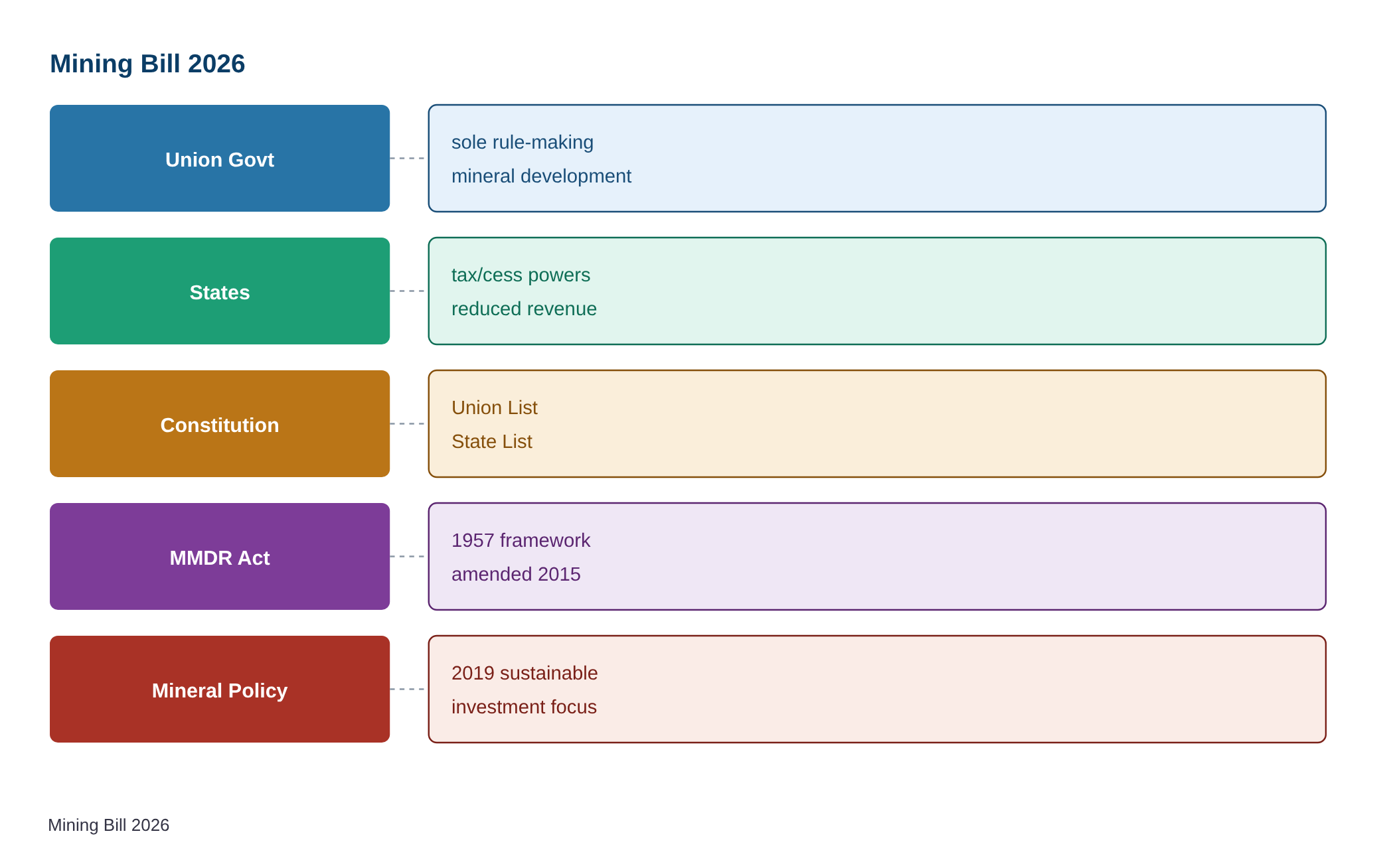
Quick Revision: The Mines and Minerals (Development and Regulation) Amendment Bill, 2026, centralises rule-making authority in the Union Government, potentially restricting State fiscal autonomy over mineral resources, and raises critical questions on federalism under the Seventh Schedule of the Constitution.
Why is this in the news?
The Mines and Minerals (Development and Regulation) Amendment Bill, 2026, has been passed by Parliament, triggering concerns from mineral-rich States such as Odisha and Jharkhand over the alleged erosion of their fiscal autonomy and constitutional rights over mineral resources. The Bill grants the Union Government sole authority to frame rules for mineral development, restricting State powers to levy taxes and cesses on minerals. This has led to political and constitutional debates regarding the balance of power between the Centre and States in the governance of natural resources.
Background
- The Mines and Minerals (Development and Regulation) Act, 1957 (MMDR Act) is the primary legislation governing the mining sector in India, regulating the grant of mineral concessions and the development of minerals.
- Mineral resources in India are classified under the Union List (List I) and State List (List II) of the Seventh Schedule of the Constitution, with the Union Government having exclusive power to legislate on minerals specified in the Union List.
- States such as Odisha, Jharkhand, and Chhattisgarh are major mineral producers, contributing significantly to their revenue through taxes, royalties, and cesses on mining activities.
- The MMDR Act has undergone multiple amendments, including the MMDR Amendment Act, 2015, which introduced auctions for mineral concessions to curb illegal mining and enhance transparency.
- The National Mineral Policy, 2019, aims to foster sustainable mining practices, attract investment, and ensure equitable sharing of mineral wealth between the Centre and States.
- Federal tensions over resource governance have historically centred on revenue-sharing mechanisms, environmental regulations, and the autonomy of States in utilising mineral wealth for local development.
What is the Mines and Minerals (Development and Regulation) Amendment Bill, 2026?
- Objective: The Bill seeks to amend the MMDR Act, 1957, to streamline mineral governance, enhance transparency, and align with contemporary economic and environmental priorities.
- Key Provisions: The Bill grants the Union Government exclusive authority to frame rules for mineral development.
- Restriction on State Powers: States are barred from levying additional taxes, cesses, or royalties on minerals beyond those prescribed by the Union Government, potentially reducing their fiscal autonomy.
- Auction Mechanism: The Bill reinforces the auction-based regime for mineral concessions, aiming to curb illegal mining and ensure competitive bidding for mineral rights.
- Federal Implications: The Bill raises constitutional questions regarding the balance of powers between the Centre and States under the Seventh Schedule, particularly concerning the State List entry on ‘taxes on lands and buildings’ and the Union List entry on ‘regulation of mines and minerals’.
Key Features
| Feature | Significance |
|---|---|
| Centralisation of rule-making authority | The Mines and Minerals (Development and Regulation) Amendment Bill, 2026, grants the Union Government exclusive power to frame rules for mineral development, superseding State-level discretion in regulatory design. |
| Restriction on State taxation powers | The Bill limits States’ ability to levy taxes or cesses on minerals, curtailing their fiscal autonomy in revenue generation from natural resources. |
| Impact on mineral-rich States | States like Odisha and Jharkhand, endowed with significant mineral deposits, face potential revenue losses due to reduced fiscal flexibility in exploiting their natural wealth. |
| Constitutional implications of federalism | The Bill raises questions about the balance of powers between the Union and State governments under the constitutional framework of cooperative federalism. |
| Developmental financing concerns | Revenue from mining operations is a critical source of funding for State-led welfare schemes, healthcare, education, and infrastructure projects. |
Why it Matters
Economic
- The Bill’s provisions may reduce State revenue from mining, impacting public expenditure on essential services and developmental projects in mineral-rich regions.
- Restricted fiscal autonomy could hinder States’ ability to allocate resources based on local priorities, potentially widening inter-State disparities.
- Long-term implications for investment in mining-dependent economies, as regulatory uncertainty may deter private sector participation.
Federalism and Governance
- The Bill challenges the principle of cooperative federalism by centralising regulatory authority, raising debates on the constitutional division of powers.
- State governments argue that such measures infringe upon their rights under the Constitution to manage local resources and generate revenue.
- Potential for inter-State conflicts over resource allocation and revenue sharing, necessitating institutional mechanisms for dispute resolution.
Legal and Constitutional
- The Bill’s provisions intersect with the Seventh Schedule of the Constitution, particularly the State List (Entry 23: Regulation of mines and minerals) and the Union List (Entry 54: Regulation of mines and minerals development).
- Questions arise regarding the validity of the Bill under Article 246, which delineates the legislative competence of Parliament and State Legislatures.
- The Bill may require judicial scrutiny to determine its consistency with the constitutional framework of federalism and State autonomy.
Strategic and Resource Security
- Centralisation of mineral governance could impact national resource security strategies, particularly for critical minerals essential for industrial and defence applications.
- States with significant mineral reserves may face challenges in balancing local developmental needs with national priorities in resource utilisation.
Challenges
1. Fiscal Autonomy vs. Centralisation
- States like Odisha and Jharkhand risk losing significant revenue streams from mining, which are vital for funding local welfare schemes and infrastructure.
- The Bill’s provisions may exacerbate fiscal imbalances between resource-rich and resource-poor States, undermining the principle of equitable development.
- Potential for legal challenges from States contesting the Bill’s constitutional validity, leading to prolonged litigation and policy uncertainty.
UPSC Link: GS-II: Federal Structure, Cooperative Federalism
2. Resource Governance and Development
- Centralised rule-making may not adequately account for local socio-economic and environmental contexts, leading to suboptimal resource utilisation.
- Restricted State autonomy in taxation could disincentivise investment in sustainable mining practices, as States lose financial leverage to enforce compliance.
- Potential for conflicts between State developmental goals and Union policies, particularly in balancing economic exploitation with environmental conservation.
UPSC Link: GS-III: Mineral Resources, Environmental Governance
3. Legal and Institutional Challenges
- The Bill’s provisions may be subject to judicial review, raising questions about the balance of powers between the Union and State governments.
- Lack of clear mechanisms for inter-State coordination in mineral governance could lead to disputes over resource sharing and revenue distribution.
- Potential for policy reversals or amendments, creating uncertainty for investors and State governments alike.
UPSC Link: GS-II: Judiciary and Constitutional Framework
4.
- Convene an all-party meeting at the State level to consolidate opposition and propose amendments to the Bill, ensuring State concerns are represented in Parliament.
- Engage with the Union Government through constitutional channels, such as the Inter-State Council, to negotiate a more balanced framework for mineral governance.
- Strengthen State-level institutional capacities to manage mineral resources effectively, even under centralised regulatory frameworks.
- Explore legal recourse, if necessary, to challenge the Bill’s provisions that infringe upon State rights under the Constitution.
- Develop alternative revenue models for States to compensate for potential losses from restricted taxation powers, such as grants-in-aid or shared revenues.
- Enhance transparency and stakeholder consultations in the implementation of the Bill to ensure alignment with local developmental priorities.
Challenges — UPSC Perspective
| Issue | Concern |
|---|---|
| Revenue loss for States | Restricted taxation powers may reduce funding for welfare schemes and infrastructure projects in mineral-rich States. |
| Erosion of fiscal federalism | Centralisation of rule-making undermines the constitutional balance between Union and State governments. |
| Policy uncertainty | Potential for legal challenges and amendments creates instability for investors and State governments. |
| Inter-State conflicts | Disputes over resource sharing and revenue distribution may arise, necessitating institutional mechanisms for resolution. |
| Environmental governance risks | Centralised rules may not adequately address local environmental and socio-economic contexts, leading to unsustainable practices. |
Way Forward
- Convene an all-party meeting at the State level to consolidate opposition and propose amendments to the Mines and Minerals (Development and Regulation) Amendment Bill, 2026.
- Engage with the Union Government through constitutional channels, such as the Inter-State Council, to negotiate a more balanced framework for mineral governance.
- Strengthen State-level institutional capacities to manage mineral resources effectively, even under centralised regulatory frameworks.
- Explore legal recourse, if necessary, to challenge the Bill’s provisions that infringe upon State rights under the Constitution.
- Develop alternative revenue models for States to compensate for potential losses from restricted taxation powers, such as grants-in-aid or shared revenues.
- Enhance transparency and stakeholder consultations in the implementation of the Bill to ensure alignment with local developmental priorities.
- Conduct a detailed impact assessment of the Bill’s provisions on State revenues and developmental expenditures to inform policy responses.
- Promote inter-State cooperation to address common challenges in mineral governance and share best practices for sustainable resource utilisation.
UPSC Value Addition
Keywords for Mains Answer-Writing
Mines and Minerals (Development and Regulation) Amendment Bill, 2026 · fiscal federalism · State autonomy in resource governance · Article 246 and Seventh Schedule · Union-State financial relations · mineral taxation powers · federal structure of India · concurrent list · State revenue autonomy · developmental federalism · Parliamentary sovereignty vs State rights · mineral-rich States and Centre-State disputes · constitutional provisions on natural resources · Centre-state financial coordination · fiscal federalism in India
Constitutional & Policy Linkages
- Article 246: Legislative competence of Parliament and State Legislatures
- Seventh Schedule: State List (Entry 23) and Union List (Entry 54)
- Article 263: Inter-State Council for coordination between Union and States
Concept Flow
Mines and Minerals (Development and Regulation) Amendment Bill, 2026 introduced in Parliament → Bill passed by both Houses, centralising rule-making authority with the Union Government → Restriction imposed on States’ power to levy taxes or cesses on minerals → Mineral-rich States (e.g., Odisha, Jharkhand) express concerns over revenue loss and erosion of fiscal autonomy → State governments argue the Bill infringes upon constitutional rights and cooperative federalism → Potential legal challenges and inter-State conflicts over resource governance and revenue sharing → Policy uncertainty and need for institutional mechanisms to address governance gaps
Prelims Practice Questions
Q1. Consider the following statements regarding the Mines and Minerals (Development and Regulation) Amendment Bill, 2026:
1. The Bill grants the Union Government sole authority to frame rules for mineral development.
2. The Bill restricts State Governments from levying any taxes or cesses on minerals extracted within their territory.
3. The Bill is in conformity with the constitutional provisions under Article 246 and the Seventh Schedule.
How many of the above statements are correct?
- Only one
- Only two
- All three
- None
Answer: All three — Statements 1 and 2 are correct as the Bill centralises rule-making authority and restricts State taxation powers. Statement 3 is incorrect because the Bill may encroach upon the State’s legislative competence under the State List (Seventh Schedule).
Q2. Assertion (A): The Mines and Minerals (Development and Regulation) Amendment Bill, 2026, seeks to enhance the fiscal autonomy of mineral-rich States like Odisha.
Reason (R): The Bill empowers State Governments to levy additional taxes on mineral extraction activities to fund local development.
In the context of the above two statements, which one of the following is correct?
- Both A and R are true, and R is the correct explanation of A.
- Both A and R are true, but R is not the correct explanation of A.
- A is true, but R is false.
- A is false, but R is true.
Answer: A is false, but R is true. — Assertion (A) is false because the Bill restricts State taxation powers, thereby reducing fiscal autonomy. Reason (R) is false as the Bill does not empower States to levy additional taxes.
Q3. Match the following provisions of the Mines and Minerals (Development and Regulation) Amendment Bill, 2026 with their constitutional implications:
Column I (Provision)
A. Centralisation of rule-making authority
B. Restriction on State taxation of minerals
C. Empowerment of State Governments to allocate mineral concessions
D. Exclusive Union control over mineral development
Column II (Constitutional Implication)
1. Encroachment on State List (Seventh Schedule)
2. Violation of fiscal federalism
3. Compliance with Article 246(1)
4. Alignment with concurrent legislative powers
Select the correct match:
- A-1, B-2, C-4, D-3
- A-3, B-1, C-2, D-4
- A-2, B-3, C-1, D-4
- A-4, B-2, C-3, D-1
Answer: A-1, B-2, C-4, D-3 — A (Centralisation of rule-making) encroaches on the State List (Seventh Schedule) — 1. B (Restriction on State taxation) violates fiscal federalism — 2. C (Empowerment of State Governments) aligns with concurrent powers — 4. D (Exclusive Union control) complies with Article 246(1) — 3.
Mains Practice Question
✍ The Mines and Minerals (Development and Regulation) Amendment Bill, 2026, has been criticised for undermining the fiscal autonomy of mineral-rich States. Critically examine the constitutional and federal implications of the Bill, with reference to the Seventh Schedule, Article 246, and the principles of cooperative federalism. (15 Marks)
Approach: MODEL-ANSWER SKELETON:
1. **Constitutional Framework**:
– Briefly explain the distribution of legislative and executive powers under the Seventh Schedule (Union List, State List, Concurrent List).
– Highlight that minerals are under the State List (Entry 23, State List), implying State jurisdiction over mineral development and taxation.
– Mention Article 246(1) which vests Parliament with exclusive power to legislate on matters in the Union List, while States have exclusive power over the State List.
2. **Provisions of the Bill**:
– Centralisation of rule-making authority with the Union Government (Section X of the Bill).
– Restriction on State Governments’ power to levy taxes or cesses on minerals (Section Y of the Bill).
– Implications for State revenue autonomy and developmental financing.
3. **Federal Implications**:
– **Cooperative Federalism**: Discuss the principle of cooperative federalism as envisaged in the Constitution (e.g., NITI Aayog’s role, GST Council).
– **Encroachment on State Autonomy**: Argue how the Bill encroaches upon the State List, thereby violating the federal structure.
– **Fiscal Federalism**: Explain how the restriction on State taxation powers undermines fiscal federalism and State revenue generation.
4. **Judicial Precedents**:
– Cite relevant Supreme Court judgments such as *State of West Bengal v. Kesoram Industries Ltd.* (2004) on the State’s power to tax minerals.
– Reference *S.R. Bommai v. Union of India* (1994) on federalism and the limits of Union power.
5. **Balancing Views**:
– Present the Union Government’s argument: uniformity in mineral governance, national interest, and streamlining regulatory processes.
– Present the State Governments’ argument: protection of fiscal autonomy, local developmental needs, and constitutional rights.
6. **Conclusion**:
– Weigh the competing claims and argue that while centralisation may have administrative benefits, it must not undermine the constitutional balance of federalism.
– Suggest a middle path: consultative process involving States in rule-making, and compensatory mechanisms for revenue loss.
Source: The Hindu
Generated by AanyaAi for educational purpose.

- क्या शांतिपूर्ण असहमति भारत में कमजोर हो रही है? जानिए संवैधानिक अधिकार - October 7, 2026
- Lok Sabha Speaker on Strengthening Democracy Through Dialogue and Inclusion - October 6, 2026
- बेंगलुरु में पांच पुलिस आयुक्तालयों के गठन को कैबिनेट की मंजूरी, पूर्व अधिकारियों ने व्यक्त की चिंता - October 6, 2026

No Comments