


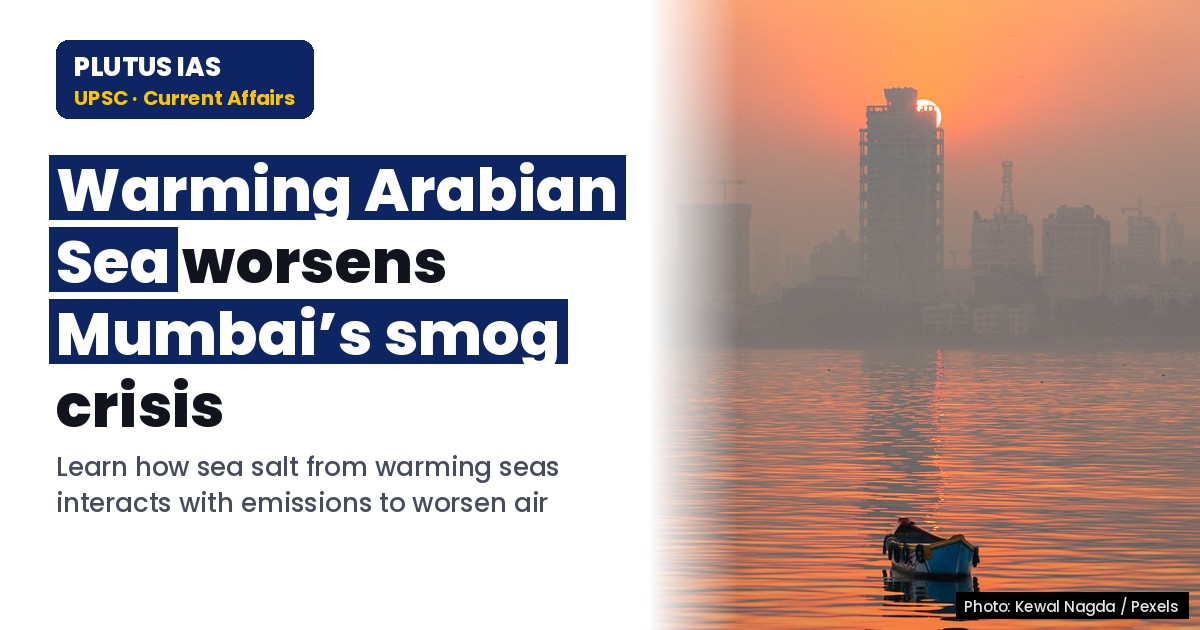
24 Oct How Warming Arabian Sea Fuels Mumbai’s Smog Crisis: UPSC Perspective
✎ Sea salt aerosols, generated by wave action in a warming Arabian Sea, reduce visibility and interact with anthropogenic emissions to form secondary pollutants, thereby contributing to urban haze and degrading air quality in…
Subject Relevance — Where This Topic Fits
- GS Paper III — Environment, Ecology, Bio-diversity and Climate Change | GS Paper III — Science and Technology — Developments and their Applications
- Prelims: Sea salt aerosols, Secondary pollutants, Particulate Matter (PM10, PM2.5), El Niño and its climatic impacts, National Clean Air Programme (NCAP), Central Pollution Control Board (CPCB), National Environmental Engineering Research Institute (NEERI), Marine aerosol formation, Atmospheric visibility, Urban air quality management
- Essay: Climate change and urban resilience: Addressing the paradox of warming seas and deteriorating air quality in coastal metropolises
Quick Revision: Sea salt aerosols, generated by wave action in a warming Arabian Sea, reduce visibility and interact with anthropogenic emissions to form secondary pollutants, thereby contributing to urban haze and degrading air quality in coastal cities like Mumbai.
Why is this in the news?
The civic administration of Mumbai has, for the first time, identified sodium chloride (NaCl) from the Arabian Sea as a contributor to the city’s persistent haze, particularly during periods of elevated temperatures associated with El Niño. This development underscores the complex interplay between natural marine processes and anthropogenic emissions in exacerbating urban air pollution, necessitating a re-evaluation of air quality mitigation strategies in coastal urban centres.
Background
- The Arabian Sea has exhibited a warming trend over the past two decades, attributed to climate change and regional ocean-atmosphere interactions, including El Niño events, which alter sea surface temperatures and evaporation rates.
- Urban air quality in Mumbai has deteriorated since 2022, with particulate matter (PM10 and PM2.5) frequently exceeding the National Ambient Air Quality Standards (NAAQS) prescribed by the CPCB.
- The National Clean Air Programme (NCAP), launched in 2019, aims to reduce PM2.5 and PM10 concentrations by 20–30% by 2024 in 132 non-attainment cities, including Mumbai, though progress has been uneven.
- Secondary pollutants, formed through chemical reactions between primary emissions (e.g., NOx, SOx) and atmospheric constituents, play a critical role in urban haze formation, complicating pollution control efforts.
- Marine aerosols, including sea salt particles, are increasingly recognised as significant contributors to atmospheric particulate load, particularly in coastal urban regions.
- Lower wind speeds and stable atmospheric conditions in urban areas can prolong the residence time of aerosols, exacerbating haze and reducing visibility.
What are sea salt aerosols and their role in urban air pollution?
- Sea salt aerosols are microscopic particles of sodium chloride (NaCl) and other salts generated through the mechanical action of waves and wind on the ocean surface, a process known as sea spray.
- These particles are typically in the size range of 0.1–10 micrometers (µm), allowing them to remain suspended in the atmosphere for extended periods and travel inland, particularly under favourable wind conditions.
- Sea salt aerosols contribute to haze by scattering and absorbing sunlight, reducing atmospheric visibility and creating a characteristic ‘hazy’ appearance in the sky.
- While sea salt itself is not classified as a toxic pollutant by the CPCB, its presence can interact with anthropogenic emissions (e.g., nitrogen oxides from vehicles, sulphur oxides from industries) to form secondary pollutants such as ammonium nitrate and ammonium sulphate.
- The formation of secondary pollutants via heterogeneous reactions on sea salt particles can amplify the total particulate load in urban air, thereby worsening air quality indices.
- Sea salt aerosols can also act as cloud condensation nuclei, influencing cloud formation and precipitation patterns, which may further affect local meteorology and air quality dynamics.
- Prolonged exposure to high concentrations of sea salt aerosols may contribute to the corrosion of infrastructure and electronic equipment, posing economic and operational challenges in urban environments.
- The contribution of sea salt to urban air pollution is exacerbated during El Niño events, which elevate sea surface temperatures and increase evaporation rates, leading to higher aerosol generation.
Key Features
| Feature | Significance |
|---|---|
| Sea salt (NaCl) aerosols | Contributes to haze formation by scattering light and reducing atmospheric visibility in coastal urban areas like Mumbai. |
| El Niño-induced warming of Arabian Sea | Elevates sea surface temperatures, increasing evaporation rates and sea spray generation, thereby enhancing aerosol load in the atmosphere. |
| Interaction with anthropogenic pollutants | Sea salt aerosols can react with vehicular emissions (NOx, SOx) and industrial effluents to form secondary pollutants, exacerbating air quality degradation. |
| Meteorological stagnation (low wind speeds) | Prolongs the residence time of particulate matter and aerosols in the atmosphere, intensifying haze persistence. |
| Corrosive impact on infrastructure | Prolonged exposure to salt aerosols accelerates corrosion of electrical and electronic equipment, including circuit boards and mobile devices. |
UPSC Value Addition
Keywords for Mains Answer-Writing
Air Quality Index (AQI) · Particulate Matter (PM2.5 and PM10) · Secondary Pollutants · National Clean Air Programme (NCAP) · Central Pollution Control Board (CPCB) · El Niño-Southern Oscillation (ENSO) · Marine Aerosols · Haze Formation Mechanisms · Urban Air Pollution Governance · Atmospheric Chemistry · Suspended Particulate Matter (SPM) · Secondary Organic Aerosols (SOA) · Mumbai’s Air Quality Management · Climate-Water-Air Nexus · Environmental Impact Assessment (EIA)
Prelims Practice Questions
Q1. Consider the following statements regarding the formation of haze in urban areas:
1. Haze formation is solely dependent on vehicular emissions and industrial pollutants.
2. Sea salt aerosols can contribute to haze by reducing atmospheric visibility.
3. Secondary pollutants are formed exclusively by the interaction of primary pollutants with sunlight.
4. Lower wind speeds can prolong the persistence of haze by trapping suspended particles.
How many of the above statements are correct?
- Only one
- Only two
- Only three
- All
Answer: Only three — Statement 2 and 4 are correct. Sea salt aerosols contribute to haze by scattering light, reducing visibility. Lower wind speeds trap suspended particles, prolonging haze. Statement 1 is incorrect because haze formation involves multiple sources, not solely vehicular emissions. Statement 3 is incorrect as secondary pollutants can form through interactions with other atmospheric compounds, not exclusively sunlight.
Q2. Assertion (A): The Central Pollution Control Board (CPCB) does not classify sodium chloride (NaCl) as a separate air pollutant.
Reason (R): Sodium chloride is considered harmless to human health at ambient concentrations and does not contribute to secondary pollution.
- Both A and R are true, and R is the correct explanation of A
- Both A and R are true, but R is NOT the correct explanation of A
- A is true, but R is false
- A is false, but R is true
Answer: A is false, but R is true — Assertion (A) is true: CPCB does not list NaCl as a separate pollutant. However, Reason (R) is false: NaCl can react with other compounds to form secondary pollutants, though direct health risks at ambient levels are not established.
Q3. Match the following pollutants with their primary sources:
Column I (Pollutant) | Column II (Primary Source)
1. Particulate Matter (PM2.5) | A. Sea spray and evaporation
2. Nitrogen Oxides (NOx) | B. Vehicle exhaust and industrial emissions
3. Sea Salt (NaCl) | C. Combustion of fossil fuels
4. Sulphur Dioxide (SO2) | D. Agricultural burning and construction dust
- 1-B, 2-C, 3-A, 4-D; 1-D, 2-C, 3-A, 4-B; 1-A, 2-B, 3-C, 4-D; 1-D, 2-A, 3-B, 4-C
- answer_matrix_indexes_to_options_indexes_answer_0
- explain_matrix_pairs_explain_2_lines
- format_match
Answer: answer_matrix_indexes_to_options_indexes_answer_0 — 1-B: PM2.5 primarily originates from vehicle exhaust, industrial emissions, and construction dust. 2-C: NOx is emitted from fossil fuel combustion in vehicles and industries. 3-A: Sea salt (NaCl) is derived from sea spray and evaporation. 4-D: SO2 is largely emitted from burning of fossil fuels and agricultural residue.
Mains Practice Question
✍ The interaction of marine aerosols with anthropogenic emissions is increasingly contributing to urban haze and secondary pollution in coastal cities. Critically examine the mechanisms through which sea salt aerosols exacerbate air pollution in cities like Mumbai. Also, evaluate the adequacy of existing air quality governance frameworks in addressing such emerging challenges. (15 Marks)
Approach: MODEL-ANSWER SKELETON:
1. **Mechanisms of Haze Formation and Secondary Pollution (8 points, 120 words)**
– Define marine aerosols and sea salt aerosols (NaCl) as primary contributors to haze via light scattering and visibility reduction.
– Explain the role of warmer Arabian Sea waters (linked to El Niño and climate change) in enhancing evaporation and sea spray generation.
– Describe how suspended salt particles interact with anthropogenic pollutants (NOx, SOx, VOCs) to form secondary pollutants such as secondary organic aerosols (SOA) and secondary inorganic aerosols (SIA).
– Highlight the role of meteorological factors (low wind speeds, temperature inversions) in prolonging aerosol residence time.
– Note the potential for salt particles to corrode infrastructure (e.g., electrical equipment) and their indirect health impacts via secondary pollutant formation.
2. **Existing Air Quality Governance Frameworks (7 points, 130 words)**
– National Clean Air Programme (NCAP): Objectives, targets (30% reduction in PM2.5/PM10 by 2024), and implementation gaps (e.g., lack of city-specific strategies for marine aerosol integration).
– Central Pollution Control Board (CPCB): Role in monitoring AQI, but limitations in addressing secondary pollutants formed via marine-aerosol interactions.
– Urban Local Bodies (ULBs): Constraints in integrating climate-water-air nexus into air quality management plans (e.g., Mumbai’s haze mitigation strategies).
– Inter-ministerial coordination challenges between MoEFCC, IMD, and state agencies in addressing climate-induced air pollution.
– Need for dynamic AQI frameworks that incorporate marine aerosol data and secondary pollutant chemistry.
3. **Way Forward (3 points, 50 words)**
– Strengthen multi-hazard early warning systems linking climate variability (ENSO) with air quality forecasting.
– Enhance source apportionment studies to quantify marine aerosol contributions in coastal cities.
– Promote low-emission zones and green infrastructure to mitigate both anthropogenic and marine aerosol impacts.
Source: The Indian Express
Maharashtra PCS (MPSC) — State PCS Practice
Prelims: Which of the following is the primary reason for the increase in smog levels in Mumbai due to sea salt from the Arabian Sea?
- A. Rising sea surface temperatures in the Arabian Sea
- B. Increased industrial pollution along the Mumbai coast
- C. Decline in monsoon rainfall over Maharashtra
- D. Expansion of coastal salt pans in Konkan region
Answer: A. Rising sea surface temperatures in the Arabian Sea — Rising sea surface temperatures in the Arabian Sea enhance evaporation, increasing sea salt aerosol formation, which contributes to smog formation in Mumbai.
Mains: Examine how climate change-induced warming of the Arabian Sea is exacerbating air pollution in Mumbai. Suggest policy measures for the Maharashtra government to mitigate this issue, with a focus on coastal urban planning and pollution control strategies.
Generated by AanyaAi for educational purpose.
Related guides on our sites
- How to prepare for GS paper 1 for UPSC CSE mains exam
- Best UPSC coaching for IFOS exam
- Best geography optional coaching
- Best geography optional coaching

- How Warming Arabian Sea Fuels Mumbai’s Smog Crisis: UPSC Perspective - October 24, 2026
- महाराष्ट्र सरकार ने ‘मिशन मुर्गास’ शुरू किया, जानें कैसे होगा पशुओं का चारा संकट दूर - October 24, 2026
- Allahabad HC Slams UP Govt Over Shop Evictions for Ayodhya Hospital - October 24, 2026

No Comments