


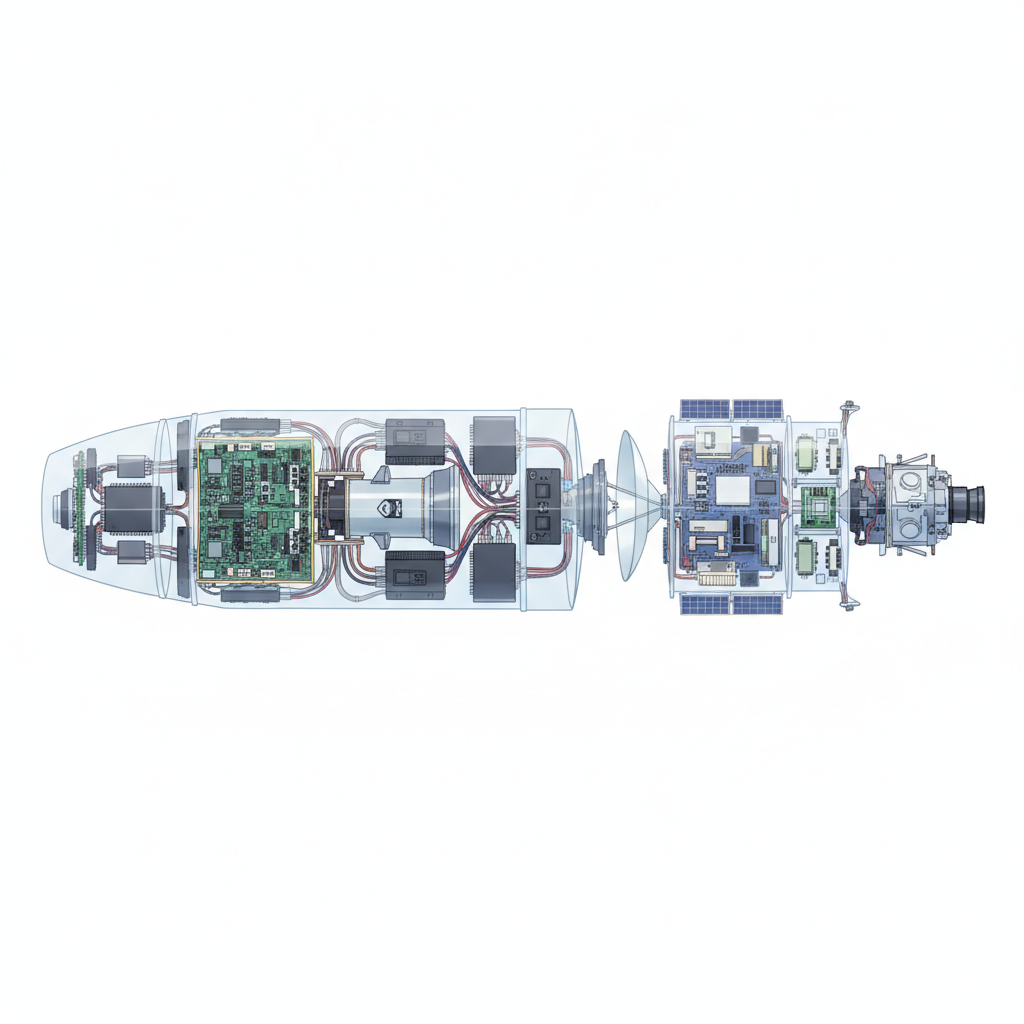
04 Sep Hyderabad Firm’s Critical Role in ISRO’s GSLV-F17 & EOS-05 Mission
✎ Indigenous private sector participation in ISRO missions, exemplified by Ananth Technologies Limited’s contribution to GSLV-F17 and EOS-05 (GISAT-1A), signifies a strategic shift towards self-reliance in space technology under…
Subject Relevance — Where This Topic Fits
- GS Paper III — Science and Technology — Developments and their Applications and Effects in Everyday Life | GS Paper III — Indian Economy and Issues relating to Planning, Mobilization of Resources, Growth, Development and Employment — Industrial Policy and Promotion
- Prelims: ISRO, GSLV-F17, EOS-05 (GISAT-1A), Avionics, Spacecraft Subsystems, Private Sector Participation in Space Sector, Geosynchronous Orbit, Power Management Systems, Navigation Guidance and Control (NGC), Launch Vehicle Electronics
- Essay: India’s Space Odyssey: From Self-Reliance to Global Leadership, Role of Private Sector in National Development: A Case Study of India’s Space Programme
Quick Revision: Indigenous private sector participation in ISRO missions, exemplified by Ananth Technologies Limited’s contribution to GSLV-F17 and EOS-05 (GISAT-1A), signifies a strategic shift towards self-reliance in space technology under India’s Space Sector Reforms.
Why is this in the news?
The successful integration of critical avionics and electronics systems by a Hyderabad-based private firm, Ananth Technologies Limited (ATL), into ISRO’s GSLV-F17 launch vehicle and EOS-05 (GISAT-1A) Earth observation satellite underscores the expanding role of indigenous private enterprises in India’s space programme. This development highlights the government’s strategic push for self-reliance in space technology, the increasing sophistication of India’s space missions, and the growing synergy between ISRO and the private sector in advancing India’s space capabilities.
Background
- The Indian Space Research Organisation (ISRO) has historically been the primary agency responsible for the design, development, and execution of India’s space missions, including launch vehicles, satellites, and associated technologies.
- In recent years, the Government of India has actively promoted the participation of private enterprises in the space sector to enhance innovation, reduce dependency on foreign suppliers, and leverage domestic industrial capabilities.
- The ‘Space Sector Reforms’ announced in 2020 and subsequent policy measures have opened avenues for private entities to engage in end-to-end satellite manufacturing, launch services, and subsystem development.
- Ananth Technologies Limited (ATL), headquartered in Hyderabad, is one of the leading private firms in India specialising in the design, development, and integration of advanced avionics, electronics, and spacecraft subsystems.
- ISRO’s GSLV-F17 mission represents a medium-lift launch vehicle designed for geosynchronous satellite launches, while EOS-05 (GISAT-1A) is India’s first Earth observation satellite positioned in geosynchronous orbit, enabling real-time monitoring and data acquisition.
- The collaboration between ISRO and private firms like ATL exemplifies the ‘Atmanirbhar Bharat’ (Self-Reliant India) initiative, particularly in high-technology sectors such as space.
What are Avionics and Spacecraft Subsystems?
- Avionics refers to the electronic systems used on aircraft, spacecraft, and artificial satellites, encompassing components such as navigation, guidance, control systems, power management, and communication systems.
- Spacecraft subsystems are modular components that perform specific functions essential for the operation of a satellite or space probe, including power systems, attitude control, thermal management, and payload instruments.
- In the context of launch vehicles like GSLV-F17, avionics systems are critical for mission success, as they manage stage separation, propulsion control, guidance navigation, and real-time telemetry.
- For Earth observation satellites such as EOS-05 (GISAT-1A), spacecraft subsystems include power management packages, onboard computing units, attitude determination systems, and payload integration frameworks.
- Private sector involvement in avionics and spacecraft subsystem development enhances ISRO’s capacity to execute multiple missions simultaneously while focusing on core research and development activities.
- The integration of such systems by firms like ATL involves rigorous testing, validation, and quality assurance to ensure compatibility with ISRO’s stringent technical and safety standards.
- This collaboration also supports India’s broader goal of achieving self-sufficiency in space technology, reducing reliance on imports for critical components.
- The development of indigenous avionics and electronics systems aligns with India’s long-term space policy objectives, including the establishment of a robust domestic space industry ecosystem.
Key Features
| Feature | Significance |
|---|---|
| Avionics and electronics systems | Critical for mission success, including power management, navigation, guidance, and control functions in both launch vehicle and spacecraft. |
| Stage integration and harnessing | Ensures structural integrity and electrical connectivity of launch vehicle stages, particularly GS2 and L-40 nose-cone decks. |
| Onboard computing and attitude determination | Enables real-time decision-making, spacecraft orientation, and mission autonomy for EOS-05 (GISAT-1A). |
| Power conversion and distribution systems | Supports continuous and stable power supply to payloads and subsystems during mission phases. |
| Testing and evaluation of control electronics | Validates system reliability under extreme launch and orbital conditions, reducing mission failure risks. |
Why it Matters
Economic
- Demonstrates India’s indigenous capability in high-technology manufacturing, reducing dependence on foreign suppliers for critical space components.
- Enhances export potential of Indian aerospace electronics, contributing to the ‘Make in India’ initiative in the space sector.
- Creates high-skilled employment opportunities in Hyderabad, Bengaluru, and Thiruvananthapuram, fostering regional industrial development.
Strategic
- Strengthens India’s self-reliance in space technology, a key pillar of national security and strategic autonomy.
- Supports the operationalisation of geosynchronous Earth observation satellites (EOS-05), enhancing surveillance, disaster management, and resource monitoring capabilities.
- Contributes to the development of heavy-lift launch vehicles (GSLV), crucial for future interplanetary and human spaceflight missions.
Technological
- Validates the integration of advanced avionics in India’s indigenous launch vehicles, aligning with ISRO’s goal of reducing reliance on imported systems.
- Demonstrates end-to-end capability in satellite assembly, integration, and testing (AIT), a critical phase in space mission execution.
- Advances indigenous development of power management and attitude control systems, reducing vulnerabilities in global supply chains.
Institutional
- Highlights the role of private sector entities in complementing ISRO’s efforts, reflecting the evolving public-private partnership model in space exploration.
- Showcases the capabilities of Hyderabad-based Ananth Technologies, a key player in India’s space ecosystem, alongside established centres like VSSC and URSC.
Challenges
1. Technological Complexity in Avionics Integration
- Achieving precise timing and synchronization across multiple avionics packages during launch and orbital phases remains a critical engineering challenge.
- Ensuring electromagnetic compatibility (EMC) and interference mitigation in densely packed electronic systems is essential for mission reliability.
- The need for radiation-hardened components in geosynchronous orbits demands advanced materials and testing protocols.
UPSC Link: GSLV development challenges
2. Supply Chain and Indigenous Component Development
- Dependence on imported semiconductor and microelectronic components for avionics systems poses risks to long-term self-reliance.
- Scaling up indigenous production of high-reliability electronic components requires sustained investment in R&D and manufacturing infrastructure.
- Quality assurance and certification of components for space applications involve rigorous and time-consuming processes.
UPSC Link: Atmanirbhar Bharat in space
3. Cost and Resource Optimization
- Balancing the cost of advanced avionics systems with budgetary constraints while maintaining mission reliability is a persistent challenge.
- Optimizing the weight and power consumption of electronic systems without compromising performance is critical for launch vehicle efficiency.
- Ensuring cost-effective testing and validation processes for multiple mission configurations remains a priority.
UPSC Link: Space mission economics
4. Human Resource and Skill Development
- Developing a skilled workforce capable of designing, integrating, and maintaining advanced avionics systems requires targeted educational and training initiatives.
- Retaining talent in the space sector amid competition from other high-technology industries is essential for sustained growth.
- Fostering interdisciplinary collaboration between engineers, physicists, and software developers is necessary for innovation.
UPSC Link: Human capital in space sector
Challenges — UPSC Perspective
| Issue | Concern |
|---|---|
| Radiation exposure in geosynchronous orbit | Degradation of electronic components over mission lifetime, requiring radiation-hardened designs. |
| Thermal management in avionics | Heat dissipation in confined spaces during launch and orbital operations to prevent system failure. |
| Real-time fault detection and recovery | Ensuring rapid identification and mitigation of anomalies to avoid mission critical failures. |
| Miniaturization vs. reliability trade-off | Reducing size and weight of electronics while maintaining robustness under extreme conditions. |
| Cross-platform compatibility | Ensuring avionics systems are adaptable across different launch vehicles and spacecraft configurations. |
Way Forward
- Enhance public-private partnerships to accelerate indigenous development of high-reliability avionics components.
- Invest in semiconductor fabrication and microelectronics manufacturing to reduce dependence on imported components.
- Establish dedicated training programmes in aerospace electronics and avionics integration at premier engineering institutions.
- Strengthen ISRO’s testing and validation infrastructure to support rapid prototyping and certification of new systems.
- Promote R&D in radiation-hardened materials and thermal management solutions for geosynchronous missions.
- Develop a national strategy for standardising avionics interfaces and protocols across launch vehicles and satellites.
- Encourage startups and MSMEs in Hyderabad and other space hubs to participate in the supply chain for space electronics.
- Facilitate knowledge-sharing between ISRO, private firms, and academic institutions to foster innovation in space avionics.
UPSC Value Addition
Keywords for Mains Answer-Writing
Indian Space Research Organisation (ISRO) · GSLV-F17 mission · EOS-05 (GISAT-1A) · space avionics · satellite subsystems · power management systems · spacecraft attitude determination · public-private partnership in space sector · Make in India in aerospace · satellite assembly integration and testing (AIT) · geosynchronous orbit · launch vehicle electronics · space technology indigenisation · Indian space ecosystem
Concept Flow
ISRO’s GSLV-F17 mission requires advanced avionics for launch vehicle control and spacecraft deployment. → Hyderabad-based Ananth Technologies develops and supplies critical power management, navigation, and control electronics. → Integration of these systems involves stage harnessing, onboard computing, and attitude determination for mission success. → Successful deployment of EOS-05 (GISAT-1A) in geosynchronous orbit validates the avionics systems under operational conditions. → The mission demonstrates India’s indigenous capability, reducing reliance on foreign suppliers for strategic space components. → Strengthened private sector participation in space missions aligns with national policies for self-reliance and technological advancement.
Prelims Practice Questions
Q1. Consider the following statements regarding the GSLV-F17 mission and EOS-05 (GISAT-1A):
1. The GSLV-F17 mission involved the integration and checkout of all four L-40 nose-cone decks.
2. EOS-05 (GISAT-1A) is India’s first imaging satellite placed in geosynchronous orbit.
3. Ananth Technologies supplied 15 systems to the EOS-05 spacecraft, including 10 critical power-management packages.
4. The GSLV-F17 mission did not involve any testing or evaluation of navigation, guidance and control electronics.
How many of the above statements are correct?
- Only one
- Only two
- Only three
- All
Answer: Only three — Statements 1, 2, and 3 are correct. Statement 4 is incorrect as the mission involved testing and evaluation of navigation, guidance and control electronics.
Q2. Assertion (A): The EOS-05 (GISAT-1A) satellite is designed to operate from a geosynchronous orbit.
Reason (R): Geosynchronous orbits allow satellites to maintain a fixed position relative to the Earth’s surface, enabling continuous observation of a specific region.
Select the correct code:
- Both A and R are true, and R is the correct explanation of A
- Both A and R are true, but R is not the correct explanation of A
- A is true, but R is false
- A is false, but R is true
Answer: Both A and R are true, but R is not the correct explanation of A — The EOS-05 (GISAT-1A) is indeed designed to operate from a geosynchronous orbit, which allows it to maintain a fixed position relative to the Earth’s surface. This enables continuous observation of a specific region, making R the correct explanation for A.
Q3. Match the following contributions of Ananth Technologies with the respective components of ISRO missions:
Column I (Contribution) Column II (Component)
A. Integration and checkout of L-40 nose-cone decks 1. EOS-05 (GISAT-1A) spacecraft
B. Supply of 10 critical power-management packages 2. GSLV-F17 launch vehicle
C. Testing of navigation, guidance and control electronics 3. EOS-05 (GISAT-1A) spacecraft
D. Harnessing of the complete GS2 stage 4. GSLV-F17 launch vehicle
Select the correct match:
- A-2, B-1, C-4, D-2
- A-4, B-1, C-2, D-4
- A-2, B-3, C-4, D-2
- A-2, B-1, C-4, D-4
Answer: A-2, B-1, C-4, D-4 — A matches with 2 (GSLV-F17 launch vehicle), B matches with 3 (EOS-05 spacecraft), C matches with 4 (GSLV-F17 launch vehicle), and D matches with 2 (GSLV-F17 launch vehicle).
Mains Practice Question
✍ The Indian Space Research Organisation (ISRO) has increasingly leveraged the capabilities of domestic private enterprises in the development of critical space technologies. Critically examine the significance of this trend in the context of India’s space programme, with particular reference to the contributions of Hyderabad-based Ananth Technologies to the GSLV-F17 mission and EOS-05 (GISAT-1A) satellite. Also, outline the broader implications for India’s space ecosystem and the ‘Make in India’ initiative. (15 Marks)
Approach: MODEL-ANSWER SKELETON:
1. **Context and Significance of Private Sector Participation**
– Brief overview of ISRO’s historical reliance on in-house development vs. contemporary shift toward public-private partnerships (PPPs).
– Reference the Space Activities Bill, 2017, and the Indian Space Policy, 2023, which formalise private sector participation.
2. **Contributions of Ananth Technologies**
– **GSLV-F17 Mission**: 28 packages including power management, stage processing, command execution, integration of L-40 nose-cone decks, harnessing of GS2 stage, and testing of navigation/guidance/control electronics.
– **EOS-05 (GISAT-1A)**: 15 systems including 10 power-management packages for power conversion, distribution, onboard computing, and spacecraft attitude determination.
– Highlight the role in satellite assembly, integration, and testing (AIT) facilities in Bengaluru and Thiruvananthapuram.
3. **Strategic and Economic Implications**
– **Indigenisation and Self-Reliance**: Reduction in import dependence for critical avionics and electronics, aligning with ‘Atmanirbhar Bharat’ and ‘Make in India’.
– **Cost Efficiency**: Potential reduction in mission costs through competitive private sector participation.
– **Technological Advancement**: Acceleration of innovation by leveraging private sector expertise in niche domains like power management and attitude determination.
4. **Broader Ecosystem Development**
– **Skill Development and Employment**: Creation of high-skilled jobs in aerospace engineering and satellite technology.
– **Supply Chain Integration**: Strengthening of India’s aerospace supply chain, including MSMEs and startups.
– **Global Competitiveness**: Positioning India as a cost-effective and reliable hub for space technology manufacturing and services.
5. **Challenges and Considerations**
– **Regulatory and Compliance Framework**: Ensuring adherence to international space treaties (e.g., Outer Space Treaty, 1967) and national security protocols.
– **Quality Control and Standardisation**: Need for robust certification and quality assurance mechanisms for private sector contributions.
– **Intellectual Property Rights (IPR)**: Balancing innovation incentives with open access to critical technologies.
6. **Conclusion**
– Summarise the transformative potential of private sector participation in India’s space programme.
– Emphasise the need for sustained policy support, investment in R&D, and fostering a collaborative ecosystem between ISRO, academia, and industry.
Source: The Hindu
Telangana PCS (TGPSC (TSPSC)) — State PCS Practice
Prelims: Which Hyderabad-based firm supplied critical avionics and electronics systems to ISRO’s recent mission, as highlighted in the state’s current affairs?
- Bharat Electronics Limited (BEL)
- Tata Advanced Systems Limited (TASL)
- Hyderabad Systems Private Limited (HSPL)
- Defence Research and Development Organisation (DRDO)
Answer: Bharat Electronics Limited (BEL) — Bharat Electronics Limited (BEL), headquartered in Hyderabad, supplied critical avionics and electronics systems for ISRO’s recent mission, contributing to the state’s technological advancements.
Mains: Discuss the significance of Hyderabad’s role in India’s space missions, with a focus on the contributions of local firms like BEL to ISRO’s technological capabilities. Analyze how such collaborations enhance Telangana’s position in the national space sector.
Generated by AanyaAi for educational purpose.
Related guides on our sites
- Anthropology VS PSIR
- Best PSIR optional coaching
- Best PSIR optional coaching online
- Best ias coaching in Hyderabad

- India-Australia AUSTRAHIND 2026 Exercise: Key Highlights for UPSC & State PCS - October 22, 2026
- एससीओ बैठक में भारत का आतंकवाद विरोध: क्षेत्रीय सहयोग पर जोर - October 22, 2026
- SEC Directs Strict SC Order Compliance for Andhra ULB Polls - October 22, 2026

No Comments