


17 Sep Hyderabad Liberation Day 2026: VP to lead grand parade in Secunderabad
✎ Hyderabad Liberation Day, observed on 17 September, marks the integration of the erstwhile Hyderabad State into the Indian Union in 1948, reinforcing India’s territorial integrity and sovereignty.
Subject Relevance — Where This Topic Fits
- GS Paper I — Modern Indian History (Post-1947 Consolidation of India) | GS Paper I — Indian Culture — Salient Aspects of Art Forms, Literature and Architecture from Ancient to Modern Times | GS Paper II — Functions and Responsibilities of the Union and the States, Issues and Challenges Pertaining to the Federal Structure
- Prelims: Hyderabad State, Operation Polo, Nizam of Hyderabad, States Reorganisation Act, 1956, Salar Jung Museum, Central Armed Police Forces (CAPFs), Integration of Princely States
- Essay: The Idea of India: Unity in Diversity, Historical Lessons for National Integration
Quick Revision: Hyderabad Liberation Day, observed on 17 September, marks the integration of the erstwhile Hyderabad State into the Indian Union in 1948, reinforcing India’s territorial integrity and sovereignty.
Why is this in the news?
The Union Ministry of Culture, Government of India, is organising a grand ceremony on 17 September 2026 at the Secunderabad Parade Ground to commemorate Hyderabad Liberation Day. The event, presided over by the Vice-President of India, will feature a cultural performance, a parade by Central Armed Police Forces (CAPFs), the felicitation of winners of a quiz competition held at the Salar Jung Museum, and the collective singing of the national anthem “Vande Mataram”. The occasion serves as a solemn reminder of the historical process of integrating the erstwhile Hyderabad State into the Indian Union in 1948, underscoring the themes of national unity and integrity.
Background
- Hyderabad State was one of the largest and wealthiest princely states under British paramountcy, ruled by the Nizam of Hyderabad until 1947.
- Post-independence, the Nizam initially sought to retain an independent status for Hyderabad, leading to political and administrative instability.
- The integration was completed on 17 September 1948, marking the end of the Nizam’s rule and the accession of Hyderabad to India.
- The States Reorganisation Act, 1956, later reorganised the administrative boundaries of Hyderabad State, leading to the formation of the present-day states of Andhra Pradesh and Telangana.
- The Salar Jung Museum in Hyderabad houses a rich collection of art, artefacts, and manuscripts, including those from the erstwhile Hyderabad State, symbolising its cultural heritage.
What is Hyderabad Liberation Day?
- Hyderabad Liberation Day commemorates the integration of the erstwhile Hyderabad State into the Indian Union on 17 September 1948, following the cessation of the Nizam’s rule.
- The day symbolises the culmination of a historical process that reinforced India’s territorial integrity and sovereignty after independence.
- The Razakar militia, led by Kasim Razvi, was a paramilitary organisation that resisted integration, leading to widespread civil strife and communal tensions in the region.
- The day is observed to pay tribute to the contributions of individuals, including police personnel, soldiers, and civilians, who participated in the integration process and safeguarded national unity.
- Cultural and educational initiatives, such as exhibitions and quiz competitions, are organised to disseminate the historical significance of the event and promote national integration among the youth.
- The observance of Hyderabad Liberation Day aligns with the broader constitutional mandate of promoting unity and integrity, as enshrined in the Preamble of the Constitution of India.
Key Features
| Feature | Significance |
|---|---|
| Organiser and Venue | The event is organised by the Ministry of Culture, Government of India, at the Secunderabad Parade Ground, Hyderabad, symbolising the Union Government’s role in commemorating national integration. |
| Chief Guest | The Vice-President of India will be the Chief Guest, underscoring the constitutional status and national importance of the occasion. |
| Cultural Presentation | A special cultural performance titled ‘Hyderabad Vimochanam’ will be organised, reflecting the syncretic cultural heritage of the region. |
| Exhibition | A dedicated exhibition by the Ministry of Information and Broadcasting highlights historical narratives of the Hyderabad State merger and themes of national unity. |
| Tribute to Freedom Fighters | A formal tribute will be paid to individuals whose contributions strengthened the unity and integrity of the nation during the integration of Hyderabad State. |
Why it Matters
Historical Significance
- The commemoration of the liberation of Hyderabad (1948) marks the culmination of Operation Polo, the military action that integrated the princely state of Hyderabad into the Dominion of India, thereby fulfilling the constitutional vision of a unified India.
- The event reinforces the historical narrative of India’s territorial consolidation post-Independence, a critical theme in the study of Modern Indian History (UPSC GS Paper-I).
- It serves as a reminder of the pluralistic ethos of Hyderabad, a region known for its syncretic culture, which is integral to India’s composite national identity.
Constitutional and Governance Significance
- The integration of Hyderabad State (1948) was executed under the authority of the Government of India, acting upon the principles of the Indian Independence Act, 1947, and the provisions of the Constitution of India, particularly Article 370 (as applicable at the time) and the Seventh Schedule.
- The event underscores the role of the Union Government in preserving and promoting the unity and integrity of the nation, a directive principle enshrined in the Preamble and Article 51A of the Constitution.
- The participation of central armed police forces in the parade symbolises the constitutional mandate to maintain internal security and uphold the sovereignty of the nation.
Cultural and Societal Significance
- The cultural programme and exhibition highlight the shared heritage of Hyderabad, fostering a sense of national pride and cultural continuity among citizens, particularly the youth.
- The inclusion of a quiz competition and the honouring of winners at the Salar Jung Museum underscores the government’s commitment to educational outreach and historical awareness.
- The collective singing of ‘Vande Mataram’ aligns with the cultural ethos of the nation and reinforces the spirit of patriotism.
Administrative and Symbolic Significance
- The event is a demonstration of the Union Government’s outreach to regional stakeholders, including state governors, ministers, and local representatives, to foster inclusive governance.
- The parade of central armed police forces serves as a symbolic display of the nation’s preparedness and commitment to internal security and territorial integrity.
Challenges
1. Historical Narrative Construction
- Balancing the commemoration of Hyderabad’s liberation with the complexities of its historical context, including the Nizam’s rule and the subsequent integration, requires careful narrative framing to avoid misinterpretation.
- Ensuring that the event resonates with diverse communities in Hyderabad, including linguistic and religious groups, to foster inclusivity and national unity.
UPSC Link: GS Paper-I: Modern Indian History
2. Cultural Preservation and Promotion
- Maintaining the authenticity of cultural presentations while ensuring their relevance to contemporary audiences, particularly the youth, poses a challenge in preserving heritage.
- Avoiding the commercialisation or politicisation of cultural expressions during such commemorative events.
UPSC Link: GS Paper-I: Indian Culture
3. Educational Outreach and Awareness
- Ensuring that the historical and constitutional significance of the event is effectively communicated to students and the general public through exhibitions and interactive programmes.
- Addressing gaps in historical awareness among younger generations regarding the integration of princely states.
UPSC Link: GS Paper-II: Governance
4. Logistical and Security Coordination
- Managing large-scale events involving central and state agencies, including armed forces, requires meticulous planning to ensure safety and smooth execution.
- Ensuring the participation of dignitaries and the public without compromising security protocols.
UPSC Link: GS Paper-III: Internal Security
Challenges — UPSC Perspective
| Issue | Concern |
|---|---|
| Historical Complexity | Balancing the narrative of liberation with the nuances of princely state integration to avoid oversimplification. |
| Cultural Authenticity | Ensuring cultural presentations reflect the region’s syncretic heritage without distortion. |
| Public Engagement | Maximising participation and awareness among diverse demographic groups. |
| Security Management | Coordinating central and state agencies for a safe and orderly event. |
| Educational Impact | Translating historical events into lasting educational value for students. |
Way Forward
- Strengthen historical documentation and archival efforts to preserve the narratives of Hyderabad’s integration for future generations.
- Expand educational programmes in schools and colleges to include detailed studies of the integration of princely states in modern Indian history.
- Promote inter-community dialogues in Hyderabad to foster mutual understanding and national integration.
- Enhance the role of cultural institutions like the Salar Jung Museum in disseminating historical knowledge through exhibitions and outreach programmes.
- Ensure that commemorative events are inclusive, representing the linguistic and cultural diversity of the region.
- Integrate digital platforms to broaden the reach of historical and cultural content related to the event.
- Conduct periodic reviews of such commemorative events to assess their impact on public awareness and national unity.
UPSC Value Addition
Keywords for Mains Answer-Writing
Hyderabad State integration · Operation Polo · Nizam of Hyderabad · Instrument of Accession · State Reorganisation Act 1956 · National Integration Council · Cultural diplomacy · Salar Jung Museum · Police Action 1948 · Sovereignty and territorial integrity · Constitutional history of India · Military governance and civil administration
Constitutional & Policy Linkages
- Article 1: Territory of India — Defines the extent of India’s territory, including the integration of princely states.
- Seventh Schedule: Division of powers between the Union and States, relevant to the governance of integrated regions.
Concept Flow
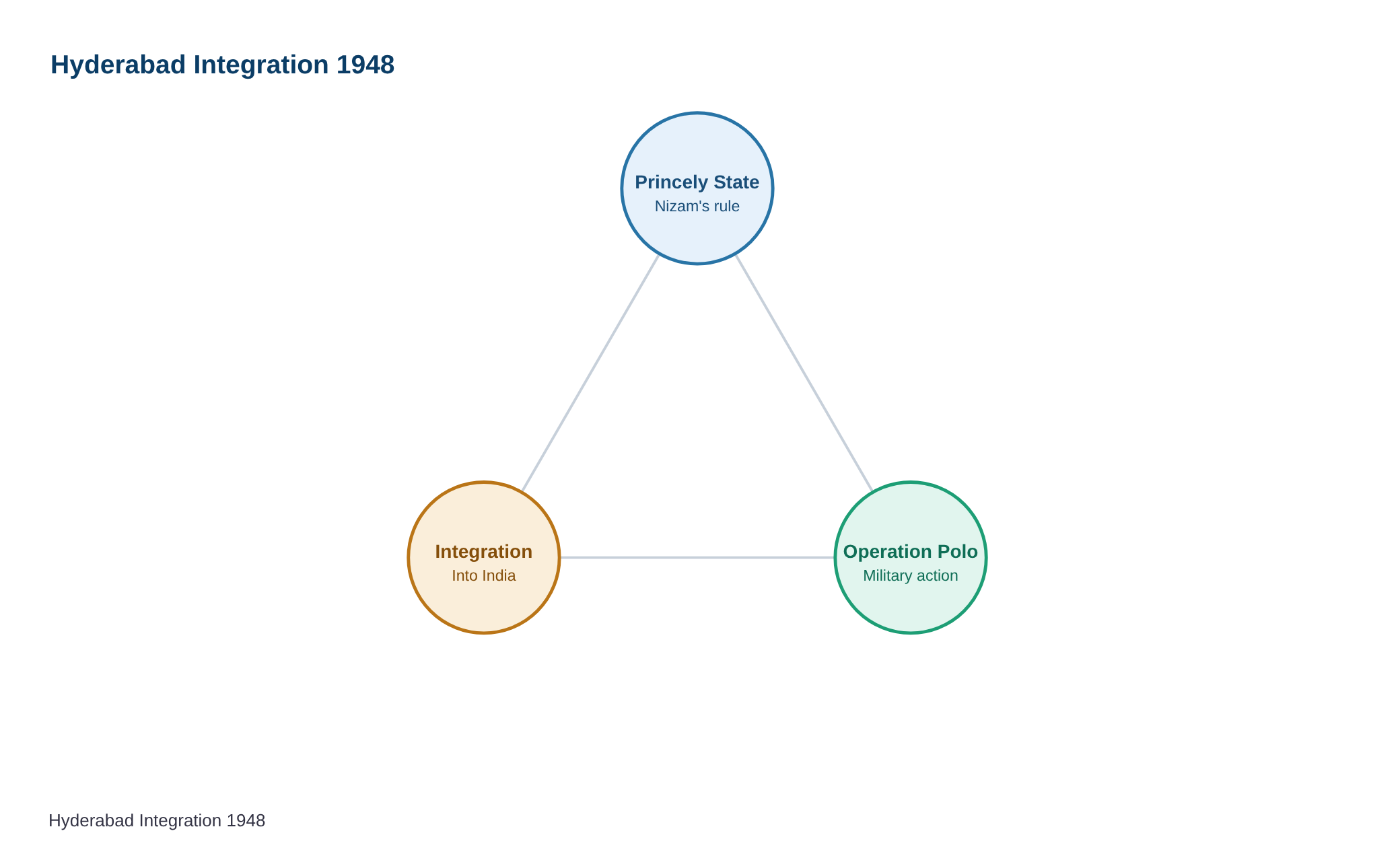
Princely State of Hyderabad under Nizam’s rule → Operation Polo (1948) → Integration into Dominion of India → Formation of Hyderabad State (1950) → States Reorganisation Act (1956) → Formation of Andhra Pradesh and later Telangana (2014) → Commemoration of Hyderabad Liberation Day (2026). → Integration of Hyderabad State → Strengthening of national unity and integrity → Constitutional provisions (Article 1, Seventh Schedule) → Role of Union Government in territorial consolidation. → Historical narrative of Hyderabad → Cultural syncretism → Commemoration through cultural programmes and exhibitions → Reinforcement of national identity. → Government of India’s outreach to regional stakeholders → Inclusive governance → Participation of state governors, ministers, and local representatives. → Central armed police forces’ parade → Symbolic display of national preparedness → Upholding internal security and sovereignty. → Educational outreach through exhibitions and quizzes → Enhancing historical awareness among students → Fostering civic consciousness.
Prelims Practice Questions
Q1. Consider the following statements regarding the integration of the Hyderabad State into the Indian Union:
1. The Hyderabad State was integrated through the Instrument of Accession signed by the Nizam.
2. The integration was achieved through a military operation codenamed ‘Operation Polo’.
3. The integration was completed before the adoption of the Constitution of India in 1950.
How many of the above statements are correct?
- Only one
- Only two
- All three
- None
Answer: Only two — Statement 1 is incorrect because the Nizam did not sign the Instrument of Accession; instead, the integration was enforced through military action. Statement 2 is correct as ‘Operation Polo’ was the military operation that led to the integration. Statement 3 is incorrect because the integration occurred in 1948, before the Constitution came into force in 1950.
Q2. Assertion (A): The integration of the Hyderabad State into the Indian Union was a significant milestone in the consolidation of India’s territorial integrity.
Reason (R): The integration was achieved through a combination of military action and diplomatic negotiations, ensuring the accession of the princely state without a referendum.
- Both A and R are true, and R is the correct explanation of A
- Both A and R are true, but R is not the correct explanation of A
- A is true, but R is false
- A is false, but R is true
Answer: Both A and R are true, and R is the correct explanation of A — The assertion (A) is correct as the integration of Hyderabad was pivotal in consolidating India’s territorial integrity. The reason (R) is also correct and directly explains the assertion, as the integration was achieved through military action (‘Operation Polo’) and diplomatic efforts, without a referendum.
Q3. Match the following princely states with the year of their integration into the Indian Union:
Column I (Princely State) | Column II (Year of Integration)
1. Junagadh | A. 1947
2. Hyderabad | B. 1948
3. Jammu and Kashmir | C. 1949
4. Manipur | D. 1947 (Accession) & 1949 (Merger)
- 1-A, 2-B, 3-D, 4-C
- 1-D, 2-B, 3-A, 4-C
- 1-B, 2-A, 3-D, 4-C
- 1-A, 2-C, 3-B, 4-D
Answer: 1-A, 2-B, 3-D, 4-C — Junagadh was integrated in 1947, Hyderabad in 1948, Jammu and Kashmir acceded in 1947 but was fully integrated by 1949, and Manipur was integrated in 1949.
Mains Practice Question
✍ The integration of the Hyderabad State into the Indian Union in 1948 represents a critical episode in the consolidation of India’s territorial integrity. Critically examine the historical, political, and constitutional dimensions of this integration. Also, analyse how this episode reflects the broader challenges of integrating princely states in post-colonial India. (15 Marks)
Approach: MODEL-ANSWER SKELETON:
1. **Historical Context**:
– Brief background of the Hyderabad State under the Nizam and its semi-autonomous status under the British Paramountcy.
– The demand for integration by the Indian National Congress and the Telangana Rebellion (1946-48).
2. **Political Dimensions**:
– The role of Sardar Vallabhbhai Patel and the States Department in negotiating the integration.
– The failure of diplomatic negotiations and the military action codenamed ‘Operation Polo’ (13-18 September 1948).
– The immediate aftermath: imposition of military governance and subsequent civil administration.
3. **Constitutional Dimensions**:
– Legal basis for integration: Article 3 of the Constitution of India (adopted in 1950) and the States Reorganisation Act, 1956.
– The concept of ‘Police Action’ and its constitutional validity under the Government of India Act, 1935.
– The role of the National Integration Council in addressing post-integration challenges.
4. **Broader Challenges of Princely State Integration**:
– Comparative analysis with other princely states (e.g., Junagadh, Jammu and Kashmir, Manipur).
– The dilemma of popular consent vs. coercive integration and its implications for democratic governance.
– The role of cultural and linguistic identity in post-integration state formation (e.g., formation of Andhra Pradesh in 1956).
5. **Contemporary Relevance**:
– The celebration of ‘Hyderabad Liberation Day’ as a symbol of national unity and historical memory.
– Lessons for contemporary debates on federalism, regional autonomy, and the preservation of cultural heritage.
6. **Conclusion**:
– Balance between national integration and respect for regional identities.
– The integration of Hyderabad as a case study in the broader narrative of India’s nation-building.
Source: PIB (Press Information Bureau)
Telangana PCS (TGPSC (TSPSC)) — State PCS Practice
Prelims: Where will the ‘Hyderabad Liberation Day’ celebrations be held in Telangana, as per recent announcements?
- A. Sardar Patel Stadium, Hyderabad
- B. Parade Ground, Secunderabad
- C. Public Gardens, Hyderabad
- D. Raj Bhavan Grounds, Hyderabad
Answer: B. Parade Ground, Secunderabad — The ‘Hyderabad Liberation Day’ celebrations will be held at the Parade Ground in Secunderabad, as announced by the state government.
Mains: Discuss the significance of ‘Hyderabad Liberation Day’ in the context of Telangana’s state formation and its impact on the socio-political landscape of the region.
Generated by AanyaAi for educational purpose.
Related guides on our sites
- Current affairs for upsc 2026
- UPSC History optional
- Is history a good optional for upsc exam
- Best history optional teacher for UPSC

- स्वच्छता ही सेवा अभियान 2026: सामाजिक न्याय विभाग की बड़ी पहल, जानिए क्या है लक्ष्य - September 17, 2026
- Social Justice Dept Launches ‘Swachhata Hi Seva’ Campaign 2026 for UPSC & PCS - September 17, 2026
- प्रधानमंत्री मोदी ने पश्चिम बंगाल में अन्नपूर्णा योजना की चौथी किस्त जारी की - September 17, 2026

No Comments