


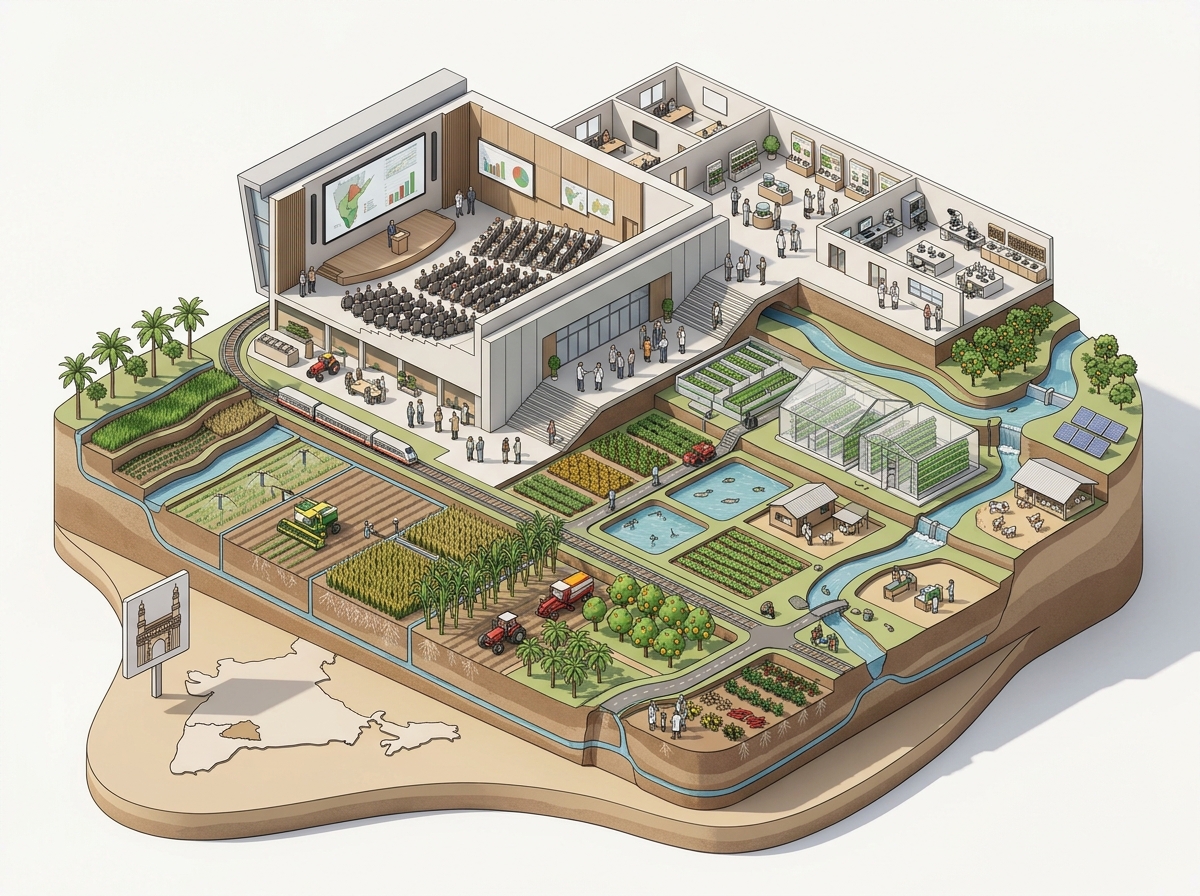
18 Sep Hyderabad to Host South Regional Agriculture Conference on Sustainable Farming
✎ Regional Agricultural Conclaves are institutionalised platforms under the Ministry of Agriculture to operationalise cooperative federalism in agriculture, combining state-level innovations with national priorities for sustainable…
Subject Relevance — Where This Topic Fits
- GS Paper III — Agriculture, Food Processing and Related Issues | GS Paper III — Technology Missions and Digital Initiatives in Agriculture
- Prelims: Regional Agricultural Conclaves, Digital Agriculture, Farmer Registry, Precision Farming, Integrated Farming Systems, Natural Farming, Food Processing Infrastructure, Pesticide and Fertilizer Regulation
- Essay: The Role of Technology in Transforming Indian Agriculture, Sustainable Farming as a Pathway to Rural Prosperity
Quick Revision: Regional Agricultural Conclaves are institutionalised platforms under the Ministry of Agriculture to operationalise cooperative federalism in agriculture, combining state-level innovations with national priorities for sustainable and resilient farming.
Why is this in the news?
The Union Ministry of Agriculture and Farmers’ Welfare, Government of India, is convening the South Regional Agricultural Conclave in Hyderabad on 18 September 2026 to deliberate on sustainable and resilient agricultural practices. This conclave is significant as it brings together central and state governments, agricultural research institutions, progressive farmers, and industry stakeholders to identify actionable strategies for enhancing agricultural productivity, climate resilience, and market integration in South India.
Background
- The Indian agricultural sector faces dual challenges of ensuring food security and adapting to climate change while maintaining ecological balance.
- South India, comprising eight states and union territories, contributes significantly to the national output of horticulture, pulses, and oilseeds but remains vulnerable to monsoon variability and input market distortions.
- The Government of India has prioritised agricultural sustainability through initiatives such as the National Mission for Sustainable Agriculture (NMSA), Paramparagat Krishi Vikas Yojana (PKVY), and Digital Agriculture Mission.
- Regional agricultural conclaves are institutional mechanisms to foster cooperative federalism, enabling states to share best practices and align with national priorities.
- The conclave aligns with the broader objective of achieving self-reliance in edible oils and pulses, reducing import dependence, and promoting high-value horticulture.
- Institutional frameworks like the Indian Council of Agricultural Research (ICAR) and state agricultural universities play a pivotal role in knowledge dissemination and technology adoption.
What is the South Regional Agricultural Conclave?
- A high-level policy forum organised by the Union Ministry of Agriculture and Farmers’ Welfare to facilitate dialogue between central and state governments on agricultural sustainability and resilience.
- Focus areas include digital agriculture, farmer registries, precision farming, integrated farming systems, natural farming, balanced fertiliser management, and regulatory measures against spurious pesticides and fertilisers.
- The conclave serves as a platform for states to showcase innovative agricultural practices and successful models, such as Telangana’s Rythu Nestham, Andhra Pradesh’s climate-resilient agriculture strategies, Karnataka’s improved pulse production techniques, Kerala’s procurement and market initiatives, and Tamil Nadu’s precision and high-tech farming systems.
- Aims to strengthen centre-state coordination, share and scale successful initiatives, and develop targeted strategies for achieving self-reliance in food oils and pulses, high-value horticulture, and climate-adaptive agriculture.
- Includes participation from ICAR institutions, progressive farmers, agri-startups, and market intermediaries to ensure multi-stakeholder engagement.
- Emphasises the development of robust infrastructure for storage, processing, value addition, and marketing to enhance farm incomes and reduce post-harvest losses.
- Serves as a precursor to national-level policy formulation, integrating state-level innovations into national agricultural development frameworks.
Key Features
| Feature | Significance |
|---|---|
| Regional Agricultural Conclave (South) | Facilitates multi-stakeholder deliberation among Centre, southern states, ICAR institutions, and farmers to align agricultural priorities and share best practices. |
| Digital Agriculture & Farmer Registry | Enables precision farming, real-time data analytics, and targeted policy interventions through digitised land records and farmer profiles. |
| High-Value Horticulture & Value Addition | Promotes crop diversification, export competitiveness, and farmer income enhancement via post-harvest processing and market linkages. |
| Self-Reliance in Edible Oils & Pulses | Addresses import dependency through promotion of oilseed and pulse cultivation, integrated farming systems, and balanced fertiliser use. |
| Natural Farming & Integrated Systems | Advocates agroecological practices (e.g., zero-budget farming, crop-livestock integration) to reduce input costs and soil degradation. |
| Anti-Adulteration Measures for Agri-Inputs | Strengthens regulatory frameworks to curb spurious pesticides and fertilisers, ensuring quality and farmer welfare. |
Why it Matters
Economic
- Enhances agricultural productivity and farmer incomes through technology adoption, value addition, and market integration.
- Reduces import dependency in edible oils and pulses, improving trade balance and food security.
- Boosts high-value horticulture exports, contributing to rural employment and foreign exchange earnings.
Strategic
- Strengthens Centre-state coordination for uniform policy implementation and resource allocation in agriculture.
- Promotes climate-resilient agriculture to mitigate risks from erratic monsoons and extreme weather events.
- Ensures food supply chain resilience via improved storage, processing, and marketing infrastructure.
Environmental
- Encourages sustainable farming practices (e.g., natural farming, integrated systems) to reduce chemical use and soil degradation.
- Integrates climate-smart agriculture to adapt to changing weather patterns and reduce carbon footprint.
- Promotes biodiversity conservation through crop diversification and agroforestry models.
Social
- Empowers small and marginal farmers through digital tools, access to credit, and market linkages.
- Facilitates knowledge exchange between progressive farmers and research institutions for scalable innovations.
- Enhances gender inclusivity by integrating women farmers into decision-making processes and value chains.
Challenges
1. Fragmented Policy Implementation
- Divergent state-level agricultural policies hinder uniform adoption of national priorities.
- Lack of convergence between Centre and state schemes delays impact on ground-level outcomes.
UPSC Link: GS-II: Centre-State Relations
2. Agricultural Input Market Distortions
- Pervasive issue of spurious pesticides and fertilisers undermines crop productivity and farmer trust.
- Price volatility in agri-inputs (seeds, fertilisers) disrupts long-term planning for farmers.
UPSC Link: GS-III: Agricultural Marketing
3. Climate Vulnerability & Resource Constraints
- Erratic monsoons and rising temperatures threaten crop yields and soil health.
- Groundwater depletion and soil degradation limit sustainable intensification of agriculture.
UPSC Link: GS-III: Conservation, Environmental Pollution
4. Digital Divide & Farmer Awareness Gaps
- Limited digital literacy among smallholders restricts adoption of precision farming tools.
- Inadequate extension services delay dissemination of best practices and technological innovations.
UPSC Link: GS-III: Technology Missions
5. Market Access & Post-Harvest Losses
- Inadequate storage and processing infrastructure leads to 15-20% post-harvest losses annually.
- Weak market linkages and price discovery mechanisms disadvantage small farmers.
UPSC Link: GS-III: Food Processing Industries
Challenges — UPSC Perspective
| Issue | Concern |
|---|---|
| Spurious Agri-Inputs | Undermines productivity, increases costs, and erodes farmer confidence in formal markets. |
| Climate-Induced Yield Variability | Threatens food security and farmer livelihoods due to erratic rainfall and temperature shifts. |
| Low Digital Literacy | Hinders adoption of farmer registries, e-NAM, and precision agriculture tools. |
| Post-Harvest Infrastructure Gaps | Results in significant food loss and reduces income realisation for farmers. |
| Policy Fragmentation | Delays implementation of national schemes due to state-level bureaucratic hurdles. |
| Market Price Volatility | Exposes farmers to income instability and reduces incentive for long-term investments. |
Government Initiatives — Must-Memorise for Prelims
- National Mission on Sustainable Agriculture (NMSA)
- Paramparagat Krishi Vikas Yojana (PKVY)
- Sub-Mission on Agricultural Mechanization (SMAM)
- Mission for Integrated Development of Horticulture (MIDH)
- National Mission on Oilseeds and Oil Palm (NMOOP)
Way Forward
- Establish a unified digital platform integrating farmer registries, soil health cards, and weather advisories for real-time decision support.
- Strengthen state-level agricultural extension services through public-private partnerships and digital training modules.
- Expand market linkages via e-NAM integration and cluster-based procurement to ensure fair price discovery for perishable produce.
- Promote climate-resilient crop varieties and agroforestry models through ICAR-led research and farmer participatory trials.
- Enforce stringent quality control for agri-inputs via third-party audits and QR-code-based tracking systems.
- Develop decentralised storage and processing hubs in high-production clusters to reduce post-harvest losses.
- Incentivise natural farming adoption through direct benefit transfers and certification support for export markets.
- Conduct annual regional conclaves to review progress, share innovations, and align Centre-state priorities.
UPSC Value Addition
Keywords for Mains Answer-Writing
Sustainable Agriculture · Climate-Resilient Farming · Digital Agriculture · Farmer Registry · Natural Farming · Integrated Farming Systems · Precision Farming · Food Self-Sufficiency · High-Value Horticulture · Balanced Fertilizer Management · Pesticide Regulation · Agricultural Infrastructure · Centre-State Coordination in Agriculture · ICAR Institutions · Climate-Smart Agriculture · Value Addition in Agriculture
Constitutional & Policy Linkages
- Article 246: Distribution of Legislative Powers (Agriculture is State Subject, Entry 14 of List II)
- Article 39(b): Directive Principle of State Policy (Promotion of welfare-oriented agricultural policies)
- Article 48: Directive Principle of State Policy (Organisation of agriculture and animal husbandry on modern lines)
Concept Flow
Climate variability and input market distortions → Reduced agricultural productivity and farmer incomes → Regional conclaves for policy alignment → Regional conclaves → Identification of state-specific innovations (e.g., Telangana’s Rythu Nestham) → Scalable best practices → Best practices adoption → Digital agriculture integration (farmer registries, e-NAM) → Enhanced market access and income → Market access improvements → Increased high-value horticulture production → Export competitiveness and import substitution → Export competitiveness → Strengthened food security and trade balance → Sustainable agricultural growth → Sustainable growth → Reduced chemical use and soil degradation → Climate-resilient agriculture adoption → Climate-resilient agriculture → Mitigated climate risks for smallholders → Enhanced rural livelihoods and food security
Prelims Practice Questions
Q1. Consider the following statements regarding the South Regional Agricultural Conference held in Hyderabad:
1. The conference primarily focuses on sustainable and climate-resilient agriculture.
2. It includes discussions on digital agriculture and farmer registries.
3. The conference aims to achieve self-sufficiency in food oils and pulses.
4. The conference is attended exclusively by central government officials and excludes state-level stakeholders.
How many of the above statements are correct?
- Only one
- Only two
- Only three
- All
Answer: Only three — Statements 1, 2, and 3 are correct as per the conference objectives. Statement 4 is incorrect because the conference involves both central and state-level stakeholders, including ministers and officials from southern states and union territories.
Q2. Assertion (A): The South Regional Agricultural Conference emphasizes the adoption of natural farming practices to enhance sustainability.
Reason (R): Natural farming reduces dependence on synthetic fertilizers and pesticides, aligning with climate-resilient agriculture goals.
Options:
A. Both A and R are true, and R is the correct explanation of A.
B. Both A and R are true, but R is not the correct explanation of A.
C. A is true, but R is false.
D. A is false, but R is true.
Answer: ? — Assertion (A) is true as the conference includes discussions on natural farming. Reason (R) is also true and correctly explains the assertion, as natural farming indeed reduces reliance on synthetic inputs and supports climate resilience.
Q3. Match the following states with their respective agricultural innovations or best practices showcased at the South Regional Agricultural Conference:
State Innovation/Best Practice
1. Telangana A. Precision Farming and High-Tech Agriculture
2. Andhra Pradesh B. Rythu Nestham (Farmer Welfare)
3. Karnataka C. Weather Variability Management Approach
4. Tamil Nadu D. Enhanced Pulses Production Practices
Options:
A. 1-B, 2-C, 3-D, 4-A
B. 1-A, 2-B, 3-C, 4-D
C. 1-D, 2-A, 3-B, 3-C
D. 1-C, 2-D, 3-A, 4-B
Answer: ? — The correct matches are: 1-B (Telangana: Rythu Nestham), 2-C (Andhra Pradesh: Weather Variability Management), 3-D (Karnataka: Enhanced Pulses Production), and 4-A (Tamil Nadu: Precision Farming and High-Tech Agriculture).
Mains Practice Question
✍ The South Regional Agricultural Conference in Hyderabad underscores the necessity of transitioning from conventional agriculture to climate-resilient and sustainable farming systems. Critically examine the key pillars of this transition, with special reference to the initiatives highlighted in the conference. Also, assess the role of digital agriculture and farmer registries in achieving these objectives. (15 Marks)
Approach: MODEL-ANSWER SKELETON:
1. **Introduction (2 marks)**
– Briefly define sustainable and climate-resilient agriculture.
– Mention the context: South Regional Agricultural Conference, Hyderabad, 2026.
2. **Key Pillars of Transition (6 marks)**
– **Natural Farming**: Explain its principles (zero synthetic inputs, soil health focus) and its inclusion in the conference.
– **Integrated Farming Systems**: Discuss the integration of crops, livestock, and aquaculture for resource efficiency.
– **Balanced Fertilizer Management**: Highlight the need for soil testing, site-specific nutrient management, and organic inputs.
– **Self-Sufficiency in Food Oils and Pulses**: Link to the conference’s emphasis on reducing import dependence.
– **High-Value Horticulture and Value Addition**: Discuss the shift from staple crops to high-value produce and processing.
3. **Role of Digital Agriculture and Farmer Registries (5 marks)**
– **Digital Agriculture**: Explain how technologies like AI, IoT, and remote sensing can optimize resource use, improve yield predictions, and enhance decision-making.
– **Farmer Registries**: Discuss the benefits of a centralized digital registry (e.g., PM-KISAN, Soil Health Card) for targeted interventions, subsidy disbursement, and market linkages.
– **Challenges**: Highlight issues like digital divide, data privacy, and interoperability between state and central systems.
4. **Conclusion (2 marks)**
– Summarize the importance of a multi-pronged approach combining technological, policy, and institutional reforms.
– Emphasize the need for Centre-State coordination and stakeholder collaboration as highlighted in the conference.
Source: PIB (Press Information Bureau)
Telangana PCS (TGPSC (TSPSC)) — State PCS Practice
Prelims: The Southern Regional Agricultural Conference held in Hyderabad in 2023 focused on which of the following themes?
- Sustainable and resilient agriculture
- Digital transformation in rural India
- Climate change mitigation strategies
- Agro-based industrialization
Answer: Sustainable and resilient agriculture — The conference specifically deliberated on sustainable and resilient farming practices to address climate challenges and food security.
Mains: Discuss the key recommendations of the Southern Regional Agricultural Conference (2023) held in Hyderabad for promoting sustainable and resilient agriculture in Telangana. Highlight the role of government policies and community participation in implementation.
Generated by AanyaAi for educational purpose.
Related guides on our sites
- How to prepare for GS paper 1 for UPSC CSE mains exam
- Best UPSC coaching for IFOS exam
- Best agriculture optional coaching
- Best geography optional coaching

- Shivraj Singh Chouhan Urges Southern States to Fast-Track Agricultural Reforms for UPSC 2026 - September 18, 2026
- भारतीय नौसेना के लिए दूसरी पीढ़ी के मिसाइल पोत की स्टील कटिंग: आत्मनिर्भरता की दिशा में बड़ा कदम - September 18, 2026
- UPSC Alert: Indian Navy’s 2nd Next-Gen Missile Vessel Steel Cutting at CSL Kochi - September 18, 2026

No Comments