


25 Sep ICAI to integrate AI, Data Analytics in Revamped CA Curriculum 2026
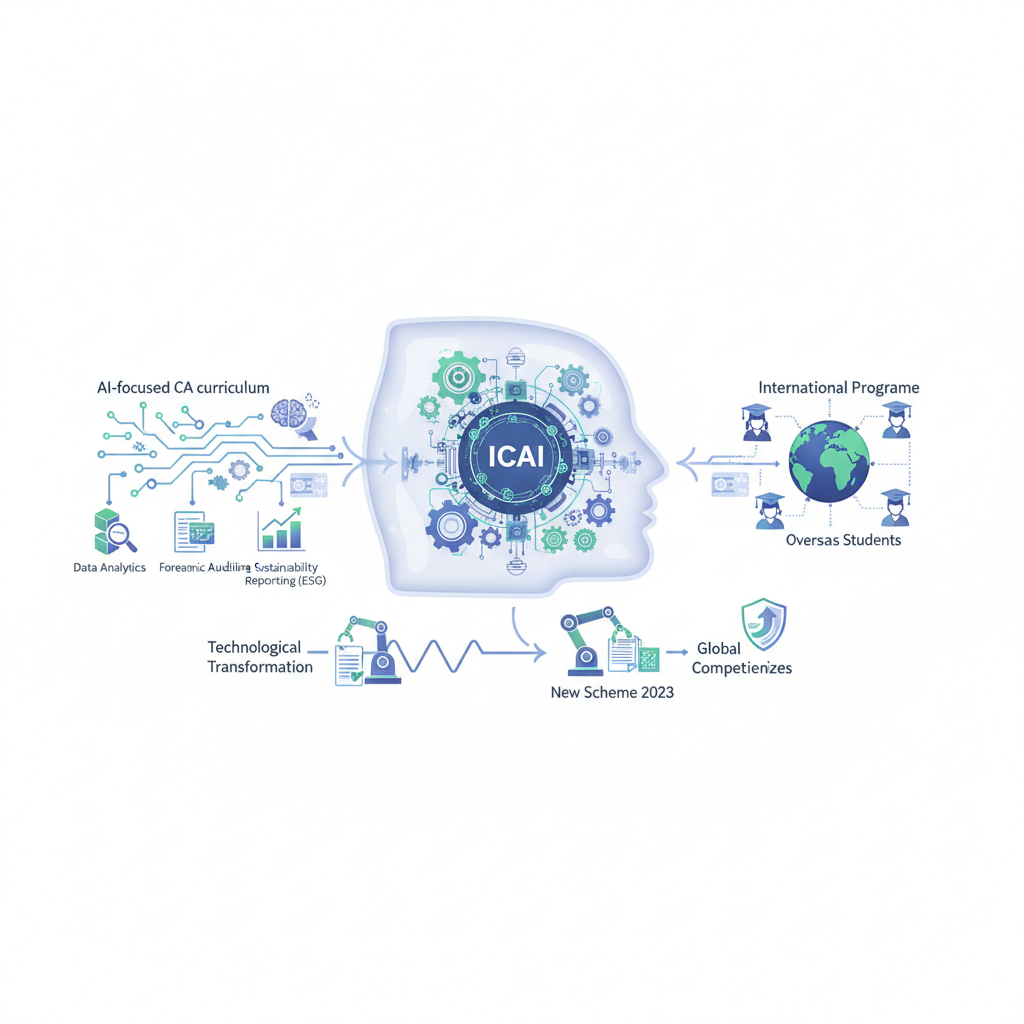
✎ ICAI’s curriculum reform integrates AI, data analytics, forensic auditing, and ESG criteria into the Chartered Accountancy framework via the CRET committee, aligning with the New Scheme of Education and Training (2023) to enhance…
Subject Relevance — Where This Topic Fits
- GS Paper III — Indian Economy and issues relating to planning, mobilization of resources, growth, development and employment | GS Paper III — Role of technology in governance, including e-governance- applications, models, successes, limitations, and potential; Science and Technology- developments and their applications and effects in everyday life
- Prelims: Chartered Accountancy (CA) curriculum, Committee for Review of Education and Training (CRET), Artificial Intelligence (AI), Data Analytics, Forensic Auditing, ESG (Environmental, Social, and Governance), ICAI, AURA programme, AI Certificate Course for Chartered Accountants (AICA), New Scheme of Education and Training (2023)
- Essay: The intersection of technology and traditional professions: Challenges and opportunities for India’s workforce, Reforming professional education to meet the demands of a digital economy
Quick Revision: ICAI’s curriculum reform integrates AI, data analytics, forensic auditing, and ESG criteria into the Chartered Accountancy framework via the CRET committee, aligning with the New Scheme of Education and Training (2023) to enhance professional relevance and global competitiveness.
Why is this in the news?
The Institute of Chartered Accountants of India (ICAI) has announced a comprehensive review of the Chartered Accountancy (CA) curriculum to incorporate artificial intelligence (AI), data analytics, forensic auditing, and sustainability reporting, including Environmental, Social, and Governance (ESG) criteria. This reform is driven by the rapid technological transformation in the accounting profession and aims to future-proof the qualification for global competitiveness. The initiative follows the introduction of the New Scheme of Education and Training in 2023 and aligns with ICAI’s ongoing efforts to enhance the employability of newly qualified CAs through technology-integrated training programmes.
Background
- The accounting profession is undergoing a paradigm shift due to advancements in artificial intelligence, machine learning, and data analytics, necessitating a corresponding evolution in professional education.
- ICAI, the statutory body regulating the Chartered Accountancy profession in India, introduced the New Scheme of Education and Training in 2023 to modernise the CA curriculum and align it with contemporary professional demands.
- The Institute has already introduced standalone training programmes such as the Artificial Intelligence Understanding for Rising Achievers (AURA) to equip members and students with foundational and advanced AI competencies.
- The placement data for 2026 indicates strong demand for CAs, with nearly 8,000 vacancies offered against 5,834 candidates, underscoring the need for a curriculum that bridges the skill gap in emerging technologies.
- The Committee for Review of Education and Training (CRET) has been constituted to systematically review and recommend reforms to the CA education and training framework, including syllabus, practical training, and examination methods.
- ICAI’s initiative reflects a broader trend among professional bodies worldwide to integrate technology-driven competencies into traditional qualifications to enhance professional relevance and global mobility.
What is the ICAI’s initiative to reform the Chartered Accountancy curriculum?
- The Institute of Chartered Accountants of India (ICAI) is reviewing the Chartered Accountancy (CA) curriculum to incorporate artificial intelligence (AI), data analytics, forensic auditing, and sustainability reporting, including Environmental, Social, and Governance (ESG) criteria.
- The reform is being undertaken by the Committee for Review of Education and Training (CRET), which will examine syllabus design, practical training, soft skills, communication training, and examination methods to align the programme with industry requirements.
- The CRET is expected to complete its recommendations by December, following which they will be placed in the public domain for feedback and discussion before finalisation.
- ICAI has already introduced technology-focused training programmes such as the Artificial Intelligence Understanding for Rising Achievers (AURA) to equip students and members with AI competencies.
- The AURA programme, now in its second phase (AURA 2.0), focuses on practical applications of AI in finance, audit, and taxation, ensuring hands-on exposure to emerging tools and technologies.
- The reform aims to future-proof the CA qualification by integrating technology-driven competencies, thereby enhancing the employability and global competitiveness of Indian CAs.
- The initiative also includes plans to introduce an international programme for overseas students, expanding the reach and relevance of the CA qualification beyond India.
Key Features
| Feature | Significance |
|---|---|
| AI-focused CA curriculum | Aligns the Chartered Accountancy (CA) qualification with the technological transformation of the accounting profession, ensuring future-ready professionals equipped to handle AI-driven financial systems and audits. |
| Data analytics integration | Enables CAs to process large datasets efficiently, detect anomalies, and derive actionable insights, enhancing audit quality and risk assessment in compliance with global standards. |
| ESG and sustainability modules | Equips CAs to assess non-financial risks and opportunities, aligning with international reporting frameworks such as the Global Reporting Initiative (GRI) and the Task Force on Climate-related Financial Disclosures (TCFD). |
| Forensic auditing component | Strengthens the detection and prevention of financial fraud, money laundering, and cybercrimes, reinforcing the integrity of financial systems and regulatory compliance. |
| International programme for overseas students | Expands the global footprint of the CA qualification, facilitating cross-border mobility of Indian accountants and harmonising professional standards with international best practices. |
Why it Matters
Professional Competitiveness
- Bridges the skill gap between traditional accounting education and the evolving demands of the industry, ensuring Indian CAs remain globally competitive in an AI-driven economy.
- Enhances employability by embedding practical technology skills in the CA curriculum, aligning with the requirements of multinational corporations and financial institutions.
Regulatory and Governance Impact
- Strengthens the capacity of CAs to perform statutory audits and forensic investigations, thereby improving corporate governance and reducing financial misreporting risks.
- Facilitates compliance with international financial reporting standards (IFRS) and sustainability disclosures, positioning India as a leader in global financial governance.
Technological Adaptation
- Positions the CA profession at the forefront of digital transformation, enabling professionals to leverage AI, machine learning, and data analytics for predictive financial modelling and real-time decision-making.
- Supports the adoption of automation in routine accounting tasks, allowing CAs to focus on strategic advisory roles and value-added services.
Educational Reforms
- Demonstrates the importance of continuous curriculum review in professional education to keep pace with technological advancements and industry needs.
- Sets a precedent for other professional bodies (e.g., ICMAI, ICSI) to integrate emerging technologies into their respective education frameworks.
Challenges
1. Curriculum Design and Implementation
- Balancing the integration of AI and data analytics without diluting core accounting principles, ensuring a robust foundational knowledge base.
- Developing pedagogical methods that effectively teach abstract AI concepts to students with varying levels of technical proficiency.
UPSC Link: GS-II: Education System
2. Faculty Training and Capacity Building
- Ensuring that faculty members possess the requisite expertise in AI, data analytics, and forensic auditing to deliver the revised curriculum effectively.
- Addressing the resource constraints in institutions offering CA education, particularly in tier-2 and tier-3 cities.
UPSC Link: GS-II: Human Resource Development
3. Industry-Academia Collaboration
- Establishing robust partnerships with technology firms, financial institutions, and audit firms to provide practical exposure and internships for CA students.
- Ensuring that the curriculum remains aligned with industry trends through regular feedback mechanisms and advisory roles for professionals.
UPSC Link: GS-III: Industrial Policy
4. Examination and Assessment Reforms
- Redesigning examination formats to evaluate not only theoretical knowledge but also practical application of AI tools and data analytics in accounting scenarios.
- Addressing concerns of subjectivity and consistency in evaluating soft skills and communication abilities within the new curriculum.
UPSC Link: GS-II: Examination Reforms
5. Global Recognition and Standardisation
- Ensuring that the international programme for overseas students meets the accreditation standards of foreign accounting bodies (e.g., AICPA, ACCA) to facilitate mutual recognition.
- Harmonising the CA curriculum with international frameworks to avoid duplication of efforts and reduce barriers to global professional mobility.
UPSC Link: GS-II: International Organisations
Challenges — UPSC Perspective
| Issue | Concern |
|---|---|
| Resource allocation for faculty training | Limited availability of trainers with expertise in AI and data analytics in CA coaching institutions. |
| Resistance to change among traditional practitioners | Skepticism about the relevance of AI in core accounting functions, leading to slow adoption of new modules. |
| High costs of technology integration | Significant investment required for software licences, hardware upgrades, and digital infrastructure in educational institutions. |
| Ensuring inclusivity across regions | Variations in access to technology and internet connectivity between urban and rural CA coaching centres. |
| Balancing theoretical and practical content | Risk of overemphasising technology at the expense of foundational accounting and taxation principles. |
Way Forward
- Conduct pilot programmes in select CA coaching centres to test the revised curriculum and gather feedback from students and faculty before full-scale implementation.
- Establish a dedicated fund under the Ministry of Corporate Affairs to support technology integration in CA education institutions, particularly in underserved regions.
- Develop a national-level digital platform for CA students to access AI tools, case studies, and interactive learning modules, in collaboration with technology partners.
- Introduce mandatory internships with AI-driven audit firms and financial institutions to provide hands-on exposure to emerging technologies.
- Organise regular industry-academia conclaves to align the curriculum with evolving industry needs and technological advancements.
- Strengthen the CRET’s mandate to include periodic reviews of the curriculum, ensuring it remains responsive to global trends and regulatory changes.
- Expand the AICA (AI Certificate Course for Chartered Accountants) to include regional language modules, enhancing accessibility for non-English-speaking professionals.
- Collaborate with international accounting bodies to develop a mutual recognition framework for the CA qualification, facilitating global mobility.
UPSC Value Addition
Keywords for Mains Answer-Writing
Institute of Chartered Accountants of India (ICAI) · Chartered Accountancy curriculum reform · Artificial Intelligence in finance · Data analytics in accounting · Forensic auditing · Environmental, Social, and Governance (ESG) reporting · Committee for Review of Education and Training (CRET) · New Scheme of Education and Training 2023 · AI Certificate Course for Chartered Accountants (AICA) · Professional education and technological adaptation · Sustainability accounting · Globalisation of professional education
Concept Flow
Rapid advancements in AI and data analytics → Disruption in traditional accounting practices → Need for skill upgradation in the CA profession. → ICAI’s Committee for Review of Education and Training (CRET) constituted → Curriculum review initiated with focus on AI, data analytics, and forensic auditing. → New modules integrated into CA syllabus → Practical training and internships introduced to enhance employability. → International programme launched for overseas students → Expansion of CA qualification’s global recognition and mobility. → Faculty training programmes conducted → Capacity building to deliver the revised curriculum effectively. → Industry partnerships established → Alignment of education with industry demands and technological trends. → Examination reforms introduced → Assessment methods updated to evaluate practical application of new skills.
Prelims Practice Questions
Q1. Consider the following statements regarding the Committee for Review of Education and Training (CRET) constituted by the Institute of Chartered Accountants of India (ICAI):
1. The CRET is mandated to review the syllabus, practical training, and examination methods of the Chartered Accountancy course.
2. The CRET is expected to complete its work by December 2026.
3. The CRET’s recommendations will be placed in the public domain for feedback and discussion.
How many of the above statements are correct?
- Only one
- Only two
- Only three
- None
Answer: Only three — Statements 1 and 3 are correct as per the ICAI’s stated objectives for CRET. Statement 2 is incorrect as the committee is expected to complete its work by December 2026, not 2026.
Q2. Assertion (A): The Institute of Chartered Accountants of India (ICAI) has introduced the Artificial Intelligence Certificate Course for Chartered Accountants (AICA) to enhance the technological competencies of its members.
Reason (R): The AICA programme is designed to provide foundational and advanced training in AI applications relevant to finance, audit, and taxation.
Options:
A. Both A and R are true, and R is the correct explanation of A.
B. Both A and R are true, but R is not the correct explanation of A.
C. A is true, but R is false.
D. A is false, but R is true.
Answer: ? — Both the assertion and reason are true, and the reason correctly explains the assertion as AICA is explicitly introduced to train members in AI applications for finance, audit, and taxation.
Q3. Match the following programmes launched by the Institute of Chartered Accountants of India (ICAI) with their respective focuses:
Programme:
1. Artificial Intelligence Understanding for Rising Achievers (AURA) 1.0
2. AURA 2.0
3. AI Certificate Course for Chartered Accountants (AICA) Level 1
4. AICA Level 2
Focus:
A. Foundational AI concepts and tools for members
B. Advanced applications of AI in finance, audit, and taxation for students
C. Practical applications of AI in finance, audit, and taxation for students
D. Foundational AI concepts and tools for students
- 1-D, 2-C, 3-A, 4-B
- 1-C, 2-D, 3-B, 4-A
- 1-B, 2-A, 3-D, 4-C
- 1-A, 2-B, 3-C, 4-D
Answer: 1-D, 2-C, 3-A, 4-B — The correct match is: AURA 1.0 (1-D) focuses on foundational AI concepts for students, AURA 2.0 (2-C) focuses on practical applications for students, AICA Level 1 (3-A) focuses on foundational AI concepts for members, and AICA Level 2 (4-B) focuses on advanced applications for members.
Mains Practice Question
✍ The Institute of Chartered Accountants of India (ICAI) has undertaken a comprehensive review of the Chartered Accountancy curriculum to integrate artificial intelligence, data analytics, ESG reporting, and forensic auditing. Critically examine the rationale behind this reform and its implications for the future of the accounting profession in India. Also, assess the effectiveness of the Committee for Review of Education and Training (CRET) in addressing the challenges posed by rapid technological change. (15 Marks)
Approach: MODEL-ANSWER SKELETON:
1. **Rationale for Curriculum Reform (6 points)**
– **Technological Disruption**: Explain the impact of AI, data analytics, and automation on traditional accounting functions (e.g., audit trails, fraud detection, financial reporting) citing industry reports or ICAI data.
– **Global Standards**: Reference international frameworks such as the International Federation of Accountants (IFAC) or International Standards on Auditing (ISA) that advocate for integrating technology into professional education.
– **Skill Gaps**: Highlight the demand for tech-savvy professionals in the job market (e.g., ICAI’s placement data: 8,000 vacancies vs. 5,834 candidates) to justify the need for reform.
– **Regulatory Compliance**: Discuss the role of ESG reporting and forensic auditing in meeting statutory requirements (e.g., SEBI’s ESG disclosures, Companies Act 2013 provisions).
– **Professional Relevance**: Argue that the reform aligns with the evolving role of CAs as strategic advisors rather than mere number-crunchers.
– **Inclusivity**: Note the introduction of international programmes to cater to overseas students, reflecting globalisation of the profession.
2. **Implications for the Accounting Profession (5 points)**
– **Positive Implications**:
– Enhanced employability and career prospects for CAs with tech skills.
– Improved audit quality and reduced human error through automation.
– Alignment with global best practices, boosting India’s position in the accounting services sector.
– **Challenges**:
– Resistance from traditional practitioners due to the learning curve.
– High costs of training and infrastructure for ICAI and students.
– Ethical concerns (e.g., bias in AI algorithms, data privacy in forensic auditing).
– **Balancing Act**: Discuss the need to preserve foundational accounting principles while integrating new technologies.
3. **Effectiveness of CRET (4 points)**
– **Strengths**:
– Multi-dimensional review covering syllabus, practical training, soft skills, and examination methods.
– Public consultation phase to ensure stakeholder buy-in.
– Timeline (December 2026 completion) demonstrates urgency and commitment.
– **Limitations**:
– Potential delays in implementation due to bureaucratic hurdles.
– Risk of the reform being too theoretical without adequate hands-on training.
– Need for periodic reviews to keep pace with technological advancements.
– **Conclusion**: Assess whether CRET’s approach is sufficient to future-proof the CA curriculum or if additional measures (e.g., partnerships with tech firms) are required.
Source: The Indian Express
Generated by AanyaAi for educational purpose.
Related guides on our sites

- आईसीएआई ने सीए पाठ्यक्रम में एआई, ईएसजी और वैश्विक कार्यक्रम शामिल करने की योजना बनाई - September 25, 2026
- ICAI to integrate AI, Data Analytics in Revamped CA Curriculum 2026 - September 25, 2026
- भारत-अफ्रीका जल एवं स्वच्छता सहयोग: आईआईडब्ल्यूडब्ल्यू 2026 में गोलमेज सम्मेलन - September 25, 2026

No Comments