


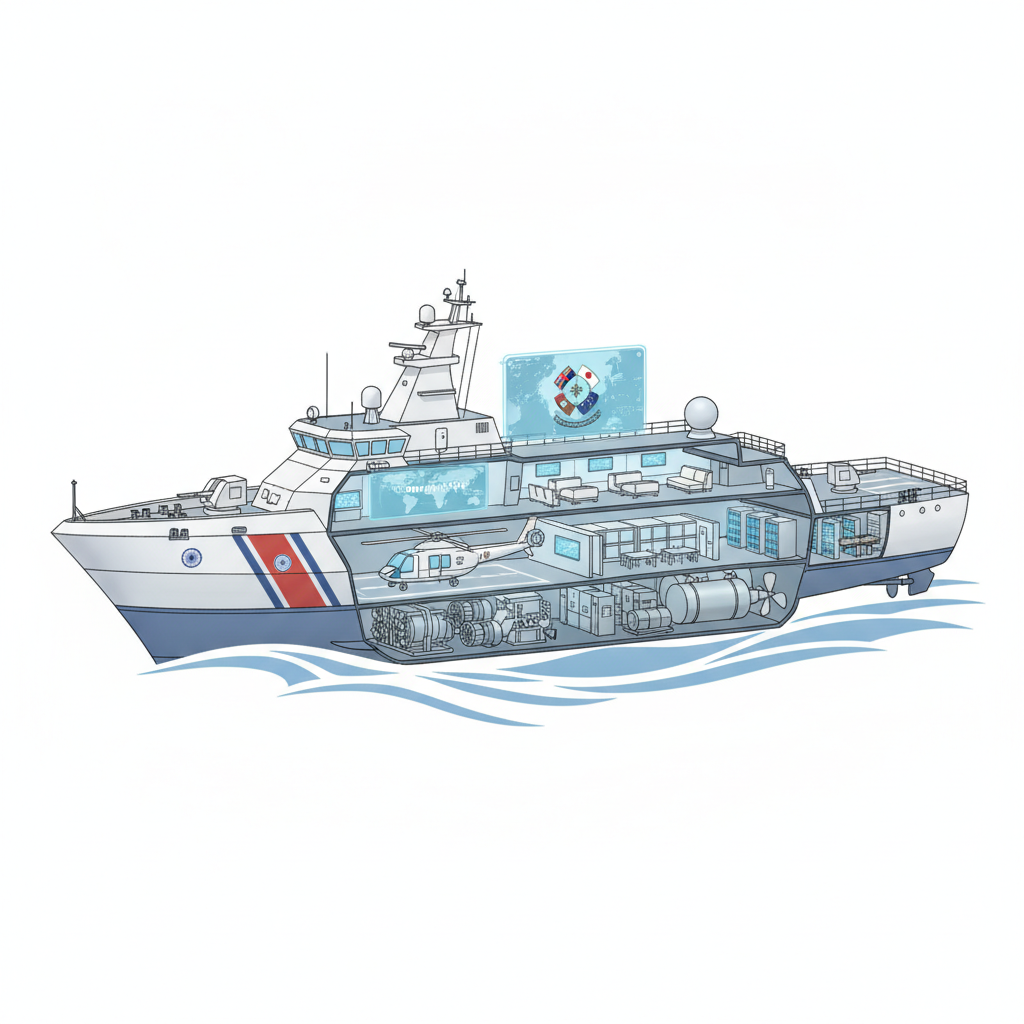
25 Sep ICG Ship Shaunak Embarks on QUAD-at-Sea Observer Mission 2026 for Maritime Cooperation
✎ The Quad-at-Sea Ship Observer Mission is a Quad initiative to enhance maritime cooperation, interoperability, and trust-building among India, Australia, Japan, and the United States through joint operational exercises and…
Subject Relevance — Where This Topic Fits
- GS Paper II — International Relations: Regional and Global Groupings and Agreements Involving India | GS Paper III — Security Challenges and their Management
- Prelims: Quadrilateral Security Dialogue (Quad), Indian Coast Guard (ICG), Hind-Pacific Region, Maritime Domain Awareness, Rules-Based International Order, Maritime Security Cooperation
- Essay: The Role of Multilateralism in Ensuring Global Maritime Security, India’s Strategic Engagement in the Indo-Pacific
Quick Revision: The Quad-at-Sea Ship Observer Mission is a Quad initiative to enhance maritime cooperation, interoperability, and trust-building among India, Australia, Japan, and the United States through joint operational exercises and professional exchanges.
Why is this in the news?
The Indian Coast Guard (ICG) vessel ICGS Shaunak departed from Chennai to Perth on 25 September 2026 under the Quad-at-Sea Ship Observer Mission, marking a significant step in operational collaboration and mutual trust-building among India, Australia, Japan, and the United States. This initiative aligns with the Quad’s commitment to maintaining a free, open, inclusive, and rules-based maritime order in the Indo-Pacific region, as outlined in the Quad Foreign Ministers’ Joint Statement of 26 May 2026.
Background
- The Quadrilateral Security Dialogue (Quad) is a strategic forum comprising India, Australia, Japan, and the United States, established to promote a rules-based maritime order in the Indo-Pacific.
- The Indo-Pacific region is a geopolitical construct encompassing the Indian and Pacific Oceans, recognized for its strategic importance in global trade, security, and connectivity.
- Maritime security challenges in the Indo-Pacific include piracy, illegal fishing, arms smuggling, and territorial disputes, necessitating collective action by littoral states.
- India’s SAGAR (Security and Growth for All in the Region) doctrine underscores its commitment to maritime security, regional cooperation, and sustainable development in the Indian Ocean.
- The Indian Coast Guard (ICG), established in 1978, is the principal maritime law enforcement and search-and-rescue agency under the Ministry of Defence, playing a pivotal role in safeguarding India’s maritime interests.
- The Quad-at-Sea initiative is a practical manifestation of the Quad’s focus on capacity-building, interoperability, and confidence-building measures among member states.
What is the Quad-at-Sea Ship Observer Mission?
- The Quad-at-Sea Ship Observer Mission is a collaborative exercise involving the Indian Coast Guard (ICG) and maritime agencies from Australia, Japan, and the United States.
- Under this mission, officers from the participating countries, termed ‘Sea Riders,’ embark on designated vessels to observe and participate in operational activities, fostering mutual understanding and professional exchange.
- The ICGS Shaunak, deployed from Chennai to Perth, serves as the platform for this mission, facilitating joint training, operational drills, and knowledge-sharing among the participating personnel.
- The mission aligns with the Quad’s broader objectives of enhancing maritime domain awareness, promoting interoperability, and strengthening collective response mechanisms in the Indo-Pacific.
- Participating officers engage in professional exchanges, including navigation, communication, search-and-rescue operations, and maritime law enforcement, to enhance operational synergy.
- The initiative is a tangible demonstration of the Quad’s commitment to upholding a rules-based maritime order, as articulated in the Quad Foreign Ministers’ Joint Statement of 26 May 2026.
- The mission underscores India’s proactive role in maritime security cooperation, reflecting its strategic vision for the Indo-Pacific as outlined in the SAGAR doctrine.
- Such exercises contribute to building trust, reducing misperceptions, and enhancing the operational readiness of maritime agencies across the Quad countries.
Key Features
| Feature | Significance |
|---|---|
| Participation of ICG Ship Shaunak | Demonstrates India’s operational commitment to the Quad’s maritime security framework in the Indo-Pacific. |
| Deployment of ‘Sea Riders’ (6 officers) | Enhances interoperability, mutual trust, and professional exchange among Quad partner nations. |
| Route: Chennai to Perth | Highlights strategic maritime connectivity and operational reach of the Indian Coast Guard in critical sea lanes. |
| Alignment with Quad Foreign Ministers’ Statement (26 May 2026) | Reinforces Quad’s collective commitment to a free, open, inclusive, and rules-based maritime order. |
| Focus on Professional Activities & Exercises | Strengthens operational coordination, standardisation of procedures, and crisis-response capabilities. |
Why it Matters
Strategic Security
- Validates India’s role as a net security provider in the Indo-Pacific through active participation in Quad maritime initiatives.
- Demonstrates India’s proactive stance in countering non-traditional and traditional maritime threats, including piracy, illegal fishing, and smuggling.
- Reinforces the Quad’s strategic coherence in the Indian Ocean Region (IOR) and Western Pacific, aligning with the broader Indo-Pacific vision.
Operational Synergy
- Facilitates real-time operational learning and adaptation through joint exercises, thereby enhancing interoperability among Quad coast guards.
- Promotes standardisation of maritime domain awareness (MDA) protocols, search-and-rescue (SAR) operations, and environmental monitoring.
- Supports the Quad’s broader maritime security architecture, including the Indo-Pacific Partnership for Maritime Domain Awareness (IPMDA).
Geopolitical Messaging
- Signals India’s alignment with like-minded partners in upholding a rules-based maritime order, countering coercive practices in the Indo-Pacific.
- Reinforces India’s diplomatic leverage in maritime governance forums, including the Indian Ocean Rim Association (IORA) and ASEAN-led mechanisms.
- Demonstrates India’s capability to project soft power through capacity-building and joint exercises, fostering regional trust.
Capacity Building & Maritime Governance
- Contributes to India’s ‘SAGAR’ (Security and Growth for All in the Region) doctrine by enhancing regional maritime security through collaborative frameworks.
- Supports India’s leadership in maritime domain awareness initiatives, including satellite-based monitoring and information-sharing platforms.
- Strengthens India’s role in shaping global maritime norms, particularly in areas such as blue economy, sustainable fisheries, and climate-resilient ports.
Challenges
1. Interoperability Gaps Among Quad Partners
- Differences in operational doctrines, equipment standards, and communication protocols may hinder seamless coordination during joint missions.
- Variations in legal frameworks governing maritime law enforcement across Quad nations could complicate joint operations in disputed or contested waters.
UPSC Link: GS-III: Maritime Security Challenges
2. Resource Constraints in Maritime Domain Awareness
- Limited real-time data-sharing infrastructure and satellite coverage may restrict the effectiveness of joint surveillance and monitoring efforts.
- Inadequate funding for modernising coast guard fleets and sensor networks could undermine India’s ability to sustain long-term operational commitments.
UPSC Link: GS-III: Maritime Security Infrastructure
3. Geopolitical Tensions in the Indo-Pacific
- Escalating great-power rivalry, particularly between the US and China, may strain Quad cohesion and limit the scope of collaborative maritime initiatives.
- Regional states’ perceptions of Quad as a ‘security bloc’ rather than a cooperative framework could lead to pushback or non-participation in joint exercises.
UPSC Link: GS-II: Regional Groupings and Agreements
4. Climate Change and Non-Traditional Threats
- Increasing frequency of extreme weather events, such as cyclones and tsunamis, poses operational challenges for coast guard missions in the Indo-Pacific.
- Illegal, Unreported, and Unregulated (IUU) fishing, maritime pollution, and human trafficking require sustained multi-national responses beyond traditional security paradigms.
UPSC Link: GS-III: Environmental Security and Climate Change
Challenges — UPSC Perspective
| Issue | Concern |
|---|---|
| Doctrinal Differences | Variations in maritime operational procedures may impede joint exercises and real-time coordination. |
| Data-Sharing Limitations | Inadequate interoperable maritime surveillance systems hinder effective information exchange. |
| Regional Skepticism | Perceptions of Quad as a ‘security bloc’ may deter participation from non-aligned Indo-Pacific states. |
| Resource Allocation | Budgetary constraints in modernising coast guard fleets limit sustained operational deployments. |
| Climate-Induced Disruptions | Extreme weather events disrupt maritime operations and increase search-and-rescue demands. |
Way Forward
- Institutionalise regular Quad coast guard exercises with predefined objectives, including SAR drills, pollution response, and counter-piracy operations.
- Establish a Quad Maritime Domain Awareness (MDA) hub in India to centralise data-sharing, leveraging satellite and AI-driven analytics for real-time monitoring.
- Develop a standardised training curriculum for ‘Sea Riders’ to ensure uniformity in operational protocols and crisis management across Quad nations.
- Expand India’s ‘SAGAR’ partnerships with littoral states in the Indian Ocean to integrate regional capacities into the Quad’s maritime security framework.
- Enhance India’s indigenous maritime surveillance capabilities, including the deployment of additional Dornier aircraft and unmanned aerial vehicles (UAVs).
- Promote Quad-led capacity-building initiatives in Southeast Asia and the Pacific Islands to address IUU fishing and climate-resilient port development.
- Strengthen legal frameworks for joint maritime law enforcement, including mutual legal assistance treaties (MLATs) and standardised rules of engagement.
UPSC Value Addition
Keywords for Mains Answer-Writing
Quadrilateral Security Dialogue (Quad) · Indian Coast Guard (ICG) · Hind-Paschimi Mahasagar (Indo-Pacific Region) · Maritime security cooperation · Ship Observer Mission · Rules-based maritime order · Maritime domain awareness · Quad Foreign Ministers’ Joint Statement · Maritime law enforcement · Multilateral naval exercises · Maritime confidence-building measures · Regional maritime architecture
Concept Flow
Quad Foreign Ministers’ Statement (26 May 2026) → Commitment to a rules-based maritime order in the Indo-Pacific. → Operationalisation through Quad Working Groups → Focus on maritime security, domain awareness, and capacity building. → Indian Coast Guard’s ‘Shaunak’ Deployment → Symbolic and practical demonstration of India’s maritime commitments. → Participation of ‘Sea Riders’ → Professional exchange and interoperability enhancement among Quad partners. → Joint Activities & Exercises → Strengthening operational synergy, trust, and standardisation of procedures. → Outcome: Reinforced Quad maritime security architecture → Contribution to a free, open, and inclusive Indo-Pacific.
Prelims Practice Questions
Q1. Consider the following statements regarding the Quadrilateral Security Dialogue (Quad):
1. It is a strategic forum comprising India, Australia, Japan, and the United States.
2. The Quad’s primary focus is exclusively on military cooperation.
3. The Quad has been formally institutionalised as a treaty-based alliance.
4. The Quad’s vision includes maintaining a free, open, and inclusive Indo-Pacific region.
How many of the above statements are correct?
- Only one
- Only two
- Only three
- All
Answer: Only three — Statements 1 and 4 are correct. Statement 2 is incorrect as the Quad’s focus extends beyond military cooperation to include maritime security, infrastructure, and supply chain resilience. Statement 3 is incorrect as the Quad operates as a non-treaty-based consultative framework.
Q2. Assertion (A): The Indian Coast Guard (ICG) plays a crucial role in maritime law enforcement and search-and-rescue operations.
Reason (R): The ICG is mandated under the Coast Guard Act, 1978, to protect India’s maritime interests and enforce maritime laws.
Options:
A. Both A and R are true, and R is the correct explanation of A.
B. Both A and R are true, but R is not the correct explanation of A.
C. A is true, but R is false.
D. A is false, but R is true.
Answer: ? — Both the Assertion (A) and Reason (R) are true, and R correctly explains A. The ICG’s statutory mandate under the Coast Guard Act, 1978, includes maritime law enforcement and search-and-rescue, which are critical to its role.
Q3. Match the following maritime security initiatives with their respective countries:
Column I (Initiative) | Column II (Country)
1. ‘SAGAR’ Vision | A. United States
2. ‘Free and Open Indo-Pacific’ | B. Japan
3. ‘Quad’ Ship Observer Mission | C. India
4. ‘Indo-Pacific Partnership for Maritime Domain Awareness’ | D. Australia
Options:
A. 1-C, 2-B, 3-A, 4-D
B. 1-C, 2-A, 3-B, 4-D
C. 1-A, 2-B, 3-C, 4-D
D. 1-D, 2-A, 3-B, 4-C
- A
- B
- C
- D
Answer: A — 1-C: India’s ‘SAGAR’ (Security and Growth for All in the Region) Vision; 2-A: The United States’ ‘Free and Open Indo-Pacific’ strategy; 3-B: Japan’s active participation in the Quad; 4-D: Australia’s role in the Indo-Pacific Partnership for Maritime Domain Awareness.
Mains Practice Question
✍ The Quadrilateral Security Dialogue (Quad) has increasingly focused on maritime cooperation as a cornerstone of its strategic architecture. In this context, critically examine the significance of the ‘Quad-At-Sea Ship Observer Mission’ for India’s maritime security posture and the broader Indo-Pacific region. (15 Marks)
Approach: MODEL-ANSWER SKELETON:
1. **Contextualisation**:
– Define the Quad as a plurilateral consultative framework (no treaty basis) comprising India, Australia, Japan, and the United States.
– Highlight its evolution from a post-tsunami humanitarian initiative (2004) to a strategic grouping post-2017, with a focus on the Indo-Pacific.
2. **Quad’s Maritime Vision**:
– Reference the Quad Foreign Ministers’ Joint Statement (26 May 2026) outlining commitment to a free, open, inclusive, and rules-based maritime order.
– Link to India’s ‘SAGAR’ (Security and Growth for All in the Region) vision and its emphasis on mutual trust, transparency, and respect for international law.
3. **Operational Significance of the Ship Observer Mission**:
– Explain the mission’s objective: enhancing maritime domain awareness, interoperability, and mutual trust among Quad navies.
– Detail the role of the Indian Coast Guard (ICG) ship ‘Shaunak’ as a platform for professional exchange and operational cooperation.
– Highlight the participation of six ‘Sea Riders’ (two each from India and Japan; one each from Australia and the US) as a confidence-building measure.
4. **Strategic Implications for India**:
– **Maritime Security**: Strengthening surveillance, anti-piracy, and search-and-rescue capabilities in the Indian Ocean and beyond.
– **Diplomatic Leverage**: Demonstrating India’s commitment to multilateralism and its role as a net security provider in the Indo-Pacific.
– **Capacity Building**: Leveraging Quad partnerships for technology transfer, joint exercises (e.g., Malabar), and maritime domain awareness initiatives.
5. **Challenges and Limitations**:
– Address potential constraints: lack of formal institutionalisation, differing national priorities, and the risk of militarisation of maritime cooperation.
– Discuss the need for sustained engagement and tangible outcomes to avoid the Quad being perceived as a ‘talk shop’.
6. **Conclusion**:
– Summarise the mission’s role in advancing India’s strategic interests while contributing to regional stability.
– Emphasise the Quad’s potential as a model for plurilateral cooperation in the Indo-Pacific, provided it delivers on concrete deliverables.
Source: PIB (Press Information Bureau)
Generated by AanyaAi for educational purpose.
Related guides on our sites
- Best PSIR optional coaching for upsc
- Best PSIR optional teacher for upsc
- Best teacher of PSIR optional for upsc
- Best PSIR optional coaching in delhi for UPSC

- PM Modi Praises Youth-Led Nasha Mukt Yuva Abhiyan Momentum - September 27, 2026
- राजनाथ सिंह का बड़ा बयान: भारत किसी की ज़मीन कब्ज़ा नहीं करेगा, लेकिन सुरक्षा पर होगा कठोर - September 27, 2026
- Exercise Tarang Shakti 2026: India’s Mega Multi-Nation Air Power Showcase - September 27, 2026

No Comments