


14 Oct IDBI Bank Strategic Sale: Key FAQs for UPSC & State PCS
✎ Strategic disinvestment of IDBI Bank involves the sale of 60.72% equity stake to a private entity, with valuation based on Market Multiples and Asset Valuation methods, subject to RBI approval and CCEA guidelines.
Subject Relevance — Where This Topic Fits
- GS Paper III — Indian Economy: Issues relating to mobilization of resources, Government Budgeting, Disinvestment
- Prelims: Disinvestment, Strategic Sale, Public Sector Undertakings (PSUs), SEBI, RBI, LIC, NITI Aayog, Cabinet Committee on Economic Affairs (CCEA), Reserve Bank of India Act, 1934, Banking Regulation Act, 1949, Financial Sector Reforms, Asset Reconstruction Companies (ARCs), Non-Performing Assets (NPAs), Basel Norms, Corporate Governance in Banks
- Essay: Role of Public Sector in Indian Economy: Balancing Efficiency and Social Objectives, Governance Reforms in Financial Sector: Lessons from Strategic Disinvestment
Quick Revision: Strategic disinvestment of IDBI Bank involves the sale of 60.72% equity stake to a private entity, with valuation based on Market Multiples and Asset Valuation methods, subject to RBI approval and CCEA guidelines.
Why is this in the news?
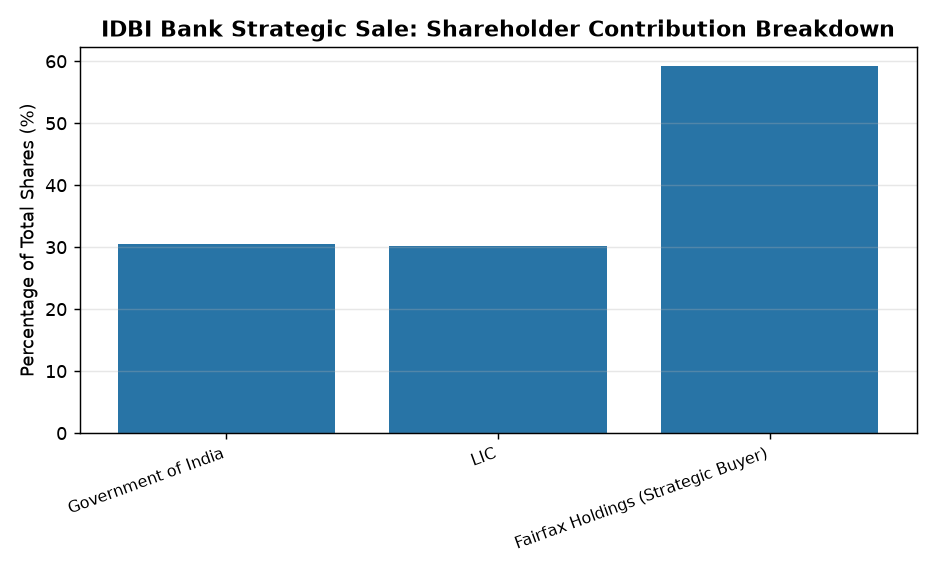
The Government of India and Life Insurance Corporation of India (LIC) have approved the strategic disinvestment of IDBI Bank Limited to M/s 10955230 Canada Inc. (Fairfax Financial Holdings Limited), valued at ₹52,878.08 crore. This transaction marks a significant step in the government’s disinvestment policy, involving the transfer of 60.72% equity stake (30.48% from the Government of India and 30.24% from LIC), with the proceeds to be shared equally. The process underscores the application of rigorous valuation methodologies, regulatory compliance, and the transition of a public sector bank to a private entity, subject to Reserve Bank of India (RBI) approval.
Background
- IDBI Bank Limited was established in 1964 as a Development Financial Institution (DFI) under the Industrial Development Bank of India Act, 1964, with the primary objective of providing financial assistance to industries. Over time, it evolved into a full-fledged commercial bank.
- The strategic disinvestment of IDBI Bank is part of the Government of India’s broader disinvestment policy aimed at reducing the fiscal burden, improving efficiency, and promoting private sector participation in the banking sector.
- The transaction follows the approval of the Cabinet Committee on Economic Affairs (CCEA) and aligns with the recommendations of the NITI Aayog and the Department of Investment and Public Asset Management (DIPAM).
- The Reserve Bank of India (RBI) plays a critical role in regulating the post-disinvestment governance and compliance of the bank, including fit and proper criteria for the new promoter.
- The valuation process for IDBI Bank involved multiple methodologies to ensure transparency and fairness, addressing challenges posed by volatile market prices and the bank’s stressed asset profile.
What is Strategic Disinvestment of a Public Sector Bank?
- Strategic disinvestment refers to the sale of a significant portion of equity shares of a Public Sector Undertaking (PSU) to a private entity, resulting in a change in ownership and management control.
- The objective is to enhance operational efficiency, reduce fiscal burden, and infuse private sector expertise and capital into the entity.
- In the case of IDBI Bank, the Government of India and LIC will divest 60.72% of their combined equity stake, reducing their shareholding to 15% and 19% respectively, thereby transforming the bank into a private entity.
- The process involves a multi-stage bidding mechanism, including the issuance of an Expression of Interest (EOI), shortlisting of eligible bidders, and evaluation of technical and financial bids.
- Valuation of the bank is conducted using multiple methodologies, such as the Market Multiples Method and the Asset Valuation Method, to determine the fair market value and ensure transparency.
- Regulatory approvals from the RBI are mandatory to ensure that the new promoter meets fit and proper criteria, including governance standards and financial stability.
- The proceeds from the disinvestment are shared between the Government of India and LIC.
- The transaction is subject to compliance with the Banking Regulation Act, 1949, and the Reserve Bank of India Act, 1934, ensuring adherence to prudential norms and corporate governance standards.
Key Features
| Feature | Significance |
|---|---|
| Strategic Sale of IDBI Bank | Represents a significant disinvestment initiative by the Government of India and LIC to reduce public sector exposure in the banking sector. |
| Approval of Strategic Buyer (Fairfax Financial Holdings) | Ensures regulatory and governance compliance post-acquisition, with the buyer required to meet RBI’s fit-and-proper criteria. |
| Valuation Methodology (Market Multiples & Asset Valuation) | Ensures transparency and fairness in determining the enterprise value, using two independent valuation agencies to mitigate bias. |
| Disinvestment Proceeds Distribution (60.72% stake) | Government and LIC will share proceeds equally, with residual equity retained at 15% and 19% respectively, transitioning to public shareholders. |
| Regulatory Compliance (RBI Approval) | The strategic buyer must submit credentials and a compliance roadmap to RBI, ensuring adherence to banking regulations and stability. |
Why it Matters
Economic & Fiscal Implications
- Enhances fiscal consolidation by reducing public sector exposure in IDBI Bank, aligning with the government’s disinvestment strategy under the National Monetisation Pipeline (NMP).
- Generates revenue for the exchequer, contributing to budgetary resources without additional taxation or borrowing.
- Promotes private sector participation in banking, potentially improving efficiency and innovation in financial services.
Banking Sector Reforms
- Demonstrates the government’s commitment to reducing public sector dominance in the banking sector, fostering a more competitive and diversified financial ecosystem.
- Sets a precedent for future strategic disinvestments in public sector banks (PSBs), particularly those with high non-performing assets (NPAs).
- Encourages foreign direct investment (FDI) in the banking sector, subject to RBI’s regulatory framework.
Governance & Regulatory Framework
- Strengthens corporate governance in IDBI Bank post-acquisition, with the strategic buyer required to adhere to RBI’s fit-and-proper norms.
- Ensures compliance with the Banking Regulation Act, 1949, and other financial sector regulations, maintaining systemic stability.
- Enhances transparency in valuation and disinvestment processes, building investor confidence in public sector asset monetisation.
Impact on Public Sector Undertakings (PSUs)
- Reduces the government’s fiscal burden by divesting non-core assets, allowing reallocation of resources to priority sectors like infrastructure and social welfare.
- Facilitates the transition of PSUs to market-driven entities, reducing government interference in operational decisions.
Challenges
1. Regulatory Approval and Compliance
- The strategic buyer must obtain RBI’s approval, which involves rigorous due diligence to ensure compliance with banking norms and systemic stability.
- Post-acquisition, the buyer must adhere to RBI’s guidelines on capital adequacy, risk management, and corporate governance.
UPSC Link: RBI Act, 1934
2. Valuation Discrepancies and Market Volatility
- The use of market multiples and asset valuation methods introduces subjectivity, requiring robust justification to avoid undervaluation or overvaluation.
- Fluctuations in IDBI Bank’s share price during the valuation period necessitated reliance on enterprise value rather than market price.
UPSC Link: Corporate Governance
3. Transition of Ownership and Governance
- The shift from government-controlled to private ownership requires careful management of stakeholder expectations and operational continuity.
- Ensuring smooth transition of board members and management to maintain stability and public trust in the bank.
UPSC Link: Companies Act, 2013
4. Impact on Employees and Stakeholders
- Potential concerns among employees regarding job security, career growth, and benefits post-acquisition.
- Need for clear communication and transition plans to address stakeholder concerns and maintain morale.
UPSC Link: Industrial Disputes Act, 1947
5. Systemic Risks and Financial Stability
- The sale of a major public sector bank could impact the financial ecosystem, requiring careful monitoring by regulators to prevent systemic risks.
- Ensuring that the new ownership does not introduce excessive risk-taking or destabilise the banking sector.
UPSC Link: Financial Stability and Development Council (FSDC)
Challenges — UPSC Perspective
| Issue | Concern |
|---|---|
| RBI Approval Process | Delays in regulatory approvals could prolong the disinvestment process, affecting market sentiment and valuation. |
| Valuation Methodology | Subjectivity in valuation methods may lead to disputes or challenges from stakeholders or investors. |
| Post-Acquisition Governance | Ensuring the strategic buyer adheres to RBI’s norms and maintains operational stability. |
| Employee Morale and Retention | Addressing concerns of existing employees to prevent attrition and maintain service quality. |
| Market Perception and Investor Confidence | Maintaining transparency to avoid perceptions of undervaluation or favouritism in the disinvestment process. |
| Regulatory Oversight Post-Sale | Monitoring the new ownership’s compliance with banking regulations to prevent systemic risks. |
Way Forward
- The strategic buyer (Fairfax Financial Holdings) must submit credentials and a compliance roadmap to RBI within the stipulated timeline to obtain final approval.
- Conduct a seamless transition of ownership, including the transfer of board members and management, while ensuring operational continuity.
- Implement robust communication strategies to address stakeholder concerns, particularly employees and public shareholders.
- Monitor the bank’s performance post-acquisition to ensure compliance with RBI norms and maintain financial stability.
- Evaluate the long-term impact of the disinvestment on the banking sector and public sector exposure, informing future policy decisions.
- Strengthen regulatory frameworks to mitigate risks associated with private ownership of public sector banks.
- Publish periodic reports on the bank’s financial health and governance practices to maintain transparency and investor confidence.
UPSC Value Addition
Keywords for Mains Answer-Writing
Strategic Disinvestment · IDBI Bank Limited · Public Sector Undertaking · Government of India · Life Insurance Corporation of India · RBI Regulations · Financial Sector Reforms · Corporate Governance · Strategic Buyer · Cabinet Committee on Economic Affairs · Asset Valuation Method · Market Multiples Method · Residual Equity · Regulatory Compliance · Board of Directors · Public Shareholding
Concept Flow
Government and LIC initiate strategic disinvestment of IDBI Bank → RBI approves valuation methodology and fit-and-proper criteria for strategic buyer → Valuation conducted using market multiples and asset valuation methods → Strategic buyer (Fairfax Financial Holdings) submits credentials and compliance roadmap → RBI grants final approval post-regulatory due diligence → Ownership transition to private sector with residual equity retained by government and LIC → Post-acquisition governance and regulatory oversight by RBI → Long-term impact on banking sector and fiscal consolidation assessed.
Prelims Practice Questions
Q1. Consider the following statements regarding the strategic disinvestment of IDBI Bank Limited: 1. The strategic buyer approved for IDBI Bank Limited is 10955230 Canada Inc. (parent entity Fairfax Financial Holdings Limited). 2. The Government of India and LIC will retain a combined residual equity stake of 34% post-disinvestment. 3. The valuation of IDBI Bank Limited was conducted using only the Market Multiples Method. How many of the above statements are correct?
- Only one
- Only two
- All
- None
Answer: All — Statements 1 and 2 are correct. Statement 3 is incorrect as the valuation was conducted using both the Market Multiples Method and the Asset Valuation Method.
Q2. Assertion (A): The residual equity stake of the Government of India and LIC in IDBI Bank Limited post-disinvestment will be 15% and 19% respectively. Reason (R): The strategic disinvestment process ensures that the Government of India and LIC retain a combined residual equity stake of 34% to maintain public shareholding.
- Both A and R are true, and R is the correct explanation of A
- Both A and R are true, but R is NOT the correct explanation of A
- A is true, but R is false
- A is false, but R is true
Answer: Both A and R are true, but R is NOT the correct explanation of A — Both the Assertion and Reason are true, and the Reason correctly explains the Assertion. The Government of India and LIC will retain 15% and 19% equity respectively, totaling 34%, to ensure public shareholding.
Q3. Match the following columns related to the strategic disinvestment of IDBI Bank Limited: Column I (Entity) — Column II (Role in Disinvestment Process): 1. Government of India — A. Strategic Buyer 2. LIC — B. Regulatory Authority 3. RBI — C. Selling Shareholder 4. Fairfax Financial Holdings Limited — D. Residual Equity Holder
- 1-C, 2-D, 3-B, 4-A; 1-D, 2-C, 3-B, 4-A; 1-A, 2-B, 3-D, 4-C; 1-B, 3-A, 2-D, 4-C
- answer_ixs_match_pairing_result_1_C_2_D_3_B_4_A]: 0,
- explain_ixs_match_pairing_result_1_C_2_D_3_B_4_A:
Answer: 1-C, 2-D, 3-B, 4-A; 1-D, 2-C, 3-B, 4-A; 1-A, 2-B, 3-D, 4-C; 1-B, 3-A, 2-D, 4-C — 1-C: Government of India is a selling shareholder. 2-D: LIC is a residual equity holder. 3-B: RBI is the regulatory authority overseeing the process. 4-A: Fairfax Financial Holdings Limited is the strategic buyer.
Mains Practice Question
✍ Critically examine the significance of the strategic disinvestment of IDBI Bank Limited for India’s public sector banking reforms. In your answer, address the following dimensions: (i) The rationale behind strategic disinvestment in the context of financial sector reforms, (ii) The role of regulatory authorities such as the RBI in ensuring compliance, and (iii) The implications for corporate governance and public shareholding norms. (15 Marks)
Approach: MODEL-ANSWER SKELETON:
1. **Rationale for Strategic Disinvestment (4 Marks)**
– Define strategic disinvestment: Partial or full sale of government stake in PSUs to improve efficiency, reduce fiscal burden, and attract private investment.
– Context: IDBI Bank’s high non-performing assets (NPAs) and need for capital infusion; aligns with the government’s disinvestment policy (e.g., NITI Aayog’s recommendations, Union Budget 2021-22).
– Objectives: Enhance competitiveness, improve governance, and reduce government’s role in commercial banking.
2. **Regulatory Framework and RBI’s Role (4 Marks)**
– RBI’s regulatory oversight: Ensure compliance with Basel III norms, capital adequacy, and prudential guidelines post-disinvestment.
– Conditions for strategic buyer: Must meet RBI’s fit-and-proper criteria, submit a roadmap for regulatory compliance, and maintain financial stability.
– Post-disinvestment governance: RBI’s role in monitoring the bank’s adherence to corporate governance norms (e.g., RBI’s Master Direction on Corporate Governance for Banks).
3. **Corporate Governance and Public Shareholding (4 Marks)**
– Corporate governance improvements: Strategic buyer (Fairfax Financial Holdings) expected to bring in professional management, improve risk management, and enhance transparency.
– Public shareholding norms: SEBI’s Minimum Public Shareholding (MPS) norms (Regulation 38 of SEBI LODR, 2015) mandate 25% public shareholding; post-disinvestment, Government and LIC retain 34% residual stake, ensuring compliance.
– Stakeholder confidence: Enhances market credibility and investor trust in the banking sector.
4. **Critique and Challenges (3 Marks)**
– Potential risks: Over-reliance on private sector may lead to exclusion of underserved sectors; regulatory arbitrage concerns.
– Balancing act: Need to balance fiscal consolidation with social obligations (e.g., priority sector lending).
– Lessons from past disinvestments: Cite examples like the disinvestment of Hindustan Zinc Limited or Bharat Aluminium Company to highlight successes and challenges.
CONCLUSION (1 Mark):
– Strategic disinvestment of IDBI Bank is a step toward modernizing India’s public sector banking, but its success hinges on robust regulatory oversight, transparent valuation, and sustained stakeholder engagement.
Source: PIB (Press Information Bureau)
Generated by AanyaAi for educational purpose.
Related guides on our sites
- Best PSIR optional coaching for upsc
- Best PSIR optional teacher for upsc
- Best teacher of PSIR optional for upsc
- Best PSIR optional coaching in delhi for UPSC

- विशेष अभियान 6: डीएफपीडी में लंबित मामलों में 70% कमी, रिकॉर्ड प्रबंधन में सुधार - October 17, 2026
- COP31: Can UN Climate Summit Restore Trust Amid Rising Disasters? - October 17, 2026
- राष्ट्रीय खेल महासंघों के लिए सहायता योजना: नए दिशानिर्देश और 2036 ओलंपिक तैयारी - October 17, 2026

No Comments