


19 Jul IGNOU Extends July 2026 Admission Deadline to July 31: Key Details
Subject Relevance — Where This Topic Fits
- GS Paper II — Social Justice: Issues relating to development and management of Social Sector/Services relating to Education, Human Resources. | GS Paper III — Economy: Indian Economy and issues relating to planning, mobilization of resources, growth, development and employment. | GS Paper IV — Ethics, Integrity, and Aptitude: Quality of service delivery, utilization of public funds, challenges of corruption.
- Prelims: IGNOU, Open and Distance Learning, Online Education, National Education Policy 2020, Digital India, Gross Enrolment Ratio, Skill Development, Lifelong Learning
- Essay: Education as an enabler for socio-economic transformation in India., Leveraging technology for inclusive and equitable education: Opportunities and challenges., The role of higher education in building a knowledge economy.
Quick Revision: Open and Distance Learning (ODL) and online education are pivotal for democratising higher education in India, addressing access disparities, and fostering skill development, despite facing challenges related to digital infrastructure and quality assurance.
Why is this in the news?
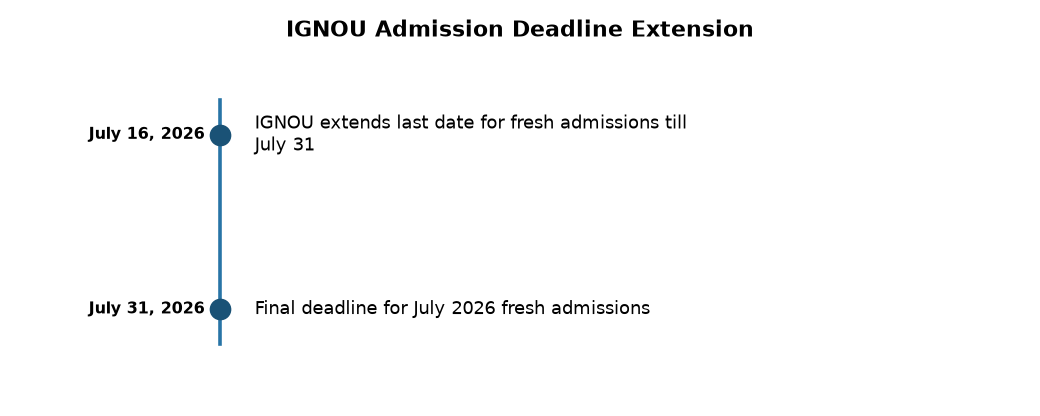
The Indira Gandhi National Open University (IGNOU) has extended the deadline for fresh admissions for its July 2026 academic session, encompassing both Open and Distance Learning (ODL) and online programmes. This extension facilitates broader access for prospective students, underscoring the university’s commitment to inclusive higher education and aligning with national objectives for enhancing educational outreach.
Background
- IGNOU was established in 1985 by an Act of Parliament with the mandate to democratise higher education.
- It is the world’s largest university in terms of student enrolment, offering a wide array of academic programmes.
- The university plays a crucial role in achieving the national Gross Enrolment Ratio (GER) targets, particularly in higher education.
- The National Education Policy (NEP) 2020 advocates for the expansion of ODL and online modes to increase access and flexibility in education.
- Technological advancements and digital infrastructure initiatives like Digital India have significantly bolstered the potential for online learning.
- The COVID-19 pandemic accelerated the adoption and acceptance of online education, highlighting its resilience and reach.
What is Open and Distance Learning (ODL) and Online Education?
- Open and Distance Learning (ODL) refers to a system where teaching and learning are conducted remotely, without the necessity of students and teachers being present at the same place or time.
- It encompasses various modes of delivery, including self-instructional print materials, audio-visual aids, teleconferencing, and internet-based resources.
- Online Education is a subset of ODL, primarily utilizing internet-based platforms and digital technologies for content delivery, interaction, and assessment.
- Key characteristics include flexibility in pace, place, and time of study, catering to diverse learners, including working professionals and those in remote areas.
- ODL and online modes are instrumental in promoting lifelong learning, skill development, and re-skilling initiatives.
- They aim to overcome geographical, socio-economic, and temporal barriers to education, thereby democratising access to higher learning.
- Regulatory bodies like the University Grants Commission (UGC) formulate guidelines for ODL and online programmes to ensure quality and standards.
- IGNOU is a pioneering institution in India for ODL, offering a vast portfolio of undergraduate, postgraduate, diploma, and certificate programmes.
Key Features
| Feature | Significance |
|---|---|
| Flexible Learning Pathways | Accommodates diverse learner needs, including working professionals and those in remote areas, promoting lifelong learning. |
| Wide Programme Portfolio | Offers a broad spectrum of academic and vocational courses, enhancing skill development and employability across disciplines. |
| Affordable Education | Generally lower fee structures compared to conventional universities, making higher education accessible to economically weaker sections. |
| Pan-India Reach | Leverages a vast network of regional centres and study centres, ensuring educational access even in underserved regions. |
| Technological Integration | Utilises digital platforms for content delivery, student support, and examinations, aligning with Digital India initiatives. |
| Emphasis on Self-Paced Learning | Empowers students to learn at their own convenience, fostering self-discipline and independent study habits. |
Why it Matters
Inclusive Education and Access
- ODL and online modes significantly expand access to higher education for individuals who cannot pursue traditional full-time courses due to geographical constraints, financial limitations, or professional commitments.
- They are crucial for increasing the Gross Enrolment Ratio (GER) in higher education, a key objective of the National Education Policy 2020.
- These modes particularly benefit women, individuals from rural and remote areas, and those belonging to marginalised communities, promoting educational equity.
Skill Development and Employability
- The diverse range of certificate, diploma, and degree programmes offered through ODL and online platforms facilitates continuous skill upgradation and re-skilling.
- This is vital for meeting the evolving demands of the job market and enhancing the employability of the workforce.
- Programmes focused on emerging technologies and vocational skills contribute directly to national economic growth and human resource development.
Lifelong Learning and Professional Growth
- ODL and online education foster a culture of lifelong learning, enabling individuals to acquire new knowledge and competencies throughout their careers.
- They provide opportunities for working professionals to pursue higher qualifications or specialised courses without interrupting their employment.
- This continuous learning paradigm is essential for personal enrichment, career advancement, and staying competitive in a dynamic global environment.
Leveraging Technology for Educational Outreach
- The integration of digital platforms and e-learning resources in ODL and online education aligns with the government’s Digital India vision.
- It promotes the efficient delivery of educational content, facilitates interactive learning experiences, and streamlines administrative processes.
- This technological leverage ensures scalability and sustainability of educational initiatives, reaching a larger population with quality content.
Challenges
1. Quality Assurance and Accreditation
- Ensuring the academic rigor and quality of ODL and online programmes is paramount to maintain their credibility and value.
- Robust accreditation mechanisms and regular quality audits are essential to prevent dilution of standards and ensure learning outcomes.
UPSC Link: Education standards; Regulatory bodies
2. Digital Divide and Infrastructure
- Unequal access to reliable internet connectivity, digital devices, and electricity, particularly in rural and remote areas, creates a significant digital divide.
- This disparity can exclude a substantial portion of the target population from benefiting from online education.
UPSC Link: Infrastructure; Social Justice
3. Student Engagement and Retention
- Maintaining student motivation, engagement, and preventing high dropout rates in self-paced, remote learning environments can be challenging.
- Effective pedagogical strategies, interactive content, and robust student support services are crucial for retention.
UPSC Link: Human resource development; Education policy
4. Faculty Training and Development
- Educators require specialised training in online pedagogy, instructional design, and the use of digital tools to effectively deliver ODL and online programmes.
- Continuous professional development is necessary to adapt to evolving technological landscapes and teaching methodologies.
UPSC Link: Human resource development; Capacity building
5. Authenticity of Assessments
- Ensuring the integrity and authenticity of examinations and assessments in an online environment poses significant challenges.
- Developing secure and reliable online proctoring mechanisms and alternative assessment methods is critical.
UPSC Link: Governance; Transparency and accountability
6. Recognition and Acceptance
- Despite increasing acceptance, ODL and online degrees sometimes face perception challenges regarding their equivalence and recognition compared to conventional degrees.
- Consistent policy frameworks and awareness campaigns are needed to address these perceptions.
UPSC Link: Education policy; Employability
Challenges — UPSC Perspective
| Issue | Concern |
|---|---|
| Digital Literacy Gap | Many potential learners lack the necessary digital skills to navigate online learning platforms effectively. |
| Content Quality and Relevance | Ensuring that digital learning materials are engaging, up-to-date, and aligned with industry requirements. |
| Lack of Peer Interaction | Reduced opportunities for collaborative learning and social interaction, which are integral to holistic development. |
| Cybersecurity and Data Privacy | Protecting student data and ensuring the security of online learning platforms from cyber threats. |
| Funding and Resource Allocation | Adequate financial investment required for developing high-quality digital infrastructure and content. |
| Regulatory Harmonisation | Ensuring consistency and clarity in regulations governing ODL and online education across different institutions and states. |
Government Initiatives — Must-Memorise for Prelims
- SWAYAM (Study Webs of Active-learning for Young Aspiring Minds)
- SWAYAM Prabha (DTH channels for educational content)
- National Digital Library of India (NDLI)
- PM eVIDYA (One Nation, One Digital Platform)
- National Education Policy (NEP) 2020
- Digital India Programme
- National Programme on Technology Enhanced Learning (NPTEL)
- Skill India Mission
- Pradhan Mantri Kaushal Vikas Yojana (PMKVY)
- National Higher Education Qualification Framework (NHEQF)
Way Forward
- Invest in robust digital infrastructure and ensure equitable access to high-speed internet, especially in rural and remote areas.
- Develop high-quality, interactive, and locally relevant digital content, leveraging artificial intelligence and adaptive learning technologies.
- Strengthen faculty training programmes in online pedagogy, instructional design, and the effective use of digital tools.
- Implement stringent quality assurance frameworks and accreditation processes for ODL and online programmes to enhance their credibility.
- Establish comprehensive student support services, including counselling, technical assistance, and mentorship, to improve retention rates.
- Promote public-private partnerships to leverage expertise and resources for content development and technological innovation in online education.
- Conduct awareness campaigns to highlight the benefits and recognition of ODL and online degrees, addressing societal perceptions.
- Integrate ODL and online learning seamlessly into the mainstream education system, fostering a blended learning approach where appropriate.
UPSC Value Addition
Keywords for Mains Answer-Writing
Open and Distance Learning · Online Education · Digital Divide · Gross Enrolment Ratio · National Education Policy 2020 · Lifelong Learning · Skill Development · Inclusive Education · Quality Assurance · Digital Literacy · Educational Equity · Technological Integration
Constitutional & Policy Linkages
- Article 21A: Right to Education
- Article 45: Provision for early childhood care and education to children below the age of six years (Directive Principle)
- Article 46: Promotion of educational and economic interests of Scheduled Castes, Scheduled Tribes and other weaker sections (Directive Principle)
- Seventh Schedule (List III – Concurrent List): Education, including technical education, medical education and universities
- UGC Act, 1956: Establishment and regulation of universities, including ODL institutions
- National Education Policy 2020: Comprehensive policy framework for education
Concept Flow
Policy formulation (e.g., NEP 2020) → Investment in digital infrastructure → Expansion of ODL & Online programmes → Increased access to higher education → Enhanced Gross Enrolment Ratio (GER) → Improved skill development & employability → Socio-economic development
Prelims Practice Questions
Q1. Which of the following statements about Indira Gandhi National Open University (IGNOU) is/are correct?
1. IGNOU was established by an Act of Parliament in 1985.
2. It is the largest university in the world in terms of student enrolment.
3. IGNOU offers programmes exclusively in the Open and Distance Learning (ODL) mode, not online.
Select the correct answer using the code given below:
- 1 only
- 1 and 2 only
- 2 and 3 only
- 1, 2 and 3
Answer: 1 and 2 only — Statement 1 is correct: IGNOU was indeed established by an Act of Parliament in 1985. Statement 2 is correct: IGNOU is widely recognised as the world’s largest university by student enrolment. Statement 3 is incorrect: The news explicitly states that IGNOU offers programmes in both Open and Distance Learning (ODL) and online modes.
Q2. Consider the following initiatives:
1. SWAYAM
2. SWAYAM Prabha
3. National Digital Library of India
4. PM eVIDYA
Which of the above initiatives are aimed at promoting digital education and online learning in India?
- 1 and 2 only
- 2, 3 and 4 only
- 1, 3 and 4 only
- 1, 2, 3 and 4
Answer: 1, 2, 3 and 4 — All four initiatives listed – SWAYAM, SWAYAM Prabha, National Digital Library of India, and PM eVIDYA – are key government initiatives designed to promote and facilitate digital education and online learning across various levels in India. Therefore, all statements are correct.
Mains Practice Question
✍ “The expansion of Open and Distance Learning (ODL) and online education is critical for achieving India’s educational and socio-economic aspirations, yet it faces significant challenges.” Discuss this statement in the context of the National Education Policy 2020, highlighting the opportunities and obstacles in leveraging technology for inclusive education. (250 words)
Approach: Begin by acknowledging the significance of ODL and online education as enablers for inclusive growth, linking it to NEP 2020’s goals of increasing GER and promoting lifelong learning. Discuss opportunities such as enhanced access, skill development, and leveraging digital infrastructure (e.g., SWAYAM, Digital India). Subsequently, elaborate on the challenges, including the digital divide, quality assurance, faculty training, and assessment integrity. Conclude by suggesting a balanced way forward, emphasizing policy interventions, infrastructure development, and quality control measures to harness the full potential of these modes for national development.
Source: The Indian Express
Generated by AanyaAi for educational purpose.

- Exercise Tarang Shakti 2026: India’s Mega Multi-Nation Air Power Showcase - September 27, 2026
- रबी अभियान 2026: राष्ट्रीय सम्मेलन में केंद्र-राज्य तालमेल पर होगा जोर - September 27, 2026
- Himachal CM Sukhu: All Doctor Vacancies to be Filled by March - September 27, 2026

No Comments