


04 Aug IIT Hyderabad Launches ANUGYAN: India’s First Nuclear Tech Programme for UPSC & PCS Aspirants
✎ ANUGYAN is India’s first industry-academia nuclear technology orientation programme, designed to bridge the skills gap in the civil nuclear sector by integrating academic rigour with industrial expertise, particularly in reactor…
 Industry-academia programmeNuclear technologyCivil nuclear sector
Subject Relevance — Where This Topic Fits
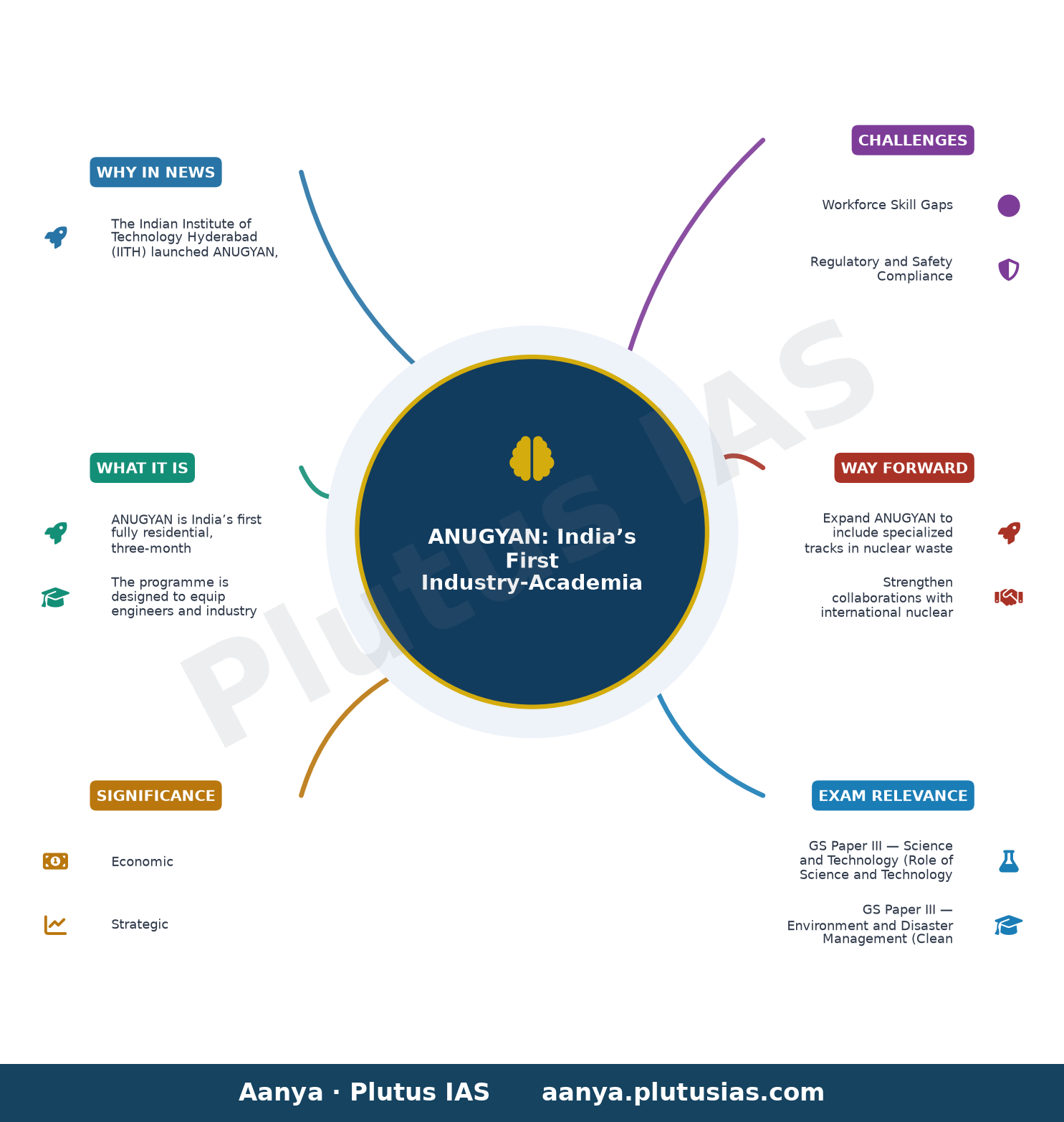
- GS Paper III — Science and Technology (Role of Science and Technology in Development, Indigenous Technologies) | GS Paper III — Environment and Disaster Management (Clean Energy, Nuclear Energy and Sustainability)
- Prelims: ANUGYAN, Small Modular Reactors (SMRs), AERB regulatory compliance, Centre of Design Excellence in Nuclear Engineering (CODENE), India’s nuclear power capacity target (8.8 GWe to 100 GWe by 2047)
- Essay: The imperative of self-reliance in nuclear technology for India’s energy security and climate commitments, Bridging the academia-industry divide: A case study of ANUGYAN
Quick Revision: ANUGYAN is India’s first industry-academia nuclear technology orientation programme, designed to bridge the skills gap in the civil nuclear sector by integrating academic rigour with industrial expertise, particularly in reactor physics, SMRs, and AERB regulatory compliance.
Why is this in the news?
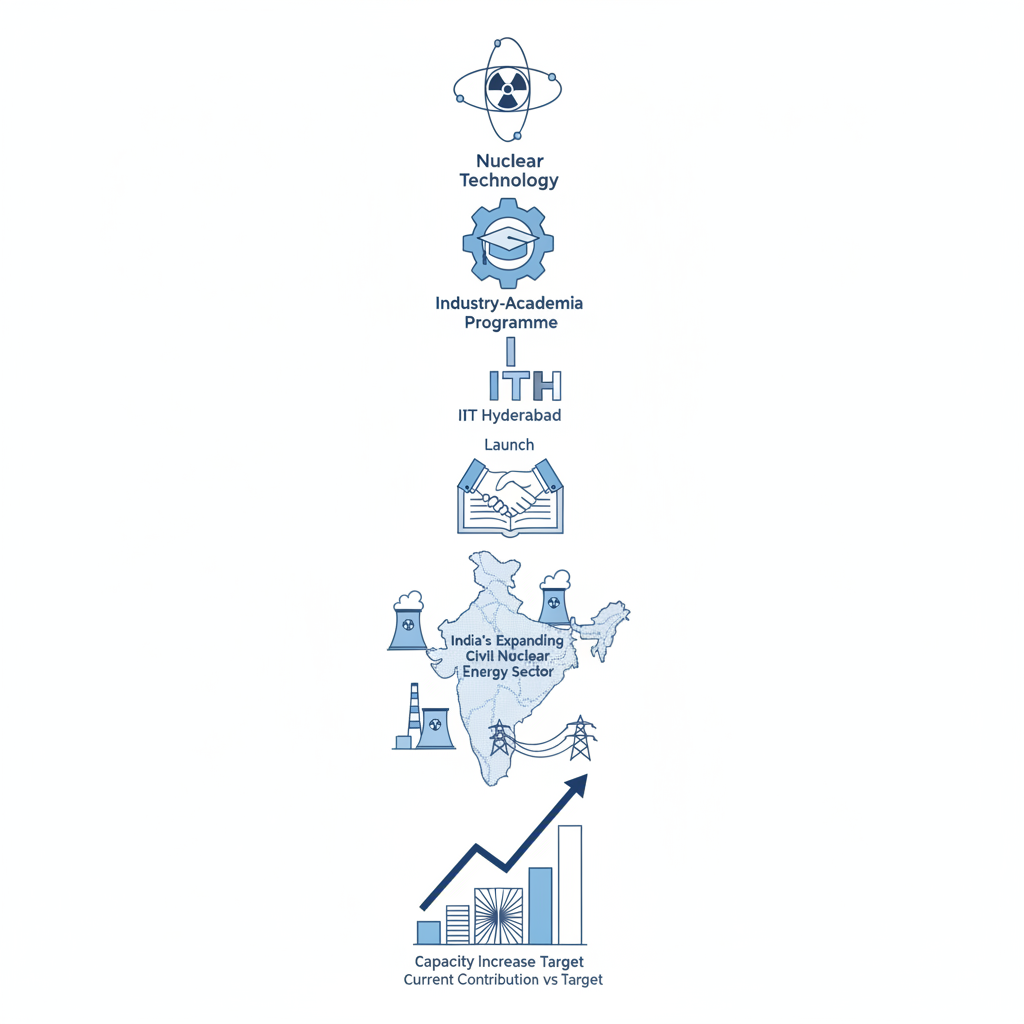
The Indian Institute of Technology Hyderabad (IITH) launched ANUGYAN, India’s first industry-academia programme in nuclear technology, on 3 August 2026. This initiative, developed in collaboration with Crimson Energy Experts Private Limited (CEEPL), marks a significant step toward addressing the acute shortage of skilled professionals in India’s expanding civil nuclear energy sector. The programme aligns with India’s ambitious target to increase nuclear power generation capacity from 8.8 GWe to 100 GWe by 2047, underscoring the urgency of workforce development and indigenous technological capability-building.
Background
- India’s nuclear power capacity currently stands at approximately 8.8 GWe, contributing around 3% to the national electricity mix, far below the global average of 10%.
- The Government of India has set a target to increase nuclear power capacity to 100 GWe by 2047 as part of its clean energy transition strategy, necessitating a substantial expansion of the nuclear workforce.
- The Atomic Energy Regulatory Board (AERB) is the nodal authority for nuclear safety and regulatory compliance in India, ensuring adherence to international standards.
- Small Modular Reactors (SMRs) are emerging as a key technology in India’s nuclear expansion, offering scalability, enhanced safety, and lower capital costs compared to conventional reactors.
- The collaboration between IIT Hyderabad and Crimson Energy Experts is formalised through a Memorandum of Understanding (MoU) signed at Bharat Innovate 2026, also involving Dassault Systèmes to establish the Centre of Design Excellence in Nuclear Engineering (CODENE).
- Academia-industry partnerships in nuclear technology are critical to bridge the gap between theoretical knowledge and practical industrial applications, particularly in a high-safety sector like nuclear energy.
What is ANUGYAN?
- ANUGYAN is India’s first fully residential, three-month industry-academia programme in nuclear technology, launched by IIT Hyderabad in collaboration with Crimson Energy Experts Private Limited (CEEPL).
- The programme is designed to equip engineers and industry professionals with both academic knowledge and real-world industrial exposure in nuclear engineering, ensuring readiness for the civil nuclear sector.
- The curriculum integrates core nuclear engineering disciplines, including reactor physics, thermal hydraulics, radiation safety, Small Modular Reactors (SMRs), engineering design, quality assurance, and AERB regulatory compliance.
- The programme includes simulator-based training, enabling participants to gain hands-on experience in reactor operations and safety protocols, a critical requirement for nuclear sector professionals.
- ANUGYAN targets a diverse cohort, including engineering graduates, working professionals, PSU executives, EPC contractors, and industrial equipment manufacturers, to strengthen India’s nuclear supply chain.
- Upon completion, participants receive a joint certification from IIT Hyderabad and Crimson Energy Experts, enhancing their employability in India’s nuclear energy sector.
- The programme aligns with the broader initiative to establish the Centre of Design Excellence in Nuclear Engineering (CODENE), focusing on advanced nuclear engineering design, digital simulation, and collaborative research.
- ANUGYAN’s launch underscores the growing emphasis on indigenous nuclear technology development, workforce skilling, and the integration of academia-industry collaboration to achieve India’s clean energy goals.
Key Features
| Feature | Significance |
|---|---|
| Fully residential three-month programme | Ensures immersive learning and eliminates external distractions, fostering focused skill development in nuclear technology. |
| Joint certification by IIT Hyderabad and Crimson Energy Experts | Enhances credibility and industry recognition of the programme, aligning academic rigour with practical expertise. |
| Curriculum covering reactor physics, thermal hydraulics, and SMRs | Addresses critical gaps in India’s nuclear engineering education by integrating modern and emerging technologies. |
| Simulator-based training and AERB regulatory compliance modules | Provides hands-on experience with nuclear safety protocols and regulatory frameworks, essential for workforce readiness. |
| Collaboration with Dassault Systèmes under CODENE initiative | Leverages advanced digital simulation tools for nuclear engineering design, enhancing research and innovation capabilities. |
Why it Matters
Economic
- Facilitates India’s transition to 100 GWe nuclear capacity by 2047, reducing reliance on fossil fuels and lowering carbon emissions.
- Creates high-skilled employment opportunities in the civil nuclear sector, aligning with the Atmanirbhar Bharat vision.
- Strengthens the nuclear supply chain by training professionals for PSUs, EPC contractors, and equipment manufacturers.
Strategic
- Enhances indigenous nuclear engineering capabilities, reducing dependence on foreign expertise and technology.
- Supports India’s nuclear non-proliferation commitments while advancing peaceful uses of nuclear energy.
- Aligns with the National Nuclear Energy Programme (NNEP) and India’s clean energy transition goals.
Educational
- Introduces India’s first industry-academia programme in nuclear technology, bridging the gap between academic theory and industrial practice.
- Provides a model for future collaborations between IITs and industry in high-technology sectors.
- Promotes interdisciplinary learning by integrating regulatory, design, and safety aspects of nuclear engineering.
Technological
- Focuses on Small Modular Reactors (SMRs), a cutting-edge technology with potential for decentralized and scalable nuclear power.
- Incorporates digital simulation tools (e.g., Dassault Systèmes) for advanced nuclear engineering design and research.
- Emphasizes simulator-based training to ensure hands-on proficiency in nuclear operations and safety.
Challenges
1. Workforce Skill Gaps
- India’s nuclear sector faces a shortage of trained professionals, necessitating rapid upskilling through programmes like ANUGYAN.
- The programme must ensure that participants can apply theoretical knowledge to real-world industrial challenges.
- Industry-academia collaboration must be sustained to keep the curriculum aligned with technological advancements.
UPSC Link: GS3: Science & Technology – Skill Development
2. Regulatory and Safety Compliance
- Nuclear programmes require strict adherence to AERB regulations, posing challenges in curriculum design and implementation.
- Ensuring that simulator-based training meets international safety standards is critical for workforce readiness.
- Regulatory hurdles may delay the deployment of trained professionals in operational nuclear facilities.
UPSC Link: GS3: Science & Technology – Nuclear Safety
3. Public Perception and Acceptance
- Nuclear energy often faces public scepticism due to safety concerns and historical incidents.
- The programme must incorporate public communication strategies to address misconceptions about nuclear technology.
- Engaging local communities near nuclear sites is essential for fostering acceptance of new projects.
UPSC Link: GS3: Science & Technology – Environmental Impact
4. Infrastructure and Resource Constraints
- Establishing simulator-based training and research facilities requires significant investment and expertise.
- Limited access to advanced nuclear facilities may restrict hands-on training opportunities for participants.
- Sustaining the programme’s operational costs over the long term is a challenge for both IIT Hyderabad and industry partners.
UPSC Link: GS3: Science & Technology – Infrastructure
Challenges — UPSC Perspective
| Issue | Concern |
|---|---|
| Regulatory complexity | Strict AERB compliance may delay programme implementation and workforce deployment. |
| Public opposition | Scepticism about nuclear safety could hinder the adoption of trained professionals in the sector. |
| High infrastructure costs | Establishing simulator-based training and research facilities requires substantial investment. |
| Skill retention | Ensuring that trained professionals remain in the nuclear sector amid competing job opportunities. |
| Curriculum relevance | Keeping the programme aligned with rapid technological advancements in nuclear engineering. |
Way Forward
- Expand ANUGYAN to include specialized tracks in nuclear waste management and decommissioning, addressing critical gaps in the nuclear lifecycle.
- Strengthen collaborations with international nuclear agencies (e.g., IAEA) to enhance curriculum standards and faculty expertise.
- Establish a dedicated Centre of Excellence in Nuclear Engineering at IIT Hyderabad to sustain long-term research and innovation.
- Develop a national framework for nuclear engineering education, integrating ANUGYAN’s model across other IITs and technical institutions.
- Incorporate public outreach initiatives to improve societal acceptance of nuclear energy and address misconceptions.
- Leverage digital platforms to offer hybrid or online modules, increasing accessibility for working professionals.
- Partner with PSUs like NPCIL and BHAVINI to provide on-site training and internships for programme participants.
- Align the programme with India’s hydrogen energy mission by integrating nuclear-powered hydrogen production technologies.
UPSC Value Addition
Keywords for Mains Answer-Writing
ANUGYAN programme · India’s nuclear energy capacity expansion · Small Modular Reactors (SMRs) · Atomic Energy Regulatory Board (AERB) · Centre of Design Excellence in Nuclear Engineering (CODENE) · industry-academia collaboration in nuclear technology · self-reliance in nuclear engineering education · nuclear power generation capacity targets · reactor physics and thermal hydraulics · radiation safety and regulatory compliance · Dassault Systèmes · Crimson Energy Experts Private Limited · nuclear workforce development · clean energy technologies
Concept Flow
India’s ambitious nuclear power expansion targets (8.8 GWe to 100 GWe by 2047) create demand for skilled professionals. → IIT Hyderabad and Crimson Energy Experts launch ANUGYAN to bridge the gap between academic training and industrial needs. → The programme integrates reactor physics, SMRs, and AERB compliance to ensure workforce readiness. → Collaboration with Dassault Systèmes under CODENE enhances digital simulation and design capabilities. → Trained professionals contribute to India’s nuclear supply chain, supporting PSUs, EPC contractors, and equipment manufacturers. → Programme graduates enhance India’s self-reliance in nuclear engineering, aligning with Atmanirbhar Bharat and clean energy goals.
Prelims Practice Questions
Q1. Consider the following statements regarding the ANUGYAN programme launched by IIT Hyderabad: 1. It is a three-month fully residential programme. 2. The programme focuses exclusively on theoretical aspects of nuclear engineering. 3. Participants receive a joint certification from IIT Hyderabad and Crimson Energy Experts Pvt. Ltd. How many of the above statements are correct?
- Only one
- Only two
- All three
- None
Answer: All three — Statement 1 is correct as ANUGYAN is a three-month fully residential programme. Statement 2 is incorrect because the programme includes both academic learning and real-world industrial exposure. Statement 3 is correct as participants receive a joint certification from IIT Hyderabad and Crimson Energy Experts Pvt. Ltd.
Q2. Assertion (A): The ANUGYAN programme aims to fortify India’s self-reliance in nuclear engineering education and workforce development. Reason (R): The programme is designed to cater to the growing demand for trained professionals as India plans to increase its nuclear power generation capacity to 100 GWe by 2047.
- Both A and R are true, and R is the correct explanation of A.
- Both A and R are true, but R is not the correct explanation of A.
- A is true, but R is false.
- A is false, but R is true.
Answer: Both A and R are true, but R is not the correct explanation of A. — Both Assertion (A) and Reason (R) are true. The programme’s objective to fortify self-reliance in nuclear engineering education and workforce development aligns with the need to meet the projected increase in nuclear power generation capacity, making R the correct explanation of A.
Q3. Match the following elements of the ANUGYAN programme with their respective descriptions: 1. Small Modular Reactors (SMRs) 2. Atomic Energy Regulatory Board (AERB) 3. Centre of Design Excellence in Nuclear Engineering (CODENE) 4. Dassault Systèmes
A. Regulatory body overseeing nuclear safety and compliance
B. A collaborative initiative for advanced nuclear engineering design and digital simulation
C. A technology company partnering in the programme
D. A focus area of the curriculum addressing compact, scalable nuclear reactors
- 1-D, 2-A, 3-B, 4-C
- 1-B, 2-A, 3-D, 4-C
- 1-C, 2-D, 3-A, 4-B
- 1-A, 2-B, 3-C, 4-D
Answer: 1-D, 2-A, 3-B, 4-C — 1-D: Small Modular Reactors (SMRs) are compact, scalable nuclear reactors. 2-A: The Atomic Energy Regulatory Board (AERB) is the regulatory body overseeing nuclear safety and compliance. 3-B: The Centre of Design Excellence in Nuclear Engineering (CODENE) is a collaborative initiative for advanced nuclear engineering design and digital simulation. 4-C: Dassault Systèmes is a technology company partnering in the programme.
Mains Practice Question
✍ Critically examine the significance of the ANUGYAN programme in the context of India’s nuclear energy ambitions and the broader objectives of self-reliance in clean energy technologies. (15 Marks)
Approach: MODEL-ANSWER SKELETON:
1. **Introduction (2 Marks)**: Briefly outline India’s nuclear energy capacity targets (e.g., increasing from 8.8 GWe to 100 GWe by 2047) and the role of nuclear power in achieving clean energy goals. Mention the ANUGYAN programme as a flagship initiative.
2. **Significance of ANUGYAN (5 Marks)**:
– **Industry-Academia Collaboration**: Highlight the unique model of combining IIT Hyderabad’s academic excellence with industry expertise (Crimson Energy Experts, Dassault Systèmes).
– **Curriculum Depth**: Discuss key components such as reactor physics, thermal hydraulics, radiation safety, SMRs, AERB compliance, and simulator-based training.
– **Workforce Development**: Emphasise the programme’s role in addressing the critical shortage of trained professionals in the nuclear sector.
– **Self-Reliance**: Link the programme to India’s broader goal of Atmanirbhar Bharat in nuclear technology.
3. **Broader Implications (5 Marks)**:
– **Clean Energy Transition**: Discuss how nuclear energy complements renewable sources in India’s energy mix.
– **Technological Innovation**: Highlight the inclusion of SMRs and digital simulation (CODENE) as steps toward modernising nuclear infrastructure.
– **Regulatory and Safety Framework**: Explain the importance of AERB compliance in ensuring safe and sustainable nuclear operations.
– **Global Competitiveness**: Comment on how such initiatives position India as a leader in nuclear technology education and innovation.
4. **Challenges and Critique (3 Marks)**:
– **Implementation Hurdles**: Discuss potential challenges such as funding, scalability, and industry readiness.
– **Public Perception**: Address concerns related to nuclear safety and public acceptance.
– **Sustainability**: Evaluate whether the programme can sustain long-term growth in nuclear capacity.
Source: The Indian Express
Generated by AanyaAi for educational purpose.

- ISRO Launches Free GIS Online Course for UPSC & PCS Aspirants - October 2, 2026
- ओडिशा के SAMS पोर्टल को मिला SKOCH प्लेटिनम अवार्ड 2026 - October 2, 2026
- Government Identifies 28 Places in Ladakh on Survey of India Map - October 2, 2026

No Comments